On This Page
Description
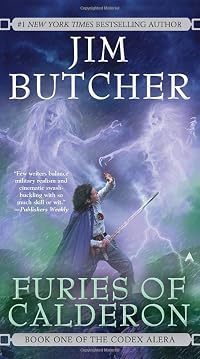
In this extraordinary fantasy epic, the #1 New York Times bestselling author of the Dresden Files leads readers into a world where the fate of the realm rests on the shoulders of a boy with no power to call his own...For a thousand years, the people of Alera have united against the aggressive and threatening races that inhabit the world, using their unique bond with the furies—elementals of earth, air, fire, water, wood, and metal. But in the remote Calderon Valley, the boy Tavi show more struggles with his lack of furycrafting. At fifteen, he has no wind fury to help him fly, no fire fury to light his lamps. Yet as the Alerans’ most savage enemy—the Marat horde—return to the Valley, Tavi’s courage and resourcefulness will be a power greater than any fury, one that could turn the tides of war... show less
Tags
Recommendations






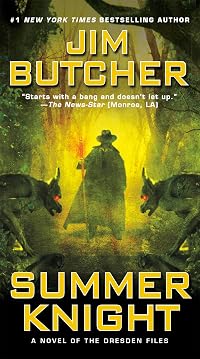
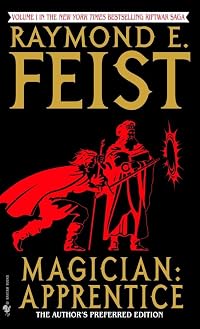
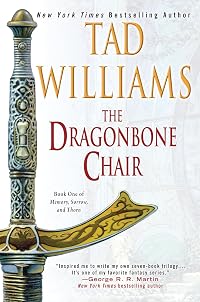
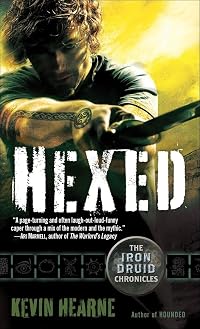
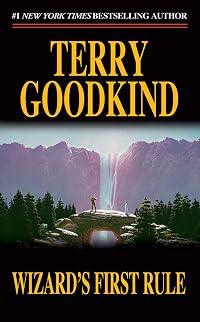
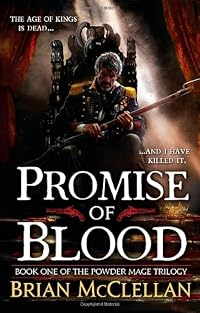

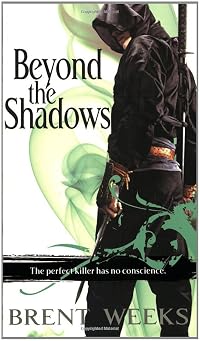
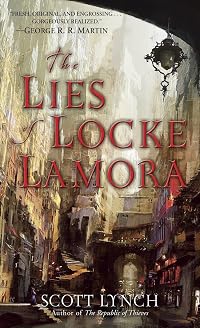
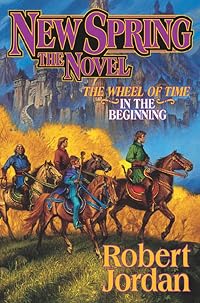
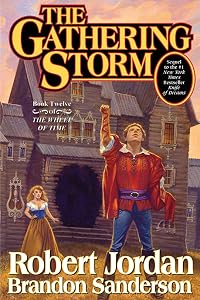

Member Recommendations

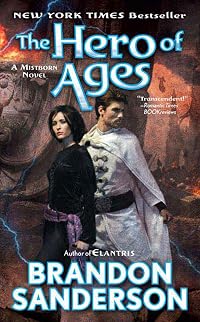
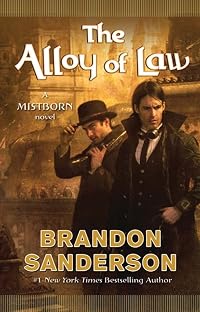
Morgester You just have to cheer for Yelena - Strong, vibrant characters and impressive narrative ability.
50
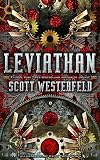
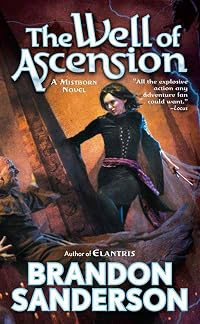
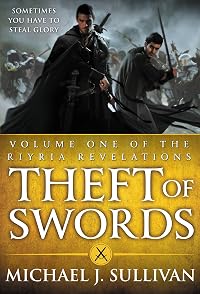
majkia Another coming of age book, but granted, in a completely different environment. Still, both have strong central characters who grow, and change to the backdrop of war, and have a marked impact on their worlds.
20
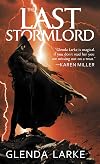
majkia another coming of age book where young boy and young girl find they are more than they seem.
20
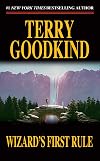

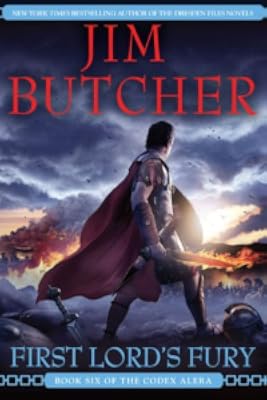
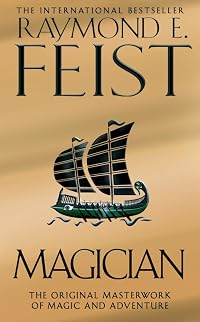
elbakerone Both of these works are Book One in their respective series and represent a wonderful foray into epic fantasy with expansive landscapes and well-drawn characters.
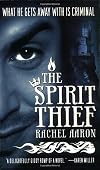
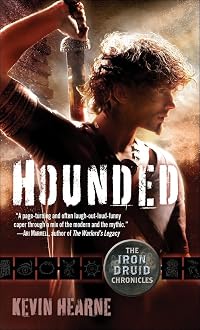
reading_fox Both feature young boys without magic in an inherently magic using society and a more complex landscape than they'd expected growing up.
Member Reviews
This is the first Jim Butcher book I read. My husband has read the series as well and told me it would be something I'd like. As usual he was right. He was right about something else, and I'll pass it along to all of you as advice.
Do NOT judge this book by its first half. I'm not sure what was going on, or why, but this book does NOT show its true colors right away. It's a little tedious at the beginning, when you're switching between storylines and getting everyone's names straight, figuring out their situations, loyalties, and relationships. STICK WITH IT. My husband told me to promise to read the whole book, and I'm glad he did, because I would have chucked it partway through and look what I would have missed! This is one of my show more favorite series, now. It picks up and MAN does it ever get good! Once Butcher has all the pieces he wants in place - varoom! He's off! The characters become personal, mesmorizing, touching, unique, and fully three dimensional - no mean feat for a newly published author to juggle so many main characters and not bore you with at least one storyline! And the PLOT! I like the little mysteries you can figure out (or wait and have revealed to you) and even the minor characters are often memorable in some way.
I like the fairly unique feel of these - high Roman fantasy - mixed with relatable yet heroic characters. Butcher's sense of humor is always right on target and his sex scenes are sexy without being ridiculously overwrought (think steamy PG-13). This is good stuff. show less
Do NOT judge this book by its first half. I'm not sure what was going on, or why, but this book does NOT show its true colors right away. It's a little tedious at the beginning, when you're switching between storylines and getting everyone's names straight, figuring out their situations, loyalties, and relationships. STICK WITH IT. My husband told me to promise to read the whole book, and I'm glad he did, because I would have chucked it partway through and look what I would have missed! This is one of my show more favorite series, now. It picks up and MAN does it ever get good! Once Butcher has all the pieces he wants in place - varoom! He's off! The characters become personal, mesmorizing, touching, unique, and fully three dimensional - no mean feat for a newly published author to juggle so many main characters and not bore you with at least one storyline! And the PLOT! I like the little mysteries you can figure out (or wait and have revealed to you) and even the minor characters are often memorable in some way.
I like the fairly unique feel of these - high Roman fantasy - mixed with relatable yet heroic characters. Butcher's sense of humor is always right on target and his sex scenes are sexy without being ridiculously overwrought (think steamy PG-13). This is good stuff. show less
A good start to a fantasy series. Butcher has created a plausible fantasy world, with interesting human and non-human inhabitants and monsters. There are no elves, dwarves or dragons and his magic system is relatively (not completely) unique.
The humans of the Calderon Valley live on the edges of the human lands, threatened by challenging weather, non-human Marat tribesmen and the politics of the human realm. The politics are driven by a fairly standard story - an aging monarch with no heir. Isana, Tavi, Bernard, the locals of the Calderon Valley must survive several threats, including those from neighbors. Amara, the First Lord's newest cursor - a magical warrior/spy, with control of a wind fury, must navigate multiple threats and show more nasty politics.
Well written and fun to read. Not overly complicated or epic. show less
The humans of the Calderon Valley live on the edges of the human lands, threatened by challenging weather, non-human Marat tribesmen and the politics of the human realm. The politics are driven by a fairly standard story - an aging monarch with no heir. Isana, Tavi, Bernard, the locals of the Calderon Valley must survive several threats, including those from neighbors. Amara, the First Lord's newest cursor - a magical warrior/spy, with control of a wind fury, must navigate multiple threats and show more nasty politics.
Well written and fun to read. Not overly complicated or epic. show less
"Furies of Calderon" (Codex Alera 1) by Jim Butcher
After reading most of the "Harry Dresden" series one has some pretty high expectations for a new series by Butcher…but this book doesn't ring the same bells that the Dresden series rang. Butcher isn't quite able to pull off large battle scenes here the way he does the gladiatorial fights of Dresden. It's not that it's boring, but that it's slower(?) maybe missing some details(?) maybe too chaotic(?). It's not that individual fight scenes aren't handled well, but that they're few and not as spectacular. With that said, what I see happening is that Butcher is writing a different sort of stories in this series…there's no "magic", just idiosyncratic control of specific natural forces: show more wind, wood, air, rock, that kind of thing. This puts a limitation on the action—it creates a restricted framework within which the story must unfold, necessarily on a more drawn-out timescale.
Yes, I admit that it took me a while to get into the story but I plowed on just to see what Butcher did with the structure he's worked so hard to develop. And I'm happy I did. Yes, the action did increase as the pages turned and it's good to see that Butcher was able to tell an exciting story within the world definition he invented, and I do think it's worth at least a "4 out of 5". But it's still not the most exciting stuff he's written. The main reason I rate it so highly is that, as I read the second book in the series, I can see that this book is necessary for setting the scene for the future action.
So read this book with a part of your mind focused on the future. One of the nice things about Butcher is that he tends to reuse characters in the various books of his series…rather than dropping the old and introducing new ones with every book (which is partly why I stopped reading "Harry Potter"). I find myself settling into a comfort-zone when I encounter a familiar character whose personality, strengths and weaknesses are known…and then watch them grow over time.
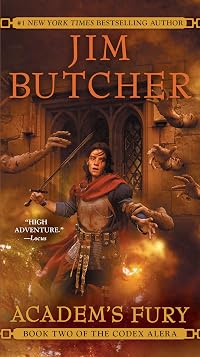
This same goes for Butcher; I can tell you that the second book, "Academ's Fury" (Codex Alera 2), has more mature battle-scenes. Obviously it took a while for Butcher to learn how to describe a war, rather than a fight. Meanwhile, he does use his martial arts experience to describe some really detailed one-on-one (and one-on-two and -three) fight scenes quite satisfactorily.
In general, I'm impressed with the self-consistency of the story. The physical reality of Calderon is explained and developed without Deus ex Machina surprises. The lives and relationships of the characters and societies are consistent enough to hold and maintain the plot together without causing me to groan. Sure, the heroes survive some pretty horrific scenes…but their survival makes sense. No one suddenly develops super-powers, or discovers a secret weapon, etc. Even the ability to control pretty strong elemental forces comes with self-limiting drawbacks. The use of these powers drains the user's own physical energy pretty quickly and leaves him/her weak and susceptible. And then we also have to come to terms with the fact that EVERYONE has some fury-crafting ability (except the hero). It's kind of like the wild West again—everyone had a gun, but not many people did anything but shoot rattlesnakes with them. And you usually were required to leave your weapons "outside".
Something else missing from this series is the smart-aleck, spit-in-your-eye antics of Harry Dresden---the characters are all pretty sober people, not given to challenging authorities out of sheer childishness and immaturity. Now that I think about it, with Harry Dresden I kept being thrust "outside the story"; Dresden's smart-ass comments tended to wake me up from the written page to think "how stupid can you get" when you challenge someone/something so much more powerful than yourself. There's none of that in this book. The hero knows his severe limitations and toes-the-line with appropriate behavior. However, with that said, there is one line, at the very end of one of the last chapters, where Butcher couldn't resist inserting an insanely funny anachronism that I challenge anyone reading it to not burst out in laughter. Of course I won't tell you what it is, but don't email me if you don't see it because there's nothing I could do for you anyway. show less
After reading most of the "Harry Dresden" series one has some pretty high expectations for a new series by Butcher…but this book doesn't ring the same bells that the Dresden series rang. Butcher isn't quite able to pull off large battle scenes here the way he does the gladiatorial fights of Dresden. It's not that it's boring, but that it's slower(?) maybe missing some details(?) maybe too chaotic(?). It's not that individual fight scenes aren't handled well, but that they're few and not as spectacular. With that said, what I see happening is that Butcher is writing a different sort of stories in this series…there's no "magic", just idiosyncratic control of specific natural forces: show more wind, wood, air, rock, that kind of thing. This puts a limitation on the action—it creates a restricted framework within which the story must unfold, necessarily on a more drawn-out timescale.
Yes, I admit that it took me a while to get into the story but I plowed on just to see what Butcher did with the structure he's worked so hard to develop. And I'm happy I did. Yes, the action did increase as the pages turned and it's good to see that Butcher was able to tell an exciting story within the world definition he invented, and I do think it's worth at least a "4 out of 5". But it's still not the most exciting stuff he's written. The main reason I rate it so highly is that, as I read the second book in the series, I can see that this book is necessary for setting the scene for the future action.
So read this book with a part of your mind focused on the future. One of the nice things about Butcher is that he tends to reuse characters in the various books of his series…rather than dropping the old and introducing new ones with every book (which is partly why I stopped reading "Harry Potter"). I find myself settling into a comfort-zone when I encounter a familiar character whose personality, strengths and weaknesses are known…and then watch them grow over time.
This same goes for Butcher; I can tell you that the second book, "Academ's Fury" (Codex Alera 2), has more mature battle-scenes. Obviously it took a while for Butcher to learn how to describe a war, rather than a fight. Meanwhile, he does use his martial arts experience to describe some really detailed one-on-one (and one-on-two and -three) fight scenes quite satisfactorily.
In general, I'm impressed with the self-consistency of the story. The physical reality of Calderon is explained and developed without Deus ex Machina surprises. The lives and relationships of the characters and societies are consistent enough to hold and maintain the plot together without causing me to groan. Sure, the heroes survive some pretty horrific scenes…but their survival makes sense. No one suddenly develops super-powers, or discovers a secret weapon, etc. Even the ability to control pretty strong elemental forces comes with self-limiting drawbacks. The use of these powers drains the user's own physical energy pretty quickly and leaves him/her weak and susceptible. And then we also have to come to terms with the fact that EVERYONE has some fury-crafting ability (except the hero). It's kind of like the wild West again—everyone had a gun, but not many people did anything but shoot rattlesnakes with them. And you usually were required to leave your weapons "outside".
Something else missing from this series is the smart-aleck, spit-in-your-eye antics of Harry Dresden---the characters are all pretty sober people, not given to challenging authorities out of sheer childishness and immaturity. Now that I think about it, with Harry Dresden I kept being thrust "outside the story"; Dresden's smart-ass comments tended to wake me up from the written page to think "how stupid can you get" when you challenge someone/something so much more powerful than yourself. There's none of that in this book. The hero knows his severe limitations and toes-the-line with appropriate behavior. However, with that said, there is one line, at the very end of one of the last chapters, where Butcher couldn't resist inserting an insanely funny anachronism that I challenge anyone reading it to not burst out in laughter. Of course I won't tell you what it is, but don't email me if you don't see it because there's nothing I could do for you anyway. show less
According to the author, the Codex Alera series owes its birth to a forum flamewar. Several (unpublished) authors argued that a brilliant initial concept/central idea was required for a good fantasy novel. Butcher argued that characters, story complexity, and execution were what mattered. When dared to make good on his claim, he bet that he could write a successful story based on whatever two concepts his opponents gave him. They gave him Roman legions and Pokemon. Thus Alera was born.
Butcher made good on his bet. The characters in Codex Alera are surprisingly likeable, and it is their interactions and problems that drive the story. He creates a world with ambiguous morals, alien viewpoints, and a willingness to challenge the reader's show more perceptions and beliefs. The book's mood is a roller-coaster from laugh-out-loud humour (and some amazing one-liners) to points where the action is so graphic and painful that I was tempted to skim. Heroes and villains all remain complex, but in a way that's hard to describe: in terms of actions or fast descriptions, they are pretty stereotypical. Yet even the heroic, unselfish ones are oddly likeable rather than irritating. Butcher's prose is workmanlike. His dialogue is especially good at giving the world and characters shape and depth. (At the same time, I'd love to know how many times the tired phrase, "arched an eyebrow", occurs in the series. I'd bet it would be in the hundreds.)
One thing to note: I read the books out of order, starting with the second, third, and sixth before hitting this one (curse library availability!) so this is more a review of the series rather than this book; fair warning that I may impute more depth to the characters than they actually show here. One of the most impressive aspects of the series is the intricate plotting: plot points are set up in this book that become crucial in the last, and some of the characters' "out of character" responses or activities are due to a much more complex backstory. Also on a sidenote, other than Max, who first appears in the next book, I mainly find the characters here to be less likeable than those in the Dresden Files, Butcher's other series. I think this is due in large measure to the structure of the epic fantasy/quest story, where all the characters' skills and abilities are typically larger than life, often to the detriment of their personalities. In a full worldbuilding setting, it is harder to capture the eccentricities that give dimensionality to the DF characters (e.g. Waldo Butters' one-man polka band.) However, if you find the Codex Alera characters rather flat here, note that they become significantly fuller and more complex in the second book in the series, and a large number of fun new personalities are added to the gang.
One might, however, consider that Butcher lost his bet. Perhaps the world is loosely based on Pokemon and the Roman legion, but he has brought so much additional complexity and creativity that one might argue his central concept contains deeper themes--loyalty versus obedience, love versus dependence, humanity versus duty--as well as an amazingly complex and intricate world. The plot is intricate--basically, if you think of something awesome you wish might happen, it probably will. It is unusual for an author to create such a real magical world, with intricate rules and a complex society. He never breaks these rules, yet manages to to incredible, surprising, and creative things with it. I am not one for battle scenes--I tended to skim those bloodthirsty, brutal, and above all boring scenes in Tolkein or Sanderson--but the creativity Butcher brings leaves one with only one good description: purely awesome.
The story takes place in the Calderon Valley of the Kingdom of Alera, where the descendents of the lost Roman legions apparently settled thousands of years ago. Alera is a savage, hierarchical land, with a failing high king who is the last of his line, a set of scheming lords anxious to relieve him of the burden of office, an economy built upon slavery, and a tendency try to massacre the members of the neighboring lands. Not that its neighbors aren't doing their fair share. Alera, the only human civilization, is surrounded by the savage icemen, the barbaric Marat, and the warg-like Canim. Alerans themselves are superhuman: they are all gifted with and dependent on their Furies: elemental magic that can be embodied in beings of wind, fire, and stone (this is where the Pokemon come in, although it's actually a little hard to connect them the much more original and well-thought-out furies.) All Alerans have furycrafting skills and use them for everything from mundane household tasks to healing, flying, and superhuman epic battlemagic.
Only Tavi, a shepherd boy in the Calderon Valley, is furyless. Lucky Tavi is treated like a retarded child: he not only looks like a young 12-year-old, but at fifteen years, his lack of furies appears permanent and means he is essentially useless and helpless. In a world dependent on the furies, he cannot turn on or off lights, help with the farming, or even travel fast on the roads (which are specially designed for fast travel via earthcrafting).
The story--and the series--starts with a seemingly mundane incident. Tavi wants to bring flowers to the girl he is sweet on, and is therefore so late bringing in the sheep that they wander away and are lost. In retrieving them, he stumbles upon proof of a traitorous scheme that will endanger the entire Calderon Valley. Aided by his watercrafting aunt Isana, his stolid stonecrafting uncle Bernard, and the mysterious windcrafting servant of the high lord, Amara, Tavi must bring news--and preferably proof--to the garrison to alert the legions (yes, Roman legions) to the danger. Along the way, he and his allies must evade and outwit scheming mercenaries, vicious slavers, and bloodthirsty barbarians.
The most impressive part about the book, for me, was the way Butcher created a world with perspectives so alien to our own, and yet managed to make it immersive. I also thought he deftly separated culture from personalities: Marat happily practice cannibalism and don't have a word for lying, yet each individual somehow manages to escape simple characterizations such as "noble savage" or "vicious barbarian." Alerans live in a world where women are subordinate to their men, only Citizens of the realm have the protection of law, and slavery is the norm. They even utilize "discipline collars", which use incredible amounts of pain and pleasure to bend slaves to the slavers' wills. I found this concept the most horrible and long-lasting one of the book. Butcher graphically explores the loss of self-will hover for spoiler. The book is light and fun, yet opens some troubling questions: from the definitions of slavery and self-will to the limits of loyalty and duty, and what happens when the duty to the community conflicts with the path of truth, justice, and humanity.
~4.5 stars. show less
Butcher made good on his bet. The characters in Codex Alera are surprisingly likeable, and it is their interactions and problems that drive the story. He creates a world with ambiguous morals, alien viewpoints, and a willingness to challenge the reader's show more perceptions and beliefs. The book's mood is a roller-coaster from laugh-out-loud humour (and some amazing one-liners) to points where the action is so graphic and painful that I was tempted to skim. Heroes and villains all remain complex, but in a way that's hard to describe: in terms of actions or fast descriptions, they are pretty stereotypical. Yet even the heroic, unselfish ones are oddly likeable rather than irritating. Butcher's prose is workmanlike. His dialogue is especially good at giving the world and characters shape and depth. (At the same time, I'd love to know how many times the tired phrase, "arched an eyebrow", occurs in the series. I'd bet it would be in the hundreds.)
One thing to note: I read the books out of order, starting with the second, third, and sixth before hitting this one (curse library availability!) so this is more a review of the series rather than this book; fair warning that I may impute more depth to the characters than they actually show here. One of the most impressive aspects of the series is the intricate plotting: plot points are set up in this book that become crucial in the last, and some of the characters' "out of character" responses or activities are due to a much more complex backstory. Also on a sidenote, other than Max, who first appears in the next book, I mainly find the characters here to be less likeable than those in the Dresden Files, Butcher's other series. I think this is due in large measure to the structure of the epic fantasy/quest story, where all the characters' skills and abilities are typically larger than life, often to the detriment of their personalities. In a full worldbuilding setting, it is harder to capture the eccentricities that give dimensionality to the DF characters (e.g. Waldo Butters' one-man polka band.) However, if you find the Codex Alera characters rather flat here, note that they become significantly fuller and more complex in the second book in the series, and a large number of fun new personalities are added to the gang.
One might, however, consider that Butcher lost his bet. Perhaps the world is loosely based on Pokemon and the Roman legion, but he has brought so much additional complexity and creativity that one might argue his central concept contains deeper themes--loyalty versus obedience, love versus dependence, humanity versus duty--as well as an amazingly complex and intricate world. The plot is intricate--basically, if you think of something awesome you wish might happen, it probably will. It is unusual for an author to create such a real magical world, with intricate rules and a complex society. He never breaks these rules, yet manages to to incredible, surprising, and creative things with it. I am not one for battle scenes--I tended to skim those bloodthirsty, brutal, and above all boring scenes in Tolkein or Sanderson--but the creativity Butcher brings leaves one with only one good description: purely awesome.
The story takes place in the Calderon Valley of the Kingdom of Alera, where the descendents of the lost Roman legions apparently settled thousands of years ago. Alera is a savage, hierarchical land, with a failing high king who is the last of his line, a set of scheming lords anxious to relieve him of the burden of office, an economy built upon slavery, and a tendency try to massacre the members of the neighboring lands. Not that its neighbors aren't doing their fair share. Alera, the only human civilization, is surrounded by the savage icemen, the barbaric Marat, and the warg-like Canim. Alerans themselves are superhuman: they are all gifted with and dependent on their Furies: elemental magic that can be embodied in beings of wind, fire, and stone (this is where the Pokemon come in, although it's actually a little hard to connect them the much more original and well-thought-out furies.) All Alerans have furycrafting skills and use them for everything from mundane household tasks to healing, flying, and superhuman epic battlemagic.
Only Tavi, a shepherd boy in the Calderon Valley, is furyless. Lucky Tavi is treated like a retarded child: he not only looks like a young 12-year-old, but at fifteen years, his lack of furies appears permanent and means he is essentially useless and helpless. In a world dependent on the furies, he cannot turn on or off lights, help with the farming, or even travel fast on the roads (which are specially designed for fast travel via earthcrafting).
The story--and the series--starts with a seemingly mundane incident. Tavi wants to bring flowers to the girl he is sweet on, and is therefore so late bringing in the sheep that they wander away and are lost. In retrieving them, he stumbles upon proof of a traitorous scheme that will endanger the entire Calderon Valley. Aided by his watercrafting aunt Isana, his stolid stonecrafting uncle Bernard, and the mysterious windcrafting servant of the high lord, Amara, Tavi must bring news--and preferably proof--to the garrison to alert the legions (yes, Roman legions) to the danger. Along the way, he and his allies must evade and outwit scheming mercenaries, vicious slavers, and bloodthirsty barbarians.
The most impressive part about the book, for me, was the way Butcher created a world with perspectives so alien to our own, and yet managed to make it immersive. I also thought he deftly separated culture from personalities: Marat happily practice cannibalism and don't have a word for lying, yet each individual somehow manages to escape simple characterizations such as "noble savage" or "vicious barbarian." Alerans live in a world where women are subordinate to their men, only Citizens of the realm have the protection of law, and slavery is the norm. They even utilize "discipline collars", which use incredible amounts of pain and pleasure to bend slaves to the slavers' wills. I found this concept the most horrible and long-lasting one of the book. Butcher graphically explores the loss of self-will hover for spoiler. The book is light and fun, yet opens some troubling questions: from the definitions of slavery and self-will to the limits of loyalty and duty, and what happens when the duty to the community conflicts with the path of truth, justice, and humanity.
~4.5 stars. show less
The worldbuilding in this one was wicked cool. The social structure and military is Roman-based, which you don't find too often in fantasy. Additionally, Furies of Calderon gives us a magical system that is elementals meets familiars. Powers are well balanced and varied, but the magic exists so easily in the world that it doesn't take over the feel of the fantasy. Still, it was a thrill. Furies has a wide cast of characters, so there's someone for everyone in this book.
My personal favorite is Tavi, who really stumbles unaware into the adventure and ends up not only contributing importantly to the main storyline, but has an excellent little side-adventure of his own. Tavi is a great character - raw and honest in the way that young adults show more can be but he's also kind-hearted and genuine. I really liked following him.
Furies is definitely not meant for the light of heart - there's everything from slavery to cannibalism mentioned in the book, and there was a scene where I was sort of waiting to see if someone was going to get raped, because it was getting very sketchy. Do know that this has a lot of adult themes between the magic and war, and be prepared for that going in. show less
My personal favorite is Tavi, who really stumbles unaware into the adventure and ends up not only contributing importantly to the main storyline, but has an excellent little side-adventure of his own. Tavi is a great character - raw and honest in the way that young adults show more can be but he's also kind-hearted and genuine. I really liked following him.
Furies is definitely not meant for the light of heart - there's everything from slavery to cannibalism mentioned in the book, and there was a scene where I was sort of waiting to see if someone was going to get raped, because it was getting very sketchy. Do know that this has a lot of adult themes between the magic and war, and be prepared for that going in. show less
Dagnabbit, Jim Butcher! I have a job and a family. Quit keeping me up all night!
I actually have not read plain old fantasy since I was a teenager, but I love urban fantasy, and, of course, the Harry Dresden series. I've run through all the good urban fantasy books, so I figured why not? So glad, I did! Butcher has built a complicated and beautifully fit together fantasy world, but even better, this author excels in his amazingly likable and complex characters. Our hero Tavi is the shepherd boy with the hidden destiny who manages to be tenacious, clever, decent, and wildly endearing all by the fifth chapter. And there begins a wonderful cast of characters that are immediately fascinating even as you jump from subplot to subplot on route show more to the dramatic conclusion. There was no down time in this book where you wait around for the characters to quit talking or sharpening their weapons. Everything feels urgent, and it's near impossible to put the book down. Which is why I'm saving the sequel till the weekend. No more snoring at work, Butcher! show less
I actually have not read plain old fantasy since I was a teenager, but I love urban fantasy, and, of course, the Harry Dresden series. I've run through all the good urban fantasy books, so I figured why not? So glad, I did! Butcher has built a complicated and beautifully fit together fantasy world, but even better, this author excels in his amazingly likable and complex characters. Our hero Tavi is the shepherd boy with the hidden destiny who manages to be tenacious, clever, decent, and wildly endearing all by the fifth chapter. And there begins a wonderful cast of characters that are immediately fascinating even as you jump from subplot to subplot on route show more to the dramatic conclusion. There was no down time in this book where you wait around for the characters to quit talking or sharpening their weapons. Everything feels urgent, and it's near impossible to put the book down. Which is why I'm saving the sequel till the weekend. No more snoring at work, Butcher! show less
Just a few comments about Jim Butcher's Furies of Calderon (Codex Alera, Book 1) which is the first novel of his Codex Alera series.
In the paper version of the book (I actually listened to the audio version from audible.com), I was disappointed that there was neither a map of the world, nor an appendix describing key terms. I really feel that a small map would have helped to orient the reader
The largest mystery are the furies. Butcher gives only a partial discussion of what they are. Little to no time is spent describing how they are captured by (?) / bonded to (?) the human population. We know that these elemental spirits are obtained in one's youth (Tavi's lack is very clearly unusual). We are shown how the various furies are used show more (wind, water, fire, earth, wood, metal), but minimally about the relationship between Aleran and fury.
Another interesting facet of the novel is its setting in an Ancient Rome analogue. The names (Gaius Sextus, Fidelias, Aquitainus) and terms (legionares, academ, patriserus, Knights Aeris) all have a Latin sound to them. The special rights granted to those called "Citizen" are also reminiscent of Rome as is the barbarian horde attacking the land's frontiers. I'll be interested to see how far the similarities go when Tavi goes to the capital city to be educated at the Academy -- the City of Rome (likely under another name), perhaps?
The book is very dense with a good deal of character development. The villains for the most part aren't "mwuah-ha-haaa" evil, which is refreshing. Instead, they are merely greedy, ambitious, self-involved, traitorous, or believe they are more right than the current ruling class. show less
In the paper version of the book (I actually listened to the audio version from audible.com), I was disappointed that there was neither a map of the world, nor an appendix describing key terms. I really feel that a small map would have helped to orient the reader
The largest mystery are the furies. Butcher gives only a partial discussion of what they are. Little to no time is spent describing how they are captured by (?) / bonded to (?) the human population. We know that these elemental spirits are obtained in one's youth (Tavi's lack is very clearly unusual). We are shown how the various furies are used show more (wind, water, fire, earth, wood, metal), but minimally about the relationship between Aleran and fury.
Another interesting facet of the novel is its setting in an Ancient Rome analogue. The names (Gaius Sextus, Fidelias, Aquitainus) and terms (legionares, academ, patriserus, Knights Aeris) all have a Latin sound to them. The special rights granted to those called "Citizen" are also reminiscent of Rome as is the barbarian horde attacking the land's frontiers. I'll be interested to see how far the similarities go when Tavi goes to the capital city to be educated at the Academy -- the City of Rome (likely under another name), perhaps?
The book is very dense with a good deal of character development. The villains for the most part aren't "mwuah-ha-haaa" evil, which is refreshing. Instead, they are merely greedy, ambitious, self-involved, traitorous, or believe they are more right than the current ruling class. show less
Members
- Recently Added By
Lists

Best Fantasy Novels
821 works; 358 members

Farm Boy Fantasy
51 works; 21 members

NPRs your picks: top 100 Sci-Fi/Fantasy books
297 works; 80 members

Unread books
1,063 works; 83 members

Unshelved Book Clubs
579 works; 5 members

al.vick-series
381 works; 2 members

infjsarah's wishlist
408 works; 2 members

Books Read in 2020
4,379 works; 124 members

Books Read in 2013
1,630 works; 51 members

Series to Try Out
92 works; 1 member
Books We Couldn't Put Down
443 works; 197 members
Author Information

166+ Works 160,427 Members
Jim Butcher was born in Independence, Missouri on October 26, 1971. He is the author of The Dresden Files series, the Codex Alera series, Side Jobs, Ghost Story, and the Cinder Spires series. He has also written a Spider-Man novel entitled The Darkest Hours and a novelette entitled Backup. He has contributed to numerous anthologies including My show more Big Fat Supernatural Wedding, Blood Lite, and Many Bloody Returns. (Bowker Author Biography) show less
Some Editions
Series

Work Relationships
Is contained in
Common Knowledge
- Canonical title
- Furies of Calderon
- Original title
- Furies of Calderon
- Original publication date
- 2004-10-05
- People/Characters
- Tavi; Amara ex Cursori; Fidelias; Bernard; Isana; Doroga (show all 16); Aldrick ex Gladius; Odiana; Lady Invidia Aquitaine; Gaius Sextus; Lord Attis Aquitaine; Kitai; Kord; Aric; Fade; Atsurak
- Important places
- Alera; Calderon Valley
- Dedication
- For my son, hero in training.
And in memory of my father, a hero in truth. - First words
- The course of history is determined not by battles, by sieges, or usurpations, but by the actions of the individual.
- Last words
- (Click to show. Warning: May contain spoilers.)Tavi drove home Dodger's little flock of ewes and lambs, the shaggy-haired Fade loping along behind him.
- Blurbers
- Green, Simon R.; Chester, Deborah; Briggs, Patricia
- Original language
- English
- Canonical DDC/MDS
- 813.6
- Canonical LCC
- PS3602.U85
Classifications
Statistics
- Members
- 6,149
- Popularity
- 2,049
- Reviews
- 157
- Rating
- (3.95)
- Languages
- 8 — Bulgarian, Czech, English, French, German, Italian, Korean, Spanish
- Media
- Paper, Audiobook, Ebook
- ISBNs
- 26
- ASINs
- 28