
Hiroshima
by John Hersey
On This Page
Description
On August 6, 1945, an atomic bomb destroyed the city of Hiroshima, Japan. In this book, Hersey reveals what happened that day. Told through the memories of the six survivors, it is a timeless, powerful and compassionate document.Tags
Recommendations




















Member Recommendations
Member Reviews
Isn't it strange that in times of intense tragedy (like your country being at war), that one could be lulled into a false sense of security just because of the Boy Who Cried Wolf syndrome? When the village of Hiroshima was bombed many people didn't heed the warnings. Even those responsible for alerting others to oncoming attacks didn't see it coming. What are you supposed to do when the system you are taught to trust gives the "all clear" signal? How are you supposed to react?
Hiroshima follows the lives of six Hiroshima bombing survivors from the moments before the blast on August 6th, 1945 at 8:15 a.m. to the aftermath of the following year: Miss Toshiko Sasaki, Dr. Masakazu Fujii, Mrs. Hatsyo Nakamura, Dr. Terufumi Sasaki (no show more relation to Miss Toshiko), Father Wilhelm Kleinsorge, and Reverend Mr. Kiyoshi Tanimoto.
Fair warning: you will be privy to excruciating details about their injuries and subsequent health issues. People with no outward visible wounds had a delayed response to radiation sickness with symptoms difficult to fathom. Your heart will break to read of their confusion when trying to understand what happened to them. Theories and rumors about the "strange weapon" abounded. For example, for a while people assumed powdered magnesium was dumped on power lines, creating explosions and subsequent fires. Survivors believed they were doused with gasoline. show less
Hiroshima follows the lives of six Hiroshima bombing survivors from the moments before the blast on August 6th, 1945 at 8:15 a.m. to the aftermath of the following year: Miss Toshiko Sasaki, Dr. Masakazu Fujii, Mrs. Hatsyo Nakamura, Dr. Terufumi Sasaki (no show more relation to Miss Toshiko), Father Wilhelm Kleinsorge, and Reverend Mr. Kiyoshi Tanimoto.
Fair warning: you will be privy to excruciating details about their injuries and subsequent health issues. People with no outward visible wounds had a delayed response to radiation sickness with symptoms difficult to fathom. Your heart will break to read of their confusion when trying to understand what happened to them. Theories and rumors about the "strange weapon" abounded. For example, for a while people assumed powdered magnesium was dumped on power lines, creating explosions and subsequent fires. Survivors believed they were doused with gasoline. show less
A seminal change in reporting style, the zoomed in view of a handful of people to represent the tragedies of the bombing has a very gripping narrative of the events and aftermath, but becomes increasingly diffuse as it continues to follow their lives long after the events of the bombing. It completes the stories of their lives and the rebuilding efforts, but at the same time dilutes the catastrophe of the bombing itself. Is it more honest to continue the story as life just goes on? Would it have been just gratuitous to linger? Certainly the report itself seems to conclude most people did not reflect deeply on the whys, and either dealt with the trauma and medical aftermath - or not.
The power of this short book grows out of the simple virtues of honest reporting and clear writing. Hersey does not sensationalize. He traveled, as an American, to Hiroshima within a year of the blast. To get a handle on an unprecedented event with an immense scale, the author focused on six survivors; most of the text recounts their experiences: what they saw, what they felt, what they thought. He constructs the narrative with skill, interweaving each of these six strands. In the course of the book, he brings in some of the larger picture, such as the number of the dead. Only at the end does he raise the topic of the morality of the act; even here, he reports what his six interviewees think.
In addition to the inherent emotional effect show more of the tale, there was an added poignancy for me. My copy is a first edition, inherited from my father, who bought it when it came out, shortly after his discharge. When the bomb was detonated, he was on Okinawa and knew that, just as when that island was taken, he would be in the first wave sent ashore when the invasion of the home islands began. The fateful decision to use this bomb, and a second one a few days later at Nagasaki, was taken on the basis of the number of likely casualties, American and Japanese, that such an invasion would bring. Which of these alternatives was the lesser evil is a question that can probably never be decided to the satisfaction of all. The only way to reframe it, as far as I can see, would be to ask whether the demand for unconditional surrender, an appropriate demand in the case of Nazi Germany, was as necessary in the case of Japan, and if this would have obviated the need to choose between invasion and the nuclear option. But of course, we can never know how the next decades would have unfolded if that had been tried. As I write, more than seventy years later, the United States remains the only power to employ an atomic weapon. It would be nice to be able to believe none will ever again be detonated. show less
In addition to the inherent emotional effect show more of the tale, there was an added poignancy for me. My copy is a first edition, inherited from my father, who bought it when it came out, shortly after his discharge. When the bomb was detonated, he was on Okinawa and knew that, just as when that island was taken, he would be in the first wave sent ashore when the invasion of the home islands began. The fateful decision to use this bomb, and a second one a few days later at Nagasaki, was taken on the basis of the number of likely casualties, American and Japanese, that such an invasion would bring. Which of these alternatives was the lesser evil is a question that can probably never be decided to the satisfaction of all. The only way to reframe it, as far as I can see, would be to ask whether the demand for unconditional surrender, an appropriate demand in the case of Nazi Germany, was as necessary in the case of Japan, and if this would have obviated the need to choose between invasion and the nuclear option. But of course, we can never know how the next decades would have unfolded if that had been tried. As I write, more than seventy years later, the United States remains the only power to employ an atomic weapon. It would be nice to be able to believe none will ever again be detonated. show less
I knew this would be a gut-wrenching read, which is why I put off reading it for so long, but it is our duty, just as with the Holocaust, to remember.
As for the book itself, and the writing thereof - it is a report on the event through the lives of six of those who survived, and their experiences. Each page is a blow to the guts, with only straightforward accounts; no sensationalism required. The almost monotone style is, I believe, what enabled me to endure. That and my sense of obligation to know.
What stood out for me was not the death and destruction; that was mind-numbing, but how quickly people resumed their lives in spite of the pain, sickness and loss. "Of a hundred and fifty doctors in the city, sixty-five were already dead, and show more most of the rest were wounded. Of the 1,780 nurses, 1,654 were dead or too badly hurt to work." In the largest hospital, which had six hundred beds, there were only six doctors out of 30, and ten nurses out of more than two hundred, left to care for 10,000 patients the first day. None of them knew what they were dealing with. They worked day and night doing what they could to relieve pain. Those who survived tried to help those who were injured in the city with almost no help from any government or agencies. Within a week, houses began to be rebuilt and life continued, in spite of radiation sickness, for those who were living.
The human spirit is amazing, in spite of all the horrors, people did what had to be done. show less
As for the book itself, and the writing thereof - it is a report on the event through the lives of six of those who survived, and their experiences. Each page is a blow to the guts, with only straightforward accounts; no sensationalism required. The almost monotone style is, I believe, what enabled me to endure. That and my sense of obligation to know.
What stood out for me was not the death and destruction; that was mind-numbing, but how quickly people resumed their lives in spite of the pain, sickness and loss. "Of a hundred and fifty doctors in the city, sixty-five were already dead, and show more most of the rest were wounded. Of the 1,780 nurses, 1,654 were dead or too badly hurt to work." In the largest hospital, which had six hundred beds, there were only six doctors out of 30, and ten nurses out of more than two hundred, left to care for 10,000 patients the first day. None of them knew what they were dealing with. They worked day and night doing what they could to relieve pain. Those who survived tried to help those who were injured in the city with almost no help from any government or agencies. Within a week, houses began to be rebuilt and life continued, in spite of radiation sickness, for those who were living.
The human spirit is amazing, in spite of all the horrors, people did what had to be done. show less
In the West our cultural products tend to focus disproportionately on our own tragedies. Our great battles from World War Two and the Holocaust have a special place. Canadians are periodically offered new treatments on Vimy, the Somme etc. All this is right and good. National imaginaries must be constructed. We must remember for never again to have meaning. And so while we recognise the Armenian genocide, Rwanda, Congo, colonialism etc, we don't hold them up with great pride of place in constant cultural reproduction and examination. And those dark-stained moments that shame the Western conscience tend to be examined even less.
So it was refreshing to read this treatment of the horror of the first atomic bomb attack. This little book has show more pride of place on the matter in English language bookshops. It is incredibly moving. But I only gave it four stars instead of five because there is something missing. What is it?
Surely so soon after the war, a Japanese perspective on Hiroshima would have been too much for The New Yorker to print. So Hershey takes a clinical journalistic approach. Without frills or melodrama. Without excessive personalisation. By preparing his treatment of the subject in such a way one assumes he is protecting himself from possible accusations of anti-American bias. Just the facts. A plain recounting. It reads like a case report for a judicial enquiry.
So moving as it is, it is because the plain facts are so moving. And this, of course, would easily serve as a narrative defence - that the facts are moving enough on their own, that they need no embellishment, etc. Thus avoiding completely the need to acknowledge that Hiroshima has been treated differently for not being anglo-saxon. The author even manages to cut himself out of the script, letting the subjects voices speak for themselves, we can imagine the argument. And yet they are not speaking for themselves. They are speaking through John Hersey's filter.
One wonders what the story could have read like if the author had personalised more, made more of a story, dramatise more; As if the victims were Westerners and those who launched the bomb from afar.
There is something limiting about this clinical factual reading. As compassionate and brave as Hersey is being, and this is perceived by his clinical approach, one would not need to be so consciously compassionate and brave if the victims were anglo-saxons.
This is fantastic gateway into Hiroshima, and yet it is as if there is no more archive. This book composes the entirety of the Western archive on Hiroshima. It seems strange it is so featured in out bookshops, but never alongside a Japanese voice. How many decades later I find it hard to believe there is no Japanese accessible personal voice on Hiroshima available in translation?
As good as Hersey is. We ought to be able to do better still. show less
So it was refreshing to read this treatment of the horror of the first atomic bomb attack. This little book has show more pride of place on the matter in English language bookshops. It is incredibly moving. But I only gave it four stars instead of five because there is something missing. What is it?
Surely so soon after the war, a Japanese perspective on Hiroshima would have been too much for The New Yorker to print. So Hershey takes a clinical journalistic approach. Without frills or melodrama. Without excessive personalisation. By preparing his treatment of the subject in such a way one assumes he is protecting himself from possible accusations of anti-American bias. Just the facts. A plain recounting. It reads like a case report for a judicial enquiry.
So moving as it is, it is because the plain facts are so moving. And this, of course, would easily serve as a narrative defence - that the facts are moving enough on their own, that they need no embellishment, etc. Thus avoiding completely the need to acknowledge that Hiroshima has been treated differently for not being anglo-saxon. The author even manages to cut himself out of the script, letting the subjects voices speak for themselves, we can imagine the argument. And yet they are not speaking for themselves. They are speaking through John Hersey's filter.
One wonders what the story could have read like if the author had personalised more, made more of a story, dramatise more; As if the victims were Westerners and those who launched the bomb from afar.
There is something limiting about this clinical factual reading. As compassionate and brave as Hersey is being, and this is perceived by his clinical approach, one would not need to be so consciously compassionate and brave if the victims were anglo-saxons.
This is fantastic gateway into Hiroshima, and yet it is as if there is no more archive. This book composes the entirety of the Western archive on Hiroshima. It seems strange it is so featured in out bookshops, but never alongside a Japanese voice. How many decades later I find it hard to believe there is no Japanese accessible personal voice on Hiroshima available in translation?
As good as Hersey is. We ought to be able to do better still. show less
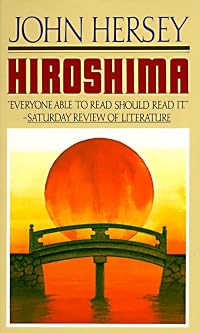
I discovered The Saturday Review of Literature in the early seventies, after reading an article about Norman Cousins, the then editor. About a decade later, the magazine ceased publication. The second thing which struck me was a blurb on John Hersey’s Hiroshima: “Everyone able to read should read it.” The early seventies were the days of antiwar rallies, and calls to ban nuclear weapons. Of course I had heard of Hiroshima and Nagasaki and all the justifications for using the atomic bomb in 1945 as a way to end World War II quickly and save many millions of military and civilian lives. John Hersey’s work really opened my eyes to the horrors of nuclear weapons.
The original history was updated about four decades later to show the show more long term effects of the bomb. Hersey tells the story through the memoirs of six civilians who were in Hiroshima on August 6, 1945 at 8:15 AM when the bomb exploded. The curious thing is the completely random steps these individuals had taken which took them out of the direct effects of the blast.
Hersey wrote, “At exactly fifteen minutes past eight in the morning, on August 6, 1945, Japanese time, at the moment when the atomic bomb flashed above Hiroshima, Miss Toshiko Sasaki, a clerk in the personnel department of the East Asia Tin Works, had just sat down at her place in the plant office and was turning her head to speak to the girl at the next guess. At that same moment, Dr. Masakazu Fuijii was settling down to read the Osaka Asahi on the porch of his private hospital, […]; Mrs. Hatsuyo Nakamura, a tailor’s widow, stood by the window of her kitchen, watching a neighbor tearing down his house because it lay in the path of an air-raid-defense fire lane; Father Wilhelm Kleinsorge, a German priest of the Society of Jesus, reclined in his underwear on a cot on the top floor of his order’s three-story mission house, […]; Dr. Terufumi Sasaki, a young member of the surgical staff of the city’s large, modern Red Cross Hospital, walked along one of the hospital corridors with a blood specimen […]; and the Revernd Mr. Kiyoshi Tanimoto, pastor of the Hiroshima Methodist Church, paused at the door of a rich man’s house in Koi, the city’s western suburb, and prepared to unload a handcart full of things he had evacuated from the town in fair of the massive B-29 [bomber] raid which everyone expected Hiroshima to suffer” (3-4). These six individuals lived to describe the aftermath of the explosion.
At first, they all thought a bomb had hit close to their location, but when they emerged from the wreckage, the amount of destruction was beyond imagination. As time passed and those who had lived through the terror, did not want to refer to themselves as “survivors” in fear of causing some slight insult to the victims. Instead, they referred to themselves as “hibakusha” or literally, “explosion-affected persons” (92). The “hibakusha” struggled for years to hold together what remained off their families, friends, and their own lives. For example, it wasn’t until 1951 that Mrs. Nakamura was able to move into a new house. Dr. Sasaki spent the next five years removing ugly keloid scars from residents of the city. Of course, as long term effects of the explosion began to surface, the full extent of the horrors of nuclear war emerged.
Yet today, we live on the brink of nuclear annihilation. Nations struggle to build nuclear weapons. Some call for using these weapons to further religious, political, or economic interests. As is the case in so many examples of war, some have forgotten the lessons of history. The Saturday Review was correct: “Everyone able to read [John Hersey’s book] should read it. 5 stars.
--Jim, 12/6/16 show less
The original history was updated about four decades later to show the show more long term effects of the bomb. Hersey tells the story through the memoirs of six civilians who were in Hiroshima on August 6, 1945 at 8:15 AM when the bomb exploded. The curious thing is the completely random steps these individuals had taken which took them out of the direct effects of the blast.
Hersey wrote, “At exactly fifteen minutes past eight in the morning, on August 6, 1945, Japanese time, at the moment when the atomic bomb flashed above Hiroshima, Miss Toshiko Sasaki, a clerk in the personnel department of the East Asia Tin Works, had just sat down at her place in the plant office and was turning her head to speak to the girl at the next guess. At that same moment, Dr. Masakazu Fuijii was settling down to read the Osaka Asahi on the porch of his private hospital, […]; Mrs. Hatsuyo Nakamura, a tailor’s widow, stood by the window of her kitchen, watching a neighbor tearing down his house because it lay in the path of an air-raid-defense fire lane; Father Wilhelm Kleinsorge, a German priest of the Society of Jesus, reclined in his underwear on a cot on the top floor of his order’s three-story mission house, […]; Dr. Terufumi Sasaki, a young member of the surgical staff of the city’s large, modern Red Cross Hospital, walked along one of the hospital corridors with a blood specimen […]; and the Revernd Mr. Kiyoshi Tanimoto, pastor of the Hiroshima Methodist Church, paused at the door of a rich man’s house in Koi, the city’s western suburb, and prepared to unload a handcart full of things he had evacuated from the town in fair of the massive B-29 [bomber] raid which everyone expected Hiroshima to suffer” (3-4). These six individuals lived to describe the aftermath of the explosion.
At first, they all thought a bomb had hit close to their location, but when they emerged from the wreckage, the amount of destruction was beyond imagination. As time passed and those who had lived through the terror, did not want to refer to themselves as “survivors” in fear of causing some slight insult to the victims. Instead, they referred to themselves as “hibakusha” or literally, “explosion-affected persons” (92). The “hibakusha” struggled for years to hold together what remained off their families, friends, and their own lives. For example, it wasn’t until 1951 that Mrs. Nakamura was able to move into a new house. Dr. Sasaki spent the next five years removing ugly keloid scars from residents of the city. Of course, as long term effects of the explosion began to surface, the full extent of the horrors of nuclear war emerged.
Yet today, we live on the brink of nuclear annihilation. Nations struggle to build nuclear weapons. Some call for using these weapons to further religious, political, or economic interests. As is the case in so many examples of war, some have forgotten the lessons of history. The Saturday Review was correct: “Everyone able to read [John Hersey’s book] should read it. 5 stars.
--Jim, 12/6/16 show less
Exceptional journalism by John Hersey and well written too! August 6th, 1945, the bomb dropped and changed the world we live in forever. The gut wrenching ordeal of the common folk in Hiroshima is documented with care. John strikes a balance between being too gory and conveying the gravity of the pain inflicted.
The book follows a set of different everyday folks from differing economic and social constructs as they lived life in Hiroshima. It starts on the day the bomb dropped and follows them loosely through for an year. The aftermath of the bomb, its destructive power and its effects are horrifying. The change in the lives of the people, the delay in governmental support and the tenacity of the human spirit to live through is quite show more touching. This account was published in the New Yorker magazine in 1946.
The author went back after 40 years and added another chapter to his book. Its very interesting how the events of this day shaped the lives of the folks that John Hersey followed. Its a quick read but the content is sobering. Like the cover says - Read it! show less
The book follows a set of different everyday folks from differing economic and social constructs as they lived life in Hiroshima. It starts on the day the bomb dropped and follows them loosely through for an year. The aftermath of the bomb, its destructive power and its effects are horrifying. The change in the lives of the people, the delay in governmental support and the tenacity of the human spirit to live through is quite show more touching. This account was published in the New Yorker magazine in 1946.
The author went back after 40 years and added another chapter to his book. Its very interesting how the events of this day shaped the lives of the folks that John Hersey followed. Its a quick read but the content is sobering. Like the cover says - Read it! show less
Members
- Recently Added By
Lists

Books About World War II
102 works; 29 members

Best History Books about Disasters
33 works; 19 members

New York Public Library's Books of the Century
120 works; 20 members

Books That Changed Me
158 works; 47 members

Best Military History Books
123 works; 21 members
Best War Stories
87 works; 16 members

New York Public Library's Books of the Century - All
170 works; 14 members
501 Must-Read Books
529 works; 72 members

Non-Fiction Worth Reading
1,015 works; 261 members

Women in War
148 works; 30 members

Read in 2013
28 works; 2 members

Books about World War II
241 works; 22 members

Oral Histories
12 works; 2 members

Best books read in 2011
200 works; 51 members

Works by Authors I have Yet to Read
8 works; 1 member

Books Read in 2023
5,547 works; 145 members

Books Read in College
80 works; 5 members

501 Must-Read Books
10 works; 1 member

My TBR Challenge Leftovers
22 works; 1 member

Five star books
1,757 works; 108 members

1940s
221 works; 25 members
Amanda's Guaranteed Books
110 works; 5 members

Blue Pyramid 1,276 Best Books of All Time
1,248 works; 32 members

Read This Next
120 works; 3 members

Global Reads: Books Set in East Asia
139 works; 12 members

Best Post-Apocalyptic Stories
143 works; 88 members

In Our Time books
4,934 works; 2 members
Author Information

60+ Works 12,718 Members
Some Editions
Awards and Honors
Distinctions
Notable Lists
Series
Belongs to Publisher Series
Bantam Pathfinder Edition (HP4442) (HP5428) (SP5997)
Modern Library (328)
Penguin Books (603)
Penguin Modern Classics (603)
Work Relationships
Is contained in
Is abridged in
Is expanded in
Has as a reference guide/companion
Has as a student's study guide
Common Knowledge
- Canonical title
- Hiroshima (original edition) (original edition); Hiroshima
- Original title
- Hiroshima
- Alternate titles*
- Hiroshima. Lundi 6 août 1945, 8h15
- Original publication date
- 1946
- People/Characters
- Miss Toshiko Sasaki; Dr. Masakazu Fujii; Mrs. Hatsuyo Nakamura; Father Wilhelm Kleinsorge; Dr. Terufumi Sasaki; The Rev. Mr. Kiyoshi Tanimoto
- Important places
- Hiroshima, Japan; Honshū, Japan; Japan
- Important events
- Atomic Bombings of Hiroshima and Nagasaki (1945); World War II (1939 | 1945); World War II, Pacific Theater (1941-12-07 | 1945-09-02)
- First words
- At exactly fifteen minutes past eight in the morning, on August 6, 1945, Japanese time, at the moment when the atomic bomb flashed above Hiroshima, Miss Toshiko Sasaki, a clerk in the personnel department of the East Asia Tin... (show all) Works, had just sat down at her place in the plant office and was turning her head to speak to the girl at the next desk.
- Last words
- (Click to show. Warning: May contain spoilers.)But Kikuki's mother was wounded and Murakami's mother, alas, was dead.
- Original language
- English
- Canonical DDC/MDS
- 940.5425
- Canonical LCC
- D767.25.H6
- Disambiguation notice
- Please distinguish between John Hersey's original Work, Hiroshima (1946), and his "New Edition With a Final Chapter Written Forty Years After the Explosion" (1985).
*Some information comes from Common Knowledge in other languages. Click "Edit" for more information.
Classifications
- Genres
- History, Nonfiction, General Nonfiction
- DDC/MDS
- 940.5425 — History & geography History of Europe History of Europe 1918- Military history of World War II Campaigns and battles by theatre East and South Asian theaters
- LCC
- D767.25 .H6 — History of Europe, Asia, Africa and Oceania History (General) World War II (1939-1945)
- BISAC
Statistics
- Members
- 2,430
- Popularity
- 8,020
- Reviews
- 47
- Rating
- (4.11)
- Languages
- 11 — Dutch, English, Finnish, French, German, Italian, Japanese, Norwegian, Portuguese, Spanish, Turkish
- Media
- Paper, Audiobook, Ebook
- ISBNs
- 55
- UPCs
- 5
- ASINs
- 98