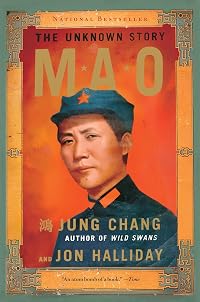
Mao: The Unknown Story
by Jung Chang, Jon Halliday
On This Page
Description
Based on a decade of research and on interviews with many of Mao's close circle in China who have never talked before--and with virtually everyone outside China who had significant dealings with him--this is the most authoritative life of Mao ever written. It is full of startling revelations, exploding the myth of the Long March, and showing a completely unknown Mao: he was not driven by idealism or ideology; his intricate relationship with Stalin went back to the 1920s, ultimately bringing show more him to power; he welcomed the Japanese occupation; and he schemed, poisoned and blackmailed to get his way. After he conquered China in 1949, his secret goal was to dominate the world. He caused the deaths of 38 million people in the greatest famine in history. In all, well over 70 million Chinese perished under Mao's rule--in peacetime. This entirely fresh look at Mao will astonish historians and the general reader alike.--From publisher description. show lessTags
Recommendations











Member Recommendations

Member Reviews
This is a thicc-ass book, at between 800 to 1000 pages, depending on which printed version you get, and damn, there's a LOT of juicy shit here.
This is my third biography by this author - 4th if you also include her bio/autobiography Wild Swans: Three Daughters of China The first two bios I read were of the Soong sisters Big Sister, Little Sister, Red Sister: Three Women at the Heart of Twentieth-Century China and of Empress Dowager Cixi Empress Dowager Cixi: The Concubine Who Launched Modern China
In her bios of the Soong sisters and Cixi, Jung is more flattering/sympathetic to them. Which does make some sense, as these women were frequently demonized/belittled/portrayed unflatteringly by others simply for being women in power. Here in show more Mao's biography, Chang does the opposite - which also makes sense given Mao's cult of personality and the propaganda machine that practically deified him despite all the suffering that he was responsible for, directly or indirectly.
In here, Chang portrays Mao as all too human - and all too selfish and greedy. It certainly was interesting to read about Mao's early days and how he treated his wives and his soldiers and subjects, and how as he amassed more and more power he got more selfish and worse. He didn't truly care about the people but he could act like he did when it suited him.
Some people have an issue with the bias in this book against him and I understand why - but at the same time I also enjoyed this book and learning all this juicy shit about Chairman Mao and why he should NOT have been deified/lionized as he was in China. It makes me think of Hitler/the Nazi Party, the Kims of North Korea, Fidel Castro in Cuba, Pol Pot in Cambodia, and so on, and how these awful people could present a pleasing image when it suited them while at the same time being responsible for the deaths of countless people.
4/5 stars for a juicy but entertaining and hella informative read. show less
This is my third biography by this author - 4th if you also include her bio/autobiography Wild Swans: Three Daughters of China The first two bios I read were of the Soong sisters Big Sister, Little Sister, Red Sister: Three Women at the Heart of Twentieth-Century China and of Empress Dowager Cixi Empress Dowager Cixi: The Concubine Who Launched Modern China
In her bios of the Soong sisters and Cixi, Jung is more flattering/sympathetic to them. Which does make some sense, as these women were frequently demonized/belittled/portrayed unflatteringly by others simply for being women in power. Here in show more Mao's biography, Chang does the opposite - which also makes sense given Mao's cult of personality and the propaganda machine that practically deified him despite all the suffering that he was responsible for, directly or indirectly.
In here, Chang portrays Mao as all too human - and all too selfish and greedy. It certainly was interesting to read about Mao's early days and how he treated his wives and his soldiers and subjects, and how as he amassed more and more power he got more selfish and worse. He didn't truly care about the people but he could act like he did when it suited him.
Some people have an issue with the bias in this book against him and I understand why - but at the same time I also enjoyed this book and learning all this juicy shit about Chairman Mao and why he should NOT have been deified/lionized as he was in China. It makes me think of Hitler/the Nazi Party, the Kims of North Korea, Fidel Castro in Cuba, Pol Pot in Cambodia, and so on, and how these awful people could present a pleasing image when it suited them while at the same time being responsible for the deaths of countless people.
4/5 stars for a juicy but entertaining and hella informative read. show less
Four stars means "liked it a lot" and yet I abandoned this book halfway through. How do those two thing fit together?
In the age of Facebook (or F******k, as I like to call it), the word "like" has come to mean something more vague and nebulous than it once did. I felt that this was an important book and I learned a great deal just getting about halfway through it. It was, however, unpleasant reading because of the sheer brutality and often needless suffering of the lives under discussion. I had escaped to this book from Mo Yan's Frog because the flippancy with which he handled some of the same themes. I needed less distance. But then I ended up needing more.
A character in The Three Body Problem [spoiler alert] faced with the Cultural show more Revolution decides that an alien race couldn't do a worse job than humans have done with life on Earth and reading Mao: The Unknown Story made me agree. I had to give it up so I could stop feeling that way and so I could sleep through the night uninterrupted by memories of torture stories which were everyday events in the history of the CCP.
Other reviewers criticized Ms Chang for allowing her hate of Mao to distort her objectivity but I am inclined to see things her way. Having read Wild Swans: Three Daughters of China I remember how she continued to believe in the cult of Mao even with so much evidence to the contrary. Would you criticize a book on Hitler(pace Mike Godwin) that failed to remain neutral on the subject of his moral worth? Perhaps the second half of the book is more "distorted" than the part I read.
Other critics complained that she didn't do enough to "explain" what made Mao the way he was. My opinion is that kind of deterministic reductionism is of little value. It is just an attempt to believe one has some kind of handle on what makes a man become a monster because it is too scary to believe otherwise. Yes, there is a correlation between those who were mistreated and those who end up mistreating others, but not everyone so abused becomes an abuser. Can one become an abuser without having undergone such treatment oneself? Some take that one cannot on faith and I am inclined to agree with them (but with the same depth of belief that goes into clicking "like"). Others think bad brain chemicals explain everything.
In addition to how horrible humans can be to each other, I also learned how important Stalin and the support of Russia was to Mao's rise to power, how ideology which superficially is the difference between Capitalism and Communism is more of a marketing strategy than an actual belief with the force of ambition being the actual impetus to events, that Chaing Kai Shek and Sun Yat Sen were also in bed with the Russians, that when the (Communist) doctrine of equality of the sexes meets culture, the doctrine is abandoned (except, maybe, for lip service), and how the wish of the young to discredit the ways of the old seems to happen over and over again. show less
In the age of Facebook (or F******k, as I like to call it), the word "like" has come to mean something more vague and nebulous than it once did. I felt that this was an important book and I learned a great deal just getting about halfway through it. It was, however, unpleasant reading because of the sheer brutality and often needless suffering of the lives under discussion. I had escaped to this book from Mo Yan's Frog because the flippancy with which he handled some of the same themes. I needed less distance. But then I ended up needing more.
A character in The Three Body Problem [spoiler alert] faced with the Cultural show more Revolution decides that an alien race couldn't do a worse job than humans have done with life on Earth and reading Mao: The Unknown Story made me agree. I had to give it up so I could stop feeling that way and so I could sleep through the night uninterrupted by memories of torture stories which were everyday events in the history of the CCP.
Other reviewers criticized Ms Chang for allowing her hate of Mao to distort her objectivity but I am inclined to see things her way. Having read Wild Swans: Three Daughters of China I remember how she continued to believe in the cult of Mao even with so much evidence to the contrary. Would you criticize a book on Hitler(pace Mike Godwin) that failed to remain neutral on the subject of his moral worth? Perhaps the second half of the book is more "distorted" than the part I read.
Other critics complained that she didn't do enough to "explain" what made Mao the way he was. My opinion is that kind of deterministic reductionism is of little value. It is just an attempt to believe one has some kind of handle on what makes a man become a monster because it is too scary to believe otherwise. Yes, there is a correlation between those who were mistreated and those who end up mistreating others, but not everyone so abused becomes an abuser. Can one become an abuser without having undergone such treatment oneself? Some take that one cannot on faith and I am inclined to agree with them (but with the same depth of belief that goes into clicking "like"). Others think bad brain chemicals explain everything.
In addition to how horrible humans can be to each other, I also learned how important Stalin and the support of Russia was to Mao's rise to power, how ideology which superficially is the difference between Capitalism and Communism is more of a marketing strategy than an actual belief with the force of ambition being the actual impetus to events, that Chaing Kai Shek and Sun Yat Sen were also in bed with the Russians, that when the (Communist) doctrine of equality of the sexes meets culture, the doctrine is abandoned (except, maybe, for lip service), and how the wish of the young to discredit the ways of the old seems to happen over and over again. show less
We've all heard of the horrible atrocities committed by the likes of Hitler, Stalin,or Mussolini. But for a long time due to the utmost secrecy Mao upheld in China and the cult of personality myth he created for himself, Mao's legacy kept him out of their league. However, from page, one it becomes clear that Author Jung Chang wrote this bio to blow away the myth that Mao was concerned about and acted in order to improve the lives of the people who served him. In Jung Chang's telling of Mao's life the only thing that concerned Mao was himself. She also makes it clear that what sets apart Mao from some of the most horrible monsters to ever walk the face of the earth, was the sheer numbers of the people concerned. During his decades long show more rule he controlled fully one fifth of the worlds total population. One fifth ! Hundreds of Hundreds of millions of these people were murdered outright. Those that escaped death suffered cruel, harsh, penniless lives. The fact that the whims of just one evil man could expose one fifth of the worlds' population to such abject misery is absolutely mind boggling. show less
I was given a copy of 'Mao: The Unknown Story' for Christmas in 2016. I read 200 pages during January 2017, found the Long March so depressing that I put the book aside for more than three and half years, then read the remaining 600 pages in two days. This isn't atypical behaviour for me and also reflects the nature of the book. It is written in highly readable and involving style, yet the content is horribly depressing. I have been very fond of Jung Chang's writing since I came across [b:Wild Swans: Three Daughters of China|1848|Wild Swans Three Daughters of China|Jung Chang|https://i.gr-assets.com/images/S/compressed.photo.goodreads.com/books/1440643710l/1848._SX50_.jpg|2969000] as a teenager and was astounded. I reread it repeatedly show more and became fascinated by China's 20th century history. I even tried to read a hagiography of Deng Xiao Ping by his daughter when I was 16 or 17 ([b:Deng Xiaoping: My Father|4796283|Deng Xiaoping My Father|Deng Maomao|https://i.gr-assets.com/images/S/compressed.photo.goodreads.com/books/1328042891l/4796283._SY75_.jpg|4861384]). This is nonetheless the most comprehensive biography of Mao that I've ever read and an unsurprisingly chilling indictment of the privations and horrors that he put China through. I was already aware of the Great Leap Forward and Cultural Revolution, but knew very little about Mao's foreign policy, relationship with Stalin, and nuclear armament programme. Chapters dealing with these issues were thus the most intellectually interesting.
The most memorable and horrifying parts, though, concerned Mao's systems of repression and control of China's population, which has the major consequence of mass starvation. I had not realised that while China went through the largest known famine in human history from 1958 to 1961, Mao's regime was selling and gifting food products abroad in an effort to build international status. Previous reading ascribed the famines more to disruption and loss of agricultural productivity due to reorganisation of communal farms and senseless pursuit of steel production during the Great Leap Forward. However, it seems that these were minor problems compared with the mass requisitions of food for export. It was not that food production didn't happen, but that the food was then taken away for political uses rather than basic subsistence. This book estimates that around 38 million people died in the 1958-61 famine, a simply unimaginable number. Once the famine abated due to policy changes, food security in rural areas remained very fragile. Food was still used as a political tool, rather than for subsistence.
When explaining Mao's systems of repression, it is impossible to avoid comparisons with other totalitarian regimes. I found some striking passages doing just that:
The orchestration of fear under Mao's regime is extraordinary in its distinctiveness. During the Cultural Revolution, he unleashed an army of indoctrinated teenagers and students (the Red Guards and Rebels) against the educational and cultural sectors of the country and then against his own party. Once these persecutions had served his purpose, he replaced the purged cadres with army personnel and exiled the Red Guards and Rebels to the labour in the countryside. Secret police had a much less significant role under his regime than in Soviet states; oppression was visible and crowd-sourced, to use a 21st century term.
Throughout the biography, the overwhelming impression the reader gets of Mao is a combination of narcissism and callousness. Obviously these are traits shared by just about every authoritarian ruler, yet they seem to reach particular extremes in Mao. I could not help thinking of Donald Trump when reading about Mao's utter disregard for human lives, paranoia, cruelty towards rivals, and nepotism spurred not by love but by fixation on personal loyalty. Mao also lied constantly and refused to ever accept responsibility for anything. Such similarities should not be overstated, of course. While their political programmes are both characterised by narcissistic equating of self- and national interest, Mao wanted China to be recognised as a world power by other nations. Trump appears wholly disinterested in America's international reputation. This paragraph about legacy nonetheless made me wonder what Trump's death will leave behind:
This also marks a contrast to the totalitarian dynasty in North Korea.
After a very detailed start that spends 400 pages recounting how Mao came to power in China, the book ends extremely abruptly with his death. There is a two sentence epilogue stating that China's communist party still promulgates the myth of Mao as a great leader. I'd expected a chapter on the immediate aftermath of his death, but to be fair this is already a thorough and extensive biography. I found it an informative and devastating insight into China's history from the 1920s to 70s, 25 years of it shaped to a great extent by one man. 'Mao: The Unknown Story' is not interested in Mao's ideology and gives the impression he had little interest in it himself, except as a tool to promote his interests. What it seeks to document are his actions and choices in pursuit of power and prestige, which were consistently cruel, violent, and ruthless. show less
The most memorable and horrifying parts, though, concerned Mao's systems of repression and control of China's population, which has the major consequence of mass starvation. I had not realised that while China went through the largest known famine in human history from 1958 to 1961, Mao's regime was selling and gifting food products abroad in an effort to build international status. Previous reading ascribed the famines more to disruption and loss of agricultural productivity due to reorganisation of communal farms and senseless pursuit of steel production during the Great Leap Forward. However, it seems that these were minor problems compared with the mass requisitions of food for export. It was not that food production didn't happen, but that the food was then taken away for political uses rather than basic subsistence. This book estimates that around 38 million people died in the 1958-61 famine, a simply unimaginable number. Once the famine abated due to policy changes, food security in rural areas remained very fragile. Food was still used as a political tool, rather than for subsistence.
When explaining Mao's systems of repression, it is impossible to avoid comparisons with other totalitarian regimes. I found some striking passages doing just that:
Mao intended most of the population - children and adults alike - to witness the killing [during the 1950 'campaign to suppress counter-revolutionaries']. His aim was to scare and brutalise the entire population, in a way that went much further than Hitler or Stalin, who largely kept their foulest crimes out of sight.
The orchestration of fear under Mao's regime is extraordinary in its distinctiveness. During the Cultural Revolution, he unleashed an army of indoctrinated teenagers and students (the Red Guards and Rebels) against the educational and cultural sectors of the country and then against his own party. Once these persecutions had served his purpose, he replaced the purged cadres with army personnel and exiled the Red Guards and Rebels to the labour in the countryside. Secret police had a much less significant role under his regime than in Soviet states; oppression was visible and crowd-sourced, to use a 21st century term.
Throughout the biography, the overwhelming impression the reader gets of Mao is a combination of narcissism and callousness. Obviously these are traits shared by just about every authoritarian ruler, yet they seem to reach particular extremes in Mao. I could not help thinking of Donald Trump when reading about Mao's utter disregard for human lives, paranoia, cruelty towards rivals, and nepotism spurred not by love but by fixation on personal loyalty. Mao also lied constantly and refused to ever accept responsibility for anything. Such similarities should not be overstated, of course. While their political programmes are both characterised by narcissistic equating of self- and national interest, Mao wanted China to be recognised as a world power by other nations. Trump appears wholly disinterested in America's international reputation. This paragraph about legacy nonetheless made me wonder what Trump's death will leave behind:
Mao was not interested in posterity. Back in 1918, he had written, 'Some say one has a responsibility for history. I don't believe it... People like me are not building achievements to leave for future generations...' These remained his views throughout his life. In 1950, after visiting Lenin's mausoleum, Mao said to his entourage that the superb preservation of the corpse was only for the sake of others; it was irrelevant to Lenin. Once Lenin died, he felt nothing, and it did not matter to him how his corpse was kept.
When Mao died, he left neither a will nor an heir - and, in face, unlike most Chinese parents, especially Chinese emperors, he was indifferent about having an heir, which was extremely unusual.
This also marks a contrast to the totalitarian dynasty in North Korea.
After a very detailed start that spends 400 pages recounting how Mao came to power in China, the book ends extremely abruptly with his death. There is a two sentence epilogue stating that China's communist party still promulgates the myth of Mao as a great leader. I'd expected a chapter on the immediate aftermath of his death, but to be fair this is already a thorough and extensive biography. I found it an informative and devastating insight into China's history from the 1920s to 70s, 25 years of it shaped to a great extent by one man. 'Mao: The Unknown Story' is not interested in Mao's ideology and gives the impression he had little interest in it himself, except as a tool to promote his interests. What it seeks to document are his actions and choices in pursuit of power and prestige, which were consistently cruel, violent, and ruthless. show less
Mao Zedong is alone among the major tyrants of the 20th century never to have faced a historical reckoning. While the crimes of Adolf Hitler’s regime have been well documented and the Russians have at various times acknowledged the famines and purges under Josef Stalin, the full extent of the suffering inflicted by Mao remains uncertain. This is largely due to the degree to which the Communist government in China today zealously protects his image, as though to question it is to undermine the foundations of their state. As a result, many of the details about his life remain overlaid by myth, while his culpability in China’s misery during the quarter of a century he ruled it remains under-explored.
To rectify this, Jung Chang and Jon show more Halliday spent over a decade combing through archives and interviewing people who knew Mao. Their book embodies the sum of their efforts, offering an comprehensive examination of Mao, his rise to power, and his actions as the leader of the most populous nation on the planet. It’s an impressive work, but also a deeply flawed one that often reads more like a prosecutor’s brief than it does a historical study designed to illuminate the life of the man and how he came to exert such an outsized role in China’s history.
These flaws become evident early in the book when the authors set out to explain how Mao rose to power. As they make clear, Mao was hardly destined for greatness. Not only was his background relatively humble, but Mao lacked the oratorical or organizational skills that have been the path of many to power. Nor was he an energetic go-getter, as he preferred an indolent lifestyle. What Chang and Halliday demonstrate Mao possessed in abundance was an eye for the main chance and a ruthlessness in destroying anyone who he perceived as a competitor. Time and again Mao outmaneuvered more capable colleagues and competitors, steadily accruing power even at the cost of thousands of lives.
Mao did little to endear himself to his contemporaries or his superiors in the Chinese Communist Party (CCP). Yet as Chang and Halliday argue, their opinions mattered less than those of the Soviet advisers aiding the Communists in the 1920s and their superiors in Moscow. The authors’ description of the role the Soviet Union played in Chinese politics during this period is one of the main features of this book, and reflects their extensive work in Russian archives. Impressed with reports of Mao’s effectiveness, time and again they favored him over their rivals – and with Moscow’s continuing support for the CCP vital to its survival, their preferences could not be ignored. As Chang and Halliday demonstrate, their support was a key factor in Mao’s rise to the leadership of the CCP and the war against the Nationalists under Chiang Kai-shek.
Once in command, however, Mao hardly distinguished himself as a general against the Nationalists or the Japanese then occupying large portions of China, and by 1946 his forces were on the verge of being crushed by the Nationalists. Then how did the Communists ultimately triumph over Chiang’s forces? Here Chang and Halliday credit two factors: an untimely American intervention for a cease-fire, and the planting of moles within the Nationalist military command. The former gave Mao’s forces a much-needed breathing space and an opportunity to rearm with Soviet aid, while the latter often spared threatened Communist forces while leading their own men into traps. The result was Nationalist collapse and Mao’s victorious declaration of the People’s Republic in 1949, beginning his long and disastrous reign over China.
Yet ruling over China was not enough for Mao, as he aspired to nothing less than global domination. In this he was restrained by both the devastated condition of his country and Stalin’s reluctance to support the development of an indigenous arms industry. Mao sought to overcome both through a combination of adroit diplomacy and a callous exploitation of his people. Leveraging Nikita Khrushchev’s need for allies, Mao from him won the technical advice and resources he needed to develop an atomic bomb program. This he paid for by requisitioning enormous amounts of agricultural produce from the peasantry, beggaring the populace in order to support his ambitions. When others in the CCP leadership pushed back against the cost of this, Mao solidified his power with the Cultural Revolution, which threw the nation into chaos and inflicted yet further trauma upon the people. Their suffering continued largely unabated until Mao’s death in 1976, at which point his successor Deng Xiaoping soon began to reverse his policies and launch China onto the path that has brought it to the present day,
Chung and Halliday’s book is a damming indictment of its subject. Yet in painting such a uniformly negative portrait of Mao what they produce is a caricature. Nowhere in it do they consider why many people chose to follow him absent some form of compulsion, or why his second and third wives – the former of whom refused to renounce Mao even under torture, the latter a capable guerrilla leader in her own right – fell in love with him. Equally problematic is the authors’ overreliance on Soviet sources, which results in a very Russian-centric view of Mao’s life that, in the absence of similar materials from Chinese archives, likely exaggerates the Soviet Union’s influence in Communist Party politics in the 1920s and 1930s. Not that the authors allow the absence of archival material to prevent them from engaging in speculation about some of the shadowier aspects of Chinese history (such as the possibility of Nationalist moles sabotaging their war effort), provided that it fits their interpretation of Mao. Taken together, these issues make Chang and Halliday’s book one that should be treated with caution, and that for all of its research should not be regarded as the final word on Mao’s life and career. show less
To rectify this, Jung Chang and Jon show more Halliday spent over a decade combing through archives and interviewing people who knew Mao. Their book embodies the sum of their efforts, offering an comprehensive examination of Mao, his rise to power, and his actions as the leader of the most populous nation on the planet. It’s an impressive work, but also a deeply flawed one that often reads more like a prosecutor’s brief than it does a historical study designed to illuminate the life of the man and how he came to exert such an outsized role in China’s history.
These flaws become evident early in the book when the authors set out to explain how Mao rose to power. As they make clear, Mao was hardly destined for greatness. Not only was his background relatively humble, but Mao lacked the oratorical or organizational skills that have been the path of many to power. Nor was he an energetic go-getter, as he preferred an indolent lifestyle. What Chang and Halliday demonstrate Mao possessed in abundance was an eye for the main chance and a ruthlessness in destroying anyone who he perceived as a competitor. Time and again Mao outmaneuvered more capable colleagues and competitors, steadily accruing power even at the cost of thousands of lives.
Mao did little to endear himself to his contemporaries or his superiors in the Chinese Communist Party (CCP). Yet as Chang and Halliday argue, their opinions mattered less than those of the Soviet advisers aiding the Communists in the 1920s and their superiors in Moscow. The authors’ description of the role the Soviet Union played in Chinese politics during this period is one of the main features of this book, and reflects their extensive work in Russian archives. Impressed with reports of Mao’s effectiveness, time and again they favored him over their rivals – and with Moscow’s continuing support for the CCP vital to its survival, their preferences could not be ignored. As Chang and Halliday demonstrate, their support was a key factor in Mao’s rise to the leadership of the CCP and the war against the Nationalists under Chiang Kai-shek.
Once in command, however, Mao hardly distinguished himself as a general against the Nationalists or the Japanese then occupying large portions of China, and by 1946 his forces were on the verge of being crushed by the Nationalists. Then how did the Communists ultimately triumph over Chiang’s forces? Here Chang and Halliday credit two factors: an untimely American intervention for a cease-fire, and the planting of moles within the Nationalist military command. The former gave Mao’s forces a much-needed breathing space and an opportunity to rearm with Soviet aid, while the latter often spared threatened Communist forces while leading their own men into traps. The result was Nationalist collapse and Mao’s victorious declaration of the People’s Republic in 1949, beginning his long and disastrous reign over China.
Yet ruling over China was not enough for Mao, as he aspired to nothing less than global domination. In this he was restrained by both the devastated condition of his country and Stalin’s reluctance to support the development of an indigenous arms industry. Mao sought to overcome both through a combination of adroit diplomacy and a callous exploitation of his people. Leveraging Nikita Khrushchev’s need for allies, Mao from him won the technical advice and resources he needed to develop an atomic bomb program. This he paid for by requisitioning enormous amounts of agricultural produce from the peasantry, beggaring the populace in order to support his ambitions. When others in the CCP leadership pushed back against the cost of this, Mao solidified his power with the Cultural Revolution, which threw the nation into chaos and inflicted yet further trauma upon the people. Their suffering continued largely unabated until Mao’s death in 1976, at which point his successor Deng Xiaoping soon began to reverse his policies and launch China onto the path that has brought it to the present day,
Chung and Halliday’s book is a damming indictment of its subject. Yet in painting such a uniformly negative portrait of Mao what they produce is a caricature. Nowhere in it do they consider why many people chose to follow him absent some form of compulsion, or why his second and third wives – the former of whom refused to renounce Mao even under torture, the latter a capable guerrilla leader in her own right – fell in love with him. Equally problematic is the authors’ overreliance on Soviet sources, which results in a very Russian-centric view of Mao’s life that, in the absence of similar materials from Chinese archives, likely exaggerates the Soviet Union’s influence in Communist Party politics in the 1920s and 1930s. Not that the authors allow the absence of archival material to prevent them from engaging in speculation about some of the shadowier aspects of Chinese history (such as the possibility of Nationalist moles sabotaging their war effort), provided that it fits their interpretation of Mao. Taken together, these issues make Chang and Halliday’s book one that should be treated with caution, and that for all of its research should not be regarded as the final word on Mao’s life and career. show less
Mao egy dög volt. Ezt persze eddig is tudtuk. De hogy ekkora dög volt, az még számomra is újdonság. Sok szempontból Sztálin updatált verziójának tűnik: az a fajta diktátor, aki felismerte, hogy ha nem hagyja magát korlátozni az ideológiáktól, az növeli stratégiai mozgásterét. Ilyen értelemben ő is elsősorban retorikailag volt marxista, valójában bármilyen kártyát szívesen kijátszott a kultúraellenességtől a nacionalizmuson át a szimpla xenofóbiáig, ha épp attól remélte hatalma megszilárdulását. Ő is, mint a diktátorok általában, állampolgáraira absztrakcióként tekintett – viszont ezt olyan léptékben csinálta, ami ép ésszel felfoghatatlan. Meghal 300 millió kínai egy esetleges show more atomháborúban? Oda se neki, legalább mindenkinek dupla annyi helye lesz. Hát mivé lenne a világ, ha soha senki nem halna meg? A parasztoknak kevesebb napi kalória jut, mint az auschwitzi foglyoknak? Legalább nem híznak meg, mint a nyugatiak. Úgyhogy csak növeljük háromszorosára a kötelező beszolgáltatást, mert a ruszkiknak élelmiszerrel kell fizetnünk a haditechnikáért. És mellesleg Mao rendelkezett a diktátorok egyéb szériafelszereltségeivel is: paranoiás volt, és bár nem nagyon értett az olyan apróságokhoz, mint a gazdaság vagy a hadvezetés, sosem szűnt meg mégis belepofázni mindenbe. Például mekkora nagy ötlet szerszám nélkül kizavarni a jónépet, hogy a két kezükkel építsenek víztározókat! Igaz ugyan, hogy az első áradás elmosta az egészet, de kit érdekel, én nem ott lakom. Meg micsoda remek idea a kert végében vaskohókat építtetni a falusiakkal, és beolvasztatni velük még a szerszámaikat is, csak mert az acél országa akarunk lenni! Igaz ugyan, hogy az így nyert fém semmire se lesz használható – még a popónkat se tudjuk kitörölni vele, hiszen FÉM. Mindennek végösszege (a szerzőpáros számítása szerint) cirka 70.000.000 kínai holttetem.
A kötettel csak az a baj, hogy nem igazán történelem. Hanem egyfajta ellen-történelem – vagyis a hivatalos maoista üdvtörténet pontról pontra végigvitt cáfolata. Olyan szinten Mao van a középpontjában, hogy az már nemhogy a tárgyilagosság rovására megy, de egyenesen beledarálja a tárgyilagosságot a komposztba. A kuomintang például, való igaz, Mao közvetlen környezeténél jóval kevésbé volt megveszekedett tömeggyilkosok gyülekezete, de e kötet alapján konkrétan cserkészcsapatnak tűnik. Ez pedig azért van, mert a szerzők vélelmezhető szándéka szerint semmi, de semmidesemmi nem terelheti el a figyelmünket Mao páratlan gonoszságáról. Természetfeletti démont csinálnak belőle, de olyan mélységig, hogy még Sztálin agyvérzését is szép óvatosan a nyakába varrják. Komolyan. (Ráadásul Chang és Halliday valószínűleg telepatikus képességekkel is bírnak, mert olyanokat írnak, hogy „Mao az ágyában arra gondolt…” – nos, én elhiszem, hogy Mao se az ágyában, se máshol nem gondolt semmi jóra, de azt azért nem merném állítani, hogy bárki tudhatja, mire gondolt.) Mindez oda vezet, hogy az egész tömeggyilkosságért csak Mao és a legszűkebb slepp felel, maga Kína népe pedig (a legtöbb tisztviselőt is beleértve) a megerőszakolt szűzlány szerepét játssza, akit terrorral és zsarolással térítenek le az igaz útról. No most én ebben mértékkel hiszek – tapasztalatom szerint a diktatúrák nem működhetnek anélkül, hogy a népesség számottevő része (a „számottevőn” lehet vitatkozni) ne állna mellettük. Vagy azért, mert a rosszabbik énjükre erősít rá a Nagy Vezér, vagy azért, mert olyasvalamit ajánl fel nekik, amit az előző kormányzat elmulasztott: munkát, vagy továbbtanulási lehetőséget a legszegényebbek számára is. Például. Nos, ez az elem ebből a könyvből teljesen hiányzik. És szerintem enélkül meg vagyunk fosztva a lehetőségtől, hogy igazán megértsük Mao rendszerének lényegét. Csak a szörnyülködés marad.
Mert szörnyülködni amúgy igazán jóízűt lehet ezen a könyvön: igazi Fekete Könyve az ázsiai XX. századnak. Jó gyomrú olvasók mindenképpen vágjanak bele, mert számos érdekes, releváns információ van benne, még ha néha el is rejti őket a borzalmak monoton sorjázása. Csak épp egyszer szeretnék olvasni egy olyan könyvet is Mao-ról, amiből nem csöpög ennyire az amúgy jogos gyűlölet. show less
A kötettel csak az a baj, hogy nem igazán történelem. Hanem egyfajta ellen-történelem – vagyis a hivatalos maoista üdvtörténet pontról pontra végigvitt cáfolata. Olyan szinten Mao van a középpontjában, hogy az már nemhogy a tárgyilagosság rovására megy, de egyenesen beledarálja a tárgyilagosságot a komposztba. A kuomintang például, való igaz, Mao közvetlen környezeténél jóval kevésbé volt megveszekedett tömeggyilkosok gyülekezete, de e kötet alapján konkrétan cserkészcsapatnak tűnik. Ez pedig azért van, mert a szerzők vélelmezhető szándéka szerint semmi, de semmidesemmi nem terelheti el a figyelmünket Mao páratlan gonoszságáról. Természetfeletti démont csinálnak belőle, de olyan mélységig, hogy még Sztálin agyvérzését is szép óvatosan a nyakába varrják. Komolyan. (Ráadásul Chang és Halliday valószínűleg telepatikus képességekkel is bírnak, mert olyanokat írnak, hogy „Mao az ágyában arra gondolt…” – nos, én elhiszem, hogy Mao se az ágyában, se máshol nem gondolt semmi jóra, de azt azért nem merném állítani, hogy bárki tudhatja, mire gondolt.) Mindez oda vezet, hogy az egész tömeggyilkosságért csak Mao és a legszűkebb slepp felel, maga Kína népe pedig (a legtöbb tisztviselőt is beleértve) a megerőszakolt szűzlány szerepét játssza, akit terrorral és zsarolással térítenek le az igaz útról. No most én ebben mértékkel hiszek – tapasztalatom szerint a diktatúrák nem működhetnek anélkül, hogy a népesség számottevő része (a „számottevőn” lehet vitatkozni) ne állna mellettük. Vagy azért, mert a rosszabbik énjükre erősít rá a Nagy Vezér, vagy azért, mert olyasvalamit ajánl fel nekik, amit az előző kormányzat elmulasztott: munkát, vagy továbbtanulási lehetőséget a legszegényebbek számára is. Például. Nos, ez az elem ebből a könyvből teljesen hiányzik. És szerintem enélkül meg vagyunk fosztva a lehetőségtől, hogy igazán megértsük Mao rendszerének lényegét. Csak a szörnyülködés marad.
Mert szörnyülködni amúgy igazán jóízűt lehet ezen a könyvön: igazi Fekete Könyve az ázsiai XX. századnak. Jó gyomrú olvasók mindenképpen vágjanak bele, mert számos érdekes, releváns információ van benne, még ha néha el is rejti őket a borzalmak monoton sorjázása. Csak épp egyszer szeretnék olvasni egy olyan könyvet is Mao-ról, amiből nem csöpög ennyire az amúgy jogos gyűlölet. show less
This breathtaking biography of one of the 20th century's greatest villains is written with the fiery passion of personal involvement. Jung Chang's family suffered for their privileged position as intellectual upper party members during the Cultural Revolution. While Mao's life is presented from a hostile perspective, it looks to me firmly grounded in fact. The husband and wife team interviewed hundreds of people in China and around the globe (from Albania to Zaire) about Mao. Page after page of interviewees offers testimony to their exhaustive research as does the 58 pages long bibliography.
The most surprising fact about Mao was that he didn't believe in communism. From his early Randian ramblings on, he was interested in power. Joining show more the Communists. If another party had offered him a better way to power, he would have jumped ship. Not feeling any allegiance to party and idea proved to be a tactical advantage in the power struggle with his peers who often chose to sacrifice themselves for the party's sake. In contrast to most human beings, Mao only cared about himself, abandoning allies, wives and his children without qualms. Chiang Kai-shek let himself be controlled by Stalin holding his son hostage. Mao didn't care about the fate of his son held by Stalin.
Mao's supreme management incompetence is another unexpected finding of this biography. Time and time again, Mao managed to exhaust and destroy territories and armies put under his command. Most of his rivals were much more capable in command. Like a clumsy cat, Mao managed to land on his feet and walk elegantly away from the debris of his latest catastrophe. Despite a track record of failure, Mao fell upward and upward. Stalin somehow admired his survivor capability. Mao would not quit.
Regarding his management style, he was supreme at using Richard Nixon's Orthogonian technique of relying on building coalitions of less efficient but totally dependent toadies. They knew that they owed their position to Mao, a fact Mao made clear by humiliating them in public, again and again. Mao's meanness knew no bound: He even denied Zhou Enlai cancer treatment.
The biography also reveals that many of the commonly told stories need to be revised, e.g. Mao and the Communist leadership did not march but was carried on litters by starving and dying porters during the Long March. The Communists were also not in danger from Chiang Kai-shek who had pre-arranged the destination of the march with Stalin and used the Communists to gain entry into warlord-dominated Sichuan. Only when Mao foolishly deviated from the script was blood shed. Mao also needlessly prolonged the march by senseless deviations. He also didn't fight the Japanese during WWII, using them to weaken Chang Kai-shek and waiting for the war to end.
Overall, a stunning read about the 20th century's greatest butcher. One wonders where China might be now if its economic recovery process had started at the same time as the Wirtschaftswunder. Highly recommended. show less
The most surprising fact about Mao was that he didn't believe in communism. From his early Randian ramblings on, he was interested in power. Joining show more the Communists. If another party had offered him a better way to power, he would have jumped ship. Not feeling any allegiance to party and idea proved to be a tactical advantage in the power struggle with his peers who often chose to sacrifice themselves for the party's sake. In contrast to most human beings, Mao only cared about himself, abandoning allies, wives and his children without qualms. Chiang Kai-shek let himself be controlled by Stalin holding his son hostage. Mao didn't care about the fate of his son held by Stalin.
Mao's supreme management incompetence is another unexpected finding of this biography. Time and time again, Mao managed to exhaust and destroy territories and armies put under his command. Most of his rivals were much more capable in command. Like a clumsy cat, Mao managed to land on his feet and walk elegantly away from the debris of his latest catastrophe. Despite a track record of failure, Mao fell upward and upward. Stalin somehow admired his survivor capability. Mao would not quit.
Regarding his management style, he was supreme at using Richard Nixon's Orthogonian technique of relying on building coalitions of less efficient but totally dependent toadies. They knew that they owed their position to Mao, a fact Mao made clear by humiliating them in public, again and again. Mao's meanness knew no bound: He even denied Zhou Enlai cancer treatment.
The biography also reveals that many of the commonly told stories need to be revised, e.g. Mao and the Communist leadership did not march but was carried on litters by starving and dying porters during the Long March. The Communists were also not in danger from Chiang Kai-shek who had pre-arranged the destination of the march with Stalin and used the Communists to gain entry into warlord-dominated Sichuan. Only when Mao foolishly deviated from the script was blood shed. Mao also needlessly prolonged the march by senseless deviations. He also didn't fight the Japanese during WWII, using them to weaken Chang Kai-shek and waiting for the war to end.
Overall, a stunning read about the 20th century's greatest butcher. One wonders where China might be now if its economic recovery process had started at the same time as the Wirtschaftswunder. Highly recommended. show less
Members
- Recently Added By
Published Reviews
ThingScore 75
This huge biography of the 20th-century political giant is based on prodigious research and contains fascinating new material. Jung Chang, who is of Chinese origin, and Jon Halliday, her British husband, offer plenty of passion and detail in their unremittingly negative but engrossing portrait of Mao Tse-Tung. Overall the book is less the "unknown story" promised by the subtitle than a known show more story distilled into a polemic. show less
added by danielx
Lists

World History
4 works; 1 member

Donald J. Trump Favorites
31 works; 1 member

All Things China
205 works; 3 members

Club Read's Recommended Nonfiction Written by Women
618 works; 30 members

China / Hong Kong / Taiwan
25 works; 1 member
Talk Discussions
Past Discussions
Mao in Non-Fiction Readers (January 2008)
Author Information

19+ Works 14,024 Members
Jung Chang was born in Yibin, Sichuan Province, China, in 1952. She left China for Britain in 1978 and obtained a Ph.D. in linguistics from the University of York in 1982. She is the first person from the People¿s Republic of China to receive a doctorate from a British university. She lives in London with her husband, Jon Halliday, with whom she show more wrote Mao: The Unknown Story. Her non-fiction book, Wild Swans: Three Daughters of China, was a New York Times bestseller in 2014. (Bowker Author Biography) show less

12+ Works 3,390 Members
Awards and Honors
Common Knowledge
- Canonical title*
- Mao: Den sanna historien
- Original publication date
- 2005
- People/Characters
- Mao Zedong; Joseph Stalin; Chiang Kai-shek
- Important places
- China; Soviet Union
- Important events
- Long March; Chinese Civil War; Chinese Revolution of 1949
- Blurbers
- Johnson, Frank; Patten, Chris; Yahuda, Michael; Walden, George; Montefiore, Simon Sebag; Hilton, Isabel (show all 7); Rendell, Ruth
- Original language*
- Engels
*Some information comes from Common Knowledge in other languages. Click "Edit" for more information.
Classifications
- Genres
- Biography & Memoir, History, General Nonfiction, Nonfiction
- DDC/MDS
- 951.05092 — History & geography History of Asia East Asia: China, Taiwan, Hong Kong, Korea History 1949- (People's Republic, 20th century)
- LCC
- DS778 .M3 .C38 — History of Europe, Asia, Africa and Oceania Asia History of Asia China History
- BISAC
Statistics
- Members
- 3,214
- Popularity
- 5,379
- Reviews
- 57
- Rating
- (3.76)
- Languages
- 20 — Czech, Danish, Dutch, English, Estonian, Finnish, French, German, Greek, Hungarian, Icelandic, Italian, Norwegian (Bokmål), Polish, Portuguese, Russian, Spanish, Swedish, Turkish, Chinese, traditional
- Media
- Paper, Audiobook, Ebook
- ISBNs
- 70
- UPCs
- 1
- ASINs
- 13