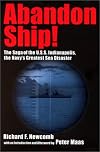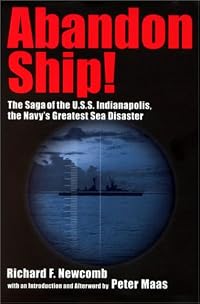
Abandon Ship!: The Saga of the U.S.S. Indianapolis, the Navy's Greatest Sea Disaster
by Richard F. Newcomb
On This Page
Description
Sailing across the Pacific, the battle-scarred heavy cruiser U.S.S. Indianapolis had just delivered a secret cargo that would trigger the end of World War II. Heading westward, she was sunk by a Japanese submarine. In twelve minutes, some 300 men went down with her. More than 900 other spent four horrific days and five nights in the ocean with no water to drink, savaged by a pitiless sun and swarms of sharks. Incredibly, no one knew they were there until a Navy patrol plane accidentally show more discovered them. In the end, only 316 crewmen survived. How could this have happened—and why?This updated edition of Abandon Ship!, with an introduction and afterword by Peter Maas, supplies the chilling answer. A harrowing account of military malfeasance and human tragedy, Abandon Ship! also scrutinizes the role of the U.S. Navy in the disaster, especially the court-martial of the ship's captain, Charles Butler McVay III. Maas reveals facts previously unavailable to Richard Newcomb and chronicles a forty-year crusade to right a wrong, a crusade Abandon Ship! inspired.
. show less
Tags
Recommendations















Member Recommendations
Member Reviews
Parts of the story of the USS Indianapolis are fairly well-known because of the speech in the movie Jaws where Quint recounts that over 1000 men went into the water when it was sunk and only 316 came out - sharks took the rest. The numbers are slightly different (800-900 went into the water) and there were 321 came out - but 4 died, and 317 survived in total. By all accounts most of these died a slower and more horrible death, being in the ocean for more than four days without food or water and with no shelter from the elements or the sun, life slowly, and painfully ebbed away. Many were taken by sharks, but the sharks took many of the already dead.
That's the story that most people know. What most do not is that this was a major SNAFU show more by the Navy, because standing directives did not require combatant ships to be listed as late when they did not arrive (no-one wanted the enemy to know where combatants were), the Indianapolis was not reported late and hence no rescue was begun until more than four days later when a plane on a routine patrol happened to see men in the water. The rescue was swift and efficient, but way too late, and literally hundreds of sailors died a horrid death, and those that lived had to deal with that.
To compound the horror the Navy decided to Court-Martial the Captain, and succeeded in ramming it through - the only Commanding Officer of a ship lost during the war who was Court-Martialed.
Later others were given career-ending reprimands, without justification. In the end Captain McVay was exonerated, but in 1968, after years of suffering abuse from those who thought him guilty he committed suicide.
Abandon Ship! was written not long after the sinking and is well-documented. It is a sad and disturbing story because of the tragedy itself, and the horrible and significant loss of life, but also because of the callous action to try and find a scapegoat after the fact. Fortunately rules were changed and others lives probably saved because of what happened, but what happened is a prime example of what happens when the focus is on fixing the blame instead of fixing the problem. show less
That's the story that most people know. What most do not is that this was a major SNAFU show more by the Navy, because standing directives did not require combatant ships to be listed as late when they did not arrive (no-one wanted the enemy to know where combatants were), the Indianapolis was not reported late and hence no rescue was begun until more than four days later when a plane on a routine patrol happened to see men in the water. The rescue was swift and efficient, but way too late, and literally hundreds of sailors died a horrid death, and those that lived had to deal with that.
To compound the horror the Navy decided to Court-Martial the Captain, and succeeded in ramming it through - the only Commanding Officer of a ship lost during the war who was Court-Martialed.
Later others were given career-ending reprimands, without justification. In the end Captain McVay was exonerated, but in 1968, after years of suffering abuse from those who thought him guilty he committed suicide.
Abandon Ship! was written not long after the sinking and is well-documented. It is a sad and disturbing story because of the tragedy itself, and the horrible and significant loss of life, but also because of the callous action to try and find a scapegoat after the fact. Fortunately rules were changed and others lives probably saved because of what happened, but what happened is a prime example of what happens when the focus is on fixing the blame instead of fixing the problem. show less
Harrowing enough story of disaster and subsequent scapegoating of the innocent and cover-up by a rule-bound hierarchy, (USNavy). Most fascinating is the postscript where a schoolboy hears a bit of the story while watching Jaws ( sharks were among the hazards of floating in the South Pacific after the sinking). He got intrigued, then obsessed by the story and the injustice and eventually brought a tardy exoneration out of the Navy for Capt McVeigh, but too late: he'd put a bullet through his head at age 70.
The hearings and court martial procedures and witness statement are hard to follow; hard to make a narrative line through that kind of labyrinth. What stands out in that section is the calling of the Japanese sub captain as witness, show more in the face of much protest and against all precedent. Why the authorities called him is not illuminated. His testimony also exonerated the Captain (zig zag maneuvers would have made no difference) but the court found Capt M guilty anyway. Fiat justitia! show less
The hearings and court martial procedures and witness statement are hard to follow; hard to make a narrative line through that kind of labyrinth. What stands out in that section is the calling of the Japanese sub captain as witness, show more in the face of much protest and against all precedent. Why the authorities called him is not illuminated. His testimony also exonerated the Captain (zig zag maneuvers would have made no difference) but the court found Capt M guilty anyway. Fiat justitia! show less
Solid account of the USS Indianapolis sinking, with significant attention given to the investigation, courts-martial trial, and disciplinary actions in response to this tragedy. Newcomb is very critical of the Navy for its handling of the matter and how it scapegoated certain officers.
3391. Abandon Ship! The Saga of the U.S.S. Indianapolis, the Navy's Greatest Sea Disaster, by Richard F. Newcomb (read 15 Jan 2001) This book details the wrenching, utterly poignant account of what happened when the USS Indianapolis was sunk on July 30 1945. I cannot remember a more grabbing account and it is superbly told. This has to be one of the most searing books I have ever read.
Great true life story of survival during WW II. The story by the Capt. in "Jaws" is about it!
Good story well and simply told of the events underlying “the only court-martial in the history of the U. S. Navy of a commanding officer for loss of his vessel in wartime.”
Great story of the USS Indianapolis and the tragic story of survival and determination.
Members
- Recently Added By
Author Information

6 Works 722 Members
Richard F. Newcomb is a pioneer of narrative nonfiction. He lives in Florida.
Awards and Honors
Distinctions
Common Knowledge
- Original publication date
- 1958
- People/Characters
- Chester W. Nimitz; Ernest J. King; Charles B. McVay III; Mochitsura Hashimoto; Oliver F. Naquin
- Important places
- Pacific Ocean; USS Indianapolis (CA-35); Indianapolis (Cruiser)
- Important events
- World War II (1939 | 1945); World War II, Pacific Theater (1941-12-07 | 1945-09-02); Sinking of the USS Indianapolis (1945-07-30)
- Related movies
- Mission of the Shark: The Saga of the U.S.S. Indianapolis (1991 | IMDb)
- Dedication
- To those who lost loved ones in the Indianapolis disaster, may understanding bring peace.
- First words
- Foreword: The story told here is not a happy one, and no official Navy imprimatur will be found upon it.
Chapter 1: Lieutenant Commander Mochitsura Hashimoto of the Imperial Japanese Navy, was not a happy man. - Last words
- (Click to show. Warning: May contain spoilers.)The strange case of the Indianapolis was closed.
(Click to show. Warning: May contain spoilers.)Afterword: As for the reason for the court-martial, Newcomb added, it was pretty simple: "Who are we going to hang, so we all don't hang together?" - Original language
- English US
Classifications
Statistics
- Members
- 473
- Popularity
- 64,027
- Reviews
- 8
- Rating
- (3.98)
- Languages
- English, French, Italian, Norwegian (Bokmål)
- Media
- Paper, Audiobook
- ISBNs
- 19
- ASINs
- 14