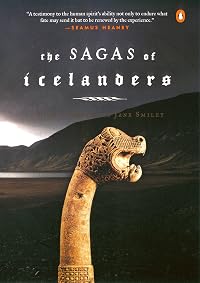
The Sagas of Icelanders
by Örnólfur Thorsson (Editor)
On This Page
Description
Presents a collection of Viking "sagas" to commemorate the adventures of the people who first settled Iceland, and then explored Greenland and North America.Tags
Recommendations




Member Recommendations
Member Reviews
This book was a monster. Not including the index and so on, 724 pages. The introduction/preface/whatever section alone was 60-odd pages. Woof.
Sagas are very different from a lot of other Olde Timey literature (and I’ve read my fair share) because it’s not like the Iliad or King Arthur or anything like that: they’re not about semi-divine heroes and kings and larger-than-life characters. Yeah there are some kings, but they’re mostly supporting cast. Mostly we hear about farmers who’ve done well for themselves. Much more relatable people than Achilles or Lancelot. And a lot of the action springs from simple, everyday misunderstandings. In that way the sagas are a lot closer to home than other epics could ever be. However… show more these everyday people do have a very different attitude toward casual murder. i.e. “Olvir drank too much ale at the feast; this made Egil angry so he took his sword and stabbed him in the belly until it came out his back. But no one liked Olvir much anyway.” Stuff like that. And believe me, that paraphrasing is not as far off as you may think. You have to remember this is a people whose idea of a fun summer vacation was to sail to other countries, burn things, steal things, and kill anyone who tried to stop them.
Some of it is mundane, “why did they bother writing this down?” stuff, but in the midst of the intertangled webs of kinship and allegiances and blood-feuds of people named Thordis, Thorbjorn, Thorstein, Thorkel, and so forth (Thor was a popular god; ‘Thor’ becomes a popular name prefix – how many Marys and Marias are there? And isn’t Mohammed the most popular name on earth?), which can be tough to keep straight, there are many humorous gems. There’s a bit where this guy is attacked by “two brothers who were both named Ulf.” WHAT?!?! “Hi! I’m Ulf, and this is my brother, Ulf.”
Some of these folks are quite well traveled. There’s a guy named Bolli who goes all the way to Constantinople and gets work burning things and killing things on behalf of the emperor (It’s ok if you do it for a politician). And naturally I was interested to read the accounts of the first trips to the Americas and meeting the ‘skraelings’ (what they called the Native Americans). Everyone knows Leif Eirikson, but his sister Freydis? She was a bit of a maniac. But a badass maniac – a fight went down and she was being pursued by a group of natives so she took her shirt off and started waving a sword around. The Native Americans decided to leave her alone. She also started some trouble between the two factions of her own expedition and, when none of her men would kill the five women that were in the other faction, she grabbed an axe and took them all out herself.
Another thing that I found surprising was how structured and detailed their legal code was. It’s tempting to think of them as a bunch of rowdy Vikings who kinda just did whatever they felt like, but no. They brought suits and accusations, had courts, assemblies, sentences and fines, the whole deal. To be totally honest, though, most of their legal proceedings centered around when it was acceptable to kill someone and who you had to pay off afterwards. Frankly I’m kind of amazed anyone’s been left standing. An interesting cultural insight all around. show less
Sagas are very different from a lot of other Olde Timey literature (and I’ve read my fair share) because it’s not like the Iliad or King Arthur or anything like that: they’re not about semi-divine heroes and kings and larger-than-life characters. Yeah there are some kings, but they’re mostly supporting cast. Mostly we hear about farmers who’ve done well for themselves. Much more relatable people than Achilles or Lancelot. And a lot of the action springs from simple, everyday misunderstandings. In that way the sagas are a lot closer to home than other epics could ever be. However… show more these everyday people do have a very different attitude toward casual murder. i.e. “Olvir drank too much ale at the feast; this made Egil angry so he took his sword and stabbed him in the belly until it came out his back. But no one liked Olvir much anyway.” Stuff like that. And believe me, that paraphrasing is not as far off as you may think. You have to remember this is a people whose idea of a fun summer vacation was to sail to other countries, burn things, steal things, and kill anyone who tried to stop them.
Some of it is mundane, “why did they bother writing this down?” stuff, but in the midst of the intertangled webs of kinship and allegiances and blood-feuds of people named Thordis, Thorbjorn, Thorstein, Thorkel, and so forth (Thor was a popular god; ‘Thor’ becomes a popular name prefix – how many Marys and Marias are there? And isn’t Mohammed the most popular name on earth?), which can be tough to keep straight, there are many humorous gems. There’s a bit where this guy is attacked by “two brothers who were both named Ulf.” WHAT?!?! “Hi! I’m Ulf, and this is my brother, Ulf.”
Some of these folks are quite well traveled. There’s a guy named Bolli who goes all the way to Constantinople and gets work burning things and killing things on behalf of the emperor (It’s ok if you do it for a politician). And naturally I was interested to read the accounts of the first trips to the Americas and meeting the ‘skraelings’ (what they called the Native Americans). Everyone knows Leif Eirikson, but his sister Freydis? She was a bit of a maniac. But a badass maniac – a fight went down and she was being pursued by a group of natives so she took her shirt off and started waving a sword around. The Native Americans decided to leave her alone. She also started some trouble between the two factions of her own expedition and, when none of her men would kill the five women that were in the other faction, she grabbed an axe and took them all out herself.
Another thing that I found surprising was how structured and detailed their legal code was. It’s tempting to think of them as a bunch of rowdy Vikings who kinda just did whatever they felt like, but no. They brought suits and accusations, had courts, assemblies, sentences and fines, the whole deal. To be totally honest, though, most of their legal proceedings centered around when it was acceptable to kill someone and who you had to pay off afterwards. Frankly I’m kind of amazed anyone’s been left standing. An interesting cultural insight all around. show less
My thoughts on the individual sagas as I read through:
Egil's saga: Egil is a massive jerk, but maybe that's part of the point. Highlights are his drunken 3-year-old shenanigans and vomiting on a guy who insulted him. I've read this before as a standalone saga.
Vatnsdal saga: This starts off with a far more conventionally heroic hero. Knowing that these sagas are quasi-historical however, I can't help but wonder whether the main family protecting their community from practitioners of "witchcraft" might be a justification for all the people they murdered in order to stay in power. Conspiracy!
Laxardal Saga: Supposedly the crown jewel of Icelandic literature. Slow to get going. Makes me think twice about crossing Icelandic women - you want show more to divorce her for wearing breeches? Be prepared for her to wear breeches as she comes to stab you in bed! The main action of the story is an unfortunate feud which develops between foster-brothers surrounding a marriage. We also get Snorri the Godi who I'm pretty sure features in other sagas - he's a bit of a wily one!
Bolli Bollasons Tale: Some extra content focusing on one of the main characters from the above saga. A short episode detailing Bolli's trip to the north and the trouble he got into.
...okay I didn't get around to reviewing every tale, but I did read them all. Great stuff, but I'm all saga'd out for a while now! show less
Egil's saga: Egil is a massive jerk, but maybe that's part of the point. Highlights are his drunken 3-year-old shenanigans and vomiting on a guy who insulted him. I've read this before as a standalone saga.
Vatnsdal saga: This starts off with a far more conventionally heroic hero. Knowing that these sagas are quasi-historical however, I can't help but wonder whether the main family protecting their community from practitioners of "witchcraft" might be a justification for all the people they murdered in order to stay in power. Conspiracy!
Laxardal Saga: Supposedly the crown jewel of Icelandic literature. Slow to get going. Makes me think twice about crossing Icelandic women - you want show more to divorce her for wearing breeches? Be prepared for her to wear breeches as she comes to stab you in bed! The main action of the story is an unfortunate feud which develops between foster-brothers surrounding a marriage. We also get Snorri the Godi who I'm pretty sure features in other sagas - he's a bit of a wily one!
Bolli Bollasons Tale: Some extra content focusing on one of the main characters from the above saga. A short episode detailing Bolli's trip to the north and the trouble he got into.
...okay I didn't get around to reviewing every tale, but I did read them all. Great stuff, but I'm all saga'd out for a while now! show less
Pretty much the first thing that struck me about these sagas is how immediately accessible they are – I have read medieval texts before (even if not very many), and usually (i.e., unless one happens to be a medievalist) it takes a lengthy introduction and extensive notes for any modern-day reader to even get the point of any tale from that period, not to mention any deeper significance or wider-ranging connotations. Not that one should expect a penetrating exploration of the conditio humana from those tales, but they are rousing good read, and I doubt there are many medieval texts out there of which one can say that.
The Penguin edition which I read, titled The Sagas of the Icelanders, does have a lengthy introduction that covers all show more kinds of aspects of Icelandic sagas: their historical context, the role they played in the society of their time, the poets and their audience, it even offers an analysis of various formal elements commonly found in those tales. It is all extremely helpful, and without a doubt did considerably enrich my reading experience of the sagas – but you could just as well simply skip all the introductory stuff and jump right into the tales themselves, and would likely enjoy them just as much as I did after dutifully having made my way through all the editorial material. This is no small feat, for texts that are almost a thousand years old to be able to grip a twenty-first century reader on such a basic, simply-enjoying-the-story level.
Which is most emphatically not to say, however, that those sagas read like contemporary texts. I feel a bit uncertain about the translations – with texts this old I am always somewhat worried that the translators might sacrifice precision to readability, creating a false sense of familiarity in a misguided attempt to make an ancient text accessible to a modern-day reader and producing what is effectively a streamlined version of the original. Not being particularly proficient in Old Norse, I really cannot say whether this is the case here, but my entirely subjective and completely uninformed impression was that the translators of the Penguin edition did a pretty good job at making the sagas immensely readable while still retaining their essential strangeness to a reader in the early twenty-first century.
The area where this strangeness made itself felt most keenly (for me at least) was neither in the matter-of-fact attitude towards supernatural occurrences that most of these tales show (with the extent of the supernatural element varying greatly, from the simple use of runes for healing to outright visions of ghosts and the battling against mages that would not be out of place in any Sword & Sorcery tale) nor in the sometimes weird customs of the Northlanders (I remember a particularly large WTF moment when someone attempted to kill his house guest because he had drank too much of his host’s ale, and nobody seemed to think that the least bit excessive), but in the way subjectivity is treated throughout all of this tale – or rather, is not treated at all, as subjectivity is something does not really happen here.
There is no interiority to the characters in these sagas, no inner space in which their thoughts and emotions could resound, no psychological motivations, in fact no psychology at all. The people the Icelandic sagas tell of are pure exteriority – we get to know their actions, but never their thoughts or feelings, everything is told from a strict outside perspective. Possibly it is that which gives events in the sagas their distinctive air of inevitability, of its protagonists marching down a prescribed road with unwavering fatalism – a fatalism, however, that is not all perceived as tragic, at least not by the protagonists of the tales; it might be very different for a listener / reader who in a way has to supply the emotions here, using the sagas as some kind of projection surface.
It would be a mistake, however, to think that the characters in these tales are flat or two-dimensional just because they are lacking an inner space – they emphatically are not; quite to the contrary, many of them are very memorable and multifaceted. They derive their plasticity from other sources, their personalities do not resonate in an inner, but an outside space, namely that of their interpersonal relationships. The Icelanders in these sagas appear to define themselves mostly by way of their relation to other people – their family, their clan, their neighbours. It is their actions and interactions that give them resonance, seeing themselves reflected in others rather than reflecting on themselves like a more contemporary subjectivity would.
It is easy to see how for a subject that defines itself by how it relates and appears to other, fame would play an important role, and by extension how the sagas themselves would serve that purpose. Even with all the supernatural elements, the sagas at their core are historical writings, chronicles that serve the remembrance and propagation of the names of Iceland’s famous men. This also gives them a slighty metafictional slant, an underlying consciousness that the deeds reported are already destined to become part of a saga even as they unfolding.
This selection from Penguin is missing what seems to be considered as the best of the sagas, Njal’s Saga, but otherwise presents a very generous selection, containing among famous ones like Eigil’s Saga and the Vinland Sagas also some lesser-known ones and several short tales; all presented in texts that appear to be excellent translations from authoritative sources with an extensive introduction and the occasional footnote where it is necessary. The only issue I had was the weird placement of maps and genealogical tables right in the middle of text (rather than at paragraph breaks) but that is just a minor distraction from an overall very much recommended edition. show less
The Penguin edition which I read, titled The Sagas of the Icelanders, does have a lengthy introduction that covers all show more kinds of aspects of Icelandic sagas: their historical context, the role they played in the society of their time, the poets and their audience, it even offers an analysis of various formal elements commonly found in those tales. It is all extremely helpful, and without a doubt did considerably enrich my reading experience of the sagas – but you could just as well simply skip all the introductory stuff and jump right into the tales themselves, and would likely enjoy them just as much as I did after dutifully having made my way through all the editorial material. This is no small feat, for texts that are almost a thousand years old to be able to grip a twenty-first century reader on such a basic, simply-enjoying-the-story level.
Which is most emphatically not to say, however, that those sagas read like contemporary texts. I feel a bit uncertain about the translations – with texts this old I am always somewhat worried that the translators might sacrifice precision to readability, creating a false sense of familiarity in a misguided attempt to make an ancient text accessible to a modern-day reader and producing what is effectively a streamlined version of the original. Not being particularly proficient in Old Norse, I really cannot say whether this is the case here, but my entirely subjective and completely uninformed impression was that the translators of the Penguin edition did a pretty good job at making the sagas immensely readable while still retaining their essential strangeness to a reader in the early twenty-first century.
The area where this strangeness made itself felt most keenly (for me at least) was neither in the matter-of-fact attitude towards supernatural occurrences that most of these tales show (with the extent of the supernatural element varying greatly, from the simple use of runes for healing to outright visions of ghosts and the battling against mages that would not be out of place in any Sword & Sorcery tale) nor in the sometimes weird customs of the Northlanders (I remember a particularly large WTF moment when someone attempted to kill his house guest because he had drank too much of his host’s ale, and nobody seemed to think that the least bit excessive), but in the way subjectivity is treated throughout all of this tale – or rather, is not treated at all, as subjectivity is something does not really happen here.
There is no interiority to the characters in these sagas, no inner space in which their thoughts and emotions could resound, no psychological motivations, in fact no psychology at all. The people the Icelandic sagas tell of are pure exteriority – we get to know their actions, but never their thoughts or feelings, everything is told from a strict outside perspective. Possibly it is that which gives events in the sagas their distinctive air of inevitability, of its protagonists marching down a prescribed road with unwavering fatalism – a fatalism, however, that is not all perceived as tragic, at least not by the protagonists of the tales; it might be very different for a listener / reader who in a way has to supply the emotions here, using the sagas as some kind of projection surface.
It would be a mistake, however, to think that the characters in these tales are flat or two-dimensional just because they are lacking an inner space – they emphatically are not; quite to the contrary, many of them are very memorable and multifaceted. They derive their plasticity from other sources, their personalities do not resonate in an inner, but an outside space, namely that of their interpersonal relationships. The Icelanders in these sagas appear to define themselves mostly by way of their relation to other people – their family, their clan, their neighbours. It is their actions and interactions that give them resonance, seeing themselves reflected in others rather than reflecting on themselves like a more contemporary subjectivity would.
It is easy to see how for a subject that defines itself by how it relates and appears to other, fame would play an important role, and by extension how the sagas themselves would serve that purpose. Even with all the supernatural elements, the sagas at their core are historical writings, chronicles that serve the remembrance and propagation of the names of Iceland’s famous men. This also gives them a slighty metafictional slant, an underlying consciousness that the deeds reported are already destined to become part of a saga even as they unfolding.
This selection from Penguin is missing what seems to be considered as the best of the sagas, Njal’s Saga, but otherwise presents a very generous selection, containing among famous ones like Eigil’s Saga and the Vinland Sagas also some lesser-known ones and several short tales; all presented in texts that appear to be excellent translations from authoritative sources with an extensive introduction and the occasional footnote where it is necessary. The only issue I had was the weird placement of maps and genealogical tables right in the middle of text (rather than at paragraph breaks) but that is just a minor distraction from an overall very much recommended edition. show less
The Sagas of Icelanders is an expansive collection of Icelandic family sagas and stories. Most of them were written from the 13th and 14th century. Iceland and Greenland were settled a few centuries earlier and the sagas cover the stories of that settlement. With all the interest in Vikings and the success of the TV series, it was fun to go back to some of the original stories of the real Viking adventures.
There are several sagas. Their society is very different from the feudal society of the rest of Europe. It is more egalitarian. Without kings, most of their government takes place at the Althings when people gather to make decisions and settle grievances. There are legal battles, confiscation courts and outlawry. Honor plays a big show more role, requiring revenge sometimes even when folks would rather not bother.
The women have more agency there than in the rest of Europe as well. They are consulted before marriage and able to reject suitors they do not like. They own property and even, occasionally, lead their own expeditions and captain their own ships. Perhaps because their husbands may be gone for a year or more on trading voyages, they gained power from the need to manage and safeguard their family estates and farms.
With all the patronymic, it can be confusing to keep track of who is who, except there are all the wonderful nicknames. I would love to know how Filth-Eyjolf and Eystein Fart got their names. There is Alf the Wealthy, Asbjorn the Fleshy, Asgeir Audunarson Scatter-brain, Atli the Squinter, Ketil Flat-Nose and so many more.
Most of the stories are about this, that, or the other person getting in a snit, killing someone, then getting killed in return, though some are pretty clever at escaping. Ref the Sly even built a cabin with walls filled with water piped from a stream to automatically put out fires by pulling shims to open the flow, a sprinkler system created around 1050.
I loved The Sagas of Icelanders. It’s a huge book of more than 750 pages so I read it over many weeks a little bit at a time. This is easy because even the longest sagas are broken up into short stories of a page or two.
I love the matter of fact writing and the quick, naturalistic characterization of the people. This person was a scold, that one was lazy, this one thought too highly of himself. They just said it. See how easily and plainly this situation is set up.
“There was a man named Thorbjorn who was rich, overbearing, a great fighter and a trouble-maker. He had lived in every quarter of the country, but the chieftains and the public had expelled him from each district in turn because of his unfairness and his manslaughters. He had not paid compensation for any man he had killed. His wife was named Rannveig; she was stupid and domineering. It was generally felt that Thorbjorn would have committed fewer outrages if she had not driven him on. Now Thorbjorn bought land at Saudafell mountain. Many of those who knew his reputation beforehand were apprehensive about his coming.”
With such plain narratives filled with action, The Sagas of Icelanders is full of adventures and heroics. It also includes the sagas of Eirek the Red and Leif Eireksson who settled, for a time, in Vinland on the coast of Canada. While these are the sagas of the people of Iceland and Greenland, they travel to Sweden, Norway, Ireland, England, Denmark, Russia, and Rome and even Constantinople, traveling all around Europe trading and raiding.
★★★★★
http://tonstantweaderreviews.wordpress.com/2016/11/05/the-sagas-of-icelanders-ed... show less
There are several sagas. Their society is very different from the feudal society of the rest of Europe. It is more egalitarian. Without kings, most of their government takes place at the Althings when people gather to make decisions and settle grievances. There are legal battles, confiscation courts and outlawry. Honor plays a big show more role, requiring revenge sometimes even when folks would rather not bother.
The women have more agency there than in the rest of Europe as well. They are consulted before marriage and able to reject suitors they do not like. They own property and even, occasionally, lead their own expeditions and captain their own ships. Perhaps because their husbands may be gone for a year or more on trading voyages, they gained power from the need to manage and safeguard their family estates and farms.
With all the patronymic, it can be confusing to keep track of who is who, except there are all the wonderful nicknames. I would love to know how Filth-Eyjolf and Eystein Fart got their names. There is Alf the Wealthy, Asbjorn the Fleshy, Asgeir Audunarson Scatter-brain, Atli the Squinter, Ketil Flat-Nose and so many more.
Most of the stories are about this, that, or the other person getting in a snit, killing someone, then getting killed in return, though some are pretty clever at escaping. Ref the Sly even built a cabin with walls filled with water piped from a stream to automatically put out fires by pulling shims to open the flow, a sprinkler system created around 1050.
I loved The Sagas of Icelanders. It’s a huge book of more than 750 pages so I read it over many weeks a little bit at a time. This is easy because even the longest sagas are broken up into short stories of a page or two.
I love the matter of fact writing and the quick, naturalistic characterization of the people. This person was a scold, that one was lazy, this one thought too highly of himself. They just said it. See how easily and plainly this situation is set up.
“There was a man named Thorbjorn who was rich, overbearing, a great fighter and a trouble-maker. He had lived in every quarter of the country, but the chieftains and the public had expelled him from each district in turn because of his unfairness and his manslaughters. He had not paid compensation for any man he had killed. His wife was named Rannveig; she was stupid and domineering. It was generally felt that Thorbjorn would have committed fewer outrages if she had not driven him on. Now Thorbjorn bought land at Saudafell mountain. Many of those who knew his reputation beforehand were apprehensive about his coming.”
With such plain narratives filled with action, The Sagas of Icelanders is full of adventures and heroics. It also includes the sagas of Eirek the Red and Leif Eireksson who settled, for a time, in Vinland on the coast of Canada. While these are the sagas of the people of Iceland and Greenland, they travel to Sweden, Norway, Ireland, England, Denmark, Russia, and Rome and even Constantinople, traveling all around Europe trading and raiding.
★★★★★
http://tonstantweaderreviews.wordpress.com/2016/11/05/the-sagas-of-icelanders-ed... show less
The Penguin Classics Deluxe Edition collection of The Sagas of the Icelanders is imposing both for its physical dimensions (hint: doorstoppish) and its content. These prose stories, written down sometime around the 14th century or so based on happenings in the 10th century, are a mix of actual things that happened and (hopefully) apocryphal bloodbaths that surpass any horror movie I've seen in terms of very messy body count.
The world described herein is fantastical: Berserkers shape-shift and transform into invincible killing machines; longboats full of furious men ply the grey waves, striking fear at every fjord and islet in Scandinavia; men kill each other over bad poetry. And the names are themselves riveting: Finn the Squinter show more fathered Eyvind the Plagiarist. Norweigians and Icelanders came in every shape, size and fiendish temperament: Atli the Slender, Bard the Peevish, Hallbjorn Half-troll, Berg the Bold, Asbjorn the Fleshy, Olvir Hump, Thorvald the Overbearing. Some characters have names that feel like an entire story: Halfdan Eysteinsson the Mild and Meal-stingy, Hallfred Ottarsson the Troublesome Poet. In fact, Hallfred does have his own entire saga.
Unlike other oral tradition, which gives us the beautiful pacing of Homeric epics, for example, the Icelandic sagas are prose narrative. What sweeps one up here is not the style, which is sort of blunt and chronological, but the landscape, the bravado and the relative insanity of everyone involved.
Now we've talked about the charming parts. The rest? In a word: Yikes. Egil's Saga, one of the most foundational of the set, was nearly 200 pages of gore and ferocity. Death was the default outcome of encounters. Oh, yes, and a stunning amount of drinking. In one typical scene everyone got way too drunk, and this is how things turned out (fair warning: this passage is graphic):
The next day, Egil was still annoyed with Armod and so 'gouged out one of his eyes with his finger, leaving it hanging on one cheek.' This led to a dispute that was quite drawn out and got several dozen folks killed.
Gak. This stuff is not for the easily-nauseated. But it is a riveting insight into a strange and intruiging culture. show less
The world described herein is fantastical: Berserkers shape-shift and transform into invincible killing machines; longboats full of furious men ply the grey waves, striking fear at every fjord and islet in Scandinavia; men kill each other over bad poetry. And the names are themselves riveting: Finn the Squinter show more fathered Eyvind the Plagiarist. Norweigians and Icelanders came in every shape, size and fiendish temperament: Atli the Slender, Bard the Peevish, Hallbjorn Half-troll, Berg the Bold, Asbjorn the Fleshy, Olvir Hump, Thorvald the Overbearing. Some characters have names that feel like an entire story: Halfdan Eysteinsson the Mild and Meal-stingy, Hallfred Ottarsson the Troublesome Poet. In fact, Hallfred does have his own entire saga.
Unlike other oral tradition, which gives us the beautiful pacing of Homeric epics, for example, the Icelandic sagas are prose narrative. What sweeps one up here is not the style, which is sort of blunt and chronological, but the landscape, the bravado and the relative insanity of everyone involved.
Now we've talked about the charming parts. The rest? In a word: Yikes. Egil's Saga, one of the most foundational of the set, was nearly 200 pages of gore and ferocity. Death was the default outcome of encounters. Oh, yes, and a stunning amount of drinking. In one typical scene everyone got way too drunk, and this is how things turned out (fair warning: this passage is graphic):
Egil started to feel that he would not be able to go on like this. He stood up and walked across the floor to where Armod was sitting, seized him by the shoulders and thrust him up against a wall-post. Then Egil spewed a torrent of vomit that gushed all over Armod's face, filling his eyes and nostrils and mouth and pouring down his beard and chest. Armod was close to choking, and when he managed to let out his breath, a jet of vomit gushed out with it.
The next day, Egil was still annoyed with Armod and so 'gouged out one of his eyes with his finger, leaving it hanging on one cheek.' This led to a dispute that was quite drawn out and got several dozen folks killed.
Gak. This stuff is not for the easily-nauseated. But it is a riveting insight into a strange and intruiging culture. show less
I LOVE the Icelanders sagas. For a long time I was drawn to the attractively-bound paperback tome in Powell's, but I kept arguing with myself: would I actually read it? Did I really need a huge book of medieval Icelandic literature taking up shelf space? Wouldn't it just sit around on my to-be-read shelf and gather dust? Finally, I caved and bought it, and immediately devoured the entire thing in a voracious style usually reserved for Nancy Drew mysteries.
Most of the medieval or ancient literature I've read features very large-scale action, adventure of epic proportions. You've got Achilles and Odysseus enlisting the gods to help them battle their larger-than-life adversaries, Beowulf trudging out of the blood-spattered hall to slay show more great monsters and their mothers, or impossibly pure-hearted knights wooing sickeningly pure maidens. The Icelandic sagas have adventure too, and a good deal of trudging, and a fair amount of bloodshed, but there's something intriguingly domestic about them as well. They are about settlers to a forbidding new place, hardy men and women who claim homesteads and raise families in a climate even harsher than the one they left behind in Norway. Although much of the stories are devoted to feuds between clans, which usually end up being settled by multiple murders, just as much space is taken up with the everyday lives of families, how hard-as-nails farmers gradually increased their wealth and made lives for themselves, showing proper hospitality with presents and feasts when neighbors or family members came to visit, how these farmers' equally tough wives bore them children and how these children gradually came of age as Icelanders. I love the contrast between the outlandish scenes of bloody battle, in which men with berserker blood shift into fierce monster-animals, and the proto-novelistic tales of everyday life. The Sagas portray the birth of a nation as the merging of these two contrasting elements, which is a profound view of history that seems surprisingly contemporary.
The characters, in some cases, are more dynamic than any other medieval literature I've read, starting out as Norwegians who claim they would never emigrate to "that god-forsaken fishing hole," but ending up as Icelanders with lives and roots on the island. Whatever they are, it is never near-divine heroes or rose-scented virgins, just strong, flawed people doing their best given the circumstances. Gender roles are also surprising at times, some of the fiercest and most warlike characters being women. In addition, whether it's because of my Norwegian ancestry or my kinship to the novelistic form and the history of the everyday, these stories seemed oddly familiar to me, despite the gap of 800 years and as many miles separating me from their composition.
And, of course, there is the fact that nearly all the men in these stories have "Thor" somewhere in their names, which should win points for them if nothing else does. Who wouldn't want to read about Thorstein's travels with his brother Thorgrim and son-in-laws Thorarin and Thorkel? I ask you. show less
Most of the medieval or ancient literature I've read features very large-scale action, adventure of epic proportions. You've got Achilles and Odysseus enlisting the gods to help them battle their larger-than-life adversaries, Beowulf trudging out of the blood-spattered hall to slay show more great monsters and their mothers, or impossibly pure-hearted knights wooing sickeningly pure maidens. The Icelandic sagas have adventure too, and a good deal of trudging, and a fair amount of bloodshed, but there's something intriguingly domestic about them as well. They are about settlers to a forbidding new place, hardy men and women who claim homesteads and raise families in a climate even harsher than the one they left behind in Norway. Although much of the stories are devoted to feuds between clans, which usually end up being settled by multiple murders, just as much space is taken up with the everyday lives of families, how hard-as-nails farmers gradually increased their wealth and made lives for themselves, showing proper hospitality with presents and feasts when neighbors or family members came to visit, how these farmers' equally tough wives bore them children and how these children gradually came of age as Icelanders. I love the contrast between the outlandish scenes of bloody battle, in which men with berserker blood shift into fierce monster-animals, and the proto-novelistic tales of everyday life. The Sagas portray the birth of a nation as the merging of these two contrasting elements, which is a profound view of history that seems surprisingly contemporary.
The characters, in some cases, are more dynamic than any other medieval literature I've read, starting out as Norwegians who claim they would never emigrate to "that god-forsaken fishing hole," but ending up as Icelanders with lives and roots on the island. Whatever they are, it is never near-divine heroes or rose-scented virgins, just strong, flawed people doing their best given the circumstances. Gender roles are also surprising at times, some of the fiercest and most warlike characters being women. In addition, whether it's because of my Norwegian ancestry or my kinship to the novelistic form and the history of the everyday, these stories seemed oddly familiar to me, despite the gap of 800 years and as many miles separating me from their composition.
And, of course, there is the fact that nearly all the men in these stories have "Thor" somewhere in their names, which should win points for them if nothing else does. Who wouldn't want to read about Thorstein's travels with his brother Thorgrim and son-in-laws Thorarin and Thorkel? I ask you. show less
This review is based on a partial reading of the first saga, Egil's Saga, and an overall assessment of the book's presentation and formatting. It was reviewed for the Go Review That Book! group.
****
The sagas of Icelanders may not be that well known to North American audiences, or at least not on the same level as the more general Norse myths. This weighty collection from Penguin Classics contains several of the most important ones, as well as introductions and explanatory material about the translation. Each "verse" of a saga is numbered, and the verses are somewhat short, making it easy to read a few at a time. This is a book that requires concentration and sustained reading in small doses over a long period. It is also important to show more keep reading it regularly; if you drop the book for a while, it may be difficult to keep track of who everybody is. The book itself is lovely, a handsome paperback with deckle edging, and will certainly look impressive on your shelves until the right moment is found to start reading it. show less
****
The sagas of Icelanders may not be that well known to North American audiences, or at least not on the same level as the more general Norse myths. This weighty collection from Penguin Classics contains several of the most important ones, as well as introductions and explanatory material about the translation. Each "verse" of a saga is numbered, and the verses are somewhat short, making it easy to read a few at a time. This is a book that requires concentration and sustained reading in small doses over a long period. It is also important to show more keep reading it regularly; if you drop the book for a while, it may be difficult to keep track of who everybody is. The book itself is lovely, a handsome paperback with deckle edging, and will certainly look impressive on your shelves until the right moment is found to start reading it. show less
Members
- Recently Added By
Lists

Epic Fiction
42 works; 12 members

Five star books
1,767 works; 110 members

Mustich's 1000 Books to Read Before You Die: A Life Changing List
1,001 works; 20 members

In Our Time books
4,934 works; 2 members

Books in the Bibliography of Contested Continent by Peter Mancall
495 works; 1 member
Author Information

All Editions
Some Editions
Awards and Honors
Notable Lists
Series
Belongs to Publisher Series
Work Relationships
Contains
Is an abridged version of
Common Knowledge
- Canonical title
- The Sagas of Icelanders
- Original publication date
- ca. 1200-1400; 1997 (The Complete Sagas of Icelanders, Volumes I-V) (The Complete Sagas of Icelanders, Volumes I-V); 2000 (this edition) (this edition)
- People/Characters
- Egill Skallagrímsson; Gisli Sursson; Gunnlaug Serpent-Tongue; Ref the Sly; Eirik the Red; Thorstein Staff-struck (show all 27); Halldor Snorrason; Thorstein Shiver; Arinbjorn Thorisson; Asgerd Bjarnardottir; Athelstan; Bolli Thorleiksson; Eirik Blood-Ax; Gellir Thorkelsson; Gest Oddleifsson; Gudrun Osvifsdottir; Gunnhild Ozurardottir; Hakon Haraldsson; Harald Fair-Hair; Harald Sigurdarson; Illugi Hallkelsson the Black; Leif Eirksson; Olaf Hoskuldsson Peacock; Osvif Helgason; Skallagrim Kvedulfsson; Snorri Thorgrimsson; Thorstein Egilsson
- Important places
- Iceland; Scandinavia; North America
- Important events
- Viking Age
- First words
- The prose literature of medieval Iceland is a great world treasure – elaborate, various, strange, profound, and as eternally current as any of the other great literary treasures – the Homeric epics, Dante's Divine Come... (show all)dy, the works of William Shakespeare or of any modern writer you could name. (Preface by Jane Smiley)
The later Middle Ages in Europe were a time of striking innovation in literature. (Introduction by Robert Kellogg)
Egil's Saga is acknowledged as one of the masterpieces of the genre, a magnificently wrought portrait of poet, warrior and farmer Egil Skallagrimsson, loosely contained within the framework of the family saga, but with an unu... (show all)sual twist - the feud that Egil and his forebears wage is with the kings of Norway. - Last words
- (Click to show. Warning: May contain spoilers.)The reader may enter the literary world of medieval Iceland with ease and pleasure, and the literary works of the nameless saga writers may take their rightful place beside those of Homer, Shakespeare, Socrates, and those few others who live at the very heart of human literary endeavor. (Preface by Jane Smiley)
(Click to show. Warning: May contain spoilers.)It is a world beyond Greenland, Finnmark or the interior of Iceland, a brave new world, with in the reach of Norse seamanship, but beyond the grasp of its civilization. (Introduction, Robert Kellogg) - Blurbers
- Hughes, Ted; Heaney, Seamus; Kundera, Milan
- Canonical DDC/MDS
- 839.63008
- Canonical LCC
- PT7262.E5 S34
- Disambiguation notice
- "The sagas and tales in this book are reprinted from the Complete sagas of Icelanders I-V, published 1997 by Leifur Eiríksson Publishing, Iceland, with minor alterations"--P. [lviii].
Classifications
- Genre
- Fiction and Literature
- DDC/MDS
- 839.63008 — Literature & rhetoric German & related literatures Other Germanic literatures Old Norse, Old Icelandic, Icelandic, Faroese literatures Old Norse fiction
- LCC
- PT7262 .E5 .S34 — Language and Literature German, Dutch and Scandinavian literatures Old Norse literature: Old Icelandic and Old Norwegian Collections Prose Sagas
- BISAC
Statistics
- Members
- 2,841
- Popularity
- 6,410
- Reviews
- 20
- Rating
- (4.25)
- Languages
- English
- Media
- Paper, Ebook
- ISBNs
- 8
- ASINs
- 15