On This Page
Description
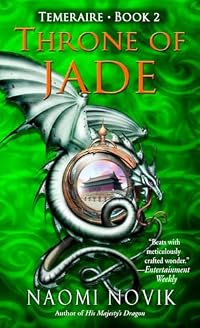
Captain Will Laurence and his noble dragon Temeraire battle against Bonaparte's invading forces. When China discovers that their rare gift, meant for Napoleon, is now in the hands of the British forces, they demand the return of the dragon.Tags
Recommendations




























Member Reviews
Once again I find myself ambivalent about cheering for the dastardly British military, but in this volume dragon and rider are obliged to take a slow boat to China as a result of the diplomatic contretemps caused by Temeraire's capture and subsequent indoctrination into the British Imperial war machine. The voyage is long and rather tense, but the eventual arrival in China is a revelation, and I quite fancy the idea of Temeraire going back and sparking a revolution amongst the dragons of Britain, I can't imagine that will go down well at all.
Did I enjoy Throne of Jade as much as its predecessor, Temeraire? If anything, I enjoyed it more. I loved it so much that yesterday I made my ever patient boyfriend drive me to a city nearly two hours away so I could purchase the next two books for twice the price than if I got them from Book Depository, because I want to read them right now, not in 7-15 days!
Reviews of those two will be forthcoming, I'm sure, but for now let's talk Throne of Jade. (Probably you should read Temeraire before you read this). The plot is basically this: China wants Temeraire back, preferably sans Laurence. So it's off to China with Laurence and Temeraire, where they hope to convince the emperor to let Britain keep Temeraire.
Let me first point out a two show more ways in which I think this book could have easily faltered. First, the depiction of the Chinese and their culture was of course going to be tricky, especially considering that our POV man, Laurence, it not favourably disposed to the Chinese AT ALL. (The are trying to remove him from Temeraire's company, after all). But Novik does a good job of contrasting China to Britain and highlighting how strange everything is to the Western characters without ever sinking into, 'gosh, look how silly these Chinese people are!' Some of the Chinese characters are portrayed negatively, but its never because they are Chinese. The insertion of Dragons into Chinese culture also felt very authentic, and far more natural than the British dragons in book one.
The second trap that I am glad Novik avoided is a common trope in books like this. Almost every character in this book is devoted to separating Laurence and Temeraire. How easy it would have been, and how predictable, to have a miss-communication or misunderstanding that does indeed separate the two, until they triumphantly overcome the obstacle. Yawn yawn yawn. The relationship between Temeraire and Laurence in this book is deeper than that trope (which I hate, without exception). There is a moment where it could have come into play; Temeraire is inexplicably absent when Laurence desperately needs him. But, but, wait for it, Laurence gives Temeraire a chance to explain and, oh my god, get this, Temeraire explains! Wow!
It was very gratifying to see Laurence and Temeraire's relationship develop. In the first book there was definitely a feeling that Temeraire was a child and Laurence an adult, but as Throne of Jade plays out we see the two slowly become equals. Temeraire starts to establish who he is outside of Laurence and, instead of seeing this as some kind of abandonment, Laurence is supportive. What I'm saying is that one of the most realistic and healthy adult relationships I have ever encountered in fiction is here, between a man and his dragon.
The plot, while I may have made it sound simple, is very exciting. Storms, sea serpents and murder attempts abound, and unlike in the previous book there is quite a few character deaths. There was also a fight between two dragons, which played out very differently to the multi dragon battles we’ve already seen and was a thrill to read.
Ultimately I felt that this book nimbly sidestepped the potential pitfalls that faced it, and has left even more eager to continue reading the adventures of Laurence and Temeraire. show less
Reviews of those two will be forthcoming, I'm sure, but for now let's talk Throne of Jade. (Probably you should read Temeraire before you read this). The plot is basically this: China wants Temeraire back, preferably sans Laurence. So it's off to China with Laurence and Temeraire, where they hope to convince the emperor to let Britain keep Temeraire.
Let me first point out a two show more ways in which I think this book could have easily faltered. First, the depiction of the Chinese and their culture was of course going to be tricky, especially considering that our POV man, Laurence, it not favourably disposed to the Chinese AT ALL. (The are trying to remove him from Temeraire's company, after all). But Novik does a good job of contrasting China to Britain and highlighting how strange everything is to the Western characters without ever sinking into, 'gosh, look how silly these Chinese people are!' Some of the Chinese characters are portrayed negatively, but its never because they are Chinese. The insertion of Dragons into Chinese culture also felt very authentic, and far more natural than the British dragons in book one.
The second trap that I am glad Novik avoided is a common trope in books like this. Almost every character in this book is devoted to separating Laurence and Temeraire. How easy it would have been, and how predictable, to have a miss-communication or misunderstanding that does indeed separate the two, until they triumphantly overcome the obstacle. Yawn yawn yawn. The relationship between Temeraire and Laurence in this book is deeper than that trope (which I hate, without exception). There is a moment where it could have come into play; Temeraire is inexplicably absent when Laurence desperately needs him. But, but, wait for it, Laurence gives Temeraire a chance to explain and, oh my god, get this, Temeraire explains! Wow!
It was very gratifying to see Laurence and Temeraire's relationship develop. In the first book there was definitely a feeling that Temeraire was a child and Laurence an adult, but as Throne of Jade plays out we see the two slowly become equals. Temeraire starts to establish who he is outside of Laurence and, instead of seeing this as some kind of abandonment, Laurence is supportive. What I'm saying is that one of the most realistic and healthy adult relationships I have ever encountered in fiction is here, between a man and his dragon.
The plot, while I may have made it sound simple, is very exciting. Storms, sea serpents and murder attempts abound, and unlike in the previous book there is quite a few character deaths. There was also a fight between two dragons, which played out very differently to the multi dragon battles we’ve already seen and was a thrill to read.
Ultimately I felt that this book nimbly sidestepped the potential pitfalls that faced it, and has left even more eager to continue reading the adventures of Laurence and Temeraire. show less
After we have gotten to know Captain Laurence and his young dragon Temeraire in the first book, we now get to go on a long and eventful journey with them. While they had only been around Britain before, this book introduces the powerful nation of China into this alternate historical setting and brings up a lot of new topics in the process.
I really enjoyed going on this journey by boat rather than by dragon, as it would be to dangerous to fly across Africa, as it gave us some more insight on the navy and command structures on this long and tedious trip. And it also brought up different cultures, as our characters had to learn to get along with the Chinese embassy, as well as difficult topics such as the treatment of other humans (slaves) show more and the sentient dragons in the other parts of the world. I was glad to see both Laurence and Temeraire think deeply on these issues, with the former having to reevaluate some of his learned conceptions and the latter just being a curious teenager dragon.
Again, the writing style made the time period come to life in my head and I immensely enjoyed reading this book. Cannot wait to see where the future takes these characters that have found a place in my heart already! show less
I really enjoyed going on this journey by boat rather than by dragon, as it would be to dangerous to fly across Africa, as it gave us some more insight on the navy and command structures on this long and tedious trip. And it also brought up different cultures, as our characters had to learn to get along with the Chinese embassy, as well as difficult topics such as the treatment of other humans (slaves) show more and the sentient dragons in the other parts of the world. I was glad to see both Laurence and Temeraire think deeply on these issues, with the former having to reevaluate some of his learned conceptions and the latter just being a curious teenager dragon.
Again, the writing style made the time period come to life in my head and I immensely enjoyed reading this book. Cannot wait to see where the future takes these characters that have found a place in my heart already! show less
A Chinese envoy arrives in England to demand that Temeraire (who, you may recall, was revealed to be a super-special Chinese Celestial breed) be returned to his rightful country. They claim that the British are treating him poorly by making him work, and that he is too special to be ridden by anyone but royalty. Skip ahead a few dozen pages and Temeraire and Laurence are, of course, on a ship bound for the Orient, and seeing much of the world along the way.
Exactly as delightful as I expected it to be, plus the addition of interesting commentaries on socialism, imperialism, and slavery. Temeraire provides a unique perspective on early 1800s politics, since he a) is seeing the world with unbiased eyes, and b) can say whatever the hell he show more wants without worrying about his position in society. I also enjoyed learning about the other dragons in different parts of the world. Perfection, really. I hope I get to the next book sooner. show less
Exactly as delightful as I expected it to be, plus the addition of interesting commentaries on socialism, imperialism, and slavery. Temeraire provides a unique perspective on early 1800s politics, since he a) is seeing the world with unbiased eyes, and b) can say whatever the hell he show more wants without worrying about his position in society. I also enjoyed learning about the other dragons in different parts of the world. Perfection, really. I hope I get to the next book sooner. show less
Well, I'm definitely hooked now. I loved the first book in the series, and this one was just as much a delight. I was halfway through, left for a trip and realized I'd forgotten the book. I spent several hours trying to figure out whether I could possibly wait the few days until I got home to finish it, or whether I should just buy a new copy. It turned out I had a terrible time reading anything else, since I just wanted to finish this ... and when the train broke down and we had to wait for a couple hours for a new one to come get us, I gave in, ordered the Kindle version, and read it on my iPhone while I waited. Not quite the same, and not something I particularly enjoyed doing, but it got me out of a jam (and definitely distracted me show more from the long wait).
Novik's Temeraire and Will Laurence are such an absolutely fascinating pair of characters, I barely even notice that some of her others don't make much of an impression. The diplomatic machinations outlined here, as Laurence and Temeraire travel to China, are fantastic, and I really enjoyed the way Novik brings the Chinese dragons to the forefront of the action, and contrasts the way dragons are seen and utliized by different human cultures.
It's a good thing the next three volumes are waiting for me when I get home ... if I can wait that long. show less
Novik's Temeraire and Will Laurence are such an absolutely fascinating pair of characters, I barely even notice that some of her others don't make much of an impression. The diplomatic machinations outlined here, as Laurence and Temeraire travel to China, are fantastic, and I really enjoyed the way Novik brings the Chinese dragons to the forefront of the action, and contrasts the way dragons are seen and utliized by different human cultures.
It's a good thing the next three volumes are waiting for me when I get home ... if I can wait that long. show less
Summary: When the British seized Temeraire's egg from a French frigate, they had no way of knowing that he was a Chinese Celestial - an exceptionally rare breed of dragon that are normally only treated as companions for members of the Emperor's family - intended as a gift to Napoleon. The Chinese embassy is outraged that one of their royal dragons is being treated like a common soldier in the British aviator corps, and they demand his immediate return to China... with or without Laurence. Rather than make enemies of the powerful nation, the British Admiralty agrees, and Temeraire and Laurence unwillingly board a transport bound for China. Neither of them wants to be parted from the other, but the Chinese embassy is none too keen on the show more idea of keeping Laurence around, or on letting Temeraire out of their control. Together, they must find a way to stay together without sabotaging British foreign relations... but first they must survive the perils of the long sea voyage.
Review: While His Majesty's Dragon charmed the socks off of me, this one actually made me think. Still charming, but also thought-provoking... sometimes uncomfortably so, in fact. In His Majesty's Dragon, Novik's introducing us not only to her characters, but also to her world, and so we take on faith that things are the way she says they are, and if none of the characters give a second thought to the way dragons are treated, and the relationship between dragons and humans, then why should we? In Throne of Jade, however, Temeraire's growing up, and has reached the dragon equivalent of teenagerhood - particularly the part where he starts questioning the status quo. The reader gets the chance to grow with him, and as we get to see the Chinese system of dragon-human interactions, we also start to question what we'd been taught in the first book was normal and right. I actually got uncomfortable when I stopped to look at my assumptions from the first book - Why did I ever think this or that was okay? What does that say about me? - and that's a neat trick for an author to pull off. Full round of applause for Novik for that one.
The rest of the book is good as well - Novik manages to capture the style and the tone of period literature while somehow keeping it captivating and easy to read. I feel like there was more high-seas adventure - Battles with the French! Intrigue and spying! Treachery and plots! Sea serpents and fierce storms! - than in the previous book, which is never a bad thing (plus boys on boats = always good), although it did come at the cost of some of the interpersonal (inter-dragonal?) interaction that so charmed me the first time around. Still, this book went in some interesting new directions without sacrificing the key elements that make the series great, and I'm excited to see what happens in the next book. 4 out of 5 stars.
Recommendation: Historical fiction and fantasy lovers alike should all be reading this series. This one isn't *quite* as strong as its predecessor, but it's still an absorbing, entertaining, and increasingly thought-provoking read. show less
Review: While His Majesty's Dragon charmed the socks off of me, this one actually made me think. Still charming, but also thought-provoking... sometimes uncomfortably so, in fact. In His Majesty's Dragon, Novik's introducing us not only to her characters, but also to her world, and so we take on faith that things are the way she says they are, and if none of the characters give a second thought to the way dragons are treated, and the relationship between dragons and humans, then why should we? In Throne of Jade, however, Temeraire's growing up, and has reached the dragon equivalent of teenagerhood - particularly the part where he starts questioning the status quo. The reader gets the chance to grow with him, and as we get to see the Chinese system of dragon-human interactions, we also start to question what we'd been taught in the first book was normal and right. I actually got uncomfortable when I stopped to look at my assumptions from the first book - Why did I ever think this or that was okay? What does that say about me? - and that's a neat trick for an author to pull off. Full round of applause for Novik for that one.
The rest of the book is good as well - Novik manages to capture the style and the tone of period literature while somehow keeping it captivating and easy to read. I feel like there was more high-seas adventure - Battles with the French! Intrigue and spying! Treachery and plots! Sea serpents and fierce storms! - than in the previous book, which is never a bad thing (plus boys on boats = always good), although it did come at the cost of some of the interpersonal (inter-dragonal?) interaction that so charmed me the first time around. Still, this book went in some interesting new directions without sacrificing the key elements that make the series great, and I'm excited to see what happens in the next book. 4 out of 5 stars.
Recommendation: Historical fiction and fantasy lovers alike should all be reading this series. This one isn't *quite* as strong as its predecessor, but it's still an absorbing, entertaining, and increasingly thought-provoking read. show less
This second novel in the Temeraire series is a strong follow up to 'His Majesty's Dragon' and, in my opinion, equally enjoyable. Part of the joy here is in the new setting -- Temeraire and Laurence travel to China -- so while we do not have all of our old friends to connect with, that emotional absence is made up for by a sense of wonderful discovery as the reader learns of new dragon breeds and dragon-related species. We are also on a ship for a good portion of this book, which allows Novik to lay out more of that nautical knowledge along with vivid descriptions of harrowing storms and other ocean challenges.
Once again, I was impressed by the integration of dragons into this world. Novik follows that idea out to its far conclusion in show more China, where the novel showcases a truly integrated society and all of the logical accommodations that would follow. Nowhere does the novel fall back on "it's just magic" or "it just happens that way" -- in fact, were it not for the dragons, this would not be fantasy at all (yeah, it's funny to say that), since it presents the species and its connected ideas in a naturalistic way.
This is the best kind of escapism, in my opinion. While the novel is not going to win its author the Nobel, its imagination and heart can engage the reader in both the fun of the narrative and the political ideas that still resonate in the real world. In this installment, Temeraire discovers slavery and inequality as concepts with which he must reconcile his own experience; his naive perspective offers the reader a fresh reminder of historical circumstance as well as the importance of self-awareness. These deeper ideas, while not the point of the story, fill out the escape with depth and relevance, in addition to connecting even more strongly to the realistic historical tone. In other words, this is like beach reading with the brains left in.
If you are in the mood for adventure, derring-do, buckling of swashes, and/or tea in the garden with a very large dragon, this is the perfect series for you. Even if you aren't in the mood, read it anyway, because it will get you there. :) show less
Once again, I was impressed by the integration of dragons into this world. Novik follows that idea out to its far conclusion in show more China, where the novel showcases a truly integrated society and all of the logical accommodations that would follow. Nowhere does the novel fall back on "it's just magic" or "it just happens that way" -- in fact, were it not for the dragons, this would not be fantasy at all (yeah, it's funny to say that), since it presents the species and its connected ideas in a naturalistic way.
This is the best kind of escapism, in my opinion. While the novel is not going to win its author the Nobel, its imagination and heart can engage the reader in both the fun of the narrative and the political ideas that still resonate in the real world. In this installment, Temeraire discovers slavery and inequality as concepts with which he must reconcile his own experience; his naive perspective offers the reader a fresh reminder of historical circumstance as well as the importance of self-awareness. These deeper ideas, while not the point of the story, fill out the escape with depth and relevance, in addition to connecting even more strongly to the realistic historical tone. In other words, this is like beach reading with the brains left in.
If you are in the mood for adventure, derring-do, buckling of swashes, and/or tea in the garden with a very large dragon, this is the perfect series for you. Even if you aren't in the mood, read it anyway, because it will get you there. :) show less
Members
- Recently Added By
Lists

Best Fantasy Novels
821 works; 358 members

Best Historical Fiction
620 works; 257 members

Best Alternate History
111 works; 60 members

Female Author
1,235 works; 67 members
Speculative Fiction to Read
706 works; 32 members

Swashbucklers
29 works; 6 members

mom
729 works; 1 member

Books Read in 2018
4,360 works; 110 members

Books Read in 2021
5,361 works; 114 members

Books Read in 2012
815 works; 31 members

Books Read in 2024
4,623 works; 126 members

Diversity in Fantasy and Science Fiction
219 works; 31 members
Author Information

56+ Works 59,573 Members
Naomi Novik was born in New York on April 30, 1973. She received a Bachelor's degree in English literature at Brown University and a Master's degree in Computer Science from Columbia University. She participated in the design and development of the computer game Neverwinter Nights: Shadows of Undrentide. Her first novel, His Majesty's Dragon, was show more published in 2006 and was the start of the Temeraire series. She has won the John W. Campbell Award for Best New Writer, the Compton Crook Award for Best First Novel, and the Locus Award for Best First Novel. Her book, Uprooted, won the 2016 Nebula Award for Best Novel. (Bowker Author Biography) show less

Naomi Novik is a LibraryThing Author, an author who lists their personal library on LibraryThing.
Some Editions
Awards and Honors
Awards
Series

Work Relationships
Is contained in
Common Knowledge
- Canonical title
- Throne of Jade
- Original title
- Throne of Jade
- Original publication date
- 2006
- People/Characters
- William Laurence; Temeraire; Jane Roland; Yongxing; Liu Bao; Sun Kai (show all 8); Granby; Riley [Temeraire]
- Important places
- China; London, England, UK
- Important events
- Napoleonic Wars
- Dedication
- In memory of Chawa Nowik, in hopes that someday I'll be ready to write her book.
- First words
- The day was unseasonably warm for November, but in some misguided deference to the Chinese embassy, the fire in the Admiralty boardroom had been heaped excessively high, and Laurence was standing directly before it.
- Quotations
- "...and all for the sake of the Government. I am very tired of this Government, which I have never seen, and which is always insisting that I must do disagreeable things, and does no good to anybody."
- Last words
- (Click to show. Warning: May contain spoilers.)"My dear, if it will make you happy he shall make you a dozen," Laurence said, and leaned against him, full of gratitude despite his concerns, to calculate by the moon when the tide should turn again for England for home.
- Blurbers
- King, Stephen; Brooks, Terry; McCaffrey, Anne; Foster, Alan Dean
- Original language
- English
Classifications
Statistics
- Members
- 5,445
- Popularity
- 2,445
- Reviews
- 184
- Rating
- (3.80)
- Languages
- 17 — Catalan, Czech, Dutch, English, Finnish, French, German, Hungarian, Italian, Korean, Norwegian (Bokmål), Polish, Portuguese, Russian, Spanish, Swedish, Turkish
- Media
- Paper, Audiobook, Ebook
- ISBNs
- 49
- ASINs
- 23