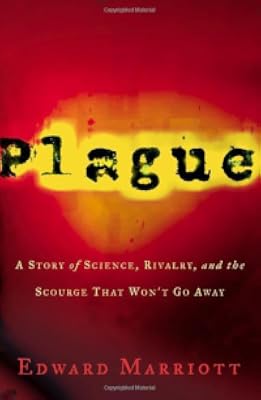
Plague: A Story of Rivalry, Science, and the Scourge That Won't Go Away
by Edward Marriott
On This Page
Description
In this recounting of medical and human history, Marriott takes us back to Hong Kong in the summer of 1894, when a diagnosis of plague brought two top scientists to the island--Alexandre Yersin, a lone, maverick French bacteriologist, and his eminent rival, the Japanese Shibasaburo Kitasato. Marriott interweaves his narrative of their competition to discover the plague's source with scenes of the scourge's persistence: California in 1900, when plague arrived in the United States; Surat, show more India, in 1994, where torrential floods drowned millions of rats, causing the worst outbreak in seventy years; and New York City, some time in the future, where there is a rat for every human being, a diminishing budget for pest control, and an emerging strain of plague that is resistant to antibiotics.--From publisher description. show lessTags
Recommendations





Member Recommendations
Member Reviews
This was an interesting, informative and chilling read. Plague. The word sends chills down my spine. No other word in the English language has the same ability to inspire fear as this one - not even words like war, torture, murder, holocaust, can inspire the same sense of dread as that one word. Plague.
Yet how many of us truly know the history of this disease? Sure, we've all heard of the famous 'Black Plague' outbreak that wiped out something like a third of Europe, but what of it's more recent history? Did you know, for example, that there had been outbreaks in America? Or that there is not a single continent on Earth not affected by plague (except, perhaps Antarctica)? Or that there had been a plague outbreak (in Surat, India) as show more recently as 1994?
I, for one, learned a lot from this well-written history of the search for this elusive creature - plague. Both informative and enjoyable to read, this book takes us through the history of this disease and the bitter rivalry that led, eventually, to the discovery of both cause and carrier. I highly recommend this to anyone with an interest in science, medicine or history, or simply with a taste for the macabre. show less
Yet how many of us truly know the history of this disease? Sure, we've all heard of the famous 'Black Plague' outbreak that wiped out something like a third of Europe, but what of it's more recent history? Did you know, for example, that there had been outbreaks in America? Or that there is not a single continent on Earth not affected by plague (except, perhaps Antarctica)? Or that there had been a plague outbreak (in Surat, India) as show more recently as 1994?
I, for one, learned a lot from this well-written history of the search for this elusive creature - plague. Both informative and enjoyable to read, this book takes us through the history of this disease and the bitter rivalry that led, eventually, to the discovery of both cause and carrier. I highly recommend this to anyone with an interest in science, medicine or history, or simply with a taste for the macabre. show less
Plague. There is a lot of books on the stuff. In fact, trying to link to this book on the forums using touchstones is quite difficult, considering the countless other books with the same name. Many of the books use plague as a blanket term to describe a disease in general, however. This, of course, is a testament to how deeply-rooted our fear of plague has become, that its name can be used to describe any disease that causes widespread destruction. It has wreaked a lot of havoc in the past, and the mere mention of its name has come to signify terror.
Edward Marriott's Plague focuses on two outbreaks a century apart, 1894 Hong Kong and 1994 Surat. I found this going back and forth a bit confusing as I sometimes didn't realize which time show more period I was reading from, but then I realized how scary that was, that I couldn't tell the difference between a plague outbreak in the 1800's and one from less than 20 years ago.
The book also focuses on the rivalry between Alexandre Yersin and Shibasaburo Kitasato. Both were in Hong Kong in 1894 trying to solve the same riddle of plague, but both had entirely different experiences. Kitasato was the local hero, who had anything he wanted and the support of the public. Yersin on the other hand, was rejected, restricted, and forced to work in a straw hut in horrible conditions. Not that it mattered, there is a reason plague is known as Yersinia Pestis today.
Plague is a perfectly decent book. It's a little all over the place and I sometimes felt the author couldn't decide where he wanted to go with his book, and in the end I felt like there was a little something missing. It left me with that vague, slightly-unsatisfied feeling. I can't find a whole lot to complain about but I find a good reason to praise it either. It's just okay. show less
Edward Marriott's Plague focuses on two outbreaks a century apart, 1894 Hong Kong and 1994 Surat. I found this going back and forth a bit confusing as I sometimes didn't realize which time show more period I was reading from, but then I realized how scary that was, that I couldn't tell the difference between a plague outbreak in the 1800's and one from less than 20 years ago.
The book also focuses on the rivalry between Alexandre Yersin and Shibasaburo Kitasato. Both were in Hong Kong in 1894 trying to solve the same riddle of plague, but both had entirely different experiences. Kitasato was the local hero, who had anything he wanted and the support of the public. Yersin on the other hand, was rejected, restricted, and forced to work in a straw hut in horrible conditions. Not that it mattered, there is a reason plague is known as Yersinia Pestis today.
Plague is a perfectly decent book. It's a little all over the place and I sometimes felt the author couldn't decide where he wanted to go with his book, and in the end I felt like there was a little something missing. It left me with that vague, slightly-unsatisfied feeling. I can't find a whole lot to complain about but I find a good reason to praise it either. It's just okay. show less
Ratings
Members
- Recently Added By
Author Information

9+ Works 363 Members
Edward Marriott is the author of "The Lost Tribe" (Owl, 2000), a finalist for the Thomas Cook Travel Book Award & a New York Times Best Travel Book for 1997. A journalist & broadcaster, he is a frequent contributor to the "BBC," "The Times," & "Esquire" magazine. He lives in London. (Bowker Author Biography)
Classifications
- Genres
- Nonfiction, History, General Nonfiction, Science & Nature
- DDC/MDS
- 614.5 — Applied science & technology Medicine & health Epidemics, Poisons, Alternative Medicine Incidence of and public measures to prevent specific diseases and kinds of diseases
- LCC
- RC172 .M374 — Medicine Internal medicine Internal medicine Infectious and parasitic diseases
- BISAC
Statistics
- Members
- 113
- Popularity
- 287,573
- Reviews
- 2
- Rating
- (3.63)
- Languages
- English
- Media
- Paper, Ebook
- ISBNs
- 4
- ASINs
- 1