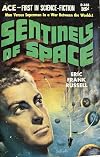
Sentinels from Space
by Eric Frank Russell
On This Page
Tags
Recommendations










Member Reviews
This 1951 novel, from British writer Eric Frank Russell, shows its age quite badly. We are thrown into a distant future, where Mars and Venus have been settled by humans who have evolved further and developed psionic powers. The World Council of Earth summons one of their top intelligence officers, David Raven, because they have just twigged that they are engaged in a cold war with the two colonies, and they instruct him to Do Something About It. After all, it's only been going on for some fifteen years or so. Quick on the uptake they are not.
This novel struck me as quite dreadful. There seemed to be no plot, merely a succession of events happening. The language was wall-to-wall 1950s tough-guy slang, not helped by Ace Books appearing show more to have an illiterate proofreader who could not spell. There was no structure; chapter breaks appeared to occur almost at random, and paragraph breaks were equally infrequent. After about eighty pages, I was ready to bail out.
That I didn't was down to a mystery hinted at in the text. David Raven is not what he seems; neither are his confederates. Slowly, we discover his true nature, and uncover a bigger picture.
Does this rescue the book? Not really. It is riven through with 1950s attitudes; the p.o.v. character shifts from chapter to chapter; there are illogicalities. A big part of the action takes place on Venus, which in 1951 was imagined to be a jungle planet; given that it has 100% cloud cover, many people assumed that that must mean that it was a world of tropical rain forests. This I could excuse: what I couldn't square away was Raven being able to see the stars from the surface of Venus, or for that matter, the sun: "...the huge but invisible sun started to poke its rim over the horizon." If it's invisible, how does anyone know when the rim of the visible sun clears the horizon? That is just garbage.
There were a few instances where Russell demonstrated insight, but these were insufficient to redeem the book for me. show less
This novel struck me as quite dreadful. There seemed to be no plot, merely a succession of events happening. The language was wall-to-wall 1950s tough-guy slang, not helped by Ace Books appearing show more to have an illiterate proofreader who could not spell. There was no structure; chapter breaks appeared to occur almost at random, and paragraph breaks were equally infrequent. After about eighty pages, I was ready to bail out.
That I didn't was down to a mystery hinted at in the text. David Raven is not what he seems; neither are his confederates. Slowly, we discover his true nature, and uncover a bigger picture.
Does this rescue the book? Not really. It is riven through with 1950s attitudes; the p.o.v. character shifts from chapter to chapter; there are illogicalities. A big part of the action takes place on Venus, which in 1951 was imagined to be a jungle planet; given that it has 100% cloud cover, many people assumed that that must mean that it was a world of tropical rain forests. This I could excuse: what I couldn't square away was Raven being able to see the stars from the surface of Venus, or for that matter, the sun: "...the huge but invisible sun started to poke its rim over the horizon." If it's invisible, how does anyone know when the rim of the visible sun clears the horizon? That is just garbage.
There were a few instances where Russell demonstrated insight, but these were insufficient to redeem the book for me. show less
Heinlein wrote a several novels on the theme of planetary colonies revolting against the domination of Terra (Between Planets, Red Planet, The Moon Is a Harsh Mistress) and any number of authors have written stories of the good mutants resisting the evil normals, but Russell here wrote of the good Terrans resisting the revolt of the colonies of Venus and Mars, whose best weapon is their mutants --not just the conventional telepaths and telekinetics, but also firestarters, miniengineers (able to build micromachines by hand), insectivocals (who command he poisonous insects of Venus), and natural hypnotists, among others. As the colonists are fully equal citizens on Terra, they are able to infiltrate and sabotage at will. To stop them, the show more World Council turns to Simon Raven, believing him to be merely an unusually gifted human (unlike other telepaths, he can keep his own mind closed while reading others), but it turns out he has many other gifts, because he is actually an alien sent out as a sentinel against a greater enemy than the colonists --the aliens of Deneb. show less
The Star Watchers first appeared in Startling Stories November 1951 edition and was later adapted and published as Sentinels From Space the following year. It is a well thought out story taking place at some time in the future when earth colonists on Venus and Mars are preparing to fight a war of independence from the mother planet. They have a distinct advantage in that exposure to radiation has resulted in the birth of mutants with super normal abilities. The most common are the telepaths and the hypnos, but there are also pyrotics, insectivocals, chameleons, nocturnals teleports and others. David Raven is called before a panel of the World Council on earth who are concerned that the rebel colonists are carrying out acts of sabotage show more on earth without actually declaring war. Raven is himself a mutant with multi capabilities and he is set the task of finding out what is happening and who is controlling it. After infiltrating a cell on earth he travels to Venus to confront the leaders.
Raven has a partner on earth a large lady called Leina and it soon becomes obvious that they know much more about the situation than anybody else. They are aware that Earth is planning to make a huge leap in space travel after the discovery of a new rocket fuel and that an alien race the mysterious Denebs already control large portions of the Galaxy. The novel builds to a climax back on earth with a twist on the locked room mystery puzzle straight from a murder story. The earlier version of the novel that I read is well written and I particularly enjoyed the mind games and battles between the mutants. Non mutants are referred to as pawns, but they are still the ruling elite. David Raven says:
"The public will swallow anything provided it appears to bear the seal of official approval and is sufficiently long sustained and plays upon their fears."
Eric Frank Russell was a British writer whose short stories and novels featured in many of the American pulp magazines. He also wrote a few novel length stories. This is the first novel I have read of his and I was impressed - 4 stars. show less
Raven has a partner on earth a large lady called Leina and it soon becomes obvious that they know much more about the situation than anybody else. They are aware that Earth is planning to make a huge leap in space travel after the discovery of a new rocket fuel and that an alien race the mysterious Denebs already control large portions of the Galaxy. The novel builds to a climax back on earth with a twist on the locked room mystery puzzle straight from a murder story. The earlier version of the novel that I read is well written and I particularly enjoyed the mind games and battles between the mutants. Non mutants are referred to as pawns, but they are still the ruling elite. David Raven says:
"The public will swallow anything provided it appears to bear the seal of official approval and is sufficiently long sustained and plays upon their fears."
Eric Frank Russell was a British writer whose short stories and novels featured in many of the American pulp magazines. He also wrote a few novel length stories. This is the first novel I have read of his and I was impressed - 4 stars. show less
"Those pale, weak, two-legged things, what had they called themselves? Oh yes, Homo Sapiens. Some among them were precocious and had regarded themselves as Homo Superior. It was pitiful in a way. It was pathetic."
A good read for an misandronist. I admire Russell's sardonic, tongue-in-cheek humor, but I'm puzzled at the lack of women characters in his work. I will have to read a book in him and answer some of my questions.
A good read for an misandronist. I admire Russell's sardonic, tongue-in-cheek humor, but I'm puzzled at the lack of women characters in his work. I will have to read a book in him and answer some of my questions.
Not my favorite of his books -- a slightly drier read than, say, Next of Kin -- but nonetheless delicious.
Human beings are not quite what they seem.
Ratings
Members
- Recently Added By
Author Information

117+ Works 4,649 Members
Some Editions
Series
Belongs to Publisher Series
Work Relationships
Common Knowledge
- Canonical title
- Sentinels from Space
- Original publication date
- 1958
Classifications
Statistics
- Members
- 250
- Popularity
- 129,777
- Reviews
- 6
- Rating
- (3.78)
- Languages
- 6 — English, French, German, Italian, Portuguese, Swedish
- Media
- Paper
- ISBNs
- 6
- ASINs
- 14