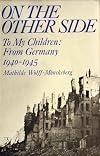
On the Other Side: Letters to My Children from Germany, 1940-1945
by Mathilde Wolff-Monckeberg
On This Page
Description
On The Other Side is a human document of great historical interest: a cultured, liberal, anti-Nazi woman's account of the day-to-day destruction of the city of Hamburg and its people. This was a manuscript that was left undiscovered for 30 years after the end of the war before being presented for publication by her daughter.Tags
Recommendations









Member Reviews
As WW2 broke out, the author and her second husband- a professor- found themselves stuck in Hamburg while four of her five children were abroad in enemy nations- Wales, Denmark, USA and S America. Unable to contact them for years, she kept a diary of her experiences - the relentless bombing, hunger, dirt and terror...
There's a sense of being torn: "However much we strain with every nerve of our beings towards the downfall of our government, we still mourn most deeply the fate of our poor Germany."
And with Hitler's suicide and UK governorship (of her area) a sense of disgruntlement with the "arrogant" occupiers, who lump all Germans in as the enemy.
The story of survival, holding it all together, books and friendship when youve no food or show more gas, taking it a day at a time...
Very vivid and shows War from the - less common (in UK) "other side" show less
There's a sense of being torn: "However much we strain with every nerve of our beings towards the downfall of our government, we still mourn most deeply the fate of our poor Germany."
And with Hitler's suicide and UK governorship (of her area) a sense of disgruntlement with the "arrogant" occupiers, who lump all Germans in as the enemy.
The story of survival, holding it all together, books and friendship when youve no food or show more gas, taking it a day at a time...
Very vivid and shows War from the - less common (in UK) "other side" show less
Letters written (but never posted) by a 60 year-old woman, to her children living abroad, about the experience of living in Hamburg during the war. Discovered in a drawer in the 1970s, they were translated by her daughter, the late Ruth Evans, and first published in England and Germany in 1979. They were serialised on `Woman's Hour' and in the Observer and a television documentary about the book, with Margaret Tyzack acting `Tilli' and many original newsreel shots of a devastated Hamburg, was shown in the autumn of 1979. The Preface, which fills in the background, is by Ruth Evans and the Afterword, which sets the letters in the context of recent controversies about the Allied bombing of German cities, is by Christopher Beauman.
Tilli show more Wolff-Mönckeberg was the daughter of a lawyer who later became Lord Mayor. She was intelligent and well-educated but married very young and had five children. Unusually for the time, she and her husband separated during the First World War and Tilli returned to Hamburg, did some translating and took in lodgers. In 1925 she married a Professor of English who later became Rector of Hamburg University. By the time the letters begin, therefore, in October 1940, her personal life is slightly complicated, with her children living in far- flung places - her youngest daughter Ruth is living in Wales - and her Hamburg relations are slightly disapproving of her unconventional personal life. They would have been even more disapproving if they had known that Tilli was keeping what was in effect a diary: the discovery of the letters would certainly have resulted in her and her husband's arrest. In the first one she writes, about the events leading up to the war, that the German people were led to believe that they had been wantonly attacked but `in truth this whole campaign had been planned long ago, the Führer's blind lust for conquest, his megalomania being the driving force.' She adds, `for me nothing was more devastating than the fact that nobody... stood up against this, but remained passive and weak.'
It is an evocation of daily life in Hamburg during the war years and immediately afterwards (the months after May 1945 make up a third of the book, partly because it was easier to write without the constant threat of bombing and partly because there was no danger in writing). `If you want to know what it was like to be a civilian in wartime Germany you must read this marvellous book' wrote Timothy Garton Ash in the Spectator in 1979, going on to add: `The letters document the terrible suffering caused to the German civil population by Allied bombing. It is difficult to read these pages without feeling that this kind of bombing was worse than a mistake' (the issues covered in the Afterword). However, this is not a harrowing book, it is gentle and domestic, human and humane - and Tilli did survive. show less
Tilli show more Wolff-Mönckeberg was the daughter of a lawyer who later became Lord Mayor. She was intelligent and well-educated but married very young and had five children. Unusually for the time, she and her husband separated during the First World War and Tilli returned to Hamburg, did some translating and took in lodgers. In 1925 she married a Professor of English who later became Rector of Hamburg University. By the time the letters begin, therefore, in October 1940, her personal life is slightly complicated, with her children living in far- flung places - her youngest daughter Ruth is living in Wales - and her Hamburg relations are slightly disapproving of her unconventional personal life. They would have been even more disapproving if they had known that Tilli was keeping what was in effect a diary: the discovery of the letters would certainly have resulted in her and her husband's arrest. In the first one she writes, about the events leading up to the war, that the German people were led to believe that they had been wantonly attacked but `in truth this whole campaign had been planned long ago, the Führer's blind lust for conquest, his megalomania being the driving force.' She adds, `for me nothing was more devastating than the fact that nobody... stood up against this, but remained passive and weak.'
It is an evocation of daily life in Hamburg during the war years and immediately afterwards (the months after May 1945 make up a third of the book, partly because it was easier to write without the constant threat of bombing and partly because there was no danger in writing). `If you want to know what it was like to be a civilian in wartime Germany you must read this marvellous book' wrote Timothy Garton Ash in the Spectator in 1979, going on to add: `The letters document the terrible suffering caused to the German civil population by Allied bombing. It is difficult to read these pages without feeling that this kind of bombing was worse than a mistake' (the issues covered in the Afterword). However, this is not a harrowing book, it is gentle and domestic, human and humane - and Tilli did survive. show less
Persephone Book No. 75, On the Other Side: Letters to my Children from Germany 1940-46 by Mathilde Wolff-Mönckeberg, are letters written (but never posted) by a 60 year-old woman, to her children living abroad, about the experience of living in Hamburg during the war. Discovered in a drawer in the 1970s, they were translated by her daughter, the late Ruth Evans, and first published in England and Germany in 1979.
The first thing that came to mind while I was reading these letters, was how easily "Tilli" could have been writing about Britain. The shortages, the cold, the bombings and shelters were as dreadful for ordinary people in Germany as they were for the people suffering in Britain. It was intersting to hear all of this from a show more Germam perspective. "Tilli" was no supporter of Hitler - quite the reverse, and I think it is easy to forget that there must have been many thousands of people who detested everything he, and the Nazi party stood for. What comes out strongly in these letters however is "Tilli's" love for her family, her children, her sisters, her husband, and numerous other people we hear about in her wonderfully lively letters. show less
The first thing that came to mind while I was reading these letters, was how easily "Tilli" could have been writing about Britain. The shortages, the cold, the bombings and shelters were as dreadful for ordinary people in Germany as they were for the people suffering in Britain. It was intersting to hear all of this from a show more Germam perspective. "Tilli" was no supporter of Hitler - quite the reverse, and I think it is easy to forget that there must have been many thousands of people who detested everything he, and the Nazi party stood for. What comes out strongly in these letters however is "Tilli's" love for her family, her children, her sisters, her husband, and numerous other people we hear about in her wonderfully lively letters. show less
1540 On the Other Side To My Children From Germany 1940-1945, by Mathilde Wolff-Monckeberg translated and edited by Ruth Evans (read 25 Nov 1979) When I read this book I said to myself: "I have just finished reading an extremely moving and well-edited book of letters written but not sent by a German woman to her children from 1940 to 1945. I was tremendously caught up in this so personal glimpse into German life. Actually, things seemed to get worse as far as privation was concerned after the war ended--but at least the bombing was over. The author of the letters did not do anything particularly: she even had a maid-cook at all times. Her husband was a teacher, and, after the war, Rector of the University at Hamburg. This was an show more extremely engrossing book, and I am grateful that the daughter of the author caused it to be published. show less
Ratings
Members
- Recently Added By
Lists

Women in War
148 works; 28 members
Author Information

2 Works 99 Members
Some Editions
Series
Belongs to Publisher Series
Persephone (75)
Common Knowledge
- Canonical title
- On the Other Side: Letters to My Children from Germany, 1940-1945
- Original publication date
- 1979
- Important places
- Hamburg, Germany
- Important events
- World War II; Bombing of Hamburg
- First words
- 10 October 1940
My beloved far-away children, everything I was not able to tell you in my letters during the first year of the war, was not allowed to say, because the censor waited only for an incautious word in order t... (show all)o stop a message from getting through to you, all this I will now put down on paper under the title 'Letters that never reached them'; so that much later perhaps you will know what really happened, what we really felt like and why I had to reassure you repeatedly that the 'organisation'was marvellous, that we were in the best of health and full of confidence. - Last words
- (Click to show. Warning: May contain spoilers.)God bless you all. Farewell. Mother.
Classifications
Statistics
- Members
- 98
- Popularity
- 328,230
- Reviews
- 4
- Rating
- (4.31)
- Languages
- English, German
- Media
- Paper
- ISBNs
- 5