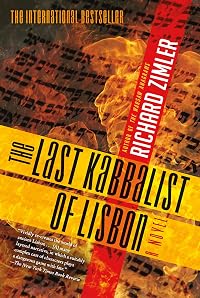
On This Page
Description
Just a few years earlier, Jews living in Portugal were dragged to the baptismal font and forced to convert to Christianity. Many of these New Christians persevered in their Jewish prayers and rituals in secret and at great risk; the hidden, arcane practices of the kabbalists, a mystical sect of Jews, continued as well. One such secret Jew was Berekiah Zarco, an intelligent young manuscript illuminator. Inflamed by love and revenge, he searches, in the crucible of the raging pogrom, for the show more killer of his beloved uncle Abraham, a renowned kabbalist and manuscript illuminator, discovered murdered in a hidden synagogue along with a young girl in dishabille. Risking his life in streets seething with mayhem, Berekiah tracks down answers among Christians, New Christians, Jews, and the fellow kabbalists of his uncle, whose secret language and codes by turns light and obscure the way to the truth he seeks. A marvelous story, a challenging mystery, and a telling tale of the evils of intolerance, The Last Kabbalist of Lisbon both compels and entertains. show lessTags
Recommendations

















Member Recommendations
Member Reviews
During 1507 Lisbon, Portugal, a kabbalist’s nephew sets out to solve his uncle’s murder & to learn the lessons his uncle tried to teach him even from the grave, all while old Christians were burning alive “new” Christians (Jews who were forced to convert). I loved how much of the mystery involved books (angels, as the main character describes them). A vast number of characters & the ending is told like a documentary: what happened to each character years later, when the main character was writing this story. The story is graphic (violence and sex) and brutal. But everything about it is in detail and the descriptions of illuminating books were lovely. I’d read more by this author.
Berekiah Zarco, a young man of about 20, is one of Lisbon's New Christians – Jews forced by the Portuguese to become Christians in 1497. At great risk, Berekiah's family continues to produce Hebrew manuscripts in secret. In addition to training him as an illustrator, Berekiah's Uncle Abraham is also training him in kabbalah. During Passover in 1506, Berekiah's uncle sends him on an errand. Berekiah returns home to find that Lisbon's Old Christians are massacring the “New Christians” (i.e., Jews). He is grieved to find his uncle's slain body in the secret cellar where the manuscripts are hidden. After he examines the body, Berekiah realizes that his uncle was not a victim of the massacre. He was murdered by a fellow Jew, one of the show more handful of people who knew about the hidden cellar and its secrets. Berekiah resolves to hunt down his uncle's killer, but he'll have to escape the massacre in order to have his vengeance on the murderer.
I knew little about kabbalah before reading this book, and I hadn't heard at all of the massacre of the Jews/New Christians in Lisbon. The setting provides plenty of tension. The “New Christians” are in a precarious situation. Berekiah's family as well as other families continue to practice Judaism in secret. Some of the “New Christians” have completely converted to Christianity, while others keep one foot in each camp. It's risky to trust anyone. Berekiah questions his faith during the events of that Passover week, but what he questions seems to be something other than kabbalah. His faith seems to be in himself and in his uncle/mentor rather than in God. Some parts of the book touch on occult matters, and there is one scene describing demon possession. Although I generally avoid books with a strong supernatural/occult element, this one stayed just within my comfort zone.
This would be a good fit for readers who enjoy historical mysteries/thrillers. It has a similar feel to S. J. Parris's Heresy and Iain Pears's An Instance of the Fingerpost. Readers who liked either of those books might want to give this one a try. show less
I knew little about kabbalah before reading this book, and I hadn't heard at all of the massacre of the Jews/New Christians in Lisbon. The setting provides plenty of tension. The “New Christians” are in a precarious situation. Berekiah's family as well as other families continue to practice Judaism in secret. Some of the “New Christians” have completely converted to Christianity, while others keep one foot in each camp. It's risky to trust anyone. Berekiah questions his faith during the events of that Passover week, but what he questions seems to be something other than kabbalah. His faith seems to be in himself and in his uncle/mentor rather than in God. Some parts of the book touch on occult matters, and there is one scene describing demon possession. Although I generally avoid books with a strong supernatural/occult element, this one stayed just within my comfort zone.
This would be a good fit for readers who enjoy historical mysteries/thrillers. It has a similar feel to S. J. Parris's Heresy and Iain Pears's An Instance of the Fingerpost. Readers who liked either of those books might want to give this one a try. show less
45. The Last Kabbalist of Lisbon by Richard Zimler (1996, 318 page Kindle e-book, Read August 4-13)
Read for my book club. I'm kind of surprised how little this is criticized. It's a readable and somewhat fun mystery. It can be lyrical, and has higher aspirations, but there are gaping flaws make it hard to take seriously on any level.
The mystery is set in the Lisbon massacre of 1506, an unusual and quite interesting setting. The story behind the massacre involves Portugal’s response to the Spanish inquisition. In 1497 Portugal forced all its Jews to convert to Christianity, en mass. These Jews became “New Christians”, or, marranos. Their conversion in doubt, the marranos were not trusted by the general population. However, the show more inquisition did not begin in Portugal until about 1536. During Easter/Passover in 1506 an anti-marrano mob, led and incited by Dominican friars, gathered hundreds of marranos throughout Lisbon and then tortured, burned or otherwise massacred them.
Zimler’s narrator is a young marrano manuscript illuminator in Lisbon who studies under his uncle, a master Kabbalist, and member of a small secret Kabbalist group that includes a priest. When someone close to the narrator is murdered early in the massacre, he sets out to find out who did it. As the book progresses, he becomes more obsessed, emotionally insulated from everything around him, abusive and more adaptable to other people’s repulsive activities. This is interesting.
The book wholly fails in creating an authentic a sense of experience. The initial setting simply doesn’t make sense. The reader is introduced to a group of secret “Kabbalists” who would fit better in the Blues Brothers movie than in any type of spiritual environment. At no point in the book do any of these characters pause to read, study or pray or anything of the like. Then, as the massacre takes place, none of the characters makes any emotional expression consistent with it. There is no sense of fear or confusion, desperation, uncertainty, or even discomfort. Life goes on. One almost gets the sense that the massacre was a late, and awkward, addition to the story. There are other oddities, but these two were the most glaring to me.
I did not exactly mind reading this, but I’m not sure I took much away, other than an awareness of odd history of Portuguese antisemitism.
2014
https://www.librarything.com/topic/172769#4810094 show less
Read for my book club. I'm kind of surprised how little this is criticized. It's a readable and somewhat fun mystery. It can be lyrical, and has higher aspirations, but there are gaping flaws make it hard to take seriously on any level.
The mystery is set in the Lisbon massacre of 1506, an unusual and quite interesting setting. The story behind the massacre involves Portugal’s response to the Spanish inquisition. In 1497 Portugal forced all its Jews to convert to Christianity, en mass. These Jews became “New Christians”, or, marranos. Their conversion in doubt, the marranos were not trusted by the general population. However, the show more inquisition did not begin in Portugal until about 1536. During Easter/Passover in 1506 an anti-marrano mob, led and incited by Dominican friars, gathered hundreds of marranos throughout Lisbon and then tortured, burned or otherwise massacred them.
Zimler’s narrator is a young marrano manuscript illuminator in Lisbon who studies under his uncle, a master Kabbalist, and member of a small secret Kabbalist group that includes a priest. When someone close to the narrator is murdered early in the massacre, he sets out to find out who did it. As the book progresses, he becomes more obsessed, emotionally insulated from everything around him, abusive and more adaptable to other people’s repulsive activities. This is interesting.
The book wholly fails in creating an authentic a sense of experience. The initial setting simply doesn’t make sense. The reader is introduced to a group of secret “Kabbalists” who would fit better in the Blues Brothers movie than in any type of spiritual environment. At no point in the book do any of these characters pause to read, study or pray or anything of the like. Then, as the massacre takes place, none of the characters makes any emotional expression consistent with it. There is no sense of fear or confusion, desperation, uncertainty, or even discomfort. Life goes on. One almost gets the sense that the massacre was a late, and awkward, addition to the story. There are other oddities, but these two were the most glaring to me.
I did not exactly mind reading this, but I’m not sure I took much away, other than an awareness of odd history of Portuguese antisemitism.
2014
https://www.librarything.com/topic/172769#4810094 show less
The last Kabbalist of Lisbon is not so much about Kabbalah as it is a locked room murder mystery set amid the riots against the Jews of Portugal in the early part of the 16th century. During this time, which actually spanned the late 15th century to almost mid-16th century, many Jews were forced to publically give up their faith and convert to Christianity; the only other option was death at the hands of a mob.
Despite the dangers, many Jews still practiced their religion in secret. Kabbalah is the mystic branch of Judaism and because of its mysticism, it was usually practiced in secret by a closed group of initiates. Enter the primary protagonist, Berekiah (Pedro) Zarco, who arrives at home after running an extended errand for his show more Kabbalist uncle, Abraham, to find his neighborhood engulfed in a riot, his uncle Abraham murdered in his locked, secret “library” of holy books (genizah) along with an unknown, dead naked woman.
The detective work Berekiah undertakes with a trusted companion, a mute Sufi scholar named Farid is slow, but persistent and methodical. What will keep the reader’s attention is the backdrop of narrow escapes the duo endures as they keep encountering mob violence going on all around them. The duo, separately and together, finds respite in some unlikely places and meet some characters that are not always what they seem to be.
I particularly liked the pairing of a Sufi Scholar, the mystic side of the Islamic faith, with a Kabbalist. Adding to the historical background of the story, this shows that two faiths have a shared heritage and that in the past, the two people commonly aided each other.
The author makes use of the “found manuscript” as an opening gambit to get the reader hooked into the story. This succeeds to the point that an Internet search for the name “Berekiah Zarco” will yield some discussion if such a person actually existed. While this is a work of fiction, the history that serves as a backdrop is well documented. While you do not have to be Jewish, and certainly not a Kabbalist, to enjoy the book, if you are Jewish you may find yourself more involved in the story on a more personal level.
While very original and well narrated, the story does drag on in parts. Some of the deception is predictable as well. I was fully engaged throughout and really did care about finding out the truth, so I still have to award this novel four stars. For those that enjoy historical fiction and wish to gain an insight to mob behavior, this is a must read. show less
Despite the dangers, many Jews still practiced their religion in secret. Kabbalah is the mystic branch of Judaism and because of its mysticism, it was usually practiced in secret by a closed group of initiates. Enter the primary protagonist, Berekiah (Pedro) Zarco, who arrives at home after running an extended errand for his show more Kabbalist uncle, Abraham, to find his neighborhood engulfed in a riot, his uncle Abraham murdered in his locked, secret “library” of holy books (genizah) along with an unknown, dead naked woman.
The detective work Berekiah undertakes with a trusted companion, a mute Sufi scholar named Farid is slow, but persistent and methodical. What will keep the reader’s attention is the backdrop of narrow escapes the duo endures as they keep encountering mob violence going on all around them. The duo, separately and together, finds respite in some unlikely places and meet some characters that are not always what they seem to be.
I particularly liked the pairing of a Sufi Scholar, the mystic side of the Islamic faith, with a Kabbalist. Adding to the historical background of the story, this shows that two faiths have a shared heritage and that in the past, the two people commonly aided each other.
The author makes use of the “found manuscript” as an opening gambit to get the reader hooked into the story. This succeeds to the point that an Internet search for the name “Berekiah Zarco” will yield some discussion if such a person actually existed. While this is a work of fiction, the history that serves as a backdrop is well documented. While you do not have to be Jewish, and certainly not a Kabbalist, to enjoy the book, if you are Jewish you may find yourself more involved in the story on a more personal level.
While very original and well narrated, the story does drag on in parts. Some of the deception is predictable as well. I was fully engaged throughout and really did care about finding out the truth, so I still have to award this novel four stars. For those that enjoy historical fiction and wish to gain an insight to mob behavior, this is a must read. show less
The Last Kabbalist of Lisbon by Richard Zimler is a treasure box of a book, filled with gems of beautiful writing, philosophical questions, and contemplations on right and wrong, love and betrayal. The story begins with the author renting an old house in Istanbul, and discovering a hidden room containing rare, beautifully illuminated Jewish manuscripts from the 1500's written by an illuminator, Berekiah Zarco. The author translates the books, and Zarco's story unfolds:
He was a young Jew boy caught up in the Lisbon during the infamous massacre of the Jewish in 1506. During these horrific events, when the world is turned upside down for him, someone kills his beloved uncle. It falls to him to solve the mystery of his uncle's murder show more against the backdrop of the pogrom taking place around him.
The story is captivating, the setting is atmospheric & authentic, the myriad characters are all complex, real characters, and the writing is exquisite. If that is not enough, the story raises questions about human nature, good and evil, religion, tolerance, love and hate -- everything that is important is discussed in this book in a thoughtful, thought-provoking way. So highly recommended that I went out and got a second copy of the book so that I could lend it without giving up my own copy. show less
He was a young Jew boy caught up in the Lisbon during the infamous massacre of the Jewish in 1506. During these horrific events, when the world is turned upside down for him, someone kills his beloved uncle. It falls to him to solve the mystery of his uncle's murder show more against the backdrop of the pogrom taking place around him.
The story is captivating, the setting is atmospheric & authentic, the myriad characters are all complex, real characters, and the writing is exquisite. If that is not enough, the story raises questions about human nature, good and evil, religion, tolerance, love and hate -- everything that is important is discussed in this book in a thoughtful, thought-provoking way. So highly recommended that I went out and got a second copy of the book so that I could lend it without giving up my own copy. show less
It's difficult for me to express just how much I adored this book. I picked it up intending to read a couple chapters in the tub before going to bed early. I ended reading until the water was cold and my room mates banged on the door. When I finally finished I immediately wanted to reread it to get more of the details.
It's captivating and exciting, making you want to devour the text in big gulps. Putting this down is painful because you want to know more. The loose ends are not neatly tied up at the end of each chapter, nor at the end, which is wonderful. I hate it when an author ties up the story with a neat little bow.
The book operates on several levels. It's a historical novel about Jews in Portugal, anti-semitism, forced conversion, show more reactions to the plague, kabbalah, and bonds of friendship and blood. It also deals with the masks that people wear in varying social situations, and losing yourself in those masks. Jewish religious practice and the Kaballah are, not surpisingly, very important to how the mystery plays itself out. Then there is the murder mystery, friends and family lost and feared dead, and stolen property. I'm making this sound ponderous, but Zimler keeps all those balls in the air, and doesn't ram his opinions down our throat.
This novel isn't only for Jews or mystery fans. It's a brilliant work of fiction that most anyone would love. Buy a copy for yourself, and a copy to give away. show less
It's captivating and exciting, making you want to devour the text in big gulps. Putting this down is painful because you want to know more. The loose ends are not neatly tied up at the end of each chapter, nor at the end, which is wonderful. I hate it when an author ties up the story with a neat little bow.
The book operates on several levels. It's a historical novel about Jews in Portugal, anti-semitism, forced conversion, show more reactions to the plague, kabbalah, and bonds of friendship and blood. It also deals with the masks that people wear in varying social situations, and losing yourself in those masks. Jewish religious practice and the Kaballah are, not surpisingly, very important to how the mystery plays itself out. Then there is the murder mystery, friends and family lost and feared dead, and stolen property. I'm making this sound ponderous, but Zimler keeps all those balls in the air, and doesn't ram his opinions down our throat.
This novel isn't only for Jews or mystery fans. It's a brilliant work of fiction that most anyone would love. Buy a copy for yourself, and a copy to give away. show less
An enemy one knows is often easier to bear than one who is unknown
Plot in a Nutshell
In the late 1400s all Portuguese Jews were forced to convert and became “New Christians” although many continued to practice in secret and at great personal risk. In Spring 1506 as the shadow of the Inquisition started to be seen in Lisbon a drought was further exacerbated by a plague and a large scale pogrom began. Against this backdrop Abraham, a Kabbalist is killed in an apparently locked room and his grief stricken nephew Berekiah Zarco seeks his killer whilst trying to survive the devastation.
Thoughts
Zimler had clearly invested a good deal of time and effort in his research and the geographical detail in the novel was rich and immersive show more without ever seeming to be clunky or forced – it felt like I was running through the streets of Lisbon with Zarco. The historical detail too was impressive and I finished the novel feeling much more aware of a period of history I had not known a great deal about. The writing of some of the scenes were deeply dark and visceral and Zimler’s prose impacted all of my senses – it may have felt uncomfortable to read at times but he absolutely captured the brutality and horror of the time. Here though my enjoyment of the novel stopped.
The novel purports to be a direct translation from a contemporary manuscript – however the tone, structure and language (particularly some of the highly sexual content) did not match and left me always a little confused. It seems like an unnecessary layer to have added.
However, for me the main issue with the novel was the characterisation. As expected for a story about a whole community there is a large cast of characters and I struggled a little to keep them all straight in my head or care as they inevitably suffered through the days of the massacre. In the main cast I found no one particularly sympathetic. Abraham, the uncle and victim of the crime that forms the main mystery section of the novel was cold and patronising and I found it difficult to be moved by his death or the subsequent investigation. show less
Plot in a Nutshell
In the late 1400s all Portuguese Jews were forced to convert and became “New Christians” although many continued to practice in secret and at great personal risk. In Spring 1506 as the shadow of the Inquisition started to be seen in Lisbon a drought was further exacerbated by a plague and a large scale pogrom began. Against this backdrop Abraham, a Kabbalist is killed in an apparently locked room and his grief stricken nephew Berekiah Zarco seeks his killer whilst trying to survive the devastation.
Thoughts
Zimler had clearly invested a good deal of time and effort in his research and the geographical detail in the novel was rich and immersive show more without ever seeming to be clunky or forced – it felt like I was running through the streets of Lisbon with Zarco. The historical detail too was impressive and I finished the novel feeling much more aware of a period of history I had not known a great deal about. The writing of some of the scenes were deeply dark and visceral and Zimler’s prose impacted all of my senses – it may have felt uncomfortable to read at times but he absolutely captured the brutality and horror of the time. Here though my enjoyment of the novel stopped.
The novel purports to be a direct translation from a contemporary manuscript – however the tone, structure and language (particularly some of the highly sexual content) did not match and left me always a little confused. It seems like an unnecessary layer to have added.
However, for me the main issue with the novel was the characterisation. As expected for a story about a whole community there is a large cast of characters and I struggled a little to keep them all straight in my head or care as they inevitably suffered through the days of the massacre. In the main cast I found no one particularly sympathetic. Abraham, the uncle and victim of the crime that forms the main mystery section of the novel was cold and patronising and I found it difficult to be moved by his death or the subsequent investigation. show less
Members
- Recently Added By
Published Reviews
ThingScore 88
"Zimler's portrait of the city (and the New Christians' uneasy place within it) enriches his many-layered narrative, in which a suitably complex cast of characters plays a dangerous game with fate."
added by bookfitz
"The novel exhibits a curious predilection for revoltingly detailed descriptions of torture and murder, but there’s no gainsaying its authoritative re-creation of an imperilled culture in a savage time and place, or the force of the prophecy that Berekiah finally infers from the mystery of the death his Uncle doubtless expected—and may have courted."
added by bookfitz
Lists

jewish themed novels
25 works; 5 members

History novels (not too romancey)
37 works; 5 members
Author Information

41+ Works 1,943 Members
Some Editions
Awards and Honors
Notable Lists
Torchlight List (157)
Series


Belongs to Publisher Series
Work Relationships
Common Knowledge
- Canonical title
- The Last Kabbalist of Lisbon
- Original title
- The Last Kabbalist of Lisbon
- Original publication date
- 1998
- People/Characters
- Abraham Zarco; Berikiah (Pedro) Zarco (Pedro); Farid
- Important places
- Lisbon, Portugal; Constantinople
- Important events
- Massacre at Lisbon (1506); Forced conversion of jews in Portugal (1497)
- Dedication
- For Alexandre Quintanilha
- First words
- Grief was pressing hard at the tip of my reed pen when I first began recording this story.
- Last words
- (Click to show. Warning: May contain spoilers.)Blessed are all of God's self-portraits.
Classifications
- Genres
- Fiction and Literature, General Fiction, Historical Fiction, Mystery
- DDC/MDS
- 813.54 — Literature & rhetoric American literature in English American fiction in English 1900-1999 1945-1999
- LCC
- PS3576 .I464 — Language and Literature American literature American literature Individual authors 1961-
- BISAC
Statistics
- Members
- 943
- Popularity
- 28,142
- Reviews
- 31
- Rating
- (3.64)
- Languages
- 11 — Czech, Dutch, English, French, German, Hungarian, Italian, Norwegian (Bokmål), Portuguese, Spanish, Turkish
- Media
- Paper, Audiobook, Ebook
- ISBNs
- 39
- ASINs
- 15