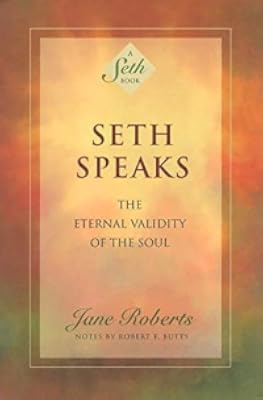
Seth Speaks
by Jane Roberts
On This Page
Description
One of the most powerful of the Seth Books, this essential guide to conscious living clearly and powerfully articulates the furthest reaches of human potential, and the concept that we all create our own reality according to our individual beliefs. Having withstood the test of time, it is still considered one of the most dynamic and brilliant maps of inner reality available today.Tags
Recommendations












Member Reviews
New Age Philosophy, January 14, 2007
First, I want to note that I am not a member of the 'new age' movement. That said, I am fascinated by various understandings of reality. I 'read around' as an avocation. Seth/Roberts here (and in the many other books in which Jane Roberts allegedly 'channeled' the Spirit of Seth) demonstrates a philosophical sensibility in that one hears, here and there, echoes of puzzles (aporias) that have haunted philosophy since the beginning. In this review I simply want to mention some of the most typical, but extraordinary, assertions of Seth/Roberts (henceforth I will simply type 'Seth') with some (hopefully useful) comments. This review is intended for people outside new age or occult circles, by someone also show more outside them, in order to give a brief description and, even more briefly, hopefully to show that there are occasional aspects of this authors work that continue (or derive from) philosophical theories that interest them. Of all the modern occult or new age books I've read (mostly on the floor of the local Barnes & Noble superstore) I've found these books to be the most intelligent and interesting.
Several things will stand out on the first reading of these texts:
1.) The sense of self-empowerment this book intends to bring to its readers is the first thing one might notice. Consciousness makes reality, including the physical world. You are responsible for the world you inhabit. There is no victimization, you chose the scenario you are currently living through. This reminds one of a remark of Nietzsche: "Siamo contenti? Son dio ho fatto questa caricatura!" ('Are we content? I am the god who has made this caricature!') - But, according to Seth we create badly; that is, we make what we did not intend to make. - That is why we incarnate, to learn how to create responsibly. It would seem that the only rule for Seth is don't do anything that brings forth consequences you don't want to face.
2.) According to Seth there is, at the deepest level, no Time. It is an illusion that we (souls incarnating in the material world) have agreed to live by. By 'no time' Seth means that everything is happening simultaneously. Technically, one could perhaps say that every instant is endless, but one must immediately add that every instant brings forth new instances. Or, to put it another way, the absence of Time must not be construed to mean that there is not an accumulation of experience. Also of note, since there is no time one can have 'backwards' reincarnations - that is, you or I could elect, in our 'next life', to reincarnate in the Renaissance!
3.) Creativity is a key concept (if not the key concept) for Seth. At one and the same time the Whole is Itself and It is also changing. Everything happens simultaneously (there is no time) but the contents of this 'everything' is always increasing. In a formula one could say that Being equals Becoming plus Creativity. In fact, this Creativity seems to demand that ALL possible occurrences will somewhere occur. In other words, everything that can happen will happen; even if only in some alternate (or probable) Reality.
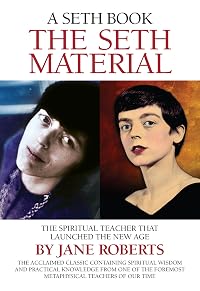
4.) Obviously, as with all reincarnation theories that I am aware of, Seth teaches that we are all immortal. However, one must understand precisely what immortality means for Seth. The appearance of Seth II is wonderfully illuminating in this regard. Seth II (who appears in the 'Seth Material') is a 'later' (or possible) development of Seth himself. But so alien is the Seth II consciousness to the Seth consciousness that Seth II will say that he has never physically incarnated! But of course Seth freely speaks of his previous incarnations. Thus one is perhaps forced to conclude that for Seth 'immortality' means becoming what you absolutely are not. Just think how alien 'Seth 10,002' will be to Seth and Seth II! Or, in other terms, would Alexander the Great recognize himself in my cup because it contains an atom that was once in his body?
5.) From the above (i.e., becoming, creativity) it follows that there are countless 'realities' that are ontologically Real. One has the 'reality' one makes. Obviously, one should avoid making fearfully or stupidly. The centrality of the individual consciousness (or soul) is paramount in Seth. According to Seth, the Truth is truly within because we are all 'Gods'. But since we are all experiencing gods our 'truths' continually evolve. This eerily reminds one that Nietzsche speaks of the 'truth' of perspectivism but, of course, he does so in a non-supernatural manner.
6.) Seth's view of what one hesitantly calls 'physics' is, to many readers of Seth, similar to the 'many-worlds' interpretation and indeterminacy of quantum physics. In Seth's multiverse there are other (probable) selves, alternate pasts and futures, many physical universes and (for Seth) many spiritual realities.
7.) Note also that there are many hierarchies in Seth; not only are their probable selves (instances of the soul in other reincarnational dramas) but there is also an 'oversoul' that stands above the the various probable souls inhabiting different realities and learns from their experiences and also, more or less gently, directs this experience too.
This book represents (as far as I, an outsider, can tell) the bleeding edge of 'new age' speculation. In it, the author (Seth and/or Jane Roberts) introduces a new way of looking at the problem of cosmogenesis. We are all Gods: but this is no mere pantheism; we are all creative gods! Thus even now we all create our reality. Actually, it is better to say realities. Seth teaches that there are 'alternative' pasts and 'probable' futures that actually exist even though none of us ever have or ever will inhabit them. Such is the plenitude of Being for our author(s)! But this echoes, however obliquely, an ancient insight: as Parmenides said so long ago - there isn't anything that is not. I know, one is tempted to sneer at the sheer naiveté of all this. But one hears echos of the history of philosophy throughout the books of Seth. For instance, it was the German Idealists who first stepped beyond pantheism by insisting that Substance must also be active Spirit. Seth merely adds that Spirit must always be God. And what of us? We incarnating souls (Spirits) are now necessarily 'Gods' in training, or so Seth maintains. We are learning, by incarnating in the sublunary (i.e., material) world, to Create responsibly. One does come away, however, wondering exactly what responsibility might mean to Seth. Given the fact of the 'plenitude of Being' there is, strictly speaking, no evil. The spaciousness of the All-That-Is (a term of art in the Seth lexicon that more or less means All/God/Whole) has room enough to Willingly contain anything. To be sure, each existent entity has to deal with the consequences of what it makes - but, strictly speaking, consequences, no matter how unpleasant, are not an evil. Consequences are an educational tool! Indeed, since Seth also teaches that there are probable selves (other instantations of ourselves) living entirely different lives in other realities one wonders whether evil, and its responsibility, has any meaning at all... So, if it is an ontological necessity that every possibility be realized what could the term 'evil' possibly mean? One comes away from the books of Seth (or Roberts) feeling that morality has been replaced by ontology, and the moral imperative -do unto others as you would have them do unto you- has been replaced by an ontological imperative - just do something. The plenitude of Being requires our continual active creation! - Which means that, for Seth, the only 'Evil' is the Nothing of non-Being cum non-activity. The position of Seth can thus be said to be an inverted Buddhism... show less
First, I want to note that I am not a member of the 'new age' movement. That said, I am fascinated by various understandings of reality. I 'read around' as an avocation. Seth/Roberts here (and in the many other books in which Jane Roberts allegedly 'channeled' the Spirit of Seth) demonstrates a philosophical sensibility in that one hears, here and there, echoes of puzzles (aporias) that have haunted philosophy since the beginning. In this review I simply want to mention some of the most typical, but extraordinary, assertions of Seth/Roberts (henceforth I will simply type 'Seth') with some (hopefully useful) comments. This review is intended for people outside new age or occult circles, by someone also show more outside them, in order to give a brief description and, even more briefly, hopefully to show that there are occasional aspects of this authors work that continue (or derive from) philosophical theories that interest them. Of all the modern occult or new age books I've read (mostly on the floor of the local Barnes & Noble superstore) I've found these books to be the most intelligent and interesting.
Several things will stand out on the first reading of these texts:
1.) The sense of self-empowerment this book intends to bring to its readers is the first thing one might notice. Consciousness makes reality, including the physical world. You are responsible for the world you inhabit. There is no victimization, you chose the scenario you are currently living through. This reminds one of a remark of Nietzsche: "Siamo contenti? Son dio ho fatto questa caricatura!" ('Are we content? I am the god who has made this caricature!') - But, according to Seth we create badly; that is, we make what we did not intend to make. - That is why we incarnate, to learn how to create responsibly. It would seem that the only rule for Seth is don't do anything that brings forth consequences you don't want to face.
2.) According to Seth there is, at the deepest level, no Time. It is an illusion that we (souls incarnating in the material world) have agreed to live by. By 'no time' Seth means that everything is happening simultaneously. Technically, one could perhaps say that every instant is endless, but one must immediately add that every instant brings forth new instances. Or, to put it another way, the absence of Time must not be construed to mean that there is not an accumulation of experience. Also of note, since there is no time one can have 'backwards' reincarnations - that is, you or I could elect, in our 'next life', to reincarnate in the Renaissance!
3.) Creativity is a key concept (if not the key concept) for Seth. At one and the same time the Whole is Itself and It is also changing. Everything happens simultaneously (there is no time) but the contents of this 'everything' is always increasing. In a formula one could say that Being equals Becoming plus Creativity. In fact, this Creativity seems to demand that ALL possible occurrences will somewhere occur. In other words, everything that can happen will happen; even if only in some alternate (or probable) Reality.
4.) Obviously, as with all reincarnation theories that I am aware of, Seth teaches that we are all immortal. However, one must understand precisely what immortality means for Seth. The appearance of Seth II is wonderfully illuminating in this regard. Seth II (who appears in the 'Seth Material') is a 'later' (or possible) development of Seth himself. But so alien is the Seth II consciousness to the Seth consciousness that Seth II will say that he has never physically incarnated! But of course Seth freely speaks of his previous incarnations. Thus one is perhaps forced to conclude that for Seth 'immortality' means becoming what you absolutely are not. Just think how alien 'Seth 10,002' will be to Seth and Seth II! Or, in other terms, would Alexander the Great recognize himself in my cup because it contains an atom that was once in his body?
5.) From the above (i.e., becoming, creativity) it follows that there are countless 'realities' that are ontologically Real. One has the 'reality' one makes. Obviously, one should avoid making fearfully or stupidly. The centrality of the individual consciousness (or soul) is paramount in Seth. According to Seth, the Truth is truly within because we are all 'Gods'. But since we are all experiencing gods our 'truths' continually evolve. This eerily reminds one that Nietzsche speaks of the 'truth' of perspectivism but, of course, he does so in a non-supernatural manner.
6.) Seth's view of what one hesitantly calls 'physics' is, to many readers of Seth, similar to the 'many-worlds' interpretation and indeterminacy of quantum physics. In Seth's multiverse there are other (probable) selves, alternate pasts and futures, many physical universes and (for Seth) many spiritual realities.
7.) Note also that there are many hierarchies in Seth; not only are their probable selves (instances of the soul in other reincarnational dramas) but there is also an 'oversoul' that stands above the the various probable souls inhabiting different realities and learns from their experiences and also, more or less gently, directs this experience too.
This book represents (as far as I, an outsider, can tell) the bleeding edge of 'new age' speculation. In it, the author (Seth and/or Jane Roberts) introduces a new way of looking at the problem of cosmogenesis. We are all Gods: but this is no mere pantheism; we are all creative gods! Thus even now we all create our reality. Actually, it is better to say realities. Seth teaches that there are 'alternative' pasts and 'probable' futures that actually exist even though none of us ever have or ever will inhabit them. Such is the plenitude of Being for our author(s)! But this echoes, however obliquely, an ancient insight: as Parmenides said so long ago - there isn't anything that is not. I know, one is tempted to sneer at the sheer naiveté of all this. But one hears echos of the history of philosophy throughout the books of Seth. For instance, it was the German Idealists who first stepped beyond pantheism by insisting that Substance must also be active Spirit. Seth merely adds that Spirit must always be God. And what of us? We incarnating souls (Spirits) are now necessarily 'Gods' in training, or so Seth maintains. We are learning, by incarnating in the sublunary (i.e., material) world, to Create responsibly. One does come away, however, wondering exactly what responsibility might mean to Seth. Given the fact of the 'plenitude of Being' there is, strictly speaking, no evil. The spaciousness of the All-That-Is (a term of art in the Seth lexicon that more or less means All/God/Whole) has room enough to Willingly contain anything. To be sure, each existent entity has to deal with the consequences of what it makes - but, strictly speaking, consequences, no matter how unpleasant, are not an evil. Consequences are an educational tool! Indeed, since Seth also teaches that there are probable selves (other instantations of ourselves) living entirely different lives in other realities one wonders whether evil, and its responsibility, has any meaning at all... So, if it is an ontological necessity that every possibility be realized what could the term 'evil' possibly mean? One comes away from the books of Seth (or Roberts) feeling that morality has been replaced by ontology, and the moral imperative -do unto others as you would have them do unto you- has been replaced by an ontological imperative - just do something. The plenitude of Being requires our continual active creation! - Which means that, for Seth, the only 'Evil' is the Nothing of non-Being cum non-activity. The position of Seth can thus be said to be an inverted Buddhism... show less
For this review I admit that I am torn between preaching to the choir, holding the book at skeptic's length, and becoming a New Age apologist.
'Seth Speaks: The Eternal Validity of the Soul' is, at face value, a channelled work. You may accept or deny that premise. I am - in this reality - choosing to accept it, and that decision makes a huge difference in the way I now regard my thoughts and my experiences. Let us hypothetically 'go there' for a while and see what happens. Obviously the immortality of the soul, the concept of reincarnation, parallel dimensions, and the elasticity of time and space are all fundamental premises for this kind of thing, so I will neither explain nor defend them.
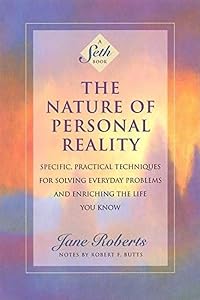
Given the fact that the channeling sessions show more from which this book was written took place in 1970-71, this book has already been regarded as a kind of modern classic on the subject. Indeed, one can see how much New Age thought can have originated in its pages. It was, in effect, 'New Age when New Age wasn't cool.' (A recommended companion volume to this and a must-read among Seth aficionados is "The Nature of Personal Reality," 1974, also channelled by Jane Roberts.) Well, given all of that: I found this book to be an engrossing examination of how extraordinarily fluid and filled with unseen possibilities life is. There is way too much content to describe in a review, of course (and stuff which the choir already knows), so I just want to hit a high point or two.
Seth explains (via Jane Roberts, medium and physical author of the book) how intertwined our waking and dream states are, and more to the point for me: how our dream state may have as much continuity as the waking state. Apparently, what we manage to remember upon waking are tiny shards of a much larger, coherent experience that we may return to night after night. The apparent weirdness and silliness of those recalled fragments are already poor, symbolic substitutions for a deeper set of experiences than could be translated to the waking mind. . . Well, what an outrageous and wonderful gospel! I love the concept - that we could be largely blind to a whole other 'life' that is being lived while we sleep. I recall an old sci-fi novel, "Wine of the Dreamers," by John D. MacDonald which touched upon a variant of this idea.
Of particular interest is the section wherein Seth explains that some lifetimes are intentionally-created living canvases, meant to be relived many times over. As such, these are exercises in probable realities for the soul. Such lives (and you may be living one now) are intended as experimental media upon which many variations may be played after the initial life is finished. The soul, intending such a use for that lifetime, can relive and reshape events after the fact, much as an artist applies a brush to a canvas, experimenting and reshaping outcomes as he or she pleases. Each experiment spins off a new probable reality – as real and concrete an existence as the 'original.' It's a fantastic idea. This of course makes me wonder whether this particular life, wherein I am writing this review, is or has been lived already on some level. Perhaps it is merely my soul continuing to experiment with outcomes. Strange. . . I suddenly have the feeling I have written this sentence before! Wonderful.
In other news: multiple lifetimes are not sequential - they happen concurrently. Time is an illusion, made necessary by the workings of our conscious mind and the nature of physical reality. At deeper levels of consciousness, we share information, premonitions and deja vu experiences back and forth between lives. And good news! Your silly little ego will indeed survive intact, but only to find it is one of many. I begin to sound tonue-in-cheek here, but Walter, this is serious!
If you like fantasy and science fiction, this book will appeal to you. If you desperately need all this to be true, then God loves you, I love you, and this book will appeal to you. And if you don't mind opening your mind, dreaming the dream and walking where visionaries and loons might fear to tread, this book will appeal to you (and I greet you, brother). Really, I think we may all be extraordinarily surprised - each of us - upon the occasion of our death. Personally, I would much rather be surprised than not. . . show less
'Seth Speaks: The Eternal Validity of the Soul' is, at face value, a channelled work. You may accept or deny that premise. I am - in this reality - choosing to accept it, and that decision makes a huge difference in the way I now regard my thoughts and my experiences. Let us hypothetically 'go there' for a while and see what happens. Obviously the immortality of the soul, the concept of reincarnation, parallel dimensions, and the elasticity of time and space are all fundamental premises for this kind of thing, so I will neither explain nor defend them.
Given the fact that the channeling sessions show more from which this book was written took place in 1970-71, this book has already been regarded as a kind of modern classic on the subject. Indeed, one can see how much New Age thought can have originated in its pages. It was, in effect, 'New Age when New Age wasn't cool.' (A recommended companion volume to this and a must-read among Seth aficionados is "The Nature of Personal Reality," 1974, also channelled by Jane Roberts.) Well, given all of that: I found this book to be an engrossing examination of how extraordinarily fluid and filled with unseen possibilities life is. There is way too much content to describe in a review, of course (and stuff which the choir already knows), so I just want to hit a high point or two.
Seth explains (via Jane Roberts, medium and physical author of the book) how intertwined our waking and dream states are, and more to the point for me: how our dream state may have as much continuity as the waking state. Apparently, what we manage to remember upon waking are tiny shards of a much larger, coherent experience that we may return to night after night. The apparent weirdness and silliness of those recalled fragments are already poor, symbolic substitutions for a deeper set of experiences than could be translated to the waking mind. . . Well, what an outrageous and wonderful gospel! I love the concept - that we could be largely blind to a whole other 'life' that is being lived while we sleep. I recall an old sci-fi novel, "Wine of the Dreamers," by John D. MacDonald which touched upon a variant of this idea.
Of particular interest is the section wherein Seth explains that some lifetimes are intentionally-created living canvases, meant to be relived many times over. As such, these are exercises in probable realities for the soul. Such lives (and you may be living one now) are intended as experimental media upon which many variations may be played after the initial life is finished. The soul, intending such a use for that lifetime, can relive and reshape events after the fact, much as an artist applies a brush to a canvas, experimenting and reshaping outcomes as he or she pleases. Each experiment spins off a new probable reality – as real and concrete an existence as the 'original.' It's a fantastic idea. This of course makes me wonder whether this particular life, wherein I am writing this review, is or has been lived already on some level. Perhaps it is merely my soul continuing to experiment with outcomes. Strange. . . I suddenly have the feeling I have written this sentence before! Wonderful.
In other news: multiple lifetimes are not sequential - they happen concurrently. Time is an illusion, made necessary by the workings of our conscious mind and the nature of physical reality. At deeper levels of consciousness, we share information, premonitions and deja vu experiences back and forth between lives. And good news! Your silly little ego will indeed survive intact, but only to find it is one of many. I begin to sound tonue-in-cheek here, but Walter, this is serious!
If you like fantasy and science fiction, this book will appeal to you. If you desperately need all this to be true, then God loves you, I love you, and this book will appeal to you. And if you don't mind opening your mind, dreaming the dream and walking where visionaries and loons might fear to tread, this book will appeal to you (and I greet you, brother). Really, I think we may all be extraordinarily surprised - each of us - upon the occasion of our death. Personally, I would much rather be surprised than not. . . show less
There is no time, there is no space. Even if he is just a fictional and/or a completely manufactured entitity, Seth still needs to be heard - especially today. I credit Roberts with having first opened my eyes to the [relative] truth that "we create our own reality." Dismiss her as a complete sham at your peril!
I first came across Seth many years ago when I was young yet it was far too advanced for my then limited knowledge of reality or where I was going. I am much older now and after a long search for truth through many volumes both good and bad I have found that this book has been a revelation. The only warning I might add is that if you aren't too long on the journey of truth then it might be a little too heavy. Although the likes of Conversations with God and other popular books might prove easier to digest on the nature of who we are and where we are going, you would be forgiven for suspecting that it was from this book that these authors originally drew their inspiration. If you are serious about the nature of your existenece then I do show more not see how you can be disappointed. This is a fascinating book that will answer many of your questions with clarity and detail. show less
Alright! i liked it . There are some claims that are formulated in a rather vague way, but i geuss that is the point to explain consciousness, that this is all a dream
Excellent book for its time. Jane Roberts was a forerunner in the field of channeling. Of course, the great Edgar Cayce preceded her but her work is different, not as documented. Still a very good read.
Perhaps the most popular of the Seth books, this is the first book written entirely by Seth for the public. In it he discusses the eternal validity of the soul and presents his very unique and original view of physical and non-physical reality. Topics include: what to expect immediately after death, how to glimpse into past lives, ways to contact friends and relatives who have died, dreams and out-of-body experiences, the three lost civilizations that preceded Atlantis, and much more. "What I will tell you has been told before throughout the centuries, and given again when it was forgotten. I hope to clarify many points that have been distorted through the years… I am primarily a personality with a message: you create the world that show more you know. You have been given perhaps the most awesome gift of all: the ability to project your thoughts outward into physical form." -Seth show less
Members
- Recently Added By
Lists

Healing resources for women
587 works; 1 member
Author Information

76+ Works 3,409 Members
Common Knowledge
- Canonical title
- Seth Speaks
- Original title
- Seth Speaks
- Original publication date
- 1972
- People/Characters
- Seth
- Dedication
- To Rob
- First words
- (In beginning these notes, let me mention that there are certain definite changes in Jane when she is in trance and speaking for Seth.)
Introduction: This book was written by a personality called Seth, who speaks of himself as an "energy personality essence" no longer focused in physical form. - Last words
- (Click to show. Warning: May contain spoilers.)Travel in peace and joy and safety, in your bodies and out.
- Blurbers
- Bach, Richard
Classifications
- Genres
- Nonfiction, Religion & Spirituality, Philosophy, General Nonfiction
- DDC/MDS
- 133.93 — Philosophy & psychology Parapsychology & occultism Specific topics in parapsychology and occultism Spiritualism Messages from Noncorporeal Beings
- LCC
- BF1301 .S387 — Philosophy, Psychology and Religion Psychology Parapsychology Spiritualism
- BISAC
Statistics
- Members
- 661
- Popularity
- 43,510
- Reviews
- 9
- Rating
- (4.15)
- Languages
- 5 — Dutch, English, French, German, Hungarian
- Media
- Paper, Audiobook, Ebook
- ISBNs
- 19
- ASINs
- 14