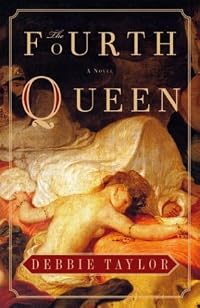
The Fourth Queen
by Debbie Taylor
On This Page
Description
This year, award-winning children's illustrators join Discworld favourites like Paul Kidby and David Wyatt with their own interpretations of Terry Pratchett's phenomenal Discworld. Each full-page illustration also appears on the back; there are biographies of the artists as well as the author on the inside front page. The calendar dates are exhaustively researched and include major real-time calendrical data for the UK, Australia, New Zealand, Canada and the United States. Artists briefed show more include Sandy Nightingale, Chris Riddell, David Frankland, Mark Edwards, Angelo Rinaldi, Mel Grant, Stephen Player, David Wyatt, Gino D'Achille, Stuart Williams, Jackie Morris and James Mayhew. show lessTags
Recommendations
Member Reviews
Based on some truth, The Fourth Queen by Debbie Taylor is a remarkable story about Helen Goag, a young Scottish girl who is captured by Barbary pirates when on her way to North America. Her pale skin, green eyes and red-blonde hair set her apart and she is sold into the Emperor of Morocco’s harem.
The bulk of the story is set in this claustrophobic court of women where everyone wants a chance to be with the Emperor with the hope of having children and securing a better life for themselves. Even when the Emperor favours her and raises her to be one of his Queens, her life is in constant danger and she must learn to navigate the schemes, lies and jealousy that surround her. Luckily, she is befriended by the curator of the harem, a dwarf show more who falls in love with the Scottish beauty.
The narrative switches between Helen and the dwarf so we get to understand the motives of each. The story is a little overlong, some of the characters felt too one-sided to be believable and there were a few details that didn’t ring absolutely true, but overall I enjoyed this exotic, evocative read and found The Fourth Queen to be a highly readable story. show less
The bulk of the story is set in this claustrophobic court of women where everyone wants a chance to be with the Emperor with the hope of having children and securing a better life for themselves. Even when the Emperor favours her and raises her to be one of his Queens, her life is in constant danger and she must learn to navigate the schemes, lies and jealousy that surround her. Luckily, she is befriended by the curator of the harem, a dwarf show more who falls in love with the Scottish beauty.
The narrative switches between Helen and the dwarf so we get to understand the motives of each. The story is a little overlong, some of the characters felt too one-sided to be believable and there were a few details that didn’t ring absolutely true, but overall I enjoyed this exotic, evocative read and found The Fourth Queen to be a highly readable story. show less
This historical novel promised to be right up my alley, but while it is an interesting book, it wasn't a page turner. It certainly succeeds in vividly describing suffocating harem life, though the portrayal is so relentlessly negative I found myself questioning it . The sources consulted by the author are all by Westerners. While women of that time and place were confined and oppressed, I found myself wondering whether their situation was uniformly so bad, or if it was the view of the few Westerners who observed it.
The plot revolves around treacherous harem politics, certainly full of tension but the tension sometimes fades in pages of dialog. There are two points of view: the kidnapped Helen's and that of the dwarf Microphilus. I'm at show more a loss as to why Helen's point of view is rendered in the third person, while Microphilus speaks to us in first person. He becomes the more interesting character by far, reminiscent of Tyrion Lannister from Game of Thrones with his world-weariness and his impossible love for Helen.
It would have been interesting to know if there are any Moroccan sources in translation that discuss Helen Gloag's story, and if so, how they saw her.
For comparison, I recommend [b:Sofia|2649638|Sofia|Ann Chamberlin|https://d.gr-assets.com/books/1266995653s/2649638.jpg|7152681] by Ann Chamberlin, about an Italian woman, roughly contemporary with Helen Goag, who was kidnapped and rose to power in the Ottoman Sultan's harem. show less
The plot revolves around treacherous harem politics, certainly full of tension but the tension sometimes fades in pages of dialog. There are two points of view: the kidnapped Helen's and that of the dwarf Microphilus. I'm at show more a loss as to why Helen's point of view is rendered in the third person, while Microphilus speaks to us in first person. He becomes the more interesting character by far, reminiscent of Tyrion Lannister from Game of Thrones with his world-weariness and his impossible love for Helen.
It would have been interesting to know if there are any Moroccan sources in translation that discuss Helen Gloag's story, and if so, how they saw her.
For comparison, I recommend [b:Sofia|2649638|Sofia|Ann Chamberlin|https://d.gr-assets.com/books/1266995653s/2649638.jpg|7152681] by Ann Chamberlin, about an Italian woman, roughly contemporary with Helen Goag, who was kidnapped and rose to power in the Ottoman Sultan's harem. show less
I know that there is a genre of historical novels that are really just an excuse to write about sex. I didn't expect that in a trade paperback with over 400 pages. Also the many subplots and the divided loyalties of the main characters don't really fit there.
But it is not satisfying to the reader expecting standard historical fiction either. There just plain isn't enough history. There could have been a lot more about the backgrounds of the secondary characters. Even the main characters - while well defined - are unlikely in the context given. What bits of history are involved are from times too widely scattered to really fit together.
Both Ms. Taylor and her editors should have a long think next time what reader they really intend this show more book for. show less
But it is not satisfying to the reader expecting standard historical fiction either. There just plain isn't enough history. There could have been a lot more about the backgrounds of the secondary characters. Even the main characters - while well defined - are unlikely in the context given. What bits of history are involved are from times too widely scattered to really fit together.
Both Ms. Taylor and her editors should have a long think next time what reader they really intend this show more book for. show less
A fictionalized tale of a Scottish woman kidnapped en route to America who becomes one of the wives of the Emperor of Morocco. The internal politics of the harem play a large role in the plot, as one of the women is poisoning others seeking advancement. A fun read, although the figure I admired most by the novel's end was Batoom, the queen who smuggled her jewels and money out of the harem to fund a war against her husband. Her stance is striking in comparison with the other harem members who merely wage battles for the emperor's attention. An interesting view of life in a harem and some of the fascinating people it could contain.
I was excited to read "The Fourth Queen" because I thought the premise was interesting. It started off really good, with Helen's caputre by pirates and her subsequent entrance into the harem. However, as the story went on, the narrative started to wane. I was slightly disappointed by the lack of character development in some of the characters (excepting Helen and Microphilus). I wanted to know more about these women and how they came to be there and what happened to them after they were no longer any use to the Emperor. Also, a major disappointment was the way the author ended the novel. Did she just get tired of writing and decide to end it? That's what it felt like. I'm all for letting the reader imagine what happened, as long as show more there is something to lead to a conclusion. This ending just felt unfinished, I guess. Having read "In the Company of the Courtesan" before this book, I felt like this one was inferior. I mean, come on - how many dwarf-loves-courtesan novels do we really need? show less
Osvjezavajuce,dugo nisam procitala nesto ovako zanimljivo,Helen je Svedjanka zarobljena u haremu marokanskog kralja,postaje kraljica i shvata svu kraljevu surovost,moze li srce voljeti patuljka i placati safirima dasak slobode u kavezu od zlata...
The Fourth Queen traces the story of an Irish girl, Helen Gloag, who rose to become the Queen of Morocco. The story oscillates between a third person account from Helen and the first person account from bedeviling fictitious dwarf Micophilus.
In Morocco, the Emperor followed the Islamic law of having four wives (thus the name of the book).
The book is roughly broken out in three parts. The first third of the book we followed Helen's abduction and her meeting Microphilus. We are introduce to Microphilus and life in the harem. Microphilus is obtuse and blunt and I can see why people do not like him. A lot of times I found his thought process fascinating until he gets hit by Cupid's Arrow and start behaving like a love sick puppy dog.
The show more second part follows Helen's rise to the fourth wife / queen ... and finally a mystery as someone is trying to kill Helen. The characters just did not interest me as much especially as they moved to their respective coordinates of their love triangle. Maybe more like a love tangle because I got frustratingly tangled wonderings of "Does he/she love me...love me not?"
There's enough to like the book that I don't regret reading it. But enough to dislike to be happy to be done reading it.
show less
Members
- Recently Added By
Author Information
5 Works 210 Members
Common Knowledge
- Canonical title
- The Fourth Queen
- Important places*
- Marokko
*Some information comes from Common Knowledge in other languages. Click "Edit" for more information.
Classifications
Statistics
- Members
- 193
- Popularity
- 169,045
- Reviews
- 10
- Rating
- (3.35)
- Languages
- English, Italian
- Media
- Paper
- ISBNs
- 6