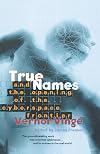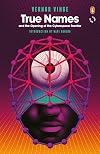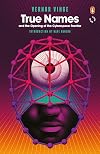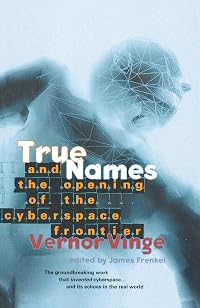
True Names and the Opening of the Cyberspace Frontier
by Vernor Vinge (Author), James Frenkel (Editor)
On This Page
Description
Penguin reissues a seminal work of cyberpunk fiction from the Hugo Award-winning author of A Fire Upon the Deep - with a new introduction by Hari Kunzru Mr Slippery is an illegal computer hacker - a Warlock - and an expert in a new virtual reality technology called the Other Plane. Arrested by US the government and forced to work for them, he finds himself pitted against a new and frightening international cybercriminal- the Mailman. The Mailman is building a network of Warlocks, promising show more them wealth and power, causing chaos around the globe - but noone has ever met him in person. As Mr Slippery and his sidekick Erythrina drain the world's computational power to track down their formidable adversary, they begin to wonder if they are chasing a ghost. Is the Mailman a man at all? Is he even human? True Names is part of the Penguin Worlds classic science fiction series show lessTags
Recommendations





Member Reviews
This book is, in a sense, two different things.
One is the 1981 story by Vernor Vinge. It is a little fantabulous, taking place partly in "cyberspace"--but a cyberspace that, despite its level of detail, acknowledges its dependence on the imagination of a community of users. The story revolves around one individual, a successful writer who is also a successful protester within cyberspace, who must deal with the myriad threats to the safety of this cyberspace, including both the government and "rogue" threats.
The rest--the bulk--of the volume is a number of essays written throughout the 1990's that respond to, critique, or extend the story from a socio-technological viewpoint. Reading this for the first time in 2008, I was amazed at the show more prescience of these essays and their importance for our time.
Danny Hillis takes a quick stab at a coming technological symbiosis, something that is coming true as certain white-collar groups are now always on, all the time, via cell phones, blackberries, Twitter linkages, etc. Timothy May describes several different applications of strong cryptography, and rants a bit. John M. Ford muses on what the computers of the future will think of us. Alan Wexelblat compares the datamining techniques of government and industry to a panopticon prison, where we do not own our own identity profiles. Pattie Maes mentions software agents.
The next few pieces are, to my mind, essential. RMS writes a beautiful parable on "the right to read," i.e. a right to be able to own anything that contains intellectual property--a right that has been limited in a post DMCA age where people no longer have physical books and the like but can only license individual access for a short time. Leonard Foner describes the history of cryptography policy and its pitfalls. Morningstar & Farmer give an account of the late-80's Habitat community, sharing the technological (separate content and presentation!) and social lessons (don't break the conventions) they learned.
Mark Pesce wraps up the essay section with a meditation on symbol, mearnings, and animism. Then the Vinge story is reprinted (with only typographical corrections made), followed by the 1983 afterword by Marvin Minsky, which tackles consciousness, language, and the human mind as computer. This is a whole topic of its own, but his piece was not a bad entrée into this area.
A couple of different essays point out that during and after crises, citizens usually lose rights, being watched more closely for tinier infringements (such as wrong-thinking) by more powerful governments. They further suggest that there are two attractor basins: one towards a free, possibly slightly anarchist, society where people have speech and privacy rights supported by high technology, the other towards a totalitarian society run by individuals who are terrified by high technology and strictly regulate its use. Optimists believed that we were heading towards the former; in the wake of the September 11, 2001 killings, it is not so clear. How can we preserve the rights of man in a post-human world?
Highly recommended. show less
One is the 1981 story by Vernor Vinge. It is a little fantabulous, taking place partly in "cyberspace"--but a cyberspace that, despite its level of detail, acknowledges its dependence on the imagination of a community of users. The story revolves around one individual, a successful writer who is also a successful protester within cyberspace, who must deal with the myriad threats to the safety of this cyberspace, including both the government and "rogue" threats.
The rest--the bulk--of the volume is a number of essays written throughout the 1990's that respond to, critique, or extend the story from a socio-technological viewpoint. Reading this for the first time in 2008, I was amazed at the show more prescience of these essays and their importance for our time.
Danny Hillis takes a quick stab at a coming technological symbiosis, something that is coming true as certain white-collar groups are now always on, all the time, via cell phones, blackberries, Twitter linkages, etc. Timothy May describes several different applications of strong cryptography, and rants a bit. John M. Ford muses on what the computers of the future will think of us. Alan Wexelblat compares the datamining techniques of government and industry to a panopticon prison, where we do not own our own identity profiles. Pattie Maes mentions software agents.
The next few pieces are, to my mind, essential. RMS writes a beautiful parable on "the right to read," i.e. a right to be able to own anything that contains intellectual property--a right that has been limited in a post DMCA age where people no longer have physical books and the like but can only license individual access for a short time. Leonard Foner describes the history of cryptography policy and its pitfalls. Morningstar & Farmer give an account of the late-80's Habitat community, sharing the technological (separate content and presentation!) and social lessons (don't break the conventions) they learned.
Mark Pesce wraps up the essay section with a meditation on symbol, mearnings, and animism. Then the Vinge story is reprinted (with only typographical corrections made), followed by the 1983 afterword by Marvin Minsky, which tackles consciousness, language, and the human mind as computer. This is a whole topic of its own, but his piece was not a bad entrée into this area.
A couple of different essays point out that during and after crises, citizens usually lose rights, being watched more closely for tinier infringements (such as wrong-thinking) by more powerful governments. They further suggest that there are two attractor basins: one towards a free, possibly slightly anarchist, society where people have speech and privacy rights supported by high technology, the other towards a totalitarian society run by individuals who are terrified by high technology and strictly regulate its use. Optimists believed that we were heading towards the former; in the wake of the September 11, 2001 killings, it is not so clear. How can we preserve the rights of man in a post-human world?
Highly recommended. show less
Like many science fiction novels, True Names is a prophetic book. However, it is also a short story, a novella, rather than a full-length novel. Vernor Vinge’s narrative focuses primarily on the adventures of two computer hackers–called warlocks–who live and operate in an alternate reality.
As in today’s world, the warlocks have assumed names and personas that express their image of themselves, much like the avatars people adopt today. The two main characters, “Mr. Slippery” and “Erythrina,” must navigate this world without giving up their real names, or else the ‘True Enemy” will force them to work for them. “The Great Enemy” is the US Government in this case.
The FBI discovers the actual name of Mr Slippery, show more forcing him and Erythrina to investigate a mysterious person called ‘The Mailman.’
I will not reveal more than this because I’d be giving away the plot. While the book has been called a science fiction classic, I consider the narrative confusing. The confusing, fluid narrative may reflect how we inhabit the virtual world.
The edition I own has several essays before the novella starts and an essay by Mr. Minsky after the narrative ends. It is critical to remember that the authors wrote these essays in the final decade of the last century when they were speculating on the future. Some of us today may consider the material in the book and the novella humdrum. Still, we must remember that Vernor Vinge wrote this book more than a decade before we even knew about the multiverse, virtual reality, and other such esoteric concepts.
When reading the essays that precede and succeed the main story, it is critical to view them as eerily prescient essays, anticipating both technological progress and societal changes occurring because of technological change. show less
As in today’s world, the warlocks have assumed names and personas that express their image of themselves, much like the avatars people adopt today. The two main characters, “Mr. Slippery” and “Erythrina,” must navigate this world without giving up their real names, or else the ‘True Enemy” will force them to work for them. “The Great Enemy” is the US Government in this case.
The FBI discovers the actual name of Mr Slippery, show more forcing him and Erythrina to investigate a mysterious person called ‘The Mailman.’
I will not reveal more than this because I’d be giving away the plot. While the book has been called a science fiction classic, I consider the narrative confusing. The confusing, fluid narrative may reflect how we inhabit the virtual world.
The edition I own has several essays before the novella starts and an essay by Mr. Minsky after the narrative ends. It is critical to remember that the authors wrote these essays in the final decade of the last century when they were speculating on the future. Some of us today may consider the material in the book and the novella humdrum. Still, we must remember that Vernor Vinge wrote this book more than a decade before we even knew about the multiverse, virtual reality, and other such esoteric concepts.
When reading the essays that precede and succeed the main story, it is critical to view them as eerily prescient essays, anticipating both technological progress and societal changes occurring because of technological change. show less
My first Vinge, even if [b:A Fire Upon the Deep|77711|A Fire Upon the Deep (Zones of Thought, #1)|Vernor Vinge|https://images.gr-assets.com/books/1333915005s/77711.jpg|1253374] is still waiting to be read as well. 'True Names and the Opening of the Cyberspace Frontier' is a re-release of Vinge's same-titled novella, caught between introductions, essays, and an afterword.
The introduction of this edition is by Hari Kunzru, whom I've never heard of, to be honest. He gives a bit of background on the novella and the period in which is was written. Editor James Frenkel reminisces about his time as Vinge's editor at Tor Books and of course about the novella, obviously. Then comes Vinge's own introduction. He tells about how the novella came show more to be, what influenced him, what it's about, and so on. The afterword is by Marvin Minsky, another unknown name to me. Neatly put after the novella itself, he uses the events as basis for his view on the matter, on how the future might (have) look(ed).
The essays are by various experts in the field of information technology. The themes range from cryptography, encryption, big data (sort of), artificial intelligence, security software, ... In other words, lots of programming, to use one general term. Not every essay is as accessible as the other, of course. One must, in my opinion, have some knowledge on (or be interested in) the matter (or computers in general) to follow along. Yes, the explanations and visions may be dated, but you have to keep in mind that these essays were written in the early to mid 1990s. A lot has happened, a lot has changed since then. Especially with regards to the internet and how we utilise it. That said, it is interesting to read these guys experiences and insights of that period.
The novella itself then. It's a good 80 pages long and is about a hacking community, with mainly one guy (Mr Slippery aka Roger Pollack) having been tracked down. Gone privacy, indeed. The Feds want a huge favour from him: Considering his skills, he's the perfect man for the job, i.e. tracking down a certain Mailman, who seems to take control over the various networks. The Feds apparently don't have the means or people to catch him, hence appealing to "the dark side". Both Roger and the Feds (lead by one Virginia) are in a luxury position: Roger is the only one capable enough, but Virginia can keep his ass out of prison, since he's broken several laws so far as a hacker.
And so, they reach an agreement (under strict conditions) and Roger sets to work. His computer equipment is first quality, allows him to go farther than any regular computer user. He meets up with his friends, a sort of coven, in a virtual world. Based on the descriptions, it reminded me of Second Life, in a way. Each having his/her avatar, codes to access locations (with different rooms), and so on. If I'm not mistaken, hackers used some kind of electrodes to go into the world and "live" there.
As Mr Slippery (Roger) executes his task, which is for the sake of all humanity, else the world will go down, Mr Vinge describes what's going on. The story is fairly accessible, but of course you get your obligatory technical vocabulary. I have to admit that some elements went over my head, but not in a way that I couldn't follow the story. As you can imagine, all's well that ends well, but Roger still isn't a free man afterwards. And the Mailman?A programma invented by the Feds back in the day, set up to run its own course, to develop on its own. Goal: Secure the system, no matter what. Someone had let a copy of the programme loose. It was actually doing it job, but was destroyed by Roger and co., because the Feds couldn't (or didn't know how to) clean up their own mess.
As the end (of the story) came near, you start to realise (or you don't) how important computers have become in our lives, in society, everywhere. Airports, railway-stations, radio, traffic, hospitals, schools, power supply (throughout the country), communication, companies, space, ... And how you don't have any privacy any more.
Long story short: An interesting and entertaining story about computers, about networks, about encryption and trying to stay under the radar (privacy, not revealing your real name, ...). The essays were a nice bonus, offering background on the elements used in the novella. show less
The introduction of this edition is by Hari Kunzru, whom I've never heard of, to be honest. He gives a bit of background on the novella and the period in which is was written. Editor James Frenkel reminisces about his time as Vinge's editor at Tor Books and of course about the novella, obviously. Then comes Vinge's own introduction. He tells about how the novella came show more to be, what influenced him, what it's about, and so on. The afterword is by Marvin Minsky, another unknown name to me. Neatly put after the novella itself, he uses the events as basis for his view on the matter, on how the future might (have) look(ed).
The essays are by various experts in the field of information technology. The themes range from cryptography, encryption, big data (sort of), artificial intelligence, security software, ... In other words, lots of programming, to use one general term. Not every essay is as accessible as the other, of course. One must, in my opinion, have some knowledge on (or be interested in) the matter (or computers in general) to follow along. Yes, the explanations and visions may be dated, but you have to keep in mind that these essays were written in the early to mid 1990s. A lot has happened, a lot has changed since then. Especially with regards to the internet and how we utilise it. That said, it is interesting to read these guys experiences and insights of that period.
The novella itself then. It's a good 80 pages long and is about a hacking community, with mainly one guy (Mr Slippery aka Roger Pollack) having been tracked down. Gone privacy, indeed. The Feds want a huge favour from him: Considering his skills, he's the perfect man for the job, i.e. tracking down a certain Mailman, who seems to take control over the various networks. The Feds apparently don't have the means or people to catch him, hence appealing to "the dark side". Both Roger and the Feds (lead by one Virginia) are in a luxury position: Roger is the only one capable enough, but Virginia can keep his ass out of prison, since he's broken several laws so far as a hacker.
And so, they reach an agreement (under strict conditions) and Roger sets to work. His computer equipment is first quality, allows him to go farther than any regular computer user. He meets up with his friends, a sort of coven, in a virtual world. Based on the descriptions, it reminded me of Second Life, in a way. Each having his/her avatar, codes to access locations (with different rooms), and so on. If I'm not mistaken, hackers used some kind of electrodes to go into the world and "live" there.
As Mr Slippery (Roger) executes his task, which is for the sake of all humanity, else the world will go down, Mr Vinge describes what's going on. The story is fairly accessible, but of course you get your obligatory technical vocabulary. I have to admit that some elements went over my head, but not in a way that I couldn't follow the story. As you can imagine, all's well that ends well, but Roger still isn't a free man afterwards. And the Mailman?
As the end (of the story) came near, you start to realise (or you don't) how important computers have become in our lives, in society, everywhere. Airports, railway-stations, radio, traffic, hospitals, schools, power supply (throughout the country), communication, companies, space, ... And how you don't have any privacy any more.
Long story short: An interesting and entertaining story about computers, about networks, about encryption and trying to stay under the radar (privacy, not revealing your real name, ...). The essays were a nice bonus, offering background on the elements used in the novella. show less
Very interesting ideas collected here. The characters are fine, but not nearly as interesting as the world Vinge conceives and contemplates.
5 stars...only for the vinge short story and its historical significance! Rest of the book is sporadic essays that seemed to be cobbled together so some publisher can sell a novel-length book.
Sits alongside Orson Scott Card's Ender's Game (but with adults instead of children). I loved the futuristic electrode connection on the human head to the Other World inside the technology. Writing very similar to Philip K Dick and Ray Bradbury. Short story.
This update includes the original True names, and commentary by everyone from Timothy May to Marvin Minsky.
Members
- Recently Added By
Author Information


All Editions
Some Editions
Awards and Honors
Series
Belongs to Publisher Series
Work Relationships
Contains
Common Knowledge
- Canonical title
- True Names and the Opening of the Cyberspace Frontier
- Original publication date
- 2001 (collection) (collection)
- Publisher's editor
- Frenkel, James
- Blurbers
- Kelly, Kevin
Classifications
- Genre
- Fiction and Literature
- DDC/MDS
- 813.0876209 — Literature & rhetoric American literature in English American fiction in English By type Genre fiction Adventure fiction Speculative fiction Science fiction Collections and anthologies History of American science fiction
- LCC
- PS3572 .I534 .T737 — Language and Literature American literature American literature Individual authors 1961-
- BISAC
Statistics
- Members
- 610
- Popularity
- 47,732
- Reviews
- 10
- Rating
- (4.02)
- Languages
- English
- Media
- Paper, Ebook
- ISBNs
- 6
- ASINs
- 5