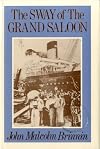
The Sway of the Grand Saloon: A Social History of the North Atlantic
by John Malcolm Brinnin
On This Page
Description
"In January 1818, six hardy souls made the first scheduled Atlantic passenger ship crossing, and a new industry was born. Reckless competition, horrific disasters, and human dramas shaped it. But with Jenny Lind, Lily Langtry, Ralph Waldo Emerson, Oscar Wilde, and Mark Twain among the newsmakers who decorated passenger lists, the liners' appeal proved irresistible. Business flourished and with it adventure and romance. By 1900, the Golden Age was in full swing. The great liners with their show more grand "saloons" became playgrounds for gilded society and magnets for the rising middle class. But danger was ever threatening. In 1912, an iceberg ripped open the Titanic, a tragedy in which John Jacob Astor's heroism made history. In 1915, the torpedoed Lusitania went down with Alfred Gwynne Vanderbilt, who refused to rush for the lifeboats, and in 1956 the Andrea Doria, victim of a collision, shattered yet again the myth of unsinkability. During the 1950s, the proud transatlantic liners steamed off the front page of history, victims of inexpensive air travel. John Malcolm Brinnin's unerring eye for fascinating details captures the excitements and traumas of a splendid century. Through the triumphs and tragedies of Inman, Cunard, Brunel, and their fellow titans, Brinnin tells how the grand saloons shaped architecture, design, and fashion - creating a world of unforgettable interest."-- show lessTags
Recommendations




































Member Recommendations






Member Reviews
Image that! Here was one, enjoying a deeply researched yet well-written narrative HISTORY book on long-gone passenger ships and historical Atlantic shipping lines to discover that – having sailed past many of these liners, and actually served as a steward on one and been a passenger on another - that one now must form part of history oneself. Bit disconcerting.
And a thoroughly enjoyable book it is too, Brinnin brings alive the Brunel and Cunard ambitions and achievements and writes the adventure-story of the challenges and competition of the early transatlantic crossings, by steam rather than the glorious ”cloud driven” sailing packets and schooners of the East Coast and the Maritimes. From the first ‘hybrids’ of show more steam-assisted clippers through to the close of the glorious trade of the super-liners with their swaying Grand Saloons the author humanizes a history peopled by many strong and daring characters (Captains Preserved Fish and Pardon Gifford) but always dominated by the Halifax based Cunarders.
Originally an immigrant family from the Rhine the Kunders became Cunard – one of the most recognized and the longest lasting shipping families in the Maritimes. The pages (and excellent index and bibliography) echo with the glorious names – the Aquitaine, Great Eastern and Western, the Queens, America, Bremen, Lusitania … and, of course, RMS Titanic.
Against all current business sense and advice, Sir Samuel Cunard alone bid compliantly to the demands of the Victorian government (with the Royal Navy in the background thinking ahead to alternative uses of such a fine training ground) for fast, reliable and steam-driven fleet to be awarded the rights – with accompanying guaranteed subsidiary – to carry the Royal Mails across the Atlantic. Hence the prefix of RMS on these great majestic ships.
Finally their glorious reign was ended by cheap and – nowadays spartan and arrogant – air service, the need for a regular crossing was being satisfied by the end of the 1960’s by multiple flag-carriers. Only in the cruise ships – those massive and probably far less seaworthy floating hotels – are there any slight echoes of the grandeur and luxury of those Grand and Swaying Saloons. show less
And a thoroughly enjoyable book it is too, Brinnin brings alive the Brunel and Cunard ambitions and achievements and writes the adventure-story of the challenges and competition of the early transatlantic crossings, by steam rather than the glorious ”cloud driven” sailing packets and schooners of the East Coast and the Maritimes. From the first ‘hybrids’ of show more steam-assisted clippers through to the close of the glorious trade of the super-liners with their swaying Grand Saloons the author humanizes a history peopled by many strong and daring characters (Captains Preserved Fish and Pardon Gifford) but always dominated by the Halifax based Cunarders.
Originally an immigrant family from the Rhine the Kunders became Cunard – one of the most recognized and the longest lasting shipping families in the Maritimes. The pages (and excellent index and bibliography) echo with the glorious names – the Aquitaine, Great Eastern and Western, the Queens, America, Bremen, Lusitania … and, of course, RMS Titanic.
Against all current business sense and advice, Sir Samuel Cunard alone bid compliantly to the demands of the Victorian government (with the Royal Navy in the background thinking ahead to alternative uses of such a fine training ground) for fast, reliable and steam-driven fleet to be awarded the rights – with accompanying guaranteed subsidiary – to carry the Royal Mails across the Atlantic. Hence the prefix of RMS on these great majestic ships.
Finally their glorious reign was ended by cheap and – nowadays spartan and arrogant – air service, the need for a regular crossing was being satisfied by the end of the 1960’s by multiple flag-carriers. Only in the cruise ships – those massive and probably far less seaworthy floating hotels – are there any slight echoes of the grandeur and luxury of those Grand and Swaying Saloons. show less
The Sway of the Grand Saloon is a minutely detailed account of shipping and travel over the North Atlantic from the days of sail, through the development of steam power, and into the 20th century. It’s filled with the people, politics, commerce, and engineering that seems so commonplace today that we forget how difficult it was. Full of toothsome facts, they sometimes get lost in the laborious tendency of historians for multi-claused sentences that can dawdle for half a page until the reader forgets the point. Nonetheless, it’s a very useful reference for anyone with an interest in shipping.
Ratings
Members
- Recently Added By
Published Reviews
It's the kind of book that has gone the way of the leviathan ocean liners that it chronicles: vast, ornate, eclectic, high-toned. For all its datedness, however, The Sway of the Grand Saloon conveys its rich material in ways that might elude contemporary argument- or narrative-driven histories.
Brinnin was a man of letters -- another now-archaic category -- and his scope in Sway is not show more documentary history alone, but literature, popular culture, journalism, engineering, and even ancillary fields like medicine (to witness the discovery of Dramamine) and art history (to relate how Blue Boy came to reside in the Huntington Gallery). In his voracious interdisciplinary reading, Brinnin anticipated the purview of cultural studies, if none of its theoretical or political underpinnings. show less
Brinnin was a man of letters -- another now-archaic category -- and his scope in Sway is not show more documentary history alone, but literature, popular culture, journalism, engineering, and even ancillary fields like medicine (to witness the discovery of Dramamine) and art history (to relate how Blue Boy came to reside in the Huntington Gallery). In his voracious interdisciplinary reading, Brinnin anticipated the purview of cultural studies, if none of its theoretical or political underpinnings. show less
added by John_Vaughan
Author Information

20+ Works 731 Members
Awards and Honors
Awards
Common Knowledge
- Original publication date
- 1971
- People/Characters
- Albert Ballin; James Gordon Bennett; Isambard Kingdom Brunel; Christopher Claxton; Edward Knight Collins; Samuel Cunard (show all 12); Thomas C. Haliburton; William Inman; J. P. Morgan; Richard Roberts, steamship captain; Junius Smith; Cornelius Vanderbilt
- Important places
- Atlantic Ocean; North Atlantic Ocean
- Important events
- Sinking of the Lusitania (1915-05-07); Sinking of the Titanic (1912-04-14 | 1912-04-15); Launch of the Great Eastern
- Dedication
- For
JACK THOMPSON
of Columbia, Missouri,
who piped me aboard - First words
- Author's Preface -- Not long ago I boarded the rubber duck of a ferryboat that crosses Halifax Harbor, got off on the Dartmouth side and stepped forty years back into a neighborhood I used to know.
January 5, 1818. A small blizzard, skittering down Broadway, suddenly envelops that "immense pile" of red brick, five stories high, known as the City Hotel, then blusters on toward the tip of Manhattan and out across the harb... (show all)or. - Last words
- (Click to show. Warning: May contain spoilers.)Indifferent to the moment, untouched by the claims of history, youngsters not yet born with the two Queens were the newest wonders of the world cling together in adolescent parodies of passion and do not bother even to look up. As the darkness closes over and the long wakes are joined, the sentimentalists stand for a while watching the ocean recover its seamless immensity. Then, one by one, like people dispersing downhill after a burial, they find their way to their cabins and close their doors.
- Canonical DDC/MDS
- 387.162091821
- Canonical LCC
- HE599
Classifications
- Genres
- Nonfiction, History, General Nonfiction, Travel
- DDC/MDS
- 387.162091821 — Society, government, & culture Commerce, communications & transportation regulations Water, air, space transportation Lighthouses
- LCC
- HE599 — Social sciences Transportation and communications Transportation and communications Water transportation Shipping
Statistics
- Members
- 128
- Popularity
- 254,885
- Reviews
- 2
- Rating
- (3.55)
- Languages
- English
- Media
- Paper
- ISBNs
- 5
- ASINs
- 6