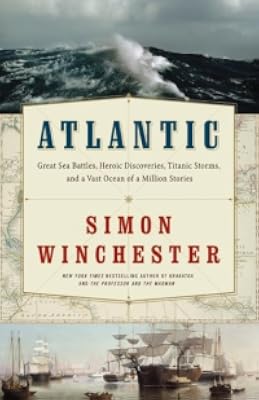
Atlantic: Great Sea Battles, Heroic Discoveries, Titanic Storms,and a Vast Ocean of a Million Stories
by Simon Winchester
On This Page
Description
Until a thousand years ago, no humans ventured into the Atlantic or imagined traversing its vastness. But once the first daring mariners successfully navigated to far shores, whether it was the Vikings, the Irish, the Chinese, Christopher Columbus in the north, or the Portuguese and the Spanish in the south, the Atlantic evolved in the world's growing consciousness of itself as an enclosed body of water bounded by the Americas to the West, and by Europe and Africa to the East. This book is a show more biography of this immense space, of a sea which has defined and determined so much about the lives of the millions who live beside or near its tens of thousands of miles of coast. The Atlantic has been central to the ambitions of explorers, scientists and warriors, and it continues to affect our character, attitudes, and dreams. The author chronicles that relationship, making the Atlantic come vividly alive.--From publisher description. show lessTags
Recommendations













Member Recommendations






Member Reviews
Oceans have always held a certain mystique for me. I've lived most of my life around the Chesapeake Bay, tidewater Virginia and the Gulf of Mexico, so there's something in me that resonates with the waves. Spending time on the water is something I rarely get to do, but always attracts me, and one of these days I'm going to learn to sail. So when Simon Winchester, author of the excellent Krakatoa among many others, wrote a biography of the Atlantic Ocean, it didn't take long to add it to my reading list.
Winchester calls this book a biography and uses the Shakespearean ages of man to frame the story of human interaction with the Atlantic through early history through modern day and into the near future. It's an interesting approach - show more treating this geological feature as a living entity that changes and grows and ages - that allows for discussion of how *we've* changed in our thoughts, beliefs and uses of the Atlantic. This approach runs the risk of anthropomorphizing an inanimate collection of chemistry, geology and biology, but Winchester doesn't fall into that trap. The book's more about us than about the ocean.
The other risk of such a work is the potential for descent into polemic. Any discussion of the history of human interaction with the Atlantic naturally has to touch on climate change and the impact of centuries of sometimes thoughtless or uncaring use of the resources there. Winchester doesn't flinch from subjects like the annihilation of cod fishing off Newfoundland from incredibly stupid resource management, but he also tells when the opposite is true - like the protection of the fish marketed as Chilean sea bass off the Falkland Islands. There's also a nice discussion of documentable changes in the Atlantic that are related to warming in the atmosphere and water and how these changes affect human both on the water and on land; this discussion stays factual and makes it clear that there's a lot we don't understand about the connection between greenhouse gas buildup and changes in the Atlantic, but also clearly makes the point that there is indeed a connection.
At the end of the day, Winchester leaves the Atlantic in an unknown place. We don't know what the end result of human-induced changes will be. We don't know how natural cycles will affect the ocean as we know it now. We seem to be changing our priorities in interacting with the ocean and in how we manage resources, but it may be too late to fix some problems. Ultimately, though, the Atlantic will be here long after we are - until the continents shift enough to rearrange the face of the Earth. show less
Winchester calls this book a biography and uses the Shakespearean ages of man to frame the story of human interaction with the Atlantic through early history through modern day and into the near future. It's an interesting approach - show more treating this geological feature as a living entity that changes and grows and ages - that allows for discussion of how *we've* changed in our thoughts, beliefs and uses of the Atlantic. This approach runs the risk of anthropomorphizing an inanimate collection of chemistry, geology and biology, but Winchester doesn't fall into that trap. The book's more about us than about the ocean.
The other risk of such a work is the potential for descent into polemic. Any discussion of the history of human interaction with the Atlantic naturally has to touch on climate change and the impact of centuries of sometimes thoughtless or uncaring use of the resources there. Winchester doesn't flinch from subjects like the annihilation of cod fishing off Newfoundland from incredibly stupid resource management, but he also tells when the opposite is true - like the protection of the fish marketed as Chilean sea bass off the Falkland Islands. There's also a nice discussion of documentable changes in the Atlantic that are related to warming in the atmosphere and water and how these changes affect human both on the water and on land; this discussion stays factual and makes it clear that there's a lot we don't understand about the connection between greenhouse gas buildup and changes in the Atlantic, but also clearly makes the point that there is indeed a connection.
At the end of the day, Winchester leaves the Atlantic in an unknown place. We don't know what the end result of human-induced changes will be. We don't know how natural cycles will affect the ocean as we know it now. We seem to be changing our priorities in interacting with the ocean and in how we manage resources, but it may be too late to fix some problems. Ultimately, though, the Atlantic will be here long after we are - until the continents shift enough to rearrange the face of the Earth. show less
This book takes the reader on a journey not only across a body of water,
but across time itself. It is not only a personal journey of the authors to
first cross and then understand this body of water, but a story of the life of the
sea and those whose lives are linked to it.
Some of the most interesting points for me were the historical facts surrounding
the discovery of America itself. The men who crafted the boats that made their
way across what was then a much more treacherous body of water than we have today.
More treacherous only because it was so unknown. Although the Atlantic is still
a force to be reckoned with, we do know and understand her a bit better.
A map found in the fifties first seemed to point to the fact that it was the Norse show more to find America
first. This map ended up in the hands of Yale university, and this is where the real controversy began.
Soon more maps and copies of a document drawn in 1570 was more important and more easily confirmed to be valid.
Further investigation , years later.. found a Norse settlement on the northern tip of Newfoundland, of what
were obviously Norse ruins. There was much here that I did not know. Amerigo Vespucci of course takes the prize, as North and South America where given his name after he publishes his account of a new continent being discovered, not just a bit of land or an island.
The author manages to tell the tale of an ocean with style. Often amusing and always able to hold onto the readers interest. He brings forth poetry, art and even music as being influenced by the great Atlantic. Shakespeare himself is given credit for the Atlantic's role in his play The Tempest.
We hear about islands once mapped that never existed. We are reminded of the effect of the Atlantic on business.
Who for instance looks out onto that great expanse and thinks of the cables laid beneath the water?
Finally, we are reminded that the world today is so much smaller than it once was. An unmapped body of water that was once unknown, is now crossed daily both by air and on the sea itself. Where once great and fearless explorers left their home ports to see if it was true that they might fall off the edge of the earth, today teenagers make ill advised crossings on their own. Or, at least make the attempt.
Even though today we have learned so much more than was known when the Norse and the Spanish explorers made their way across its waters, the Atlantic is still a force to be reckoned with. Even though we now have the tools to find most of her secrets, I suspect that there will always be a few left for generations to come to discover. I confess that I never gave much thought to the life of the sea itself. Any musings I have had were centered on the life within the sea or around it. Reading this book by Winchester has opened up a whole new perspective for me.
Finally, we see how climate changes are affecting the Atlantic and thus the planet. I suspect that this is
one of the reasons this book was written. WE need to acknowledge and try to understand that the effects that we have on the planet are fall from small, and will most likely have some serious effects on our way of life before much more time has passed. show less
but across time itself. It is not only a personal journey of the authors to
first cross and then understand this body of water, but a story of the life of the
sea and those whose lives are linked to it.
Some of the most interesting points for me were the historical facts surrounding
the discovery of America itself. The men who crafted the boats that made their
way across what was then a much more treacherous body of water than we have today.
More treacherous only because it was so unknown. Although the Atlantic is still
a force to be reckoned with, we do know and understand her a bit better.
A map found in the fifties first seemed to point to the fact that it was the Norse show more to find America
first. This map ended up in the hands of Yale university, and this is where the real controversy began.
Soon more maps and copies of a document drawn in 1570 was more important and more easily confirmed to be valid.
Further investigation , years later.. found a Norse settlement on the northern tip of Newfoundland, of what
were obviously Norse ruins. There was much here that I did not know. Amerigo Vespucci of course takes the prize, as North and South America where given his name after he publishes his account of a new continent being discovered, not just a bit of land or an island.
The author manages to tell the tale of an ocean with style. Often amusing and always able to hold onto the readers interest. He brings forth poetry, art and even music as being influenced by the great Atlantic. Shakespeare himself is given credit for the Atlantic's role in his play The Tempest.
We hear about islands once mapped that never existed. We are reminded of the effect of the Atlantic on business.
Who for instance looks out onto that great expanse and thinks of the cables laid beneath the water?
Finally, we are reminded that the world today is so much smaller than it once was. An unmapped body of water that was once unknown, is now crossed daily both by air and on the sea itself. Where once great and fearless explorers left their home ports to see if it was true that they might fall off the edge of the earth, today teenagers make ill advised crossings on their own. Or, at least make the attempt.
Even though today we have learned so much more than was known when the Norse and the Spanish explorers made their way across its waters, the Atlantic is still a force to be reckoned with. Even though we now have the tools to find most of her secrets, I suspect that there will always be a few left for generations to come to discover. I confess that I never gave much thought to the life of the sea itself. Any musings I have had were centered on the life within the sea or around it. Reading this book by Winchester has opened up a whole new perspective for me.
Finally, we see how climate changes are affecting the Atlantic and thus the planet. I suspect that this is
one of the reasons this book was written. WE need to acknowledge and try to understand that the effects that we have on the planet are fall from small, and will most likely have some serious effects on our way of life before much more time has passed. show less
Winchester took on a huge, and probably impossible, task in "Atlantic". Telling the history of this ocean clearly isn't something that can be accomplished in one book.
That said, the author once again makes what could have been a dreary, boring tale of statistics into an intimate and interesting story, using the Seven Ages of Man as his controlling metaphor. This reader, at least, was pulled along and found very few dragging spots.
Among other aspects of the Atlantic, Winchester discusses the slave trade and the destruction of the Outer Banks cod fisheries--for both of which mankind should be deeply ashamed--to demonstrate mankind's more disgusting uses of what should be one of our greatest treasures.
All in all, a worthwhile read. I could show more have done with much more about the flora and fauna, but that's my own prejudice. show less
That said, the author once again makes what could have been a dreary, boring tale of statistics into an intimate and interesting story, using the Seven Ages of Man as his controlling metaphor. This reader, at least, was pulled along and found very few dragging spots.
Among other aspects of the Atlantic, Winchester discusses the slave trade and the destruction of the Outer Banks cod fisheries--for both of which mankind should be deeply ashamed--to demonstrate mankind's more disgusting uses of what should be one of our greatest treasures.
All in all, a worthwhile read. I could show more have done with much more about the flora and fauna, but that's my own prejudice. show less
The "big picture" history book most popular these days is the magical mystery tour variety. These narratives combine a bunch of things - biography, science, cultural studies, geography, travelogue, personal essays, military studies, and traditional history - via a common nexus. It's usually, oddly, a food - cod, salt, coffee, spices.
Winchester's nexus is a body of water, but it works the same way. Bored with one topic, 20 pages later you're on to a new one.
I don't have anything against these kind of books, but, as the saying goes, "too many books, too little time". The only reason I read this one was Winchester's formal training as a geologist and his enjoyable The Map That Changed the World: William Smith and the Birth of Modern show more Geology, a biography of biostratigraphy's inventor.
And I wasn't disappointed. Winchester frames his story between the Atlantic's geological past and its projected future. In between, using the conceit of Shakespeare's Seven Ages of Man, we get the story of that ocean's influence on science, exploration, business, and warfare. That means, among other things, slavery, pirates, oceanography, whaling, Vikings, Basques, Spanish colonization, submarine warfare, Trafalgar, transatlantic flights, shipping containers, and the Skeleton Coast,
My favorite parts were, besides the geology, the business section with the American development of packet ships and the laying of the first transatlantic submarine cables. I was also entertained by Winchester's personal reminisces of being a geology student literally stranded in the wilds of Greenland with the prospect of wintering there and a gloating Argentinean naval officer he met while imprisoned during the Falklands War.
But it was all well written with no section too long to wear out your patience -- or satisfy a deep curiosity on a subject. That's the nature of these books.
Winchester does address a couple of important contemporary issues. He gives an account on how the Newfoundland Bank cod fishery collapsed and the possibility of other fisheries being protected on the model of the British administration of the waters around South Georgia Island. He gives a nuanced look at the possible perils of global warming - while not unskeptically throwing his lot in with the anthropogenic warming crowd or faithfully thinking that carbon trading will work. He also shows, whatever the truth about global warming and its cause, it doesn't seem well linked to increased incidence of hurricanes. show less
Winchester's nexus is a body of water, but it works the same way. Bored with one topic, 20 pages later you're on to a new one.
I don't have anything against these kind of books, but, as the saying goes, "too many books, too little time". The only reason I read this one was Winchester's formal training as a geologist and his enjoyable The Map That Changed the World: William Smith and the Birth of Modern show more Geology, a biography of biostratigraphy's inventor.
And I wasn't disappointed. Winchester frames his story between the Atlantic's geological past and its projected future. In between, using the conceit of Shakespeare's Seven Ages of Man, we get the story of that ocean's influence on science, exploration, business, and warfare. That means, among other things, slavery, pirates, oceanography, whaling, Vikings, Basques, Spanish colonization, submarine warfare, Trafalgar, transatlantic flights, shipping containers, and the Skeleton Coast,
My favorite parts were, besides the geology, the business section with the American development of packet ships and the laying of the first transatlantic submarine cables. I was also entertained by Winchester's personal reminisces of being a geology student literally stranded in the wilds of Greenland with the prospect of wintering there and a gloating Argentinean naval officer he met while imprisoned during the Falklands War.
But it was all well written with no section too long to wear out your patience -- or satisfy a deep curiosity on a subject. That's the nature of these books.
Winchester does address a couple of important contemporary issues. He gives an account on how the Newfoundland Bank cod fishery collapsed and the possibility of other fisheries being protected on the model of the British administration of the waters around South Georgia Island. He gives a nuanced look at the possible perils of global warming - while not unskeptically throwing his lot in with the anthropogenic warming crowd or faithfully thinking that carbon trading will work. He also shows, whatever the truth about global warming and its cause, it doesn't seem well linked to increased incidence of hurricanes. show less
I love Simon Winchester: Best selling author, broadcaster, journalist at The Guardian. I've been lucky enough to hear him speak and found him charming and delightful. A biography of the Atlantic Ocean would seem a huge and daunting task, even to such an accomplished writer. He fairly says as much while explaining his decision to use Shakespeare's "Seven Ages of Man" as an organizing literary device. We see the youth of early geological formation and exploration, the soldiers of the many wars waged on her expanse and are given a hint of her tectonic demise. Throughout is a fact-o-rama of tidbits, tales, personal stories and anecdotes. If one 'age' doesn't catch your fancy, stick around as Winchester quickly moves along to yet another show more interesting and unknown account. Some narratives worked less well for me than others. I would suggest this as a book to graze through rather than trying to swallow in one large gulp. show less
It's an odd sort of history that focuses not on any one civilization or time period but on their absence. This ambitious work seeks to recount the history of the Atlantic, beginning with its formation by the splitting of the continents and concluding with its ultimate death by their eventual reunion. In between the author will touch upon many peoples and subjects. Travel, exploration, fishing, warfare and discovery. This book is fascinating and multifaceted though not uniformally interesting. Some parts dragged for me, while I wanted others to be longer. A masterful, and ultimately thought provoking look at the ocean that divides the old world from the new.
I loved the context Winchester gave to what was, in general, a very interesting set of facts and stories, many of which would be hard to fit into any type of anthology. What bothered me was the intense ethnocentricity of the book: after the first few chapters, the African continent becomes almost forgotten, and the importance and historic significance of the slave trade is ignored. Commerce and cultural development relating to the Caribbean as well, I believed, deserved a great deal more attention. In reference to the Spanish Basque presence in North America, I have read accounts that disagree with Winchester's, but I do not know who is correct.
In general, however, I have to say that I thoroughly enjoyed what Winchester did choose to show more include as well as the framework he created for it. show less
In general, however, I have to say that I thoroughly enjoyed what Winchester did choose to show more include as well as the framework he created for it. show less
Members
- Recently Added By
Published Reviews
added by John_Vaughan
Lists

r/AskHistorians' Recommended Books
1,068 works; 18 members

2024 Reading List
49 works; 1 member
Author Information

53+ Works 38,651 Members
Simon Winchester was born in London, England on September 28, 1944. He read geology at St. Catherine's College, Oxford. After graduation in 1966, he joined a Canadian mining company and worked as field geologist in Uganda. The following year he decided to become a journalist. His first reporting job was for The Journal, Newcastle upon Tyne. In show more 1969, he joined The Guardian and was named Britain's Journalist of the Year in 1971. He also worked for the Daily Mail and the Sunday Times before becoming a freelancer. He is the author of numerous books including In Holy Terror, The River at the Center of the World, The Alice Behind Wonderland, The Professor and the Madman: A Tale of Murder, Insanity, the Making of the Oxford English Dictionary, and.Exactly: How Precision Engineers Created the Modern World. In 2006, he was made an Officer of the Order of the British Empire for services to journalism and literature. (Bowker Author Biography) show less
Some Editions
Awards and Honors
Common Knowledge
- Canonical title*
- Atlantico
- Alternate titles
- Atlantic: Great Sea Battles, Heroic Discoveries, Titanic Storms,and a Vast Ocean of a Million Stories; Atlantic: A Vast Ocean of a Million Stories; Atlantic: The Biography of an Ocean
- Original publication date
- 2010
- Important places
- Atlantic Ocean
- Epigraph
- Men might as well project a voyage to the Moon, as attempt to employ steam navigation against the stormy North Atlantic Ocean.Dionysius Lardner, Irish scientific writer and lecturer, 1838
- Dedication
- This book is for Setsuko and in memory of Angus Campbell MacintyreFirst mate of the South African Harbour Board tug Sir Charles Elliott who died in 1942, trying to save lives and whose body lies unfound somewhere in th... (show all)e Atlantic Ocean
- First words
- (Preface) The ocean romance that lies at the heart of this book was primed for me by an unanticipated but unforgettable small incident.
(Prologue) A big ocean - and the Atlantic is a very big ocean indeed - has the appearance of a settled permanence.
The Kingdom of Morocco has on its most widely used currency bill neither a camel nor a minaret nor a Touareg in desert blue, but the representation of the shell of a very large snail. - Last words
- (Click to show. Warning: May contain spoilers.)Some peculiar things are happening in the North Atlantic Ocean, and no one is quite sure why.
(Click to show. Warning: May contain spoilers.)The tiny lighthouse they call the lighthouse at the end of the world will one day meet up with another of its kind that presently stands ten thousand miles away on the far side of the globe. - Original language
- English
*Some information comes from Common Knowledge in other languages. Click "Edit" for more information.
Classifications
- Genres
- General Nonfiction, History, Science & Nature, Nonfiction, Travel
- DDC/MDS
- 551.4613 — Natural sciences & mathematics Earth sciences; geology Geology, Hydrology Meteorology Landforms / Bodies of Water Oceans Atlantic; North Sea; Baltic
- LCC
- GC481 .W56 — Geography, Anthropology and Recreation Oceanography Oceanography Oceanography. By region
- BISAC
Statistics
- Members
- 1,515
- Popularity
- 15,230
- Reviews
- 61
- Rating
- (3.55)
- Languages
- 5 — English, German, Italian, Norwegian (Bokmål), Portuguese
- Media
- Paper, Audiobook, Ebook
- ISBNs
- 26
- ASINs
- 15