
A Voyage Long and Strange: Rediscovering the New World
by Tony Horwitz
On This Page
Description
An irresistible blend of history, myth, and misadventure, A Voyage Long and Strange captures the wonder and drama of first contact. Vikings, conquistadors, French voyageurs--these and many others roamed an unknown continent in quest of grapes, gold, converts, even a cure for syphilis. Though most failed, their remarkable exploits left an enduring mark on the land and people encountered by late-arriving English settlers.--From publisher description.Tags
Recommendations















Member Recommendations

Member Reviews
Horwitz's voyages around the flashpoints of 'first contact' in North America are not so much strange as frustrating and inconclusive - not for us, mind you, but for him. Aware from the start that so much of what 'actually happened' is shrouded in myth, he wants, if he can, to discover whatever shreds of 'true fact' might still remain to be gleaned about the first explorers to the continent, focusing primarily on those who came funded by the Spanish or the English. (Champlain is mysteriously omitted.) Horwitz's method is to read extensively, decide on a strategy (people to meet and places to go), but once there, Horwitz is able to remain faithful to his set desires (say, to go out on the Mississippi or meet a member of the Pamunkey tribe show more in Virginia) while also being flexible and open-minded and that is the at the heart of what makes his quests so enjoyable. He isn't shy of admitting despair and defeat, so his stories are always as much about the present day and how people perceive the past (including himself) as the attempt to unearth and expose 'the truth'. He's in the story without taking it over, so that you feel, as a reader, that you could almost be him (if you were a little braver and more persistent). Beginning with the Vikings remote settlement in the far north, he then follows Columbus, Coronado, de Vaca, De Soto, Ponce de Leon, Ribault (the lone Frenchman in Florida), Menendez, John Smith, Pocohontas, Gosnold and finally, Plymouth. Over and over again, reasonable to decent intentions disintegrate into misunderstandings and bloodbaths - truly it is a tale of woe and destruction. The present-day myths we've plastered over the 'real' story, however, have become part of the story, and Horwitz concludes wisely that what we imagine, rightly or wrongly, ends up informing and determining the present - not that what 'really happened' becomes irrelevant, but that disentangling the threads is not do-able. There was plenty I didn't know, the tension, for example, in St. Augustine, Florida, the tension between Protestant and Catholic perceptions - it's not a big thing, but I didn't know it existed at all. The image of the Spanish conquistadors wandering through the prairies first clad in armor and eventually in nothing but old skins, is one I won't let go of quickly. I could ramble on but suffice it to say that it's a fine read, informative and lively, and the sort of book I would take with me on a driving tour around the US. **** show less
Not what I was expecting, and I usually shy away from the journalistic travel memoir, but I was pleasantly surprised. Mainly because Horwitz gets his history quite right, researches deeply, and even discusses scholarly disagreements and controversies. His "Note on Sources" is scholarly, thorough, and interesting. I knew of most of these pre-Pilgrim voyages, as I teach U.S. history, but it was good to read this account. I learned more about the Vikings particularly. Good maps, but I wish that there were more images (I usually do). And he didn't address (except a passing reference) the Spanish settlement in Virginia called Ajacán and the intriguing (and unlikely theory) that Opechancanough was Don Luis (a.k.a. Paquiquino). Look it up.
Horwitz journeys through America to the places where the earliest European adventurers appeared. Sometimes condescending, the author succeeds in his plot to learn more about the time between Columbus and Jamestown, and passes his thoughts on to readers who he hopes are interested enough in history to care. Well-developed and written with plenty of sarcastic humor, be prepared for his sometimes smart-aleck attitudes about life then and now.
Reclaiming the historical muckraker mantle he donned in Confederates in the Attic, Tony Horwitz goes a little further back in time in his latest book, A Voyage Long and Strange (Holt). After coming to the realization - during a visit to the underwhelming pebble that is Plymouth Rock - that he didn't know much about what happened on the American continents between 1492 and 1620 ("This wasn't a gap in my education; it was a chasm", he writes), Horwitz decides to both brush up on his history and explore how the historical landscapes compare with their contemporary counterparts.
To that end, he sets off on wild journeys in the footsteps of the early explorers: Newfoundland with the Vikings, the Southwest's "pueblo country" with Coronado, the show more swamps and river valleys of the Southeast with De Soto, the Florida coast with a bunch of French Huguenots in the 1560s, and the Jamestown region with Captain John Smith (among others). Alternating brief historical essays with accounts of his own travels, Horwitz offers a rollicking (if slightly selective) tour of the American backcountry (it was all backcountry then, and some parts still are). He comes away from it all with a new perspective on the early explorers, lauding (?) the Spaniards for a "tenacity that bordered on derangement," (p. 192) and noting his newfound amazement not that so many Europeans died in trying to scratch a foothold in the Americas, but that any lived at all.
One of the most fascinating parts of the book to me was Horwitz' painstaking research into the native cultures of the areas tromped through by the European invaders - not only through historical records, but also by going to the areas today (including Zuni territory in New Mexico and Pamunkey lands in Virginia) and meeting with current members of the native groups. It's easy to come away from the European travel accounts without a good (or complete) sense of who they were meeting, interacting with (and, usually, not treating very well at all).
As usual, Horwitz meets a long list of strange folks along the way; those characters make his books what they are, and those he meets during the course of these travels are quite a bunch. The book's worth reading just for them.
Throughout the book, Horwitz asks how it is American memory has chosen to prioritize the Pilgrims. In the final paragraphs, after musing about tourist traps and historical memory, he concludes "The past was a consumable, subject to the national preference for familiar products. And history, in America, is a dish best served plain. The first course could include a dollop of Indian in 1492, but not Spanish spice or French sauce or too much Indian corn. Nothing too filling or fancy ahead of the turkey and pumpkin pie, just the way Grandma used to cook it."
Deluded we stand? Perhaps. But Horwitz' book offers a good route into the forgotten history of the first American centuries, and for that reason is highly recommended.
http://philobiblos.blogspot.com/2008/05/book-review-voyage-long-and-strange.html show less
To that end, he sets off on wild journeys in the footsteps of the early explorers: Newfoundland with the Vikings, the Southwest's "pueblo country" with Coronado, the show more swamps and river valleys of the Southeast with De Soto, the Florida coast with a bunch of French Huguenots in the 1560s, and the Jamestown region with Captain John Smith (among others). Alternating brief historical essays with accounts of his own travels, Horwitz offers a rollicking (if slightly selective) tour of the American backcountry (it was all backcountry then, and some parts still are). He comes away from it all with a new perspective on the early explorers, lauding (?) the Spaniards for a "tenacity that bordered on derangement," (p. 192) and noting his newfound amazement not that so many Europeans died in trying to scratch a foothold in the Americas, but that any lived at all.
One of the most fascinating parts of the book to me was Horwitz' painstaking research into the native cultures of the areas tromped through by the European invaders - not only through historical records, but also by going to the areas today (including Zuni territory in New Mexico and Pamunkey lands in Virginia) and meeting with current members of the native groups. It's easy to come away from the European travel accounts without a good (or complete) sense of who they were meeting, interacting with (and, usually, not treating very well at all).
As usual, Horwitz meets a long list of strange folks along the way; those characters make his books what they are, and those he meets during the course of these travels are quite a bunch. The book's worth reading just for them.
Throughout the book, Horwitz asks how it is American memory has chosen to prioritize the Pilgrims. In the final paragraphs, after musing about tourist traps and historical memory, he concludes "The past was a consumable, subject to the national preference for familiar products. And history, in America, is a dish best served plain. The first course could include a dollop of Indian in 1492, but not Spanish spice or French sauce or too much Indian corn. Nothing too filling or fancy ahead of the turkey and pumpkin pie, just the way Grandma used to cook it."
Deluded we stand? Perhaps. But Horwitz' book offers a good route into the forgotten history of the first American centuries, and for that reason is highly recommended.
http://philobiblos.blogspot.com/2008/05/book-review-voyage-long-and-strange.html show less
A Voyage Long and Strange: Rediscovering the New World by Tony Horwitz has been on the shelf for awhile. I chose it as a companion to Gwendolyn Brooks' memoir of his sudden death.
Horwitz decides to figure out what happened between Columbus and the Pilgrims, some 150 years of history that have become obscured and mythologized (think the fountain of youth) in our understanding of our past. The result of his extensive travel and research is a book that helps us truly understand what our continent meant to early explorers. And, as Horwitz does so well, he used his interviews and observations to teach us lessons about ourselves.
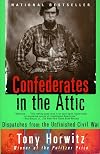
One of my favorite books of all time was his homage to southern culture, Confederates in the Attic. He used similar show more tactics of getting involved in various activities and groups then reporting what he learned with a bemused kind of attitude. There is judgement in some cases, particularly in terms of the treatment of indigenous populations and the slaves that soon followed. But he also shows the tensions in those relationships as marginalized groups tried and continue to try to figure out how to succeed in a white European dominated world.
The last section of the book focused on John Smith and Jamestown, which I see every time I take the ferry to Williamsburg. He also talked about the Pamunkey Indians who have a small reservation along Route 5, a road I travel often, passing by signs for the plantations that pushed out Indians and used slave labor to make their fortunes. show less
Horwitz decides to figure out what happened between Columbus and the Pilgrims, some 150 years of history that have become obscured and mythologized (think the fountain of youth) in our understanding of our past. The result of his extensive travel and research is a book that helps us truly understand what our continent meant to early explorers. And, as Horwitz does so well, he used his interviews and observations to teach us lessons about ourselves.
One of my favorite books of all time was his homage to southern culture, Confederates in the Attic. He used similar show more tactics of getting involved in various activities and groups then reporting what he learned with a bemused kind of attitude. There is judgement in some cases, particularly in terms of the treatment of indigenous populations and the slaves that soon followed. But he also shows the tensions in those relationships as marginalized groups tried and continue to try to figure out how to succeed in a white European dominated world.
The last section of the book focused on John Smith and Jamestown, which I see every time I take the ferry to Williamsburg. He also talked about the Pamunkey Indians who have a small reservation along Route 5, a road I travel often, passing by signs for the plantations that pushed out Indians and used slave labor to make their fortunes. show less
Since I am a fan of Horwitz's wife, Geraldine Brooks, I thought I'd pick up this work of historical investigative journalism from her husband. Traveling with him to discover the history of North America before and until the Pilgrims landed at Plymouth, was a treat.
This is not a romanticized version of what happened. He takes pains to interview not only historians but ancestors of the Native Americans whose heritage was completely upended as well. At times it was funny, his description of his experiences in a Micmac sweatlodge had me laughing. Things he found out about Hernando de Soto made me furious. But no matter where he was in the Carribean or the United States, and no matter whose historical record he was examining, I was show more fascinated. The pages turned themselves.
This is not really a feel-good story for any of us. But Horwitz did his best to find the truth of what happened. The result is a satisfying read. show less
This is not a romanticized version of what happened. He takes pains to interview not only historians but ancestors of the Native Americans whose heritage was completely upended as well. At times it was funny, his description of his experiences in a Micmac sweatlodge had me laughing. Things he found out about Hernando de Soto made me furious. But no matter where he was in the Carribean or the United States, and no matter whose historical record he was examining, I was show more fascinated. The pages turned themselves.
This is not really a feel-good story for any of us. But Horwitz did his best to find the truth of what happened. The result is a satisfying read. show less
I paid attention in history class. Either I missed the significance of most of the content Tony Horwitz covers in this book, or it simply wasn't included in my textbooks. Horwitz looks at European contact with the New World of North America preceding the Mayflower's arrival at Plymouth. From this perspective, the settlement at Plymouth marked the end of an era rather than a beginning.
The biggest surprises for me involved Spanish expeditions in what is now the United States. I had no idea that Spanish conquistadors traveled outside of the southwestern states, Florida, and the Gulf Coast. It was a revelation to learn that Coronado's route took him into the heart of Kansas. It was an even bigger revelation to learn that De Soto's route show more went right through my home territory of East Tennessee. Yes, I knew he had discovered the Mississippi River, but I had formed an erroneous impression that he discovered it by navigating up from the Gulf, not that he came across it during an overland journey that began in Florida.
One of my favorite sections of the book is the note on sources and the 12-page bibliography. Chapter by chapter, Horwitz points the reader to primary sources available for that chapter's topic (often a translated and published diary, journal, or log) and to the best of the secondary sources on that topic. I added at least a dozen items to my TBR list -- some to buy and some to borrow from the library. At the top of the list are books about De Soto's journey that took him through East Tennessee.
Recommended to readers looking for an overview of European exploration and discovery of North America. Readers of travel literature will enjoy reading about Horwitz's experiences as he followed the routes of these early explorers. show less
The biggest surprises for me involved Spanish expeditions in what is now the United States. I had no idea that Spanish conquistadors traveled outside of the southwestern states, Florida, and the Gulf Coast. It was a revelation to learn that Coronado's route took him into the heart of Kansas. It was an even bigger revelation to learn that De Soto's route show more went right through my home territory of East Tennessee. Yes, I knew he had discovered the Mississippi River, but I had formed an erroneous impression that he discovered it by navigating up from the Gulf, not that he came across it during an overland journey that began in Florida.
One of my favorite sections of the book is the note on sources and the 12-page bibliography. Chapter by chapter, Horwitz points the reader to primary sources available for that chapter's topic (often a translated and published diary, journal, or log) and to the best of the secondary sources on that topic. I added at least a dozen items to my TBR list -- some to buy and some to borrow from the library. At the top of the list are books about De Soto's journey that took him through East Tennessee.
Recommended to readers looking for an overview of European exploration and discovery of North America. Readers of travel literature will enjoy reading about Horwitz's experiences as he followed the routes of these early explorers. show less
Members
- Recently Added By
Published Reviews
Never mind his Pulitzer, the best-selling books, the writing jobs at The Wall Street Journal and The New Yorker: Tony Horwitz is a dope. Really, he’ll tell you so himself, and often does, though not in so many words, in his funny and lively new travelogue, “A Voyage Long and Strange.”
added by John_Vaughan
Lists

Best General History Books
50 works; 22 members

Top Five Books of 2019
387 works; 111 members

2008-2012 Notable Books for Adults
127 works; 10 members

Books Read in 2019
4,052 works; 110 members

r/AskHistorians' Recommended Books
1,068 works; 19 members
Author Information

11+ Works 9,930 Members
Anthony Lander Horwitz was born in Washington, D. C. on June 9, 1958. He received a bachelor's degree in history from Brown University and a master's degree from the Columbia University Graduate School of Journalism in 1983. After working as a union organizer in Mississippi, he became a newspaper reporter. He was an education reporter for The Fort show more Wayne News-Sentinel in Indiana from 1983 to 1984 and a general assignment reporter for The Sydney Morning Herald in Australia from 1985 to 1987. He joined The Wall Street Journal in 1990 as a foreign correspondent in Europe and the Middle East. He and his wife Geraldine Brooks won the Overseas Press Club's Hal Boyle Award in 1990 for their coverage of the Persian Gulf war. He returned to the United States in 1993 and was assigned to The Journal's Pittsburgh bureau. He won the 1995 Pulitzer Prize for national reporting for his accounts of working conditions in low-wage jobs. He later wrote for The New Yorker on the Middle East before becoming an author of nonfiction books. His first book, Confederates in the Attic: Dispatches from the Unfinished Civil War, was published in 1998. His other books included Blue Latitudes: Boldly Going Where Captain Cook Has Gone Before, A Voyage Long and Strange: Rediscovering the New World, Midnight Rising: John Brown and the Raid That Sparked the Civil War, and Spying on the South: An Odyssey Across the American Divide. He died on May 27, 2019 at the age of 60. (Bowker Author Biography) show less
Some Editions
Awards and Honors
Awards
Distinctions
Common Knowledge
- Original publication date
- 2008
- People/Characters
- Christopher Columbus; Hernando de Soto; Francisco Vázquez de Coronado; Erik the Red; Captain John Smith; Alvar Nuñez Cabeza de Vaca (show all 15); Pocahontas; John Rolfe; Francisco Vázquez de Coronado; Virginia Dare; Leif Eriksson; Pedro Menéndez de Avilés; Sir Walter Raleigh; Juan Ponce de León; Juan de Oñate
- Important places
- Plymouth, Massachusetts, USA; Newfoundland, Canada; Jamestown, Virginia, USA; Jacksonville, Florida, USA; St. Augustine, Florida, USA; L'Anse aux Meadows, Newfoundland, Canada (show all 15); Santo Domingo, Dominican Republic; La Isabela, Dominican Republic; Zuni, New Mexico, USA; Santa Fe, New Mexico, USA; Lindsborg, Kansas, USA; Bradenton, Florida, USA; Mavila, Alabama, USA; Walls, Alabama, USA; Roanoke Island, North Carolina, USA
- Important events
- Pueblo Revolt
- Epigraph
- "Mistakes . . . are the portals of discovery." James Joyce, Ulysses
"Pray look better, sir," quoth Sancho, "those things yonder are no giants, but windmills." Miguel de Cervantes, Don Quixote - Dedication
- To Erica and Josh, bread in the backseat sandwich of our childhood travels.
- First words
- The pilgrims didn't think much of Cape Cod.
- Last words
- (Click to show. Warning: May contain spoilers.)I reached into my pocket for a penny. Fingers chilled, I fumbled the toss, watching the coin skid off the Rock and into the rimy surf. I stood for a moment, thinking of luck, and Pilgrim feet, and my own feet, numb with cold, and then turned and set them on the way towards home.
- Blurbers
- Bryson, Bill; Philbrick, Nathaniel
- Original language
- English US
- Canonical DDC/MDS
- 970.01
- Canonical LCC
- E101.H77
Classifications
Statistics
- Members
- 2,034
- Popularity
- 10,301
- Reviews
- 58
- Rating
- (3.87)
- Languages
- English, German, Polish, Portuguese
- Media
- Paper, Audiobook, Ebook
- ISBNs
- 17
- ASINs
- 10