
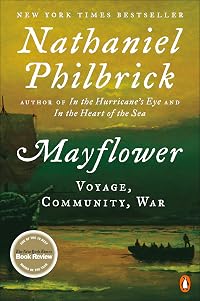
Mayflower: A Story of Courage, Community, and War
by Nathaniel Philbrick
On This Page
Description
From the perilous ocean crossing to the shared bounty of the first Thanksgiving, the Pilgrim settlement of New England has become enshrined as our most sacred national myth. Yet, as author Philbrick reveals, the true story of the Pilgrims is much more than the well-known tale of piety and sacrifice; it is a 55-year epic. The Mayflower's religious refugees arrived in Plymouth Harbor during a period of crisis for Native Americans, as disease spread by European fishermen devastated their show more populations. Initially the two groups maintained a fragile working relationship. But within decades, New England erupted into King Philip's War, a savage conflict that nearly wiped out colonists and natives alike, and forever altered the face of the fledgling colonies and the country that would grow from them. Philbrick has fashioned a fresh portrait of the dawn of American history--dominated right from the start by issues of race, violence, and religion.--From publisher description. show lessTags
Recommendations









Member Recommendations




Member Reviews
After two books I have become a Philbrick devotee. I have his newest on deck and another on order. The way he strings events together, keeping tension and anticipation tight while imparting tons of information is spellbinding. Even during the third part of this book which was about King Philip's War, I was held fast and I normally skim a lot of war scenes in books.
The story of the first English colonists to wash up in New England has become a myth stripped of most of its reality. We have visions of dour Pilgrims in tall hats and shoes with buckles, seated at a deal table breaking bread with smiling, stoic Indians. It’s so ingrained that it requires some effort to come to grips with the reality. Here’s some things I learned -
The show more Pilgrims and later the Puritans were a bunch of intolerant, bloodthirsty assholes. Both sets of “christians” came to exercise their right to worship how they wanted, but neither could allow anyone else this right. Instead the both try to stamp out the other and anyone who dares to disagree; like the Indians and non-religious settlers. The Indians were appalled at the slaughter the English got up to when in battle. Normally an Indian battle was a show of force and bravado; only a few warriors were killed and never the elderly, women or children. Neither did they rape their female captives, something we know Europeans have long been enthusiasts. Eventually though, the Indians got the hang of wholesale slaughter and got pretty good at it.
Miles Standish wasn’t much more than a thug. A convenient bludgeon wielded by the Pilgrims who didn’t deign to carry out the violence they needed to keep the Indians down themselves. Instead however much they claimed to disapprove of Standish, they let him do their dirty work; inciting fights where there weren’t any or exacerbating disagreements until it escalated into bloodshed. Also he was a short guy who had to cut 6 inches off his regulation sword lest it drag on the ground. Funny.
Both the Indians and the English manipulated each other and exploited factions and divisions to further their own ends. In the case of King Philip’s War it started because the English would impose their laws on people who already had laws. Two Indians killed another and the English put them on trial and executed them. Things like that kept happening and almost against his will King Philip (aka Metacomet, sachem of the Pokanoket tribe) went to war to keep the English from taking more advantage. Because the English quickly decided all Indians were hostile and evil, a lot of other tribes got sucked into the conflict when they would rather have been neutral. Eventually the English realized that using some Indians against others was an advantage and the tribal divisions were used against them.
When the war was winding down and over, many hundreds of inconvenient Indians were sold into slavery, ending up at brutal sugar plantations in the Caribbean.
The Wampanoag tribe didn’t exist before the English colonists. It came about to bond several tribes together in the face of the English presence. Massasoit, sachem of the Pokanokets and King Philip’s father was instrumental in creating the new tribe.
We have an idea of Indians living harmoniously the the land and showing the backward colonists how to flourish in the harsh New England climate. Truth is most of them were living hand to mouth and went hungry a lot of the time. There was a visit from the Plymouth leaders to Massasoit’s village and there was no food. None for the people that lived there and none for the guests. For two days and nights the visitors ate nothing and neither did the villagers. This happened a lot and not just to one tribe.
There was no direct representative of the English crown or government until the 1690s when James II sent someone. No oversight. No governor. Nothing. Basically the settlers were sponsored by groups of merchants and were expected to pay them back in the form of goods, but they created their own laws and government, unlike Virginia and other colonies in the south. It shed a new light on why the New England colonists got so mad about the English crown once a bunch of them started to poke their noses into things.
Oh and a big Duh to me. If I’d been taught who King Philip was, I’d evidently forgotten (somehow I think I never knew), and I couldn’t for the life of me figure out which king it was. I never heard of an English King Philip. Maybe he was French or Dutch or something. But no, he was an Indian who changed his name. I didn’t know it was a common practice in Massachusetts at the time. And I wish more of the Indian place names were still in use, even though there are a lot of them that still are. Having been born in New England and lived there for 40+ years, I really liked returning to all those lovely words. Is Massachusetts the only state named for an Indian tribe? I’ll have to google. show less
The story of the first English colonists to wash up in New England has become a myth stripped of most of its reality. We have visions of dour Pilgrims in tall hats and shoes with buckles, seated at a deal table breaking bread with smiling, stoic Indians. It’s so ingrained that it requires some effort to come to grips with the reality. Here’s some things I learned -
The show more Pilgrims and later the Puritans were a bunch of intolerant, bloodthirsty assholes. Both sets of “christians” came to exercise their right to worship how they wanted, but neither could allow anyone else this right. Instead the both try to stamp out the other and anyone who dares to disagree; like the Indians and non-religious settlers. The Indians were appalled at the slaughter the English got up to when in battle. Normally an Indian battle was a show of force and bravado; only a few warriors were killed and never the elderly, women or children. Neither did they rape their female captives, something we know Europeans have long been enthusiasts. Eventually though, the Indians got the hang of wholesale slaughter and got pretty good at it.
Miles Standish wasn’t much more than a thug. A convenient bludgeon wielded by the Pilgrims who didn’t deign to carry out the violence they needed to keep the Indians down themselves. Instead however much they claimed to disapprove of Standish, they let him do their dirty work; inciting fights where there weren’t any or exacerbating disagreements until it escalated into bloodshed. Also he was a short guy who had to cut 6 inches off his regulation sword lest it drag on the ground. Funny.
Both the Indians and the English manipulated each other and exploited factions and divisions to further their own ends. In the case of King Philip’s War it started because the English would impose their laws on people who already had laws. Two Indians killed another and the English put them on trial and executed them. Things like that kept happening and almost against his will King Philip (aka Metacomet, sachem of the Pokanoket tribe) went to war to keep the English from taking more advantage. Because the English quickly decided all Indians were hostile and evil, a lot of other tribes got sucked into the conflict when they would rather have been neutral. Eventually the English realized that using some Indians against others was an advantage and the tribal divisions were used against them.
When the war was winding down and over, many hundreds of inconvenient Indians were sold into slavery, ending up at brutal sugar plantations in the Caribbean.
The Wampanoag tribe didn’t exist before the English colonists. It came about to bond several tribes together in the face of the English presence. Massasoit, sachem of the Pokanokets and King Philip’s father was instrumental in creating the new tribe.
We have an idea of Indians living harmoniously the the land and showing the backward colonists how to flourish in the harsh New England climate. Truth is most of them were living hand to mouth and went hungry a lot of the time. There was a visit from the Plymouth leaders to Massasoit’s village and there was no food. None for the people that lived there and none for the guests. For two days and nights the visitors ate nothing and neither did the villagers. This happened a lot and not just to one tribe.
There was no direct representative of the English crown or government until the 1690s when James II sent someone. No oversight. No governor. Nothing. Basically the settlers were sponsored by groups of merchants and were expected to pay them back in the form of goods, but they created their own laws and government, unlike Virginia and other colonies in the south. It shed a new light on why the New England colonists got so mad about the English crown once a bunch of them started to poke their noses into things.
Oh and a big Duh to me. If I’d been taught who King Philip was, I’d evidently forgotten (somehow I think I never knew), and I couldn’t for the life of me figure out which king it was. I never heard of an English King Philip. Maybe he was French or Dutch or something. But no, he was an Indian who changed his name. I didn’t know it was a common practice in Massachusetts at the time. And I wish more of the Indian place names were still in use, even though there are a lot of them that still are. Having been born in New England and lived there for 40+ years, I really liked returning to all those lovely words. Is Massachusetts the only state named for an Indian tribe? I’ll have to google. show less
Nathaniel Philbrick’s Mayflower re-examines one of the founding narratives of the United States to demythologize the Pilgrims’ settlement in Massachusetts in 1620, focusing on how the journey itself developed among European religious conflict and how the Pilgrims came into conflict with the Native Americans on whose land they settled. At the beginning of his narrative, Philbrick alternates between the actions of the Pilgrims in England and Leiden and the political status of the Pokanokets, one of the members of the Wampanoag, in Massachusetts following intermittent contact with prior Europeans and the ravages of disease. Rather than settling an untouched wilderness, the Pilgrims arrived in a land that had just emerged from a show more holocaust due to European diseases (pgs. 96-97), with the various groups in the Wampanoag confederation re-evaluating their alliances and territorial claims. As Philbrick writes, “In 1620, New England was far from being a paradise of abundance and peace. Indeed the New World was, in many ways, much like the Old – a place where the fertility of the soil was a constant concern, a place where disease and war were omnipresent threats. There were profound differences between the Pilgrims and Pokanokets to be sure…, but in these early years, when the mutual challenge of survival dominated all other concerns, the two peoples had more in common than is generally appreciated today” (pgs. 108-109).
Rather than a narrative of inevitable European conquest, Philbrick portrays how they were, for a time, simply another political power in northeastern North America. In aligning himself with the Pilgrims and gaining their loyalty, Massasoit became the supreme power in Massachusetts and established the Wampanoag nation (pg. 142). Further, “In the forty years since the voyage of the Mayflower, the Native Americans had experienced wrenching change, but they had also managed to create a new, richly adaptive culture that continued to draw strength from traditional ways,” incorporating European goods and spirituality into their lives (pg. 172). Unfortunately, the arrival of the Puritans shifted the politics of the region. Where the Pilgrims sought to create a self-contained enclave, the Puritans expanded throughout New England, coming into greater and greater conflict as they bought as much land as possible, leading to King Philip’s War.
Philbrick concludes, “Fifty-six years after the sailing of the Mayflower, the Pilgrims’ children had not only defeated the Pokanokets in a devastating war, they had taken conscious, methodical measures to purge the land of its people” (pg. 307). Further, “By doing their best to destroy the Native people who had welcomed and sustained their forefathers, New Englanders had destroyed their forefathers’ way of life” (pg. 308). Philbrick’s account is essential reading for all who are interested in a deeper understanding of one of the founding myths of America. This Folio Society edition beautifully reprints Philbrick’s text with curated images from historical sources as well as several maps throughout. show less
Rather than a narrative of inevitable European conquest, Philbrick portrays how they were, for a time, simply another political power in northeastern North America. In aligning himself with the Pilgrims and gaining their loyalty, Massasoit became the supreme power in Massachusetts and established the Wampanoag nation (pg. 142). Further, “In the forty years since the voyage of the Mayflower, the Native Americans had experienced wrenching change, but they had also managed to create a new, richly adaptive culture that continued to draw strength from traditional ways,” incorporating European goods and spirituality into their lives (pg. 172). Unfortunately, the arrival of the Puritans shifted the politics of the region. Where the Pilgrims sought to create a self-contained enclave, the Puritans expanded throughout New England, coming into greater and greater conflict as they bought as much land as possible, leading to King Philip’s War.
Philbrick concludes, “Fifty-six years after the sailing of the Mayflower, the Pilgrims’ children had not only defeated the Pokanokets in a devastating war, they had taken conscious, methodical measures to purge the land of its people” (pg. 307). Further, “By doing their best to destroy the Native people who had welcomed and sustained their forefathers, New Englanders had destroyed their forefathers’ way of life” (pg. 308). Philbrick’s account is essential reading for all who are interested in a deeper understanding of one of the founding myths of America. This Folio Society edition beautifully reprints Philbrick’s text with curated images from historical sources as well as several maps throughout. show less
I remember doing the little Thanksgiving sketch in grade school, the one with Pilgrims and Indians all sharing a nice dinner of turkey and cranberries and shaking hands to be friends. Turns out that wasn’t particularly accurate. For one thing, they probably didn’t have cranberries. For another, that wasn’t the start of a peaceful new era with everyone living Happily Ever After. War was looming over them.
In Philbrick’s book, he talks about how the Pilgrim Fathers and the Native Americans, mainly Massosoit’s tribe, got off to a bit of a rocky start. But they were each committed to peace and were able to work things out. If the story ended there, America would look very different today. But it didn’t. Fifty years later, their show more children and grandchildren had forgotten what they each owed the other and focused only on what they wanted. What happened next was tragic.
I really liked this book, but it took me a while to read it because I knew how it all ended – with a war. And not a war like the American Revolution, which Philbrick has also written about, one that ended with a new nation and us sending King George’s soldiers packing and rejoicing all around. But one that ended with a virtual genocide.
Parts of this book were really hard to read. There were atrocities on both sides. The amount of racial hatred – on both sides, but especially among the English – was pretty disgusting. But it did help me understand the American character and the military traditions that eventually emerged from this conflict. If you are a history fan, I would recommend this one. It was a solid, if sobering read. Be sure to read it in a physical format at the maps are essential to understanding the story. show less
In Philbrick’s book, he talks about how the Pilgrim Fathers and the Native Americans, mainly Massosoit’s tribe, got off to a bit of a rocky start. But they were each committed to peace and were able to work things out. If the story ended there, America would look very different today. But it didn’t. Fifty years later, their show more children and grandchildren had forgotten what they each owed the other and focused only on what they wanted. What happened next was tragic.
I really liked this book, but it took me a while to read it because I knew how it all ended – with a war. And not a war like the American Revolution, which Philbrick has also written about, one that ended with a new nation and us sending King George’s soldiers packing and rejoicing all around. But one that ended with a virtual genocide.
Parts of this book were really hard to read. There were atrocities on both sides. The amount of racial hatred – on both sides, but especially among the English – was pretty disgusting. But it did help me understand the American character and the military traditions that eventually emerged from this conflict. If you are a history fan, I would recommend this one. It was a solid, if sobering read. Be sure to read it in a physical format at the maps are essential to understanding the story. show less
I read this alongside the version abridged for a YA audience, which my children and I read together, to prepare for a trip to Plimoth Plantation. I was very impressed at Philbrick's ability to present the story of the European colonization of New England and the near-extermination of the Native population in a manner that expressed empathy for both the Pilgrims and the Natives. Philbrick's position is that, after fifty years of peace and cooperation, multiple missteps, misunderstandings, and a change in philosophy among the children of the Mayflower Pilgrims led to a situation in which war was inevitable.
Some rather scattered items of interest from the book:
-"Winslow explained that these Native men, women, and children had joined in an show more uprising against the colony and were guilty of 'many notorious and execrable murders, killings, and outrages.' As a consequence, these 'heathen malefactors' had been condemned to perpetual slavery." John Locke in his 1689 Two Treatises of Government used this same rationalization for slavery of an entire race, using the situation in the New World as an example. When I first read this, I thought Winslow and his fellows had used John Locke as a reason for the enslavement of Native Americans, but based on the dates, it seems to be the opposite.
-Despite being the "fathers of our country," and themselves escaping religious persecution in England, the Pilgrims didn't believe in religious liberty. "As far as they were concerned, King James and his bishops were wrong, and they were right," and as long as they were making the rules in the New World, everyone had to follow them, regardless of their religious convictions. We see echoes of this element of Puritanism in our culture even in the twenty-first century.
-Of the next generation's difference in philosophy from their parents': "No longer mindful of the debt they owed the Pokanokets, without whom their parents would never have endured their first year in America, some of the Pilgrims’ children were less willing to treat Native leaders with the tolerance and respect their parents had once afforded Massasoit." This is a reminder of how forgetting history influences the context of our present situation, which, of course, is relevant during all periods of history.
-I knew that there were massacres of Native populations, but what surprised me was how much Bradford's graphic description of the massacre of the Pequots in Connecticut and his connection of that killing to the praise of God sounds like human sacrifice: "'It was a fearful sight to see them thus frying in the fire and the streams of blood quenching the same,' Bradford wrote, 'and horrible was the stink and scent thereof; but the victory seemed a sweet sacrifice, and they gave the praise thereof to God.'"
-Philbrick asserts that part of the reason that the English and the Native population couldn't understand one another's perspective was because there was essentially no intermarriage between the groups and therefore no children to "provide them with a genetic and cultural common ground." Considering the US's historical bias against miscegenation, I'm not sure such children would have been enough to bind these groups together.
-The way the stories had always been presented in my history classes, it seemed always to have been "the Indians" against "the colonists/Pilgrims/English." But Philbrick's history makes it clear that the Native tribes and subgroups were distinct entities, and they assumed that the different groups of colonists were as well. It was the colonies' joining forces against the entire Native population that made what would have been a regional/local disagreement into a race war (which echoes again in the work of John Locke). This is a paradigm shift so huge and yet so obvious that I still feel a little disoriented.
-The central Massachusetts town where I live is nearly seventy miles from Plymouth, and yet the fighting during what's known as King Philip's War extended all the way out here. Even more surprising, the fighting actually extended all the way out to Hadley and Northampton in western Massachusetts. I had no idea the war covered essentially the entirety of modern-day Massachusetts.
-Executions of Native leaders who had surrendered took place on Boston Common. And now there's a wading pool and a carousel and sunbathers and, to my knowledge, no plaque or monument making note of this atrocity.
-During King Philip's War, nearly 8% of men in Plymouth Colony died, nearly double the rate during the Civil War. This is shocking, but "overall, the Native American population of southern New England had sustained a loss of somewhere between 60 and 80 percent." That's men, women, and children lost to war, sickness, starvation, and slavery during fourteen months. That flabbergasts me.
-Philbrick notes: "In 2002 it was estimated that there were approximately 35 million descendants of the Mayflower passengers in the United States, which represents roughly 10 percent of the total U.S. population." I wonder if this percentage is higher in New England because it seems like every third person I meet claims to be descended from passengers on the Mayflower.
Those are my rather disjointed thoughts about parts of this history. I knew there was a fair amount of bloodshed across the state where I currently live, but reading the details of essentially just fourteen months of it (with some from during the fifty years preceding the war) really put things into perspective. I think about the violence under the foundations of cities like Boston and Providence, and I wonder if there's any part of the United States that isn't blood-stained. I also think about Europe and how many centuries of war and violence are under people's feet there, and I find it easy to lose faith in the better angels of our nature. show less
Some rather scattered items of interest from the book:
-"Winslow explained that these Native men, women, and children had joined in an show more uprising against the colony and were guilty of 'many notorious and execrable murders, killings, and outrages.' As a consequence, these 'heathen malefactors' had been condemned to perpetual slavery." John Locke in his 1689 Two Treatises of Government used this same rationalization for slavery of an entire race, using the situation in the New World as an example. When I first read this, I thought Winslow and his fellows had used John Locke as a reason for the enslavement of Native Americans, but based on the dates, it seems to be the opposite.
-Despite being the "fathers of our country," and themselves escaping religious persecution in England, the Pilgrims didn't believe in religious liberty. "As far as they were concerned, King James and his bishops were wrong, and they were right," and as long as they were making the rules in the New World, everyone had to follow them, regardless of their religious convictions. We see echoes of this element of Puritanism in our culture even in the twenty-first century.
-Of the next generation's difference in philosophy from their parents': "No longer mindful of the debt they owed the Pokanokets, without whom their parents would never have endured their first year in America, some of the Pilgrims’ children were less willing to treat Native leaders with the tolerance and respect their parents had once afforded Massasoit." This is a reminder of how forgetting history influences the context of our present situation, which, of course, is relevant during all periods of history.
-I knew that there were massacres of Native populations, but what surprised me was how much Bradford's graphic description of the massacre of the Pequots in Connecticut and his connection of that killing to the praise of God sounds like human sacrifice: "'It was a fearful sight to see them thus frying in the fire and the streams of blood quenching the same,' Bradford wrote, 'and horrible was the stink and scent thereof; but the victory seemed a sweet sacrifice, and they gave the praise thereof to God.'"
-Philbrick asserts that part of the reason that the English and the Native population couldn't understand one another's perspective was because there was essentially no intermarriage between the groups and therefore no children to "provide them with a genetic and cultural common ground." Considering the US's historical bias against miscegenation, I'm not sure such children would have been enough to bind these groups together.
-The way the stories had always been presented in my history classes, it seemed always to have been "the Indians" against "the colonists/Pilgrims/English." But Philbrick's history makes it clear that the Native tribes and subgroups were distinct entities, and they assumed that the different groups of colonists were as well. It was the colonies' joining forces against the entire Native population that made what would have been a regional/local disagreement into a race war (which echoes again in the work of John Locke). This is a paradigm shift so huge and yet so obvious that I still feel a little disoriented.
-The central Massachusetts town where I live is nearly seventy miles from Plymouth, and yet the fighting during what's known as King Philip's War extended all the way out here. Even more surprising, the fighting actually extended all the way out to Hadley and Northampton in western Massachusetts. I had no idea the war covered essentially the entirety of modern-day Massachusetts.
-Executions of Native leaders who had surrendered took place on Boston Common. And now there's a wading pool and a carousel and sunbathers and, to my knowledge, no plaque or monument making note of this atrocity.
-During King Philip's War, nearly 8% of men in Plymouth Colony died, nearly double the rate during the Civil War. This is shocking, but "overall, the Native American population of southern New England had sustained a loss of somewhere between 60 and 80 percent." That's men, women, and children lost to war, sickness, starvation, and slavery during fourteen months. That flabbergasts me.
-Philbrick notes: "In 2002 it was estimated that there were approximately 35 million descendants of the Mayflower passengers in the United States, which represents roughly 10 percent of the total U.S. population." I wonder if this percentage is higher in New England because it seems like every third person I meet claims to be descended from passengers on the Mayflower.
Those are my rather disjointed thoughts about parts of this history. I knew there was a fair amount of bloodshed across the state where I currently live, but reading the details of essentially just fourteen months of it (with some from during the fifty years preceding the war) really put things into perspective. I think about the violence under the foundations of cities like Boston and Providence, and I wonder if there's any part of the United States that isn't blood-stained. I also think about Europe and how many centuries of war and violence are under people's feet there, and I find it easy to lose faith in the better angels of our nature. show less
I read this alongside the version abridged for a YA audience, which my children and I read together, to prepare for a trip to Plimoth Plantation. I was very impressed at Philbrick's ability to present the story of the European colonization of New England and the near-extermination of the Native population in a manner that expressed empathy for both the Pilgrims and the Natives. Philbrick's position is that, after fifty years of peace and cooperation, multiple missteps, misunderstandings, and a change in philosophy among the children of the Mayflower Pilgrims led to a situation in which war was inevitable.
Some rather scattered items of interest from the book:
-"Winslow explained that these Native men, women, and children had joined in an show more uprising against the colony and were guilty of 'many notorious and execrable murders, killings, and outrages.' As a consequence, these 'heathen malefactors' had been condemned to perpetual slavery." John Locke in his 1689 Two Treatises of Government used this same rationalization for slavery of an entire race, using the situation in the New World as an example. When I first read this, I thought Winslow and his fellows had used John Locke as a reason for the enslavement of Native Americans, but based on the dates, it seems to be the opposite.
-Despite being the "fathers of our country," and themselves escaping religious persecution in England, the Pilgrims didn't believe in religious liberty. "As far as they were concerned, King James and his bishops were wrong, and they were right," and as long as they were making the rules in the New World, everyone had to follow them, regardless of their religious convictions. We see echoes of this element of Puritanism in our culture even in the twenty-first century.
-Of the next generation's difference in philosophy from their parents': "No longer mindful of the debt they owed the Pokanokets, without whom their parents would never have endured their first year in America, some of the Pilgrims’ children were less willing to treat Native leaders with the tolerance and respect their parents had once afforded Massasoit." This is a reminder of how forgetting history influences the context of our present situation, which, of course, is relevant during all periods of history.
-I knew that there were massacres of Native populations, but what surprised me was how much Bradford's graphic description of the massacre of the Pequots in Connecticut and his connection of that killing to the praise of God sounds like human sacrifice: "'It was a fearful sight to see them thus frying in the fire and the streams of blood quenching the same,' Bradford wrote, 'and horrible was the stink and scent thereof; but the victory seemed a sweet sacrifice, and they gave the praise thereof to God.'"
-Philbrick asserts that part of the reason that the English and the Native population couldn't understand one another's perspective was because there was essentially no intermarriage between the groups and therefore no children to "provide them with a genetic and cultural common ground." Considering the US's historical bias against miscegenation, I'm not sure such children would have been enough to bind these groups together.
-The way the stories had always been presented in my history classes, it seemed always to have been "the Indians" against "the colonists/Pilgrims/English." But Philbrick's history makes it clear that the Native tribes and subgroups were distinct entities, and they assumed that the different groups of colonists were as well. It was the colonies' joining forces against the entire Native population that made what would have been a regional/local disagreement into a race war (which echoes again in the work of John Locke). This is a paradigm shift so huge and yet so obvious that I still feel a little disoriented.
-The central Massachusetts town where I live is nearly seventy miles from Plymouth, and yet the fighting during what's known as King Philip's War extended all the way out here. Even more surprising, the fighting actually extended all the way out to Hadley and Northampton in western Massachusetts. I had no idea the war covered essentially the entirety of modern-day Massachusetts.
-Executions of Native leaders who had surrendered took place on Boston Common. And now there's a wading pool and a carousel and sunbathers and, to my knowledge, no plaque or monument making note of this atrocity.
-During King Philip's War, nearly 8% of men in Plymouth Colony died, nearly double the rate during the Civil War. This is shocking, but "overall, the Native American population of southern New England had sustained a loss of somewhere between 60 and 80 percent." That's men, women, and children lost to war, sickness, starvation, and slavery during fourteen months. That flabbergasts me.
-Philbrick notes: "In 2002 it was estimated that there were approximately 35 million descendants of the Mayflower passengers in the United States, which represents roughly 10 percent of the total U.S. population." I wonder if this percentage is higher in New England because it seems like every third person I meet claims to be descended from passengers on the Mayflower.
Those are my rather disjointed thoughts about parts of this history. I knew there was a fair amount of bloodshed across the state where I currently live, but reading the details of essentially just fourteen months of it (with some from during the fifty years preceding the war) really put things into perspective. I think about the violence under the foundations of cities like Boston and Providence, and I wonder if there's any part of the United States that isn't blood-stained. I also think about Europe and how many centuries of war and violence are under people's feet there, and I find it easy to lose faith in the better angels of our nature. show less
Some rather scattered items of interest from the book:
-"Winslow explained that these Native men, women, and children had joined in an show more uprising against the colony and were guilty of 'many notorious and execrable murders, killings, and outrages.' As a consequence, these 'heathen malefactors' had been condemned to perpetual slavery." John Locke in his 1689 Two Treatises of Government used this same rationalization for slavery of an entire race, using the situation in the New World as an example. When I first read this, I thought Winslow and his fellows had used John Locke as a reason for the enslavement of Native Americans, but based on the dates, it seems to be the opposite.
-Despite being the "fathers of our country," and themselves escaping religious persecution in England, the Pilgrims didn't believe in religious liberty. "As far as they were concerned, King James and his bishops were wrong, and they were right," and as long as they were making the rules in the New World, everyone had to follow them, regardless of their religious convictions. We see echoes of this element of Puritanism in our culture even in the twenty-first century.
-Of the next generation's difference in philosophy from their parents': "No longer mindful of the debt they owed the Pokanokets, without whom their parents would never have endured their first year in America, some of the Pilgrims’ children were less willing to treat Native leaders with the tolerance and respect their parents had once afforded Massasoit." This is a reminder of how forgetting history influences the context of our present situation, which, of course, is relevant during all periods of history.
-I knew that there were massacres of Native populations, but what surprised me was how much Bradford's graphic description of the massacre of the Pequots in Connecticut and his connection of that killing to the praise of God sounds like human sacrifice: "'It was a fearful sight to see them thus frying in the fire and the streams of blood quenching the same,' Bradford wrote, 'and horrible was the stink and scent thereof; but the victory seemed a sweet sacrifice, and they gave the praise thereof to God.'"
-Philbrick asserts that part of the reason that the English and the Native population couldn't understand one another's perspective was because there was essentially no intermarriage between the groups and therefore no children to "provide them with a genetic and cultural common ground." Considering the US's historical bias against miscegenation, I'm not sure such children would have been enough to bind these groups together.
-The way the stories had always been presented in my history classes, it seemed always to have been "the Indians" against "the colonists/Pilgrims/English." But Philbrick's history makes it clear that the Native tribes and subgroups were distinct entities, and they assumed that the different groups of colonists were as well. It was the colonies' joining forces against the entire Native population that made what would have been a regional/local disagreement into a race war (which echoes again in the work of John Locke). This is a paradigm shift so huge and yet so obvious that I still feel a little disoriented.
-The central Massachusetts town where I live is nearly seventy miles from Plymouth, and yet the fighting during what's known as King Philip's War extended all the way out here. Even more surprising, the fighting actually extended all the way out to Hadley and Northampton in western Massachusetts. I had no idea the war covered essentially the entirety of modern-day Massachusetts.
-Executions of Native leaders who had surrendered took place on Boston Common. And now there's a wading pool and a carousel and sunbathers and, to my knowledge, no plaque or monument making note of this atrocity.
-During King Philip's War, nearly 8% of men in Plymouth Colony died, nearly double the rate during the Civil War. This is shocking, but "overall, the Native American population of southern New England had sustained a loss of somewhere between 60 and 80 percent." That's men, women, and children lost to war, sickness, starvation, and slavery during fourteen months. That flabbergasts me.
-Philbrick notes: "In 2002 it was estimated that there were approximately 35 million descendants of the Mayflower passengers in the United States, which represents roughly 10 percent of the total U.S. population." I wonder if this percentage is higher in New England because it seems like every third person I meet claims to be descended from passengers on the Mayflower.
Those are my rather disjointed thoughts about parts of this history. I knew there was a fair amount of bloodshed across the state where I currently live, but reading the details of essentially just fourteen months of it (with some from during the fifty years preceding the war) really put things into perspective. I think about the violence under the foundations of cities like Boston and Providence, and I wonder if there's any part of the United States that isn't blood-stained. I also think about Europe and how many centuries of war and violence are under people's feet there, and I find it easy to lose faith in the better angels of our nature. show less
This is way more than just the story of the Mayflower. Using that incident as the initiation and focus for the next 50-75 years of history, Philbrick discusses not only the founding of the colony at Plymouth follows the path of the immigrants through King Philip's War.
He has a balanced look at the English and the Native sides of things, and clearly it is far more complicated than any holiday stories. There were Natives on both sides of the fight, and a variety of ideas about how to deal with Natives from the Englishmen. It is fascinating, if at times frustrating to keep up with everyone.
The tale is well written and easy for the lay person to follow - just lots of characters!
He has a balanced look at the English and the Native sides of things, and clearly it is far more complicated than any holiday stories. There were Natives on both sides of the fight, and a variety of ideas about how to deal with Natives from the Englishmen. It is fascinating, if at times frustrating to keep up with everyone.
The tale is well written and easy for the lay person to follow - just lots of characters!
Full Disclaimer: I am a bit of a history nerd.
American History...not so much.
I am always down to lodge intellectualized attacks against Western Civilization, however. What better fodder than the Pilgrims' treatment of Native Americans?
We all know Thanksgiving is a farce (National Holiday decreed by none other than Honest Abe). But what about 1620? The nitty grit of it - the 1st winter in Plymouth?
Philbrick spins a decent yarn. His style of prose is easily digestible and fully detailed. What stands out the most in this work is the depths of the colonizers depravity after the Native Americans' many kindnesses disappeared from their generational memory.
We all knew they sucked -- but not until reading this book did I learn the abhorrent show more degree of suckitude.
And I also learned a thing or two of succotash. Not the suffering kind.
You've got to read it for yourself - no spoilers here.
I enjoyed this book very much. Recommended. show less
American History...not so much.
I am always down to lodge intellectualized attacks against Western Civilization, however. What better fodder than the Pilgrims' treatment of Native Americans?
We all know Thanksgiving is a farce (National Holiday decreed by none other than Honest Abe). But what about 1620? The nitty grit of it - the 1st winter in Plymouth?
Philbrick spins a decent yarn. His style of prose is easily digestible and fully detailed. What stands out the most in this work is the depths of the colonizers depravity after the Native Americans' many kindnesses disappeared from their generational memory.
We all knew they sucked -- but not until reading this book did I learn the abhorrent show more degree of suckitude.
And I also learned a thing or two of succotash. Not the suffering kind.
You've got to read it for yourself - no spoilers here.
I enjoyed this book very much. Recommended. show less
Members
- Recently Added By
Lists

Unread books
1,063 works; 84 members

Top Five Books of 2015
811 works; 241 members

Carole's List
445 works; 13 members

Books Read in 2016
4,666 works; 197 members

r/AskHistorians' Recommended Books
1,068 works; 17 members

Books Read in 2023
5,547 works; 145 members

Read with a Friend
17 works; 1 member
Author Information

27+ Works 23,200 Members
Nathaniel Philbrick was born in Boston Massachusetts on June 11, 1956. He received a bachelor's degree in English from Brown University and a master's degree in American literature from Duke University. In 1978, he was Brown University's first Intercollegiate All-American sailor and he won the Sunfish North Americans in Barrington, Rhode Island. show more After graduate school, he worked for four years at Sailing World magazine. Afterward, he worked as a freelancer for a number of years and wrote/edited several sailing books including Yachting: A Parody. After moving to Nantucket in 1986, he became interested in the history of the island and wrote Away Off Shore: Nantucket Island and Its People. In 2000 he published In the Heart of the Sea: The Tragedy of the Whaleship Essex. A motion picture of the book was released in December 2015. His other books include Sea of Glory: America's Voyage of Discovery, The U.S. Exploring Expedition; Mayflower: A Story of Courage, Community, and War; The Last Stand: Custer, Sitting Bull, and the Battle of the Little Bighorn; Bunker Hill: A City, A Siege, A Revolution; Valiant Ambition: George Washington, Benedict Arnold, and the Fate of the American Revolution, and In the Hurricane's Eye: The Genius of George Washington and the Victory at Yorktown. (Bowker Author Biography) show less
Some Editions
Awards and Honors
Awards
Distinctions
Notable Lists
Series
Belongs to Publisher Series
Work Relationships
Common Knowledge
- Canonical title
- Mayflower: A Story of Courage, Community, and War
- Original title
- Mayflower: A Story of Courage, Community, and War
- Alternate titles
- Mayflower: A Voyage To War
- Original publication date
- 2006
- People/Characters
- Miles Standish; William Bradford; Squanto; Massasoit; Josiah Winslow; Edward Winslow (show all 20); King Philip; Samoset; Weetamoo; Benjamin Church; Alexander; Mary Rowlandson; Annawon; William Brewster; Hobbamock; William Hubbard; Christopher Jones; Captain Samuel Moseley; John Robinson; John Sassamon
- Important places
- Massachusetts, USA; Plymouth, Massachusetts, USA; Plymouth Colony; Boston, Massachusetts Bay Colony; Cape Cod, Massachusetts, USA; Pocasset, USA (show all 10); Mount Hope, Bristol, Rhode Island, USA; Rhode Island, USA; Taunton, Massachusetts, USA; Wessagussett, USA
- Important events
- Voyage of the Mayflower (1620); King Philip's War (1675-06 | 1676-08); Thanksgiving; 17th century
- Dedication
- To Melissa
- First words
- Preface
We all want to know how it was in the beginning.
Chapter 1
They Knew They Were Pilgrims
For sixty-five days, the Mayflower had blundered her way through storms and headwinds, her bottom a shaggy pelt of seaweed and barnacles, her leaky decks spewing salt wa... (show all)ter onto her passengers' devoted heads.
[Epilogue] As early as the fall of 1675, they had begun to sail from the coast of New England: the slave ships. - Last words
- (Click to show. Warning: May contain spoilers.)[Epilogue] It was a small victory to be sure, but in the winter of 1677 it was the best that Benjamin Church could do.
(Click to show. Warning: May contain spoilers.)[Preface] It is a story that is at once fundamental and obscure, and it begins with a ship on a wide and blustery sea.
(Click to show. Warning: May contain spoilers.)But when he returned to Plymouth a few days later, he discovered "to his grief" that the heads of both Annawon and Tuspaquin had joined Philip's on the palisades of Fort Hill. - Original language
- English
- Disambiguation notice
- Nathaniel Philbrick's The Mayflower and the Pilgrims' New World (2008) is a young adult adaptation of this title, Mayflower: A Story of Courage, Community, and War (2006). Please distinguish between the two Wor... (show all)ks. Thank you.
Classifications
- Genres
- History, General Nonfiction, Nonfiction
- DDC/MDS
- 973.22 — History & geography History of North America United States Colonial period (1607-1775) New England settlement (1620-43)
- LCC
- F68 .P44 — Local History of the United States, Canada and Latin America United States local history Massachusetts
- BISAC
Statistics
- Members
- 6,101
- Popularity
- 2,056
- Reviews
- 129
- Rating
- (3.88)
- Languages
- 5 — English, Estonian, French, German, Polish
- Media
- Paper, Audiobook, Ebook
- ISBNs
- 36
- UPCs
- 1
- ASINs
- 18