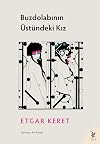
The Girl on the Fridge: Stories
by Etgar Keret
On This Page
Description
A birthday-party magician whose hat tricks end in horror and gore; a girl parented by a major household appliance; the possessor of the lowest IQ in the Mossad-such are the denizens of Etgar Keret's dark and fertile mind. The Girl on the Fridge contains the best of Keret's first collections, the ones that made him a household name in Israel and the major discovery of this last decade.Tags
Recommendations












Member Recommendations
Member Reviews
This collection is a little more uneven than The Bus Driver Who Wanted To Be God (because it's a compilation of older stories from the early 90s, rather than a collection conceived by Keret), but it does contain my personal favorite story of his: "Crazy Glue," which may be the best love story ever written (and it's only three pages long). Not to mention the shortest of the stories in the book ("Asthma Attack," which is 11 lines long), which has more heart than most novels I've read. When he's at his best, Keret's stories are on par with Borges at his best - when he's at his worst, on par with Borges at his worst (so still pretty darn good!).
I first saw Jellyfish, I think, which I liked a lot. Then I read Rutu Modan's Exit Wounds, which I liked. Somewhere in the back where there is an interview she mentioned Keret (and they have worked together before.) And then I saw $9.99, which I also liked, though not as much as Jellyfish. So I decided I should read something by Keret, and The Girl on the Fridge was the first book I could get my hands on. I suppose what I did not expect was the horror aspect of the stories. The rest was familiar from the films I had seen.
I kept thinking the stories reminded me of Gaiman's Sandman comics. Not the parts about Dream and his siblings (the Endless,) but the other parts, like the serial killers who meet up in a hotel, the girl who lives in show more the building with some bizarre characters, etc. So some horror, some mystery, some bizarre, and some political commentary. If Gaiman, Lynch, and Kafka got together and wrote a bunch of short stories that take place in Israel, this could very well be it.
With that said, Keret does have that home advantage. His stories are very much culturally infused with Israel, the conflict, the everyday urban life. Some stories can easily reproduce the horror of war and conflict, the meaningless struggle. There is always some violence, whether it be a kid being bullied aside from the main story, an Arab being run over for fun by Israeli border patrol, or a severed head of a bunny. Most lead characters are male (if not all?) and most of them are not in charge of the situation. Things happen to them, and usually they suffer. Children have a special place in some of the stories, and they seem to live in the middle of a disturbing life, unaware.
All in all, a pleasure to read, only if you like this kind of thing. If you enjoy the bizarre, the horrifying, the absurd, the surreal, you will enjoy these stories. show less
I kept thinking the stories reminded me of Gaiman's Sandman comics. Not the parts about Dream and his siblings (the Endless,) but the other parts, like the serial killers who meet up in a hotel, the girl who lives in show more the building with some bizarre characters, etc. So some horror, some mystery, some bizarre, and some political commentary. If Gaiman, Lynch, and Kafka got together and wrote a bunch of short stories that take place in Israel, this could very well be it.
With that said, Keret does have that home advantage. His stories are very much culturally infused with Israel, the conflict, the everyday urban life. Some stories can easily reproduce the horror of war and conflict, the meaningless struggle. There is always some violence, whether it be a kid being bullied aside from the main story, an Arab being run over for fun by Israeli border patrol, or a severed head of a bunny. Most lead characters are male (if not all?) and most of them are not in charge of the situation. Things happen to them, and usually they suffer. Children have a special place in some of the stories, and they seem to live in the middle of a disturbing life, unaware.
All in all, a pleasure to read, only if you like this kind of thing. If you enjoy the bizarre, the horrifying, the absurd, the surreal, you will enjoy these stories. show less
This is my second Keret collection I've read (The first being The Nimrod Flip-Out). Honestly, if you were to choose a Keret book to read for the first time, I would go with TNFO. The Girl on the Fridge was a fairly good collection of stories. Some of them are capable of giving you goosebumps, however others bore you so much that you continue reading just for the sake of finishing the story. However, Keret is a good writer as a whole with some beautiful prose (which may be a translator's touch, but probably not...). Keret is very in touch with human emotions and is great at conveying his meanings in very few words.
A collection of very short stories about topics such as all the city buses dying, the dream eating monster under the bed, a magician who suddenly has to drop the rabbit-out-of-the-hat trick from his act, whether one should trust an artist and if finding a copy of Gulliver's Travels in Iceland is a lucky thing. Nearly all the stories are surreal, lengths range from a few paragraphs to three or four pages, and the writing is original to the point of true oddness. I'm looking forward to reading more from Keret.
I was really expecting to like this book better than I did. My previous (and first) Keret book was The Nimrod Flip-out which I liked much better. The story I liked the best in The Girl on the Fridge was "Super Glue" which tells about odd uses for superglue. I found "Loquat" a fun read as well. This short story was about a soldier whose grandmother commanded him to get annoying neighborhood kids out of their loquat tree. I found the other stories in this collection much too dark and disturbing. I do like the author's bizarre way of telling a story and looking at snippets of Israeli life, though. I will definitely read more books by Keret, but hope that some of the stories in future collections that I read will be lighter and more fun.
I've had this book on my bedside table for over a year. Maybe i just didn't want it to end. These short, acerbic, funny stories are really something special. Keret is very modern but at the same time evokes the spirits of Kafka and Bruno Schultz. Really great, unforgetable work.
I bought this at Powell's in Chicago; my wife drove and I read a few stories aloud -- which isn't problematic as most of them were less than two pages and hilariously dry. I finished before we made it to Lafyette. I would read more of his work but have since grown immune to erratic impulses to flash effect.
Members
- Recently Added By
Lists

Jewish Books
367 works; 24 members
Author Information

64+ Works 3,995 Members
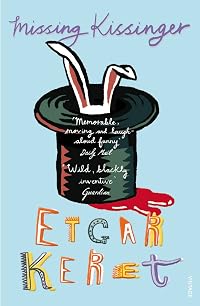
Etgar Keret was born on August 20, 1967 in Israel. He is an Israeli-Polish writer known for his short stories, graphic novels, and scriptwriting for film and television. He is a lecturer at Ben-Gurion University of the Negev in Beer Sheva, and at Tel Aviv University. Keret's first published work was Pipelines, a collection of short stories. His show more second book, Missing Kissinger, a collection of fifty very short stories, caught the attention of the general public. He has also co-authored several comic books, among them Nobody Said It Was Going to Be Fun with Rutu Modan and Streets of Fury with Asaf Hanuka. In 1998, Keret published Kneller's Happy Campers, He also wrote a children's book Dad Runs Away with the Circus. In 2016 his title The Seven Good Years made the New Zealand Best Seller List. (Bowker Author Biography) show less
Some Editions
Awards and Honors
Awards
Common Knowledge
- Original publication date
- 2008
- First words
- When you have an asthma attack, you can't breathe.
- Last words
- (Click to show. Warning: May contain spoilers.)I couldn't be sad about anything.
- Blurbers
- Rushdie, Salman; Smith, Kyle; Marche, Stephen; Martel, Yann
Classifications
- Genres
- Fiction and Literature, General Fiction
- DDC/MDS
- 892.436 — Literature & rhetoric Literatures of other languages Afro-Asiatic literatures Jewish, Israeli, and Hebrew Hebrew fiction 1947–2000
- LCC
- PJ5054 .K375 .G5713 — Language and Literature Oriental languages and literatures Oriental philology and literature Hebrew Literature Individual authors and works
- BISAC
Statistics
- Members
- 405
- Popularity
- 76,905
- Reviews
- 13
- Rating
- (3.75)
- Languages
- English, Greek, Spanish, Turkish
- Media
- Paper, Ebook
- ISBNs
- 5
- ASINs
- 6