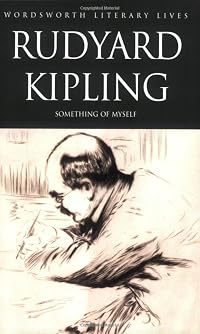
Something of Myself For My Friends, Known and Unknown
by Rudyard Kipling 
On This Page
Description
Kipling was one of the most popular writers in English, both prose and verse, in the late 19th and early 20th centuries. Henry James famously said of him: "Kipling strikes me personally as the most complete man of genius (as distinct from fine intelligence) that I have ever known." In 1907, he was awarded the Nobel Prize in Literature. This book is the world famous autobiography that Kipling penned toward the end of his life and sheds much detail on his life, career, travels and influences.Tags
Recommendations
























Member Recommendations
zasmine Cross-referenced by Naipaul in his book 'An area of darkness'
Member Reviews
Kipling meanders a bit here and definitely wasn't going for a "tell-all" sort of autobiography. At the same time, though, I enjoyed his enjoyment of the world around him. He really seemed to love India, Aukland, etc., and has an amused, yet slightly detached, view of his life and times.
An occasionally fascinating insight into the life and work of one of England's most celebrated authors; the part about his childhood was particularly interesting, though his little asides and knowing nods often left me wondering what he was talking about.
This is a less clear account of Kipling’s life than an independent biographer might aspire to write. It is basically a collection of old memories and musings written down at the end of his life, but they are at least separated out into chapters in chronological order, and written in his own readable and distinctive style. He seems to have had a good memory, stretching back to his early childhood, although of course no human memory is reliably accurate.
He was born in December 1865, survived various early hardships, and lived to January 1936, reaching the age of 70. He was awarded the Nobel Prize in Literature in 1907, arriving in Stockholm in December 1907 to find the country in mourning for the death of the King.
He was born in December 1865, survived various early hardships, and lived to January 1936, reaching the age of 70. He was awarded the Nobel Prize in Literature in 1907, arriving in Stockholm in December 1907 to find the country in mourning for the death of the King.
Dec 17, 2024 (Edited)English (UK)
Ratings
Members
- Recently Added By
Author Information

2,476+ Works 91,568 Members
Kipling, who as a novelist dramatized the ambivalence of the British colonial experience, was born of English parents in Bombay and as a child knew Hindustani better than English. He spent an unhappy period of exile from his parents (and the Indian heat) with a harsh aunt in England, followed by the public schooling that inspired his "Stalky" show more stories. He returned to India at 18 to work on the staff of the Lahore Civil and Military Gazette and rapidly became a prolific writer. His mildly satirical work won him a reputation in England, and he returned there in 1889. Shortly after, his first novel, The Light That Failed (1890) was published, but it was not altogether successful. In the early 1890s, Kipling met and married Caroline Balestier and moved with her to her family's estate in Brattleboro, Vermont. While there he wrote Many Inventions (1893), The Jungle Book (1894-95), and Captains Courageous (1897). He became dissatisfied with life in America, however, and moved back to England, returning to America only when his daughter died of pneumonia. Kipling never again returned to the United States, despite his great popularity there. Short stories form the greater portion of Kipling's work and are of several distinct types. Some of his best are stories of the supernatural, the eerie and unearthly, such as "The Phantom Rickshaw," "The Brushwood Boy," and "They." His tales of gruesome horror include "The Mark of the Beast" and "The Return of Imray." "William the Conqueror" and "The Head of the District" are among his political tales of English rule in India. The "Soldiers Three" group deals with Kipling's three musketeers: an Irishman, a Cockney, and a Yorkshireman. The Anglo-Indian Tales, of social life in Simla, make up the larger part of his first four books. Kipling wrote equally well for children and adults. His best-known children's books are Just So Stories (1902), The Jungle Books (1894-95), and Kim (1901). His short stories, although their understanding of the Indian is often moving, became minor hymns to the glory of Queen Victoria's empire and the civil servants and soldiers who staffed her outposts. Kim, an Irish boy in India who becomes the companion of a Tibetan lama, at length joins the British Secret Service, without, says Wilson, any sense of the betrayal of his friend this actually meant. Nevertheless, Kipling has left a vivid panorama of the India of his day. In 1907, Kipling became England's first Nobel Prize winner in literature and the only nineteenth-century English poet to win the Prize. He won not only on the basis of his short stories, which more closely mirror the ambiguities of the declining Edwardian world than has commonly been recognized, but also on the basis of his tremendous ability as a popular poet. His reputation was first made with Barrack Room Ballads (1892), and in "Recessional" he captured a side of Queen Victoria's final jubilee that no one else dared to address. (Bowker Author Biography) show less
Rudyard Kipling has a Legacy Library. Legacy libraries are the personal libraries of famous readers, entered by LibraryThing members from the Legacy Libraries group.
Series
Belongs to Publisher Series
Work Relationships
Common Knowledge
- Canonical title
- Something of Myself For My Friends, Known and Unknown
- Original title
- Something of Myself For My Friends, Known and Unknown
- Original publication date
- 1937-12-21
- People/Characters
- Rudyard Kipling
- First words
- Looking back from this my seventieth year, it seems to me that every card in my working life has been dealt me in such a manner that I had but to play it as it came.
- Quotations
- The House was not of a type to present to servants by lamp or candle-light. Hence electricity, which in 1902 was a serious affair. We chanced, at a week-end visit, to meet Sir William Willcocks, who had designed the Assouan D... (show all)am—a trifling affair on the Nile.
Not to be over-crowed, we told him of our project for declutching the water-wheel from an ancient mill at the end of our garden, and using its microscopical mill-pond to run a turbine. That was enough! ‘Dam?' said he. ‘You don't know anything about dams or turbines. I'll come and look.' That Monday morn he came with us, explored the brook and the mill-sluit, and foretold truly the exact amount of horse-power that we should get out of our turbine—‘Four and a half and no more.' But he called me Egyptian names for the state of my brook, which, till then, I had deemed picturesque. ‘It's all messed up with trees and bushes. Cut 'em down and slope the banks to one in three.' ‘Lend me a couple of Fellahîn Battalions and I'll begin,' I said. He said also; ‘Don't run your light cable on poles. Bury it.' So we got a deep-sea cable which had failed under test at twelve
hundred volts—our voltage being one hundred and ten—and laid him in a trench from the Mill to the house, a full furlong, where he worked for a quarter of a century. - Last words
- (Click to show. Warning: May contain spoilers.)Left and right of the table were two big globes, on one of which a great airman had once outlined in white paint those air-routes to the East and Australia which were well in use before my death.
- Original language
- English
Classifications
Statistics
- Members
- 315
- Popularity
- 101,411
- Reviews
- 3
- Rating
- (3.87)
- Languages
- 6 — Chinese, Danish, English, French, Italian, Spanish
- Media
- Paper, Ebook
- ISBNs
- 27
- ASINs
- 17