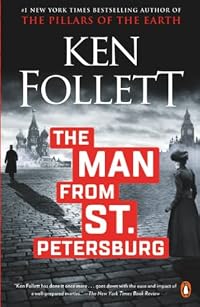
The Man from St. Petersburg
by Ken Follett
On This Page
Description
"Ken Follett has done it once more . . . goes down with the ease and impact of a well-prepared martini." —New York Times Book ReviewHis name was Feliks. He came to London to commit a murder that would change history. A master manipulator, he had many weapons at his command, but against him were ranged the whole of the English police, a brilliant and powerful lord, and the young Winston Churchill himself. These odds would have stopped any man in the world—except the man from St. Petersburg.
Tags
Recommendations










Member Reviews
This was my first Follett and I was certainly impressed. He weaves an interesting story related to events taking place in England, France, Germany and Russia in 1914 and interjects another story line concerning a respected, aristocratic family who has based their life together on lies, secrets and deception. The truth comes out in a fiery conclusion which will keep readers on the edge of their seats.
Historical fiction at its finest. Do you root for the assassin or not? Of course not, but what a conundrum while reading this novel. All the characters are well written, time frame well researched. Just a great book you will not want to put down once you start reading.
Reason read: BAC, Welsh writer
This is a story of espionage that is just prior to WWI.
The story involves an attempt to forge alliance with Russia because of Germany's arm escalation and movement towards attacking France. Feliks is an anarchist and an assassin with the intent to assassinate the Russian prince that has come to negotiate with England against Germany.
The story was interesting and engaging.
This is a story of espionage that is just prior to WWI.
The story involves an attempt to forge alliance with Russia because of Germany's arm escalation and movement towards attacking France. Feliks is an anarchist and an assassin with the intent to assassinate the Russian prince that has come to negotiate with England against Germany.
The story was interesting and engaging.
Reading this, it is clear that Follet's writing has become more polished over the years. The writing here is quite average, not the most natural of dialogues. While you get some suspense, it is mind-boggling how Charlotte can remain so calm upon learning that her real father is Feliks. Is that a natural reaction? Also, I don't know why Follet needs to dwell on how sexually ignorant Charlotte and her cousin are. Unnecessary plot diversion.
Bello bello bello! Come tutti i Ken Follet, è estremamente avvincente. Anche questo, come il precedente "Le gazze ladre" mi ha tenuta verso la fine veramente col fiato sospeso. In più devo dire che in questo libro ho adorato praticamente tutti i personaggi (tranne forse Lydia). E’ questo forse che mi ha colpito più di tutto in questo libro: quando alla fine i nodi stavano per venire al pettine, io non sapevo proprio qual lieto fine sperare, perché comunque fossero andate le cose, mi sarebbe dispiaciuto per qualcuno.
http://www.naufragio.it/iltempodileggere/98
http://www.naufragio.it/iltempodileggere/98
I have only just stated this but like it so far. The background is frankly incredible -- in My, 1914, Britain's Liberal government, expecting to be at war with Germany in alliance with France but unsure of Russian support (?! what price the Entente Cordiale?) is hoping to negotiate a secret treaty with a Russian emissary, Prince Orlov. Orlov is the nephew is the Russian-born wife of the Earl of Walden, a staunch Tory aristocrat who is persuaded by WInston Churchill (then the Liberal First Lord of the Admiralty) to represent Britain in the negotiations --at the insistence of the Czar himself. Meanwhile, a Russian anarchist assassin who, in his student days, was the countess's lover, has taken the assignment of killing Orlov and show more disrupting the negotiations as a prelude to revolution. The main plot is fine, but there is a very silly subplot involving a couple of 18 year old debutantes of the earl's family who are so ignorant of the facts of life that when they steal a medical text and a pornographic book they still have no idea how sex actually works. That I flatly refuse to believe. Reading (for instance) Margot Asquith's memoirs I certainly do not gt the impression young female aristocrats were that naive. show less
Not great writing, overall plot, or characters, but eminently readable. I stayed with it all because of the depiction of the anarchist. I was amazed that a pop writer and novel would be, if not necessarily sympathetic, at least fully descriptive of reasoning and thoughts of the anarchist. Good for Follett!
Members
- Recently Added By
Lists

Historical Fiction
889 works; 90 members

World War I Fiction
94 works; 15 members

Books about World War I
80 works; 14 members

Books Read in 2016
4,666 works; 197 members

World War I books
32 works; 8 members

Books Set in London
49 works; 3 members

Books available on Open Library
171 works; 4 members
Author Information

181+ Works 128,433 Members
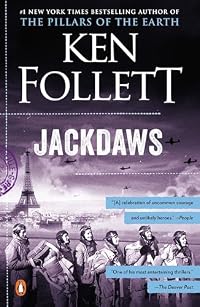
Ken Follett was born in Wales, United Kingdom on June 5, 1949. He received an Honours degree in philosophy from University College, London. He began his career as a newspaper reporter for the South Wales Echo and later with the London Evening News. He decided to switch to publishing and worked for a small London publishing house, Everest Books, show more eventually becoming Deputy Managing Director. His first bestselling novel, Eye of the Needle, was published in 1978 and won the Edgar Award. His other works include Triple, The Key to Rebecca, The Man from St. Petersburg, Lay Down with Lions, The Pillars of the Earth, The Third Twin, The Hammer of Eden, Code to Zero, Whiteout, World Without End, The Century Trilogy, and A Column of Fire. Many of his novels have been adapted into films and television miniseries. He has won numerous awards including the Corine Prize in 2003 for Jackdaws. His nonfiction works include On Wings of Eagles. (Bowker Author Biography) show less
Some Editions
Awards and Honors
Distinctions
Work Relationships
Is contained in
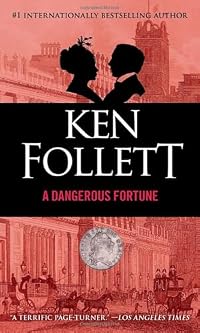
Set of 16 Techno-Thrillers by Ken Follett (Whiteout, Hornet Flight, Jackdaws, Code to Zero, Hammer of Eden, Third Twin, A Place Called Freedom, A Dangerous Fortune, Night Over Water, Lie Down with Lions, Man from St. Petersburg, Key to Rebecca, Triple, Eye of the Needle, Pillars of the Earth) by Ken Follett
Is abridged in
Der Mann aus St. Petersburg. - Egen, Jean: Die Linden von Lautenbach. - Braunburg, Rudolf: Der verratene Himmel. - Benchley, Peter: Der Berg der Fische by Reader's Digest
Reader's Digest Condensed Books 1982 v03: The Man from St. Petersburg / Pioneer Women: Voices from the Kansas Frontier / No Escape / The Citadel by Reader's Digest
Common Knowledge
- Canonical title
- The Man from St. Petersburg
- Original title
- The Man from St. Petersburg
- Original publication date
- 1982
- People/Characters
- Feliks Kschessinsky; Stephen Walden; Charlotte Walden; Lydia Walden; Winston Churchill; Basil Thompson
- Important places
- London, England, UK
- Epigraph
- One can't love humanity. One can only love people.
- Graham Greene - First words
- It was a slow Sunday afternoon, the kind Walden loved.
- Last words
- (Click to show. Warning: May contain spoilers.)Somehow I think she'll make it.
- Original language
- English
Classifications
Statistics
- Members
- 3,037
- Popularity
- 5,784
- Reviews
- 34
- Rating
- (3.54)
- Languages
- 15 — Catalan, Czech, Danish, Dutch, English, Finnish, French, German, Hungarian, Italian, Norwegian (Bokmål), Polish, Spanish, Swedish, Portuguese (Portugal)
- Media
- Paper, Audiobook, Ebook
- ISBNs
- 117
- ASINs
- 47