A General Theory of Love
by Thomas Lewis, Fari Amini (Author), Richard Lannon (Author)
On This Page
Description
This original and lucid account of the complexities of love and its essential role in human well-being draws on the latest scientific research. Three eminent psychiatrists tackle the difficult task of reconciling what artists and thinkers have known for thousands of years about the human heart with what has only recently been learned about the primitive functions of the human brain. A General Theory of Love demonstrates that our nervous systems are not self-contained: from earliest show more childhood, our brains actually link with those of the people close to us, in a silent rhythm that alters the very structure of our brains, establishes life-long emotional patterns, and makes us, in large part, who we are. Explaining how relationships function, how parents shape their child's developing self, how psychotherapy really works, and how our society dangerously flouts essential emotional laws, this is a work of rare passion and eloquence that will forever change the way you think about human intimacy. show lessTags
Recommendations


Member Reviews
This book marries neurophysiology with the Attachment Theory, via poetic -- if occasionally florid -- language. It posits that human beings possess three layers of brains: the reptilian, the mammalian, and the neocortex. The reptilian governs our most basic acts and instincts, such as our heartbeats, our fight or flight response. The mammalian governs our emotions and emotional communication, and is responsible for empathy, the foundation of basic human morality. Finally, the neocortex governs our sophisticated language centers and rational, strategic thinking.
As a theory, Attachment seems to be on the rise these days in popular psychology to explain the foundation of human happiness or lack thereof: i.e. that our developmental years as show more vital to our adult emotional stability. A steady, loving caregiver will produce an emotionally-stable human being who is not afraid to love and to give love. A cold, distant caregiver will produce an emotionally-avoidant adult who fears, even despises, intimacy. And a caregiver who blows cold and hot will produce an anxious human being, who will tend to fall into extremely turbulent relationships by their fear of, and heightened sensitivity to, abandonment.
Combined with neurophysiology, the authors goes on to say that our mammalian brains communicate to each other constantly, beyond words. People in close emotional relationships help balance each other's mood, harmonize heart beats, regulate blood pressures, and even their sleeping cycles. A caregiver -- a mother, this book stipulates, is best, because nature built women to release a glut of bonding hormones upon giving birth -- and a baby's relationship is therefore vital -- regulating the baby's heart beat, hormones, developing brain structure, and thus shaping its fundamental understanding of the world. Therefore, if you are raised by a not-so-great caregiver, you're kind of screwed, doomed to some crappy relationships unless you invest 5 years or 10 on a therapist's couch, where talk is cheap, but that your mammalian brain may be slowly but surely modified by that of an emotionally-stable therapist is the only cure. (A disingenuous recommendation, if ever I heard one, as the authors are working psychologists. Surely there is some other way to help yourself? While the intellect cannot dictate the heart, but surely it could guide in a round-about-way, once you know the underlying mechanics?)
All very interesting stuff, written so that I, with a bachelor's degree in Psych (therefore very basic understanding, alas), could easily comprehend. Highly recommended as an introduction to both the Attachment Theory and neurophysiology, but you must move on to other books for what to do afterward. show less
As a theory, Attachment seems to be on the rise these days in popular psychology to explain the foundation of human happiness or lack thereof: i.e. that our developmental years as show more vital to our adult emotional stability. A steady, loving caregiver will produce an emotionally-stable human being who is not afraid to love and to give love. A cold, distant caregiver will produce an emotionally-avoidant adult who fears, even despises, intimacy. And a caregiver who blows cold and hot will produce an anxious human being, who will tend to fall into extremely turbulent relationships by their fear of, and heightened sensitivity to, abandonment.
Combined with neurophysiology, the authors goes on to say that our mammalian brains communicate to each other constantly, beyond words. People in close emotional relationships help balance each other's mood, harmonize heart beats, regulate blood pressures, and even their sleeping cycles. A caregiver -- a mother, this book stipulates, is best, because nature built women to release a glut of bonding hormones upon giving birth -- and a baby's relationship is therefore vital -- regulating the baby's heart beat, hormones, developing brain structure, and thus shaping its fundamental understanding of the world. Therefore, if you are raised by a not-so-great caregiver, you're kind of screwed, doomed to some crappy relationships unless you invest 5 years or 10 on a therapist's couch, where talk is cheap, but that your mammalian brain may be slowly but surely modified by that of an emotionally-stable therapist is the only cure. (A disingenuous recommendation, if ever I heard one, as the authors are working psychologists. Surely there is some other way to help yourself? While the intellect cannot dictate the heart, but surely it could guide in a round-about-way, once you know the underlying mechanics?)
All very interesting stuff, written so that I, with a bachelor's degree in Psych (therefore very basic understanding, alas), could easily comprehend. Highly recommended as an introduction to both the Attachment Theory and neurophysiology, but you must move on to other books for what to do afterward. show less
For years, Erich Fromm's [b:The Art of Loving|14142|The Art of Loving|Erich Fromm|https://i.gr-assets.com/images/S/compressed.photo.goodreads.com/books/1438550243l/14142._SY75_.jpg|1561022] was a book that informed my views on love. From it, I carried along general postulates which axed naivety and turned self-growth into the love's centrifuge. Having vowed to read it once again, I found myself diverging from the straight path into the curved mazes of contemporary theories. While Fromm appeared somewhere in the sky still, though gently pushing me from the seventh heaven, this book placed me steady on the ground.
This book is not a how-to - there is no advice on sex life or household chores. It's also no personal reflection - some books, show more while baring a title general enough to appear inviting, turn out to be memoirs, which doesn't necessarily makes them a poor fit - but barely extends beyond the licking of certain leaking wounds.
Both of those things I couldn't have guessed when I started reading from colourful, self-helpy language - that cannot be a general theory of anything if it uses a metaphor or an epithet once every page! As I read on, I haven't found myself particularly annoyed or enamoured by it - on the overall, it appeared appropriate for the subject, considering the authors' attempt to breathe life into the commoditized topic.
To say that the book hypnotised me into incessant reading is to say nothing at all. The last three chapters were a numbing injection which prevented unwilling separation - the controversial topics, while not necessarily alien to me, ventured out of the family and into the world, turning the discussion less personal and, by that virtue, less engulfing.
All the chapters preceding were, perhaps, the one thing I looked for over the years of reading on love - it wasn't dogmatically scientific nor romantically psychological, but a loving mixture of both. There were some long- and short-winded incentive speeches of varying levels of tediousness - some of them utterly delightful (say, on how the future is in our children's hand) - but they served rather as the squeaking of closing chapter-curtains.
It would be hard to put into words the degree of comforting knowledge the book has given me. Throughout the book, the centrepiece is family, upbringing and togetherness. The exploration, with some shimmers and glimmers of research and poetry, focused on three brains - reptilian, limbic and neocortical - and three limbic processes involved in a relationship - resonance, regulation and revision. Along the way came attachment styles.
With the theoretical apparatus stable and sturdy, the discussion unravelled in an understandable, cohesive manner, and didn't seem to stray from the primary focus - coming up with a theory, a motley theory of not just love, but of importance of familial love and its life-changing power.
This book ruffled many inner discussions - on relationships gone and coming, on families of the past and future, on the nature of attachments before and now, and on motherhood. Being driven to a sob only by the latter made that book one of the formative readings of this year. show less
This book is not a how-to - there is no advice on sex life or household chores. It's also no personal reflection - some books, show more while baring a title general enough to appear inviting, turn out to be memoirs, which doesn't necessarily makes them a poor fit - but barely extends beyond the licking of certain leaking wounds.
Both of those things I couldn't have guessed when I started reading from colourful, self-helpy language - that cannot be a general theory of anything if it uses a metaphor or an epithet once every page! As I read on, I haven't found myself particularly annoyed or enamoured by it - on the overall, it appeared appropriate for the subject, considering the authors' attempt to breathe life into the commoditized topic.
To say that the book hypnotised me into incessant reading is to say nothing at all. The last three chapters were a numbing injection which prevented unwilling separation - the controversial topics, while not necessarily alien to me, ventured out of the family and into the world, turning the discussion less personal and, by that virtue, less engulfing.
All the chapters preceding were, perhaps, the one thing I looked for over the years of reading on love - it wasn't dogmatically scientific nor romantically psychological, but a loving mixture of both. There were some long- and short-winded incentive speeches of varying levels of tediousness - some of them utterly delightful (say, on how the future is in our children's hand) - but they served rather as the squeaking of closing chapter-curtains.
It would be hard to put into words the degree of comforting knowledge the book has given me. Throughout the book, the centrepiece is family, upbringing and togetherness. The exploration, with some shimmers and glimmers of research and poetry, focused on three brains - reptilian, limbic and neocortical - and three limbic processes involved in a relationship - resonance, regulation and revision. Along the way came attachment styles.
With the theoretical apparatus stable and sturdy, the discussion unravelled in an understandable, cohesive manner, and didn't seem to stray from the primary focus - coming up with a theory, a motley theory of not just love, but of importance of familial love and its life-changing power.
This book ruffled many inner discussions - on relationships gone and coming, on families of the past and future, on the nature of attachments before and now, and on motherhood. Being driven to a sob only by the latter made that book one of the formative readings of this year. show less
This is the third book on the psychology of love which I picked up when I was back in the UK April-June earlier this year. For the others, see my reviews of The Art of Loving and Conditions of Love. I have to say that this was the book I was looking forward to getting into most but which, in the end, delivered least. Nevertheless, it was a worthwhile read. It just had a high standard to live up to set by the other two.
This book is more about the science behind love, the “biological reality of romance.” It’s written by people with more letters after their name than Jimmy Saville and it shows. Occasionally, they quote poetry to make you think that they are well-rounded people but it’s a thin veneer which is easy to see through show more Winking smile.
In the preface, they say
Every book, if it is anything at all, is an argument: an articulate arrow of words, fledged and notched and newly anointed with sharpened stone, speeding through paragraphs to its shimmering target.
but somehow, although their book was entertaining and even informative, I missed what their argument, if they indeed had one, was in fact. On rereading the introduction, I discovered it, hidden under a flowering metaphor: an argument for love. As if to say that there is some movement out there which is arguing so strongly against it that it requires them to pool their intellectual resources to defend it. Even Hitler knew something of love. Just ask any of his dogs…. or perhaps Eva Braun. In any case, it seemed to me that saying we needed love was as straightforward as saying we need air or food. As I delved deeper into the book though, I could see that there are areas of our society where we allow economic or social pressures to prevent it altogether and that just such an argument is in fact needed.
In terms of style, that quote from the preface was also a sign of things to come. I’m not sure which of the three authors is responsible for it (it couldn’t be all three of them could it?) but there was a distinct tendency towards verbosity. Speaking of therapy, they write
the longer a patient depends, the more his stability swells, expanding infinitesimally with every session as length is added to a woven cloth with each pass of the shuttle, each contraction of the loom. And after he weaves enough of it, the day comes when the patient will unfurl his independence like a pair of spread wings. Free at last, he catches a wind and rides into other lands.
Yeesh.
Laying stylistic features aside, there’s more in the content. Did you know that mammals removed from their mothers at birth and provided with every physical nutrient simply die or at the very best go insane? Reptilian infants do not. Mammals like us require limbic resonance or the presence of other beings, even if not of our own species, in order to grow up sane. This, they say, is the basis on which love cannot be denied a human being.
What’s more, long-term relationships between humans actually re-write the neuron structure of each other’s brains (limbic revision) to the extent where severe emotionally trauma results in being deprived the presence of that familiar other. They make a very strong case for at least one parent to remain at home and they focus on the mother because biologically, a child experiences far more limbic resonance with its mother than father, at least in the early years. And they are withering in their criticism of the medical profession who, without love, reduce patients to only their illness in their rush to cure the body alone.
They give one-night stands short shrift:
Loving is limbically distant from in love.
And there is a warning to those who think Mills & Boon have somehow captured any reality at all:
in love merely brings the players together, and the end of that prelude is as inevitable as it is desirable… loving is synchronous attunement and modulation. As such, adult love depends critically upon knowing the other. In love demands only the brief acquaintance necessary to establish an emotional genre but does not demand that the book of the beloved’s soul be perused from preface to epilogue. Loving derives from intimacy, the prolonged and detailed surveillance of a foreign soul.
And I can relate to this. It was a real breakthrough for me some years back to realise that my wife was a foreign culture for me to discover and learn about in all its fascinating and bewildering richness, accepting that I would always be a welcome stranger, but a stranger to her world nonetheless.
So, while this book is aimed at society as a whole rather than individual and spends at least 75% of its time building a biological rationale as the basis for an argument for love, I found some titbits to take away. My verdict though is that this comes in third behind Fromm’s Art of Loving while Armstrong’s Conditions of Love takes Arukiyomi’s Love Book of 2011 prize. show less
This book is more about the science behind love, the “biological reality of romance.” It’s written by people with more letters after their name than Jimmy Saville and it shows. Occasionally, they quote poetry to make you think that they are well-rounded people but it’s a thin veneer which is easy to see through show more Winking smile.
In the preface, they say
Every book, if it is anything at all, is an argument: an articulate arrow of words, fledged and notched and newly anointed with sharpened stone, speeding through paragraphs to its shimmering target.
but somehow, although their book was entertaining and even informative, I missed what their argument, if they indeed had one, was in fact. On rereading the introduction, I discovered it, hidden under a flowering metaphor: an argument for love. As if to say that there is some movement out there which is arguing so strongly against it that it requires them to pool their intellectual resources to defend it. Even Hitler knew something of love. Just ask any of his dogs…. or perhaps Eva Braun. In any case, it seemed to me that saying we needed love was as straightforward as saying we need air or food. As I delved deeper into the book though, I could see that there are areas of our society where we allow economic or social pressures to prevent it altogether and that just such an argument is in fact needed.
In terms of style, that quote from the preface was also a sign of things to come. I’m not sure which of the three authors is responsible for it (it couldn’t be all three of them could it?) but there was a distinct tendency towards verbosity. Speaking of therapy, they write
the longer a patient depends, the more his stability swells, expanding infinitesimally with every session as length is added to a woven cloth with each pass of the shuttle, each contraction of the loom. And after he weaves enough of it, the day comes when the patient will unfurl his independence like a pair of spread wings. Free at last, he catches a wind and rides into other lands.
Yeesh.
Laying stylistic features aside, there’s more in the content. Did you know that mammals removed from their mothers at birth and provided with every physical nutrient simply die or at the very best go insane? Reptilian infants do not. Mammals like us require limbic resonance or the presence of other beings, even if not of our own species, in order to grow up sane. This, they say, is the basis on which love cannot be denied a human being.
What’s more, long-term relationships between humans actually re-write the neuron structure of each other’s brains (limbic revision) to the extent where severe emotionally trauma results in being deprived the presence of that familiar other. They make a very strong case for at least one parent to remain at home and they focus on the mother because biologically, a child experiences far more limbic resonance with its mother than father, at least in the early years. And they are withering in their criticism of the medical profession who, without love, reduce patients to only their illness in their rush to cure the body alone.
They give one-night stands short shrift:
Loving is limbically distant from in love.
And there is a warning to those who think Mills & Boon have somehow captured any reality at all:
in love merely brings the players together, and the end of that prelude is as inevitable as it is desirable… loving is synchronous attunement and modulation. As such, adult love depends critically upon knowing the other. In love demands only the brief acquaintance necessary to establish an emotional genre but does not demand that the book of the beloved’s soul be perused from preface to epilogue. Loving derives from intimacy, the prolonged and detailed surveillance of a foreign soul.
And I can relate to this. It was a real breakthrough for me some years back to realise that my wife was a foreign culture for me to discover and learn about in all its fascinating and bewildering richness, accepting that I would always be a welcome stranger, but a stranger to her world nonetheless.
So, while this book is aimed at society as a whole rather than individual and spends at least 75% of its time building a biological rationale as the basis for an argument for love, I found some titbits to take away. My verdict though is that this comes in third behind Fromm’s Art of Loving while Armstrong’s Conditions of Love takes Arukiyomi’s Love Book of 2011 prize. show less
The ideas are 5-stars, the packaging is 3-stars. The title of the book should be the limbic resonance, heart of connectedness. The book never really attempted to understand the complexities of “love”. Rather it explores how humans (and other mammals) develop relationships with others. While this is an important component of love, it is just one aspect of healthy relationships and falls far short of being a general theory of love.
The core lessons from this book:
1. Humans are wired to develop emotional connections with others. These connections are necessary for both physical, emotional, and mental health. People can literally die when they don't have these connections. Much of what makes these connections possible is the brain’s show more limbic system, and its ability to achieve limbic resonance with others. We co-regulate the people we are close to.
2. Our limbic system is trained through repeated experiences. The system responds much more quickly than conscious thought which makes it almost impossible to conscientiously override.
3. Our early interactions with our caregivers establish the model that is used by our limbic system. We view new experiences through the lens of these experiences. People who do not have loving caregivers struggle to develop effective limbic resonance with others.
4. Humans experience significant pain if they are isolated from others, or if existing connections are threatened. For many people, this emotionally based pain is more significant than physical pains. Drugs can dull this pain, but not eliminate it. Drug / alcohol abuse is often an attempt to self medicate this pain.
5. It is possible for people to retrain the model used by their limbic system and form healthy attachments with others. This requires consistent interactions with someone who models loving limbic resonance. The book suggests this requires multiple years. Other clinicians suggest this can be accomplished in less than a year.
While I am sympathetic to many of the points this book advocated, I feel the authors' analysis was often superficial and lacked the hard science I had expected based on the introduction. I found the writing style overly flowery, and relied too much on sometimes awkward analogies. I expected a more grounded, and less pseudo poetic book from three psychiatrists.
The authors conclude the book with their grave concern with the 21st century cultural values in the USA that favors achievement, personal comfort, and independence, and largely ignoring our need for connection. I share these concerns.
I was very frustrated with how the book handled citations. Rather than provide footnotes or numbered endnotes, the authors have a “Notes” section at the end of the book, and a separate bibliography. With the physical book, looking up a citation requires noting the page a possible citation is on, turning to the Notes section, scanning until you find your page number, figuring out which (if any of the notes) are the citation you are looking for, and then typically turning to the bibliography to get the full reference. It’s worse with the Kindle edition because there aren’t pages listed next to the notes, you have a list of notes for each chapter but nothing to easily tie the notes back to the content in the chapter. show less
The core lessons from this book:
1. Humans are wired to develop emotional connections with others. These connections are necessary for both physical, emotional, and mental health. People can literally die when they don't have these connections. Much of what makes these connections possible is the brain’s show more limbic system, and its ability to achieve limbic resonance with others. We co-regulate the people we are close to.
2. Our limbic system is trained through repeated experiences. The system responds much more quickly than conscious thought which makes it almost impossible to conscientiously override.
3. Our early interactions with our caregivers establish the model that is used by our limbic system. We view new experiences through the lens of these experiences. People who do not have loving caregivers struggle to develop effective limbic resonance with others.
4. Humans experience significant pain if they are isolated from others, or if existing connections are threatened. For many people, this emotionally based pain is more significant than physical pains. Drugs can dull this pain, but not eliminate it. Drug / alcohol abuse is often an attempt to self medicate this pain.
5. It is possible for people to retrain the model used by their limbic system and form healthy attachments with others. This requires consistent interactions with someone who models loving limbic resonance. The book suggests this requires multiple years. Other clinicians suggest this can be accomplished in less than a year.
While I am sympathetic to many of the points this book advocated, I feel the authors' analysis was often superficial and lacked the hard science I had expected based on the introduction. I found the writing style overly flowery, and relied too much on sometimes awkward analogies. I expected a more grounded, and less pseudo poetic book from three psychiatrists.
The authors conclude the book with their grave concern with the 21st century cultural values in the USA that favors achievement, personal comfort, and independence, and largely ignoring our need for connection. I share these concerns.
I was very frustrated with how the book handled citations. Rather than provide footnotes or numbered endnotes, the authors have a “Notes” section at the end of the book, and a separate bibliography. With the physical book, looking up a citation requires noting the page a possible citation is on, turning to the Notes section, scanning until you find your page number, figuring out which (if any of the notes) are the citation you are looking for, and then typically turning to the bibliography to get the full reference. It’s worse with the Kindle edition because there aren’t pages listed next to the notes, you have a list of notes for each chapter but nothing to easily tie the notes back to the content in the chapter. show less
A General Theory of Love has really made me question the use, or really for which intent, starred reads on Goodreads are of use. This book contains elegant prose and the authors have a clear, well-rounded integration of literature, philosophy and neuroscience. Ultimately an enjoyable read I found it hard to follow the path laid where the discussion of childhood attachment includes no reference to Judith Harris's research in The Nurture Assumption or really squares much of any claim with scientific data. I found some great insights into the practice and purpose of therapy, and relatedness and general, but a large erroneous claims about culture and society that were unnecessary and outdated. I wouldn't start the study of emotions and show more neuroscience with this book but I would recommend it on a reading list, especially when considering the limits of rational inquiry and the significant impact of relationships for general well-being. show less
This is what I got out of it: all our lives, our feeling mammal limbic brains are (hopefully) seeking out others in order to help us survive and/or prosper. Therefore we better learn to love and care for each other, and especially for our young, otherwise human future will be irreparably damaged at an early stage, and the healing will be difficult, if possible at all.
Must say I was slightly disappointed by this... thesis, which does not sound very new to me, quite the opposite. It sounds almost conservative, like an idea from the 50s, and whoever is bringing it up wants to confirm it by pointing out the physiological side of it. This is what we are born with... these should be our instincts. As a result, for example, mothers are put show more right back in their realm of motherhood, with its responsibilities of love and caring and... terrible mistakes, should they fail. (Parents as a couple are mentioned rarely and other parenting models are not dwelled on.) This may all well be so, however, what was lacking, was some kind of support or proof that this, indeed, is the case. The opinions in the book seemed tome to me just that - opinions and observations. And these were juxtaposed to poetry and... other observations. I hope more scientific research has been performed to confirm all this since. Obviously, should this really be the case, it would be essential to develop societies that understand and also meet and respond to these needs. And perhaps we should then teach the findings in schools - trying to develop emotional intelligence along other skills. I am giving it 3 stars because of the importance of the topic and my interest for it. show less
Must say I was slightly disappointed by this... thesis, which does not sound very new to me, quite the opposite. It sounds almost conservative, like an idea from the 50s, and whoever is bringing it up wants to confirm it by pointing out the physiological side of it. This is what we are born with... these should be our instincts. As a result, for example, mothers are put show more right back in their realm of motherhood, with its responsibilities of love and caring and... terrible mistakes, should they fail. (Parents as a couple are mentioned rarely and other parenting models are not dwelled on.) This may all well be so, however, what was lacking, was some kind of support or proof that this, indeed, is the case. The opinions in the book seemed tome to me just that - opinions and observations. And these were juxtaposed to poetry and... other observations. I hope more scientific research has been performed to confirm all this since. Obviously, should this really be the case, it would be essential to develop societies that understand and also meet and respond to these needs. And perhaps we should then teach the findings in schools - trying to develop emotional intelligence along other skills. I am giving it 3 stars because of the importance of the topic and my interest for it. show less
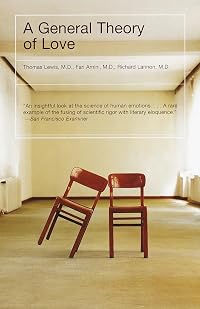
Other than a slight tendancy towards aurate magniloquence, this is a thorough and readable introduction to neuro-psychology. Worth it for anyone interested in brains at all, plus it has the best paper-back cover ever.
Members
- Recently Added By
Lists

Deathreads
78 works; 2 members
Author Information
1 Work 897 Members
Some Editions
Common Knowledge
- Canonical title
- A General Theory of Love
- Original publication date
- 2000
Classifications
- Genres
- Nonfiction, General Nonfiction, Science & Nature
- DDC/MDS
- 152.41 — Philosophy & psychology Psychology Sensory perception, movement, emotions, physiological drives Emotions Love and Affection
- LCC
- BF575 .L8 .L49 — Philosophy, Psychology and Religion Psychology Psychology Affection. Feeling. Emotion
- BISAC
Statistics
- Members
- 910
- Popularity
- 29,654
- Reviews
- 8
- Rating
- (4.10)
- Languages
- English, Portuguese, Spanish
- Media
- Paper, Audiobook, Ebook
- ISBNs
- 6
- UPCs
- 1
- ASINs
- 6