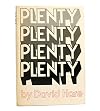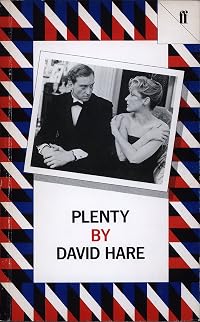
Plenty
by David Hare
On This Page
Description
This play ran at the National Theatre, London, throughout 1978 and the New York production in the autumn of 1982 was equally well received. In counterpointing the experiences of an Englishwoman helping the French Resistance during the war with her life in the following twenty years, the author offers a unique view of postwar history, as well as making a powerful statement about changing values and the collapse of ideals embodied in a single life. Plenty is also a major film produced by show more Edward R. Pressman and Joseph Papp with Mark Seiler as Executive Producer, and directed by Fred Schepisi from a screenplay by David Hare. The cast, headed by double Oscar-winner Meryl Streep, includes Charles Dance, Tracy Ullman, John Gielgud, Sting, Ian McKellen and Sam Neill. show lessTags
Recommendations





















Member Recommendations

kraaivrouw Both capture the desperation of post-war England in their own unique ways.
Member Reviews
"It's a common criticism of my works that I write about women whom I find admirable, but whom the audience dislikes."
That's what Hare writes about this play in the edition I read. I have watched the 1985 Meryl Streep film adaptation many times. It always spoke to me. Today, for the first time, I read the play, where I gained additional insights including within Hare's "A Note on Performance" where he recognizes the potential problems and discusses his intended goals.
He was right. The majority of audiences dislike Susan, in the play and film.
Susan is complex and her reactions are complex. In WWII she was an 18 year old member of Special Operations inside France, an experience that was so intense, so dangerous, and so worthwhile that show more nothing in ordinary post-WWII English life can compare. She will feel a void the remainder of her life. It will haunt her and yet always be an unnamed, maladapted never-resolved disappointment.
I honestly think, that if this had been presented as a story about a man's similar experience, (like the glimpse of Lazar's life near the end of the play) it would have been more empathetically received. And that is a major point. This is an incredibly perceptive depiction of one way that a highly intelligent, capable woman might attempt to cope with the loss of once having a profound purpose and comradery with the world. We aren't used to being made aware that women also had these kinds of war experiences. I read Hare wrote this play because 75% of women who were in Special Operations divorced in the immediate post war years.
Something significant in their expectations had changed.
Susan is not mean or cruel or cold, although it seems that way to the men in the play. She is honest in a way few of us are, or at least were. Honesty can hurt and especially so, apparently, when coming from a woman to a man. Frankly, she wears her heart on her sleeve, in a way not easily recognized, probably not even by herself.
It might look like a hard heart, or like neurosis. But, goddamn, I admire her fight against utter banality. Futile as it might be, self-destructive as it might be, baffling and hurtful to her husband as it might be, her battle never has cruelty as its goal. Indeed, most of her recurring episodes are trying to wrangle some shred of a higher objective than the bourgeoisie status quo to which the world had gladly and easily slipped into after the war.
Was she ever successful? No.
Every time I've watched (and now have read) this play, my heart hurts a little more. show less
That's what Hare writes about this play in the edition I read. I have watched the 1985 Meryl Streep film adaptation many times. It always spoke to me. Today, for the first time, I read the play, where I gained additional insights including within Hare's "A Note on Performance" where he recognizes the potential problems and discusses his intended goals.
He was right. The majority of audiences dislike Susan, in the play and film.
Susan is complex and her reactions are complex. In WWII she was an 18 year old member of Special Operations inside France, an experience that was so intense, so dangerous, and so worthwhile that show more nothing in ordinary post-WWII English life can compare. She will feel a void the remainder of her life. It will haunt her and yet always be an unnamed, maladapted never-resolved disappointment.
I honestly think, that if this had been presented as a story about a man's similar experience, (like the glimpse of Lazar's life near the end of the play) it would have been more empathetically received. And that is a major point. This is an incredibly perceptive depiction of one way that a highly intelligent, capable woman might attempt to cope with the loss of once having a profound purpose and comradery with the world. We aren't used to being made aware that women also had these kinds of war experiences. I read Hare wrote this play because 75% of women who were in Special Operations divorced in the immediate post war years.
Something significant in their expectations had changed.
Susan is not mean or cruel or cold, although it seems that way to the men in the play. She is honest in a way few of us are, or at least were. Honesty can hurt and especially so, apparently, when coming from a woman to a man. Frankly, she wears her heart on her sleeve, in a way not easily recognized, probably not even by herself.
It might look like a hard heart, or like neurosis. But, goddamn, I admire her fight against utter banality. Futile as it might be, self-destructive as it might be, baffling and hurtful to her husband as it might be, her battle never has cruelty as its goal. Indeed, most of her recurring episodes are trying to wrangle some shred of a higher objective than the bourgeoisie status quo to which the world had gladly and easily slipped into after the war.
Was she ever successful? No.
Every time I've watched (and now have read) this play, my heart hurts a little more. show less
Probably Hare's best play, showing through the disillusionment of a female SoE agent how the fine clear morality of WWII descended in the 1940s and 1950s into compromises and dishonesty in English Society. Those who saw the premiere of this play at the National Theatre in 1978 are unlikely to have forgotten it.
Ratings
Members
- Recently Added By
Lists

My Play Collection
769 works; 3 members
Author Information

77+ Works 2,756 Members
The son of Clifford and Agnes Gilmour Hare, David Hare was born on June 5, 1947, in St. Leonards, England. After graduating from Jesus College in Cambridge in 1968 with the honors Master of Arts degree in English, Hare went to work for the film company A.B. Pathe. Soon after, Hare co-founded the Portable Theatre Company, a touring experimental show more theatre group. While serving as the theatre's director from 1968 to 1971, Hare wrote his first plays. In 1970, Hare won the Evening Standard Drama Award for most promising new playwright for Slag, his first major play. Two years later, after Portable Theatre declared bankruptcy, Hare became resident dramatist at Nottingham Playhouse. Hare also co-founded the Joint Stock Theatre Group and served as its director from 1975 to 1980. During these years Hare produced many more plays, including The Great Exhibition, Brassneck, and Knuckle, the first of Hare's plays to be produced in London's West End. In addition to directing his own plays, Hare has directed such works as The Party by Trevor Griffiths, Devil's Island by Tony Bicat, and King Lear, with Anthony Hopkins in the title role. In 1982, Hare opened his own film company, Greenpoint Films. Among the screenplays written by Hare are Plenty, Paris by Night, and Wetherby, a story about repressed passions among members of the middle class. (Bowker Author Biography) The son of Clifford and Agnes Gilmour Hare, David Hare was born on June 5, 1947, in St. Leonards, England. After graduating from Jesus College in Cambridge in 1968 with an honors Master of Arts degree in English, Hare went to work for the film company A.B. Pathe. Soon after, Hare co-founded the Portable Theatre Company, a touring experimental theatre group. While serving as the theatre's director from 1968 to 1971, Hare wrote his first plays. In 1970, Hare won the Evening Standard Drama Award for most promising new playwright for Slag, his first major play. Two years later, after Portable Theatre declared bankruptcy, Hare became resident dramatist at Nottingham Playhouse. Hare also co-founded the Joint Stock Theatre Group and served as its director from 1975 to 1980. During these years Hare produced many more plays, including The Great Exhibition, Brassneck, and Knuckle, the first of Hare's plays to be produced in London's West End. In addition to directing his own plays, Hare has directed such works as The Party by Trevor Griffiths, Devil's Island by Tony Bicat, and King Lear, with Anthony Hopkins in the title role. In 1982, Hare opened his own film company, Greenpoint Films. Among the screenplays written by Hare are Plenty, Paris by Night, and Wetherby, a story about repressed passions among members of the middle class. Hare was married to theatrical agent Margaret Mathieson for 10 and they had three children, Joe, Darcy, and Lewis. They divorced in 1980. Hare married designer Nicole Farhi in December 1992. (Bowker Author Biography) David Hare is the author of over a dozen plays, including "Via Dolorosa", "The Judas Kiss", & "Skylight". He lives in London. (Bowker Author Biography) show less
Awards and Honors
Awards
Work Relationships
Is contained in
Has as a student's study guide
Classifications
Statistics
- Members
- 139
- Popularity
- 236,278
- Reviews
- 2
- Rating
- (4.00)
- Languages
- English
- Media
- Paper, Ebook
- ISBNs
- 9
- ASINs
- 4