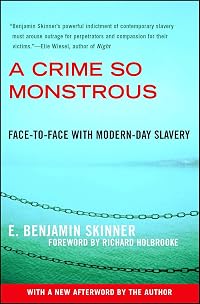
A Crime So Monstrous: Face-to-Face with Modern-Day Slavery
by E. Benjamin Skinner
On This Page
Description
There are more slaves in the world today than at any time in history. In this account of contemporary slavery, journalist Skinner travels around the globe to personally tell stories that need to be told--and heard. With years of reporting in such places as Haiti, Sudan, India, Eastern Europe, The Netherlands, and, yes, even suburban America, Skinner has produced a moving reportage on one of the great evils of our time. After spending four years infiltrating trafficking networks and slave show more sales on five continents, he tells the story of individuals who live in slavery, those who have escaped from bondage, those who own or traffic in slaves, and the mixed political motives of those who seek to combat the crime. Their stories are heartbreaking but, in the midst of tragedy, readers discover a quiet dignity that leads some slaves to resist and aspire to freedom.--From publisher description. show lessTags
Recommendations











Member Recommendations
Member Reviews
I was looking for an 'introduction' to the problem of modern day slave trading/human trafficking, and this book served that role perfectly. I'm not an expert now, but I'm certainly moved to Do Something about it (in the form of donating to Free the Slaves, pretty much the only NGO Skinner 'endorses' or consistently praises in this book). Certainly not for the faint of heart, nor for those just looking for a comfortable treatise on world affairs. Hopefully you would know just what you were getting in to when reading such a book, and this one delivers as advertised. Grim, with scant hope, and outrage-inducing. If that's what you're looking for-here it is. (Note for those overly sensitive to political or religious biases: you'll find ample show more criticism in this one, of the past four or five American presidents, of Republicans, and of evangelical Christians like myself. If that's what offends you most about this book, your soul has obviously died.) show less
I would have given the book six stars had that many been available. Skinner examines the modern day slave trade in Eastern Europe, Haiti and India. Posing as a 'buyer' he found that he could purchase a girl for the price of a used car in Romania. In India millions work as slaves to pay off a debt taken out by a grandfather. Because of interest charged it is never paid off in spite of several generations trying. Sometimes the original loan was barely $1.00.
This is the most depressing book that EVERYONE should read.
This is the most depressing book that EVERYONE should read.
Макар да е интересно да се научи за различните видове принудителен труд (граничещ с робство) днес по света, книгата не предлага почти нищо друго по темата.
Ако очаквате нещо като разследваща журналистика, ще се излъжете жестоко - а ще очаквате, щото точно това подсказва описанието и предговора. Авторът обаче очевидно е прекарал доста малко време в самите държави и не си е давал особено зор да разследва show more каквото и да е, защото 98% от цялата информация като че идва от официалните сводки на съответните организации за борба с трафика на хора и принудителния труд, които могат да се намерят в интернет. Останалите 2 % е що годе интересното.
Да не говорим, че авторът изкарва робството днес едва ли не най-големият проблем на човечеството, с който всички трябва да се борим, сякаш си нямаме друга работа освен да ни интересуват разни бананови държави, сякаш единственият начин да се оправи този проблем е с добродетелни "кръстоносни походи" от християнска благотворителност, и сякаш не е очевидно, че тия практики са резултат от провалената икономика и управление на тия държави, които ги позволяват.
Много са ми смешни всякакви леви и десни-религиозни "активисти", които се фиксират върху някакъв проблем в някакви умрели държавици и тръгват да го "решават", да "ни информират" за бедственото положение, да ни карат да заемем "правилната морална позиция", да "заклеймим злото" и да даваме пари за гладуващи деца, спин и т.н. без да им светне, че ако не оправят първо самите държави, всякакви усилия за борба с произхождащите от липсата на държавност и икономика проблеми са само наливане на вода в каца без дъно.
Ама целия тоя безсмислен труд кара съответните "активисти" да се чувстват важни и благородни, което всъщност май е единствената им истинска цел. show less
Ако очаквате нещо като разследваща журналистика, ще се излъжете жестоко - а ще очаквате, щото точно това подсказва описанието и предговора. Авторът обаче очевидно е прекарал доста малко време в самите държави и не си е давал особено зор да разследва show more каквото и да е, защото 98% от цялата информация като че идва от официалните сводки на съответните организации за борба с трафика на хора и принудителния труд, които могат да се намерят в интернет. Останалите 2 % е що годе интересното.
Да не говорим, че авторът изкарва робството днес едва ли не най-големият проблем на човечеството, с който всички трябва да се борим, сякаш си нямаме друга работа освен да ни интересуват разни бананови държави, сякаш единственият начин да се оправи този проблем е с добродетелни "кръстоносни походи" от християнска благотворителност, и сякаш не е очевидно, че тия практики са резултат от провалената икономика и управление на тия държави, които ги позволяват.
Много са ми смешни всякакви леви и десни-религиозни "активисти", които се фиксират върху някакъв проблем в някакви умрели държавици и тръгват да го "решават", да "ни информират" за бедственото положение, да ни карат да заемем "правилната морална позиция", да "заклеймим злото" и да даваме пари за гладуващи деца, спин и т.н. без да им светне, че ако не оправят първо самите държави, всякакви усилия за борба с произхождащите от липсата на държавност и икономика проблеми са само наливане на вода в каца без дъно.
Ама целия тоя безсмислен труд кара съответните "активисти" да се чувстват важни и благородни, което всъщност май е единствената им истинска цел. show less
Frankly, I had no idea how widespread the crimes of human trafficking and slavery were across the world, before I read this book. Living in the Netherlands, I was surprised to find out that many slaves even live and work for no pay in my own country. Benjamin Skinner gives these slaves a human face and describes their suffering in heart-wrenching detail. Especially the accounts of Haitian and Eastern European slavery impressed me. Skinner also provides a great portrait of the people fighting this crime, most notably John Miller of the US State Department.
Benjamin Skinner did a very good job of tackling a tremendously complicated and difficult subject in this book. As he points out, there are more slaves in the world today than ever before, but they represent a smaller percentage of the world’s population than previously. “Slavery is a slippery and confounding evil, and persists despite twelve international conventions banning the slave trade, and over three hundred international treaties banning slavery.” It’s been estimated that there are 27 million slaves in the world today. Skinner adopts as his definition of slavery human beings forced to work, through force or fraud, for no pay beyond subsistence.
Skinner admits that his book is not all inclusive. In five years he visited show more twelve countries and interviewed over 100 slaves, slave dealers, and survivors. However he did not visit or investigate countless other countries (including China) where slavery exists.
Skinner begins his story in Port-au-Prince, Haiti where more than 10,000 street kids, mostly boys as young as six, sell unprotected sex for $1.75. In addition, there are many thousands of domestic slaves called restaveks, children as young as three from rural areas who are given to the traffickers for promises that their children will be well fed and educated (something they don’t have themselves but wish for their children). They are totally unaware that their children will be sold by the trafficker as domestic or sex slaves, starved, beaten, and definitely not educated. During this section of the book Skinner interviews slaves, slave owners, traffickers, local officials whose job it is to stop slavery, church and social organizations trying to help the slaves, and parents who had given up their children in the hopes of bettering their lot.
Skinner then turns to the United States and how the Bush administration is responding, or not, to the question of slavery in the world. He introduces the reader to John Miller, the head of the United States Office to Monitor and Combat Trafficking in Persons. Skinner covers in length the dedication and many, many, many hours of work that Miller and his staff expend in trying to make some small difference in the overwhelming tide of slavery. Throughout the book he returns to Miller again and again to show how Miller is responding to each of the challenges in the areas he has visited and how the Bush administration responds, or not, to each.
Throughout the book Skinner visits the Sudan, Romania, Moldova, Turkey, the Netherlands, Dubai, India, and more. In each he exposes a little of the underbelly for us to view, but tells us about much, much more he cannot show us. Through his interviews he depicts slavery with a series of different faces, but always horrifying in whatever form it takes. Skinner cannot show us all the countries, all the faces of subjugation, but he does a good job of explaining the many ways in which slavery exists today, how it's allowed to do so, why it must be stopped, and some of the ways that it could be possible if only enough law, money, force, and power were put behind it. show less
Skinner admits that his book is not all inclusive. In five years he visited show more twelve countries and interviewed over 100 slaves, slave dealers, and survivors. However he did not visit or investigate countless other countries (including China) where slavery exists.
Skinner begins his story in Port-au-Prince, Haiti where more than 10,000 street kids, mostly boys as young as six, sell unprotected sex for $1.75. In addition, there are many thousands of domestic slaves called restaveks, children as young as three from rural areas who are given to the traffickers for promises that their children will be well fed and educated (something they don’t have themselves but wish for their children). They are totally unaware that their children will be sold by the trafficker as domestic or sex slaves, starved, beaten, and definitely not educated. During this section of the book Skinner interviews slaves, slave owners, traffickers, local officials whose job it is to stop slavery, church and social organizations trying to help the slaves, and parents who had given up their children in the hopes of bettering their lot.
Skinner then turns to the United States and how the Bush administration is responding, or not, to the question of slavery in the world. He introduces the reader to John Miller, the head of the United States Office to Monitor and Combat Trafficking in Persons. Skinner covers in length the dedication and many, many, many hours of work that Miller and his staff expend in trying to make some small difference in the overwhelming tide of slavery. Throughout the book he returns to Miller again and again to show how Miller is responding to each of the challenges in the areas he has visited and how the Bush administration responds, or not, to each.
Throughout the book Skinner visits the Sudan, Romania, Moldova, Turkey, the Netherlands, Dubai, India, and more. In each he exposes a little of the underbelly for us to view, but tells us about much, much more he cannot show us. Through his interviews he depicts slavery with a series of different faces, but always horrifying in whatever form it takes. Skinner cannot show us all the countries, all the faces of subjugation, but he does a good job of explaining the many ways in which slavery exists today, how it's allowed to do so, why it must be stopped, and some of the ways that it could be possible if only enough law, money, force, and power were put behind it. show less
This book changed the way I think about prostitution and illegal immigration. Gritty and honest. It made me realize that banning slavery is not the same as abolishing it.
This was a good book. While I knew that slavery was real and significant, I had never seen many different modern slavery situations put into the context of each other. The writing, however, wasn't to my taste. I suppose it suffered because I was reading it side by side with William Stegner, but I wanted it to feel less journalistic, more measured. I don't know - maybe I was looking for something that this book couldn't have possibly offered.
Members
- Recently Added By
Author Information

1 Work 310 Members
E. Benjamin Skinner has reported on a wide range of topics from Latin America, Africa, and the Middle East for such publications as Newsweek International, Travel + Leisure, and Foreign Affairs.
Awards and Honors
Awards
Common Knowledge
- Canonical title
- A Crime So Monstrous: Face-to-Face with Modern-Day Slavery
- Original publication date
- 2008
- Important places*
- Moldavië
- Dedication
- To my mother, who is my conscience, and To my father, who is my sense of humor
*Some information comes from Common Knowledge in other languages. Click "Edit" for more information.
Classifications
- Genres
- Nonfiction, General Nonfiction, Politics and Government, History
- DDC/MDS
- 306.362 — Society, government, & culture Social sciences, sociology & anthropology Social Behavior - Dating, Marriage, Divorce Economic institutions Systems of labor Slavery
- LCC
- HT871 .S49 — Social sciences Communities. Classes. Races Communities. Classes. Races Classes Slavery
- BISAC
Statistics
- Members
- 310
- Popularity
- 103,227
- Reviews
- 9
- Rating
- (4.10)
- Languages
- Dutch, English, German, Italian
- Media
- Paper, Ebook
- ISBNs
- 11
- UPCs
- 1
- ASINs
- 3