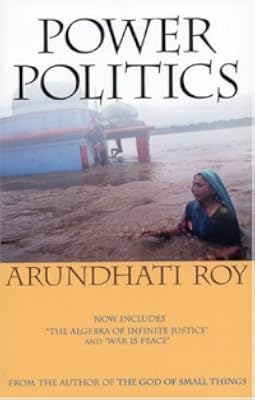
Power Politics
by Arundhati Roy
On This Page
Description
The acclaimed novelist criticizes globalization, particularly as it manifests in Indian dam construction, and challenges the idea that only "experts" can criticize social and economic policy.Tags
Recommendations






































Member Reviews
Addresses the globalization of the world economy and the privatization of India's power supply by US based energy companies and the construction of monumental dams that will dislocate hundreds of thousands of people.
Ratings
Members
- Recently Added By
Author Information

59+ Works 29,617 Members
Suzanna Arundhati Roy, 1961 - Suzanna Roy was born November 24, 1961. Her parents divorced and she lived with her mother Mary Roy, a social activist, in Aymanam. Her mother ran an informal school named Corpus Christi and it was there Roy developed her intellectual abilities, free from the rules of formal education. At the age of 16, she left home show more and lived on her own in a squatter's colony in Delhi. She went six years without seeing her mother. She attended Delhi School of Architecture where she met and married fellow student Gerard Da Cunha. Neither had a great interest in architecture so they quit school and went to Goa. They stayed there for seven months and returned broke. Their marriage lasted only four years. Roy had taken a job at the National Institute of Urban Affairs and, while cycling down a road; film director Pradeep Krishen offered her a small role as a tribal bimbo in Massey Saab. She then received a scholarship to study the restoration of monuments in Italy. During her eight months in Italy, she realized she was a writer. Now married to Krishen, they planned a 26-episode television epic called Banyan Tree. They didn't shoot enough footage for more than four episodes so the serial was scrapped. She wrote the screenplay for the film In Which Annie Gives It Those Ones and Electric Moon. Her next piece caused controversy. It was an article that criticized Shekar Kapur's film Bandit Queen, which was about Phoolan Devi. She accused Kapur of misrepresenting Devi and it eventually became a court case. Afterwards, finished with film, she concentrated on her writing, which became the novel "A God of Small Things." It is based on what it was like growing up in Kerala. The novel contains mild eroticism and again, controversy found Roy having a public interest petition filed to remove the last chapter because of the description of a sexual act. It took Roy five years to write "A God of Small Things" and was released April 4, 1997 in Delhi. It received the Booker prize in London in 1997 and has topped the best-seller lists around the world. Roy is the first non-expatriate Indian author and the first Indian woman to win the Booker prize. (Bowker Author Biography) show less
Some Editions
Awards and Honors
Notable Lists
Common Knowledge
- Canonical title
- Power Politics
- Alternate titles
- Power Politics: The Reincarnation of Rumpelstiltskin
- Original publication date
- 2000
Classifications
- Genres
- Nonfiction, Politics and Government
- DDC/MDS
- 808 — Literature & rhetoric Literature, rhetoric & criticism Rhetoric and collections of literary texts from more than two literatures
- LCC
- JQ231 .R69 — Political Science Political institutions and public administration (Asia, Africa, Australia, Pacific Area, etc.) Political institutions and public administration (Asia, India
- BISAC
Statistics
- Members
- 392
- Popularity
- 79,820
- Reviews
- 1
- Rating
- (4.17)
- Languages
- English, German
- Media
- Paper
- ISBNs
- 7