
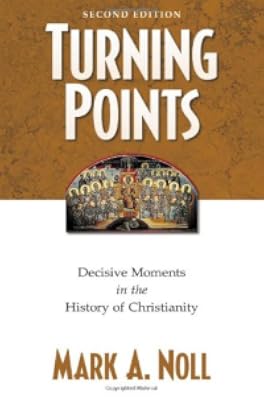
Turning Points: Decisive Moments in the History of Christianity
by Mark A. Noll
On This Page
Description
In this popular introduction to church history, now in its third edition, Mark Noll isolates key events that provide a framework for understanding the history of Christianity. The book presents Christianity as a worldwide phenomenon rather than just a Western experience. Now organized around fourteen key moments in church history, this well-received text provides contemporary Christians with a fuller understanding of God as he has revealed his purpose through the centuries. This new edition show more includes a new preface; updates throughout the book; revised "further readings" for each chapter; and two new chapters, including one spotlighting Vatican II and Lausanne as turning points of the recent past. Students in academic settings and church adult education contexts will benefit from this one-semester survey of Christian history. show lessTags
Recommendations

Member Reviews
Read this to prepare for the church history portion of my ordination trials (PCA). As a general survey, it was quite helpful. I found his assessment of 18th century evangelical and pietist movements especially interesting, considering most American evangelicals today assume they’ve been corrupted by Enlightenment values from without when really, as Noll demonstrates, evangelicalism has been an Enlightenment project from the start. Unfortunately, his evaluation of Christendom is too colored with anabaptist sympathies that he ends up leveling the same, cliched critique against Christendom as he does the various Reformation churches of the 16th century. Apparently very few Christians since Constantine have been able to resist the lure of show more earthly power. show less
Summary: Twelve decisive moments in Christian history along with twentieth century events that may be turning points.
Mark A. Noll, who has taught history at several colleges, first wrote this concise distillation of Christian history in 1997. In that edition, he identifies twelve decisive “turning points” in the history of Christianity. He also discusses important twentieth century events that may be considered turning points. Noll’s method has the advantage both of focus and offering the ability to incorporate contemporaneous events.
An example of this is his first turning point, the fall of Jerusalem, and how this led to the expansion of the church. In this chapter, he incorporates discussions of the formation of the canon, show more apostolic succession, and the early creeds of the church.
Subsequent turning points include the Councils of Nicea (on the Trinity) and Chalcedon (on Christology), the rise of monasticism with Benedict, and the culmination of Christendom in Charlemagne. Noll next turns our attention to the East-West schism of 1054, the Diet of Worms, the English Act of Supremacy, and Catholic Reforms including the missionary order of the Jesuits. Latter chapters cover the rise of pietism, focused on the conversion of the Wesleys, the decline of Christendom marked by the French Revolution and the rise of secularity, and the Edinburgh Missionary Conference of 1910 and the explosion of Protestant Missions.
There were several things I appreciated in this work. One is that each chapter opens with a hymn from the period being covered and closes with a prayer. Another was Noll’s focus on Catholic history from the Benedictines to the reforms at Trent to the Jesuit movement, the first modern missionary movements. Protestants were latecomers. A third aspect to which I would call attention are the numerous sidebars, for example “Aquinas on Sacraments.” Each chapter includes bibliographies for further reading. Finally, Noll provides an account at once detailed and yet concise of the rise of “the secular age” or modernity at far less length than Charles Taylor!
David Komline and Han-luen Kantzer Komline co-author the newest edition. In addition to Noll’s content, the edition includes new sidebars and updated reading lists. The chapter on the twentieth century now highlights the Lausanne Conference as well as Vatican II. Because of the Lausanne movement’s global impact over fifty years, this is fitting.
The book is ideal for a college-level introductory course in Christian history or an adult education class. Likewise, it makes a great read for anyone who wants to brush up their understanding of Christian history! show less
Mark A. Noll, who has taught history at several colleges, first wrote this concise distillation of Christian history in 1997. In that edition, he identifies twelve decisive “turning points” in the history of Christianity. He also discusses important twentieth century events that may be considered turning points. Noll’s method has the advantage both of focus and offering the ability to incorporate contemporaneous events.
An example of this is his first turning point, the fall of Jerusalem, and how this led to the expansion of the church. In this chapter, he incorporates discussions of the formation of the canon, show more apostolic succession, and the early creeds of the church.
Subsequent turning points include the Councils of Nicea (on the Trinity) and Chalcedon (on Christology), the rise of monasticism with Benedict, and the culmination of Christendom in Charlemagne. Noll next turns our attention to the East-West schism of 1054, the Diet of Worms, the English Act of Supremacy, and Catholic Reforms including the missionary order of the Jesuits. Latter chapters cover the rise of pietism, focused on the conversion of the Wesleys, the decline of Christendom marked by the French Revolution and the rise of secularity, and the Edinburgh Missionary Conference of 1910 and the explosion of Protestant Missions.
There were several things I appreciated in this work. One is that each chapter opens with a hymn from the period being covered and closes with a prayer. Another was Noll’s focus on Catholic history from the Benedictines to the reforms at Trent to the Jesuit movement, the first modern missionary movements. Protestants were latecomers. A third aspect to which I would call attention are the numerous sidebars, for example “Aquinas on Sacraments.” Each chapter includes bibliographies for further reading. Finally, Noll provides an account at once detailed and yet concise of the rise of “the secular age” or modernity at far less length than Charles Taylor!
David Komline and Han-luen Kantzer Komline co-author the newest edition. In addition to Noll’s content, the edition includes new sidebars and updated reading lists. The chapter on the twentieth century now highlights the Lausanne Conference as well as Vatican II. Because of the Lausanne movement’s global impact over fifty years, this is fitting.
The book is ideal for a college-level introductory course in Christian history or an adult education class. Likewise, it makes a great read for anyone who wants to brush up their understanding of Christian history! show less
This book is unique among books about church history. Rather than covering all the people, processes and events that have taken place over the past 2,000 years, this book focuses on 14 key moments which made significant impacts on the church and changed in some way what it was, what it believed or what it did. It is an excellent second source for studying church history. It is a bit dense, in that it doesn't have much fluff and shouldn't be read in a cursory manner.
Good short church history survey book. Noll is arguably THE historian when it comes to evangelical scholarship, and he doesn't disappoint in this book. Clearly it cannot cover the full breadth of the topic, but that is impossible for even a book several times this book's length.
Ratings
Members
- Recently Added By
Lists

Develop Your Personal Christian Library
101 works; 15 members
Sycamore Baptist Church Book Study Reading List
156 works; 5 members

How to Read a Christian Book Three-Year Plan
36 works; 2 members
Trinity Norman Recommended Christian Readings
170 works; 5 members
GreatBooks Worldview Academy Lists
133 works; 4 members
Author Information

63+ Works 10,686 Members
Mark A. Noll is the Francis A. McAnancy Professor Emeritus of History at the University of Notre Dame. His many other books include A History of Christianity on the Untied States and Canada. The Civil War as a Theological Crisis, Jesus Christ and the Life of the Mind, and America's God: From Jonathan Edwards to Abraham Lincoln.
Awards and Honors
Awards
Christianity Today Book Awards (No. 8 – 1998)
Series
Belongs to Publisher Series
Common Knowledge
- Original title
- Turning Points: Decisive Moments in the History of Christianity
- Alternate titles*
- 基督教會歷史里程碑
- Original publication date
- 2000
- People/Characters
- Jesus Christ
*Some information comes from Common Knowledge in other languages. Click "Edit" for more information.
Classifications
Statistics
- Members
- 1,849
- Popularity
- 11,661
- Reviews
- 4
- Rating
- (3.99)
- Languages
- English, Portuguese
- Media
- Paper, Audiobook, Ebook
- ISBNs
- 13
- ASINs
- 8