On This Page
Description
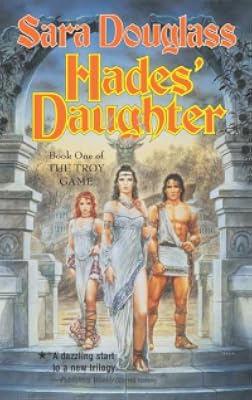
The Troy Game, Book I Hades' Daughter Ancient Greece is a place where mortals are the playthings of the gods--but at the core of each mortal city-state is a Labyrinth, where the mortals can shape the heavens to their own design. When Theseus comes away from the Labyrinth with the prize of freedom and his beloved Ariadne, the Mistress of the Labyrinth, his future seems assured. But she bears him only a daughter--and when he casts her aside for this, the world seems to change. From that day show more forward, the Labyrinths decay, and power fades from the city-states. A hundred years pass, Troy falls, the Trojans scatter. Then Brutus, the warrior-king of Troy, receives a vision of distant shores where he can rebuild the ancient kingdom. He will move heaven and earth to reach his destiny. But in the mists is a woman of power, a descendent of Ariadne, who has her own reasons for luring Brutus to this lush land. Her heart is filled with a generations-old hatred, and her vengeance on him will not be thwarted. If Brutus makes the journey successfully, it will be the next step in the Game of the Labyrinth, and the beginning of a complicated contest of wills that will last for centuries... show lessTags
Recommendations
Member Reviews
The trashy cover and ridiculous title predisposed me to discount this, but the emphasis on character development, and the healthy splashes of almost-realistic history, made me like the book despite myself. There *are* some trashy bits--the sex scenes are by and large romance-novel-y, and sometimes the female characters get locked into the "strong, beautiful, and quietly commanding" niche. Regardless, I find myself excited about reading the third and final novel, which promises to answer the question of who has survived through the centuries--and who will triumph.
I rarely have the pleasure of being so caught up in a book, so entrapped by its characters, that I fail to notice the steadily increasing pile of laundry on the floor, or dust that is accumulating past an inch. But this book did, with its heady blend of Greek and Celtic mythology, its factual references to many customs of the 11th century BCE, and its sprinkling of fantasy - just enough to claim the world as the author's own.
The characters are refreshing. Brutus, a headstrong descendant of Aeneas (founder of Rome), Cornelia, a proud child princess who is only looking for affection, to the darkwitch Genvissa, descendant of Ariadne, the original Priestess of the Labyrinth. I alternated between wanting to smack all of them for misbehaving, show more and cry during their desperate struggle. Good and evil are often very hard to define here, and all of the characters have their moments, where it is clear that they are only trying to do what is best for their land and their people (though some more at the expense of others). But where Douglass shines at fleshing out her characters, be forewarned that she is also ruthless with them. By mid-book, I knew not to be too firmly attached to any of them. Yet the snippets of happiness thrown in, made me eagerly press on, hoping for that happy ending.
If you are familiar with the myth of Ariadne, Theseus and the minotaur of Crete, you will jump right into the story. Ariadne has already helped Theseus at the expense of her family. Now pregnant and jilted, the book opens with Theseus sailing away with his new lover, and Ariadne seeking revenge by making a pact with Asterion, the minotaur. But this story isn't about Ariadne. It is about the result of her pact, and successive generations of her bloodline and their struggles, as well as those around them, to keep their land from dying. It is also the story of Brutus, determined to found New Troy on the land of once peaceful Mag and Og's domain. It is about his struggle through the Mediterranean and across the waters, and affect everyone and everything he touches, and not necessarily in a good way.
Douglass has done her research well. She throws in details familiar to many ancient historians, from the topless Minoan young women where women rule as honored priestesses, to the matriarchal society of Albion where women ask the goddess for a child and are beholden to no man. Then there are their manly neighbors who ride naked into battle, painted black and blue and cause chaos and destruction in their wake, treating women no better than chattel.
It's clear the story isn't finished with this first installment, and there are three books to go. It's also a story that leaves the reader eagerly wanting to know what happens to the characters, and who will win in the end, and I look forward to the second installment. show less
The characters are refreshing. Brutus, a headstrong descendant of Aeneas (founder of Rome), Cornelia, a proud child princess who is only looking for affection, to the darkwitch Genvissa, descendant of Ariadne, the original Priestess of the Labyrinth. I alternated between wanting to smack all of them for misbehaving, show more and cry during their desperate struggle. Good and evil are often very hard to define here, and all of the characters have their moments, where it is clear that they are only trying to do what is best for their land and their people (though some more at the expense of others). But where Douglass shines at fleshing out her characters, be forewarned that she is also ruthless with them. By mid-book, I knew not to be too firmly attached to any of them. Yet the snippets of happiness thrown in, made me eagerly press on, hoping for that happy ending.
If you are familiar with the myth of Ariadne, Theseus and the minotaur of Crete, you will jump right into the story. Ariadne has already helped Theseus at the expense of her family. Now pregnant and jilted, the book opens with Theseus sailing away with his new lover, and Ariadne seeking revenge by making a pact with Asterion, the minotaur. But this story isn't about Ariadne. It is about the result of her pact, and successive generations of her bloodline and their struggles, as well as those around them, to keep their land from dying. It is also the story of Brutus, determined to found New Troy on the land of once peaceful Mag and Og's domain. It is about his struggle through the Mediterranean and across the waters, and affect everyone and everything he touches, and not necessarily in a good way.
Douglass has done her research well. She throws in details familiar to many ancient historians, from the topless Minoan young women where women rule as honored priestesses, to the matriarchal society of Albion where women ask the goddess for a child and are beholden to no man. Then there are their manly neighbors who ride naked into battle, painted black and blue and cause chaos and destruction in their wake, treating women no better than chattel.
It's clear the story isn't finished with this first installment, and there are three books to go. It's also a story that leaves the reader eagerly wanting to know what happens to the characters, and who will win in the end, and I look forward to the second installment. show less
With Hades' Daughter, Douglass kicks off her 4-book series "The Troy Game," in which descendants of the ancient Trojans journey to a new, foreign land where, with the assistance of The Game, they begin to build Troia Nova. Along the way, they capture Cornelia, a Greek princess who is brutally forced into marriage with the Trojans' leader Brutus. Brutus ultimately plans to abandon Cornelia for Genvissa, the woman whose mystical powers will ensure that he and she will reign as king and queen.
Unfortunately, none of the main characters are particularly likable, so I didn't find I had much emotional investment in their well-being. Also, "The Game," referred to many, many times, remains even at the end of the book a somewhat confusing and show more nebulous concept. I do like Sara Douglass, so I'll still finish the series. show less
Unfortunately, none of the main characters are particularly likable, so I didn't find I had much emotional investment in their well-being. Also, "The Game," referred to many, many times, remains even at the end of the book a somewhat confusing and show more nebulous concept. I do like Sara Douglass, so I'll still finish the series. show less
As a huge fan of the Wayfarer's Redemption series, I may be rating this unfairly in comparison. But, there was no plotline or character that I liked or could get into. Lots of endless sex and went very quickly from Troy to ancient Britain with all the druid stuff that has been done to death (and better) by other authors. Seemed like endless sex between characters that went body and time hopping in confusing fashion. In some incarnations were villains who did lots of violent or evil stuff; in others were good guys losing out to or getting molested or betrayed by villains that may or not be the reincarnation of their loved ones. I have an inkling what author was going for and friends tell me the series gets better and clearer—but the show more "to read pile" too large for foreseeable future to give this series a chance to be less confusing or get characters I might get interested in. Might appeal to readers not familiar with author's other works, with a strong interest in historical eras portrayed, or who like the body and time hopping around stuff that left me confused. show less
The only problems I forsee with starting this book is that you have to have some knowledge of greek mythology. I know that when I first started this book a few years back I couldn't get into it, because I didn't understand what was being written about. But luckily for me I was able to take a class and we just so happened to cover the greeks. Dear gods, when I was actually able to get into the book a whole new world was opened it seemed. The plot is a twitsted work of great clif-hangers making the book impossiable to put down.
At first Cornelia's character annoied me, but then with the story's development I began to like her very much. Brutus was the almost bad-guy and I still very much abhore Genivissa. The other characters made for an show more enjoyable cast.
I think the one thing that rubbed me the wrong way was the constant jumps from the first to the third person. And it takes you a while to get used to jumping from the 'present' back to the story which is obviously the past.
But over all the story was very good and got me on to the second and the third (and waiting very patiently for the forth) books. show less
At first Cornelia's character annoied me, but then with the story's development I began to like her very much. Brutus was the almost bad-guy and I still very much abhore Genivissa. The other characters made for an show more enjoyable cast.
I think the one thing that rubbed me the wrong way was the constant jumps from the first to the third person. And it takes you a while to get used to jumping from the 'present' back to the story which is obviously the past.
But over all the story was very good and got me on to the second and the third (and waiting very patiently for the forth) books. show less
THE TROY GAME
Members
- Recently Added By
Lists

Myth (Reuse and Retelling)
188 works; 24 members
Author Information

59+ Works 16,728 Members
Sara Douglass was born in South Australia and spent her early working life as a nurse. When she grew tired of mitered corners and starched veils, she worked her way through three degrees at the University of Adelaide, ultimately receiving a Ph.D. in early modern English history
Awards and Honors
Awards
Series

Common Knowledge
- Canonical title
- Hades' Daughter
- Dedication
- For Roland C. Greefkes, extraordinary creator of magical flower gates, with many heartfelt thanks from Hannah and myself for our own enchanted protection.
- First words
- Confused, numbed, her mind refusing to accept what Theseus demanded, Ariadne stumbled in the sand, sinking to her knees with a sound that was half sigh, half sob.
- Last words
- (Click to show. Warning: May contain spoilers.)"Cornelia," Skelton whispered, "where are you?"
"Gone," whispered Asterion, rising out of the shadows behind Skelton. "Gone."
Classifications
Statistics
- Members
- 956
- Popularity
- 27,875
- Reviews
- 7
- Rating
- (3.64)
- Languages
- English
- Media
- Paper, Audiobook, Ebook
- ISBNs
- 9
- ASINs
- 6