On This Page
Description
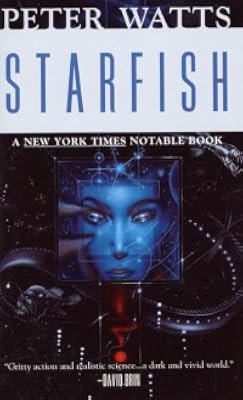
A huge international corporation has developed a facility along the Juan de Fuca Ridge at the bottom of the Pacific Ocean to exploit geothermal power. They send a bio-engineered crew - people who have been altered to withstand the pressure and breathe the seawater - down to live and work in this weird, fertile undersea darkness. Unfortunately the only people suitable for long-term employment in these experimental power stations are crazy, some of them in unpleasant ways. How many of them can show more survive, or will be allowed to survive, while worldwide disaster approaches from below? show lessTags
Recommendations

























Member Recommendations
electronicmemory Classic bleak sci-fi.

yarmando Characters biologically and technologically altered to live and work at the sea bed.
Member Reviews
So, in a radical departure, I read this baby exclusively on my phone. The author has been considerate enough to put the entire trilogy online for free and my phone has a thingy that lets me download books and the book was there so I said, that's me, all cutting edge and cyberpunky and whatnot.
Peter Watts. Not the most cheerful writer. Not your cuddly romantic heroic hard-edge but soft-hearted type of author, and this is not the most cheerful of books, and the whole trilogy's been a downer so far, but what a ride! The whole thing fizzes and pops with ideas and action and great writing, one can almost forget that the whole thing is about the world dying horribly, except Watts NEVER LETS YOU FORGET.
In Starfish, Leni Clarke is a Rifter, show more working at a new power generating station on top of a geothermal vent at the bottom of the Pacific Ocean. She has been physically altered to survive underwater at insanely high pressures, but it soon becomes apparent that the physical adaptations were easy. psychological adaptation, on the other hand, is a whole different kettle of fish. Rifters come pre-adapted to high-stress environments. They're the survivors of abuse or trauma. They're also the people who commit abuse and inflict trauma, all mixed together at the bottom of the ocean. It's a volatile mix.
What nobody expects is that the Rifters start to like it down there. The Rifters don't want to leave.
Damaged personalities who may not be human anymore in a high-pressure setting. The most hostile place on Earth, spitting lava and boiling water, teeming with hungry monsters with huge teeth. This is insanely atmospheric, claustrophobic, and scary as heck. I was utterly riveted the whole way through, and I don't actually LIKE reading on my flipping phone. I just had to keep going. show less
Peter Watts. Not the most cheerful writer. Not your cuddly romantic heroic hard-edge but soft-hearted type of author, and this is not the most cheerful of books, and the whole trilogy's been a downer so far, but what a ride! The whole thing fizzes and pops with ideas and action and great writing, one can almost forget that the whole thing is about the world dying horribly, except Watts NEVER LETS YOU FORGET.
In Starfish, Leni Clarke is a Rifter, show more working at a new power generating station on top of a geothermal vent at the bottom of the Pacific Ocean. She has been physically altered to survive underwater at insanely high pressures, but it soon becomes apparent that the physical adaptations were easy. psychological adaptation, on the other hand, is a whole different kettle of fish. Rifters come pre-adapted to high-stress environments. They're the survivors of abuse or trauma. They're also the people who commit abuse and inflict trauma, all mixed together at the bottom of the ocean. It's a volatile mix.
What nobody expects is that the Rifters start to like it down there. The Rifters don't want to leave.
Damaged personalities who may not be human anymore in a high-pressure setting. The most hostile place on Earth, spitting lava and boiling water, teeming with hungry monsters with huge teeth. This is insanely atmospheric, claustrophobic, and scary as heck. I was utterly riveted the whole way through, and I don't actually LIKE reading on my flipping phone. I just had to keep going. show less
Starfish is a really, really hard book to describe. It is a concept book -- there is all kind of shininess about ocean vents and marine biology in here -- but it is also a book about fucked-up people and what our society does to them. In the case of Starfish, what we do to them is exile them to the bottom of the ocean, child molesters and abuse survivors and bullies and killers, people who've been so bent up by life that they no longer fit in. Instead, they care for power plants at the bottom of the ocean surrounded by other neurotic people, and they're happier there.
And, despite being a book about broken people, it is not depressing. The characters are broken, but they aren't victims. I have a bit of a problem with the victim show more mentality, so for me this made them utterly sympathetic.
This book made me think. A lot. About a great many things. Go and read it. I really can't recommend this one highly enough. show less
And, despite being a book about broken people, it is not depressing. The characters are broken, but they aren't victims. I have a bit of a problem with the victim show more mentality, so for me this made them utterly sympathetic.
This book made me think. A lot. About a great many things. Go and read it. I really can't recommend this one highly enough. show less
In a biotech future of gelatinous AI cubes, exploding human populations, and resource scarcity, Starfish focuses on a crew of mentally unwell deep sea divers, who are altered significantly both physically and mentally to adapt them to the environment of the ocean floor. Their job is to maintain a geothermal energy system on the edge of the Juan De Fuca plate, which teems with gigantic, fragile sea monsters, and unpredictable thermal vents. It's a dangerous job, and an emotionally taxing one, since the entire crew is cramped in the tiny quarters of a dark and creaking substation situated right in the constantly shifting subduction zone.
The crew themselves were selected for the job because of their sordid history with abuse. Both abusers show more and the abused coexist here, creating a fraught set of relationships that develop realistically over the course of the story. I was captivated by most of the characters from beginning to end.
This was Watts' first full length published novel, something you can certainly feel in the prose and structure; it's not perfect in the slightest. Watts writes heavily in dialogue-only mode. Whole passages are nothing but conversations between the rifters, interposed with the internal thoughts of the point of view character. This style grows tedious over time, and can make the work feel more juvenile, even though the subject matter or tone certainly aren't.
A stupendous premise and gripping atmosphere are slightly let down by a lacking second-half where Watts strays into a pacing that he wasn't yet adept at writing. I couldn't help but love it though. This is thrilling, dark, rough around the edges SF at its best. show less
The crew themselves were selected for the job because of their sordid history with abuse. Both abusers show more and the abused coexist here, creating a fraught set of relationships that develop realistically over the course of the story. I was captivated by most of the characters from beginning to end.
This was Watts' first full length published novel, something you can certainly feel in the prose and structure; it's not perfect in the slightest. Watts writes heavily in dialogue-only mode. Whole passages are nothing but conversations between the rifters, interposed with the internal thoughts of the point of view character. This style grows tedious over time, and can make the work feel more juvenile, even though the subject matter or tone certainly aren't.
A stupendous premise and gripping atmosphere are slightly let down by a lacking second-half where Watts strays into a pacing that he wasn't yet adept at writing. I couldn't help but love it though. This is thrilling, dark, rough around the edges SF at its best. show less
Content warning for discussion of childhood abuse.
I loved Watts's Blindsight and Echopraxia, but am just now getting to his first trilogy. In 2050, the world is relying on geothermal power generated at deep, undersea rifts. The men and women running the equipment, 3000 meters below the surface, are surgically modified to stay underwater for extended periods, one lung replaced by an electrolysis machine for oxygen, eyes covered by white image amplifiers. Their neural chemistry is altered to stand up to the high pressure. They live in cramped, air filled habitats at one atmosphere, habitats that probably won't be crushed by the immense weight of the ocean, though the walls creak ominously. While they work outside, in the dark, they must show more guard against attacks from carnivorous sea creatures, and the extreme heat venting from the rift, which could boil the flesh off their bones.
Watts suggests that the people most suited to performing well in such threatening conditions are those who have been living with extreme stress their entire lives - survivors of childhood abuse, who have grown up to replicate their suffering in adult relationships as either abused or abuser. Extreme people under extreme stress is very much Watts's thing, and protagonist Lenie Clarke certainly holds one's attention.
But there are more monsters around the vents than the rifters knew about going in. They, and the exploitive corporations that put them there, slowly become aware of a danger to the entire world, if only it can escape its confinement in the deeps.
Watts has a PhD in marine biology, and, as usual, he provides several pages at the end for discussion of the actual science he rooted the book in. Not all of it convinces; in particular, a shortage of fossil fuel energy isn't something that we need to worry about here in 2020 - we should be so lucky.
This ferocious book ends with devastation, and a promise of more to come in the next volume, Maelstrom. show less
I loved Watts's Blindsight and Echopraxia, but am just now getting to his first trilogy. In 2050, the world is relying on geothermal power generated at deep, undersea rifts. The men and women running the equipment, 3000 meters below the surface, are surgically modified to stay underwater for extended periods, one lung replaced by an electrolysis machine for oxygen, eyes covered by white image amplifiers. Their neural chemistry is altered to stand up to the high pressure. They live in cramped, air filled habitats at one atmosphere, habitats that probably won't be crushed by the immense weight of the ocean, though the walls creak ominously. While they work outside, in the dark, they must show more guard against attacks from carnivorous sea creatures, and the extreme heat venting from the rift, which could boil the flesh off their bones.
Watts suggests that the people most suited to performing well in such threatening conditions are those who have been living with extreme stress their entire lives - survivors of childhood abuse, who have grown up to replicate their suffering in adult relationships as either abused or abuser. Extreme people under extreme stress is very much Watts's thing, and protagonist Lenie Clarke certainly holds one's attention.
But there are more monsters around the vents than the rifters knew about going in. They, and the exploitive corporations that put them there, slowly become aware of a danger to the entire world, if only it can escape its confinement in the deeps.
Watts has a PhD in marine biology, and, as usual, he provides several pages at the end for discussion of the actual science he rooted the book in. Not all of it convinces; in particular, a shortage of fossil fuel energy isn't something that we need to worry about here in 2020 - we should be so lucky.
This ferocious book ends with devastation, and a promise of more to come in the next volume, Maelstrom. show less
There's a moment of absolute darkness while her eyecaps adjust to the reduced light. Then the stars come out again.
They are so beautiful. Lenie Clarke rests on the bottom of the ocean and watches the abyss sparkle around her. And she almost laughs as she realizes, three thousand meters from the nearest sunlight, that it's only dark when the lights are on.
Only people who are profoundly disturbed, whether abusers or victims, can stand life in the deep sea bases, building and maintaining geothermal power stations along deep sea rifts, even with their bodies adapted to cope with the extreme pressure and absorb oxygen from the water. There are many dangers, from vents suddenly spouting boiling water and attacks by huge but surprisingly show more fragile fish to the instability of their colleagues, but their employers are alarmed when the rifters start to adapt rather too well to their new lives, wearing their skinsuits and eycaps inside the base rather than changing back into normal clothes, keeping the lights low and even sleeping outside the base, and not looking forward to the thought of returning to the surface when their shifts are finally over.
But when danger threatens from below, what are the the lives of the rifters worth compared to those above? Very exciting. Looking forward to the sequels. show less
They are so beautiful. Lenie Clarke rests on the bottom of the ocean and watches the abyss sparkle around her. And she almost laughs as she realizes, three thousand meters from the nearest sunlight, that it's only dark when the lights are on.
Only people who are profoundly disturbed, whether abusers or victims, can stand life in the deep sea bases, building and maintaining geothermal power stations along deep sea rifts, even with their bodies adapted to cope with the extreme pressure and absorb oxygen from the water. There are many dangers, from vents suddenly spouting boiling water and attacks by huge but surprisingly show more fragile fish to the instability of their colleagues, but their employers are alarmed when the rifters start to adapt rather too well to their new lives, wearing their skinsuits and eycaps inside the base rather than changing back into normal clothes, keeping the lights low and even sleeping outside the base, and not looking forward to the thought of returning to the surface when their shifts are finally over.
But when danger threatens from below, what are the the lives of the rifters worth compared to those above? Very exciting. Looking forward to the sequels. show less
This is definitely not my first reading of Peter Watts and it sure as hell won't be my last. He's rapidly becoming my total absolute favorite hard SF author. Maybe not quite my top top top choice, yet, but he's getting close enough to kick Alaistair Reynolds off his perch and he makes Stephen Baxter definitely run for his money.
More than anything, I'm in love with the quality. He's wild with the hard SF explorations. Transhumanism and what it means to be human at all in the face of the alien or the alien within us is merely a huge part of his novels but it is not the end. He drives so many of his characters forward with an amazing array of psychology and depravity and simply focused survival.
These guys were transformed to survive 400 show more pressures in one of the deepest trenches in the ocean, to live on the local life, to supply energy to the rest of the world. So who would go down there, fully transformed with biological computers, on their own free will?
Ah, there's the rub. They get marginalized survivors, abuse victims, pedophiles, maladjusted driven iconoclasts.
It makes perfect sense. Send the strongest people we have, the ones we can also sacrifice, and let them do what they do best. Survive at all costs.
Of course, between the psychological pressures, insane real pressure, and creeping maladjustments, you might think this was already a great psychological thriller with enough transformed humanity to keep any SF fan thrilled... but he goes a bit further and gives us the basis and an amazing exploration of a clearly superior and truly alien life form taking up residence down in the trench.
Watts does aliens AWESOME. He gets the concept that alien is probably going to be VERY alien. No blue suit humans, but thoroughly alien across the board.
I LOVE this stuff. Original, well-written, pushing all the boundaries, and it's even full of heart.
To think it's FREE, too! On the author's website!
We really ought to re-think our concepts about popular fiction. Just because it sells super well doesn't mean it's good and just because a book is free doesn't mean it's not brilliant. Popularity is capricious.
This is the kind of novel that blows me away on even the science and species level, not just story or characters. He knows his marine life and even offers up a long biography at the end. Gotta love it. :) show less
More than anything, I'm in love with the quality. He's wild with the hard SF explorations. Transhumanism and what it means to be human at all in the face of the alien or the alien within us is merely a huge part of his novels but it is not the end. He drives so many of his characters forward with an amazing array of psychology and depravity and simply focused survival.
These guys were transformed to survive 400 show more pressures in one of the deepest trenches in the ocean, to live on the local life, to supply energy to the rest of the world. So who would go down there, fully transformed with biological computers, on their own free will?
Ah, there's the rub. They get marginalized survivors, abuse victims, pedophiles, maladjusted driven iconoclasts.
It makes perfect sense. Send the strongest people we have, the ones we can also sacrifice, and let them do what they do best. Survive at all costs.
Of course, between the psychological pressures, insane real pressure, and creeping maladjustments, you might think this was already a great psychological thriller with enough transformed humanity to keep any SF fan thrilled... but he goes a bit further and gives us the basis and an amazing exploration of a clearly superior and truly alien life form taking up residence down in the trench.
Watts does aliens AWESOME. He gets the concept that alien is probably going to be VERY alien. No blue suit humans, but thoroughly alien across the board.
I LOVE this stuff. Original, well-written, pushing all the boundaries, and it's even full of heart.
To think it's FREE, too! On the author's website!
We really ought to re-think our concepts about popular fiction. Just because it sells super well doesn't mean it's good and just because a book is free doesn't mean it's not brilliant. Popularity is capricious.
This is the kind of novel that blows me away on even the science and species level, not just story or characters. He knows his marine life and even offers up a long biography at the end. Gotta love it. :) show less
It is a fairly diverse book in which, of course, science is the protagonist, but sometimes it also raises philosophical questions, such as Consciousness, Being, Evolution, Thought, Communication, Ganzfeld Effects, Psi Fields, etc. Although Peter Watts himself is a marine biologist, he reads a wealth of scholarly books and articles outside of his field, which he then reports in his notes, this time round right at the beginning of the novel just to make sure you’re made aware that the main ideas in the novel are not a mere fragment of his imagination…original, noirish, intellectual. What more could one ask for?
From Peter Watts we can always expect complex ideas that demand some attention to unravel and it makes the reader consider how show more real is his or her own perceptions of this thing we call "reality." The characters Peter Watts has created are some of the most unique I've read because he takes those ideas to extreme conclusions. Hard SF from the 21st century for sure. And that means something completely different from the heyday of the genre, 30 and 40 years ago. Back then, it was enough to write about realistic spaceships and understand the basics of Newtonian physics and astronomy. Today, from computer science to quantum mechanics to neurobiology, you have to be in many sciences - at least according to Peter Watts, whose SF is one of hardest to read. Science may make the familiar strange, undermine and disturb but SF novels like “Starfish” help people (at least me) re-appraise and reconsolidate some necessary structure in these suddenly new found worlds. Science and fiction are inevitably bound together if done right and this one is almost perfect.
(my edition bought in 2000)
This kind of novel, when done right, simply defines SF for me: it extrapolates from the frontiers of known science or social thinking to create thought experiments that act as warnings or encouragements. Asimov's "Foundation" series was a popularisation of Spengler. It is perhaps a measure of the pace of change in the real world that speculative fiction, science fiction, has a much smaller audience now than fantasy. The future overtakes it as it is being written. But nothing beats SF in my book.
SF = Speculative Fiction. show less
From Peter Watts we can always expect complex ideas that demand some attention to unravel and it makes the reader consider how show more real is his or her own perceptions of this thing we call "reality." The characters Peter Watts has created are some of the most unique I've read because he takes those ideas to extreme conclusions. Hard SF from the 21st century for sure. And that means something completely different from the heyday of the genre, 30 and 40 years ago. Back then, it was enough to write about realistic spaceships and understand the basics of Newtonian physics and astronomy. Today, from computer science to quantum mechanics to neurobiology, you have to be in many sciences - at least according to Peter Watts, whose SF is one of hardest to read. Science may make the familiar strange, undermine and disturb but SF novels like “Starfish” help people (at least me) re-appraise and reconsolidate some necessary structure in these suddenly new found worlds. Science and fiction are inevitably bound together if done right and this one is almost perfect.
(my edition bought in 2000)
This kind of novel, when done right, simply defines SF for me: it extrapolates from the frontiers of known science or social thinking to create thought experiments that act as warnings or encouragements. Asimov's "Foundation" series was a popularisation of Spengler. It is perhaps a measure of the pace of change in the real world that speculative fiction, science fiction, has a much smaller audience now than fantasy. The future overtakes it as it is being written. But nothing beats SF in my book.
SF = Speculative Fiction. show less
Members
- Recently Added By
Lists

Books Read in 2018
4,360 works; 110 members

Female Protagonist
1,056 works; 57 members
Author Information

47+ Works 8,785 Members
Peter Watts is a reformed marine biologist whom Canada's Globe and Mail has proclaimed "one of the very best hard-SF writers alive"
Some Editions
Awards and Honors
Series

Belongs to Publisher Series
AD ASTRA (2023)
Common Knowledge
- Canonical title
- Starfish
- Original publication date
- 1999
- People/Characters
- Lenie Clarke; Ken Lubin; Patricia Rowan; Yves Scanlon; Karl Acton; Gerry Fischer (show all 8); Mike Brander; Alice Nakata
- Important places
- Juan de Fuca Ridge, Eastern Pacific Ocean; Hongcouver
- Dedication
- For Susan Oshanek, on the off chance that she's still alive.
And for Laurie Channer - who, to my unexpectedly good fortune, definitely is. - First words
- The abyss should shut you up.
- Last words
- (Click to show. Warning: May contain spoilers.)That'll change. Lenie Clarke swims down and east, toward her own resurrection.
- Publisher's editor
- Hartwell, David G.
- Blurbers
- Brin, David; Stableford, Brian
Classifications
Statistics
- Members
- 1,370
- Popularity
- 17,451
- Reviews
- 51
- Rating
- (3.88)
- Languages
- 5 — English, French, German, Italian, Polish
- Media
- Paper, Audiobook, Ebook
- ISBNs
- 16
- ASINs
- 8