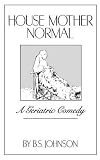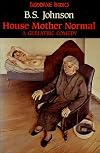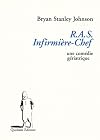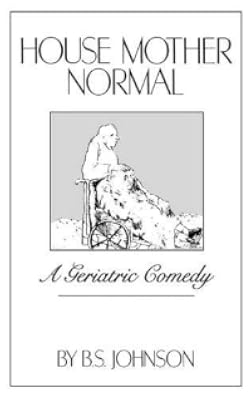
House Mother Normal: A Geriatric Comedy
by B. S. Johnson
On This Page
Description
House Mother Normal, subtitled "A Geriatric Comedy," is the English writer B. S. Johnson's fifth novel. Unusual in both its subject and structure, this novel is a remarkable study of old age, stripped of sentimentality and spiked with bizarre language and perceptions. Made up of eight monologues describing a single day at a nursing home,House Mother Normal explores the failing minds of the elderly with precision, humor, and unflagging compassion, and Johnson achieves, with inventiveness and show more escalating absurdity, a vivid multidimensional effect. show lessTags
Recommendations
























Member Reviews
This is hardcore experimental fiction, but still touching, funny and entertaining. The events of a ghastly "social evening" in a care-home for elderly people are described in turn by eight of the residents, each from his or her own perspective, and each in exactly 21 pages. And then described again by the sinister House Mother, but she gets 22.
All of the narrators are unreliable, of course, that should go without saying. But they are unreliable in different ways. The residents are lucid and articulate to different extents, and have varying attention spans and amounts of sensory acuity (tabulated carefully with mock-clinical precision for each of them at the start of their section). Some drift off into petty quarrels or memories of show more their earlier lives (usually concerned with sex), some tune out for long stretches — up to three pages at a time — of white-space. One gives us thirteen pages of apparently random Welsh words, scattered in the white-space at the rate of about five or six to a page, before bursting out with "I am a prisoner in my self. ... Let me out or I shall die."
But we're encouraged by the way the narratives all seem to advance through paper at the same speed to treat them as parallel texts, flipping back and forth, superimposing one account on another in our minds, until we have a fairly clear picture of what must have happened
including an introduction to the fascinating sport of wheelchair-jousting.
Unexpectedly inspiring. show less
All of the narrators are unreliable, of course, that should go without saying. But they are unreliable in different ways. The residents are lucid and articulate to different extents, and have varying attention spans and amounts of sensory acuity (tabulated carefully with mock-clinical precision for each of them at the start of their section). Some drift off into petty quarrels or memories of show more their earlier lives (usually concerned with sex), some tune out for long stretches — up to three pages at a time — of white-space. One gives us thirteen pages of apparently random Welsh words, scattered in the white-space at the rate of about five or six to a page, before bursting out with "I am a prisoner in my self. ... Let me out or I shall die."
But we're encouraged by the way the narratives all seem to advance through paper at the same speed to treat them as parallel texts, flipping back and forth, superimposing one account on another in our minds, until we have a fairly clear picture of what must have happened
including an introduction to the fascinating sport of wheelchair-jousting.
Unexpectedly inspiring. show less
This is the last of B S Johnson’s novels to be published during his own short lifetime and it’s about something he would never get to experience for himself: the indignities of growing old; all the horrid unravellings, bodily and psychologically, that people have to contend with as they age.
There are just eight residents (guests? inmates?) at a small unnamed home for the elderly, all in their seventies or older and apparently without relatives. Overall the book describes one particular evening, a weekly Social presided over by the rather sinister and sadistic woman in charge, the House Mother of its title: there’s dinner, a handicrafts session, games, singing and to finish with…well, an “entertainment”. We see how show more this evening, the world in fact, looks to all eight in turn, one point of view after another. More, the chapters are meticulously set out, page by page and line by line, so that they match and you can directly compare how each incident is experienced by each resident. First come the youngest and most lucid ones, understandably absorbed in their memories to some extent, but still alert and even cantankerous. As we work through them though, the grip on reality loosens with each passing viewpoint and the last few are clearly pictures of dementia, seen from the inside: minds scattered, slowed almost to a standstill, cut adrift.
Nothing here—none of the twisted “activities” and “games”—are quite what they seem at first; and as well, like all Johnson’s books, this was regarded as “experimental” when first published. But like all of them it’s sympathetically written too, at once both funny and deeply sad. show less
There are just eight residents (guests? inmates?) at a small unnamed home for the elderly, all in their seventies or older and apparently without relatives. Overall the book describes one particular evening, a weekly Social presided over by the rather sinister and sadistic woman in charge, the House Mother of its title: there’s dinner, a handicrafts session, games, singing and to finish with…well, an “entertainment”. We see how show more this evening, the world in fact, looks to all eight in turn, one point of view after another. More, the chapters are meticulously set out, page by page and line by line, so that they match and you can directly compare how each incident is experienced by each resident. First come the youngest and most lucid ones, understandably absorbed in their memories to some extent, but still alert and even cantankerous. As we work through them though, the grip on reality loosens with each passing viewpoint and the last few are clearly pictures of dementia, seen from the inside: minds scattered, slowed almost to a standstill, cut adrift.
Nothing here—none of the twisted “activities” and “games”—are quite what they seem at first; and as well, like all Johnson’s books, this was regarded as “experimental” when first published. But like all of them it’s sympathetically written too, at once both funny and deeply sad. show less
Geriatrics under the care of a Nurse Ratched-like House Mother
Review of the Audible Audio audiobook edition (2017) of the 1971 original hardcover.
The inner lives of many of the 8 geriatrics in House Mother Normal often devolve to memories of youthful sexcapades, which is at least one of the more light-hearted aspects of the book which often otherwise portrays a dark horrorshow of mockery and sadism by their resident caregiver, the House Mother of the title. Anyway, the quote from Murakami came straight to mind.
The show more other shoutout to make here is Isabel Waidner's We Are Made Of Diamond Stuff (2019) which namechecks author B.S. Johnson and even incorporates a somewhat more benign House Mother Normal character into its collage-like view of Brexit-era UK immigration and bureaucracy. It was thanks to Waidner that I looked up House Mother Normal, also pleasantly discovering that I could also now check it off from the 1001 Books to Read List.
A big point is made (even in Andrew Motion's 2012 introduction in the first 10 minutes of the audio) about how each character gets 21 pages in the print edition (except for House Mother's 22 pages) but that doesn't work out the same in the audio timings which you can see below.
Cast of Characters (spelling is approximate as I don't have access to a print copy)
1. Sarah Lampson 74 years old CQ10 38 minutes
2. Charlie Edwards 78 years old CQ10 34 minutes
3. Ivy Nicholls 79 years old CQ10 41 minutes
4. Ron Lampson 81 years old CQ8 20 minutes
5. Gloria Ridge 85 years old CQ6 40 minutes
6. Sinead Bowen 89 years old CQ8 35 minutes
7. George Hedbury 89 years old CQ2 5 minutes
8. Rosetta Stanton 94 years old CQ0 5 minutes
9. House Mother 42 years old CQ10 34 minutes
As the CQ (Comprehension Quotient, a measure of how many correct answers to 10 basic questions such as what year is it, how old are you, etc.) decreases the verbalisation drops severely as well, to the point where Rosetta Stanton is mostly making inarticulate sounds, although she becomes more verbal in the end.
Overall this was a sobering experience as it will remind you of your own mortality and also perhaps that of your mental longevity. You can only hope that it will be under better care than that of House Mother whose practices here include putting her patients to work making paper/glue souvenirs (Christmas Crackers I think?) for her re-sale, feeding them cheaply (with food that she wouldn't give to her own dog) and playing Pass-the-Parcel where the winning player unwraps a surprise package of dog shit (from the same said dog).
The performances by narrators Rosalyn Landor, Stephen Thorne and Maggie Mash were excellent and definitely bump this up to a 5 rating from what might otherwise have been a 3 to 4 for the print experience. show less
Review of the Audible Audio audiobook edition (2017) of the 1971 original hardcover.
“You have to enjoy it while you’re still young. Enjoy it to the fullest. You can use the memories of what you did to warm your body after you get old and can’t do it anymore.” - The Dowager in 1Q84 by Haruki Murakami.
The inner lives of many of the 8 geriatrics in House Mother Normal often devolve to memories of youthful sexcapades, which is at least one of the more light-hearted aspects of the book which often otherwise portrays a dark horrorshow of mockery and sadism by their resident caregiver, the House Mother of the title. Anyway, the quote from Murakami came straight to mind.
The show more other shoutout to make here is Isabel Waidner's We Are Made Of Diamond Stuff (2019) which namechecks author B.S. Johnson and even incorporates a somewhat more benign House Mother Normal character into its collage-like view of Brexit-era UK immigration and bureaucracy. It was thanks to Waidner that I looked up House Mother Normal, also pleasantly discovering that I could also now check it off from the 1001 Books to Read List.
A big point is made (even in Andrew Motion's 2012 introduction in the first 10 minutes of the audio) about how each character gets 21 pages in the print edition (except for House Mother's 22 pages) but that doesn't work out the same in the audio timings which you can see below.
Cast of Characters (spelling is approximate as I don't have access to a print copy)
1. Sarah Lampson 74 years old CQ10 38 minutes
2. Charlie Edwards 78 years old CQ10 34 minutes
3. Ivy Nicholls 79 years old CQ10 41 minutes
4. Ron Lampson 81 years old CQ8 20 minutes
5. Gloria Ridge 85 years old CQ6 40 minutes
6. Sinead Bowen 89 years old CQ8 35 minutes
7. George Hedbury 89 years old CQ2 5 minutes
8. Rosetta Stanton 94 years old CQ0 5 minutes
9. House Mother 42 years old CQ10 34 minutes
As the CQ (Comprehension Quotient, a measure of how many correct answers to 10 basic questions such as what year is it, how old are you, etc.) decreases the verbalisation drops severely as well, to the point where Rosetta Stanton is mostly making inarticulate sounds, although she becomes more verbal in the end.
Overall this was a sobering experience as it will remind you of your own mortality and also perhaps that of your mental longevity. You can only hope that it will be under better care than that of House Mother whose practices here include putting her patients to work making paper/glue souvenirs (Christmas Crackers I think?) for her re-sale, feeding them cheaply (with food that she wouldn't give to her own dog) and playing Pass-the-Parcel where the winning player unwraps a surprise package of dog shit (from the same said dog).
The performances by narrators Rosalyn Landor, Stephen Thorne and Maggie Mash were excellent and definitely bump this up to a 5 rating from what might otherwise have been a 3 to 4 for the print experience. show less
In which Johnson has lots of fun with constraints and toilet humour... Apparently, the structure isn't new. It had been deployed at least four decades before in 'Tea with Mrs Goodman' by Philip Toynbee, according to Johnson's biographer, Jonathan Coe. Clearly, telling the same events from the perspective of different characters has been done before (Lawrence Durrell's 'Alexandria Quartet' springs to mind). As with 'Trawl', I suspect this novel would be the antithesis of a "good read" for many readers. It makes him/her work and in this, it's ambitious. Only slowly, through a series of refracted mirrors and diminished consciousnesses, does it become clear what is going on in this old people's home.
Johnson creates his characters with show more affection and compassion. The abuse of them by the care home's 'house mother' carries uncomfortable echoes of recent revelations about some of these institutions. It has been said that you can judge a society by the way it treats its old people, its cultural development by its libraries. On that score, there's much work to do, here in the UK. 'House Mother Normal' ought to be required reading in the case for bringing back council-run homes at the heart of their community. show less
Johnson creates his characters with show more affection and compassion. The abuse of them by the care home's 'house mother' carries uncomfortable echoes of recent revelations about some of these institutions. It has been said that you can judge a society by the way it treats its old people, its cultural development by its libraries. On that score, there's much work to do, here in the UK. 'House Mother Normal' ought to be required reading in the case for bringing back council-run homes at the heart of their community. show less
This is another book which was recommended to me earlier this year by another LTer. The least I can say is that it is one of the strangest book I've ever read... The fact that it features residents of an old people's home also raised my interest because my father has been in such a condition for the last twelve months. I hoped I could understand how his brain was working although his reactions to external stimuli are now close to zero.
When I first tried to read this book in July, I had to stop after three pages, because I couldn't understand how it worked. I had another try recently, and I realized that you had to jump from chapter to chapter, forwards and backwards, to understand the whole story. This is something that I had sensed in show more July, but I didn't like the idea of doing so, because for me a book has a linear feature, if you see what I mean. When making progress through the book, the home and its 'House Mother' definitely appear completely crazy. There is a lot of black humour, scatology, & sex, but also philosophy, with this terrible warning at the end:
'if you are not like
our friends, laugh now, prepare, accept,
worse times are a-coming, nothing is more sure.'
This is a fantastic little book to read. It cannot leave you indifferent. Thinking that it was written by a man in his thirties is incredible. show less
When I first tried to read this book in July, I had to stop after three pages, because I couldn't understand how it worked. I had another try recently, and I realized that you had to jump from chapter to chapter, forwards and backwards, to understand the whole story. This is something that I had sensed in show more July, but I didn't like the idea of doing so, because for me a book has a linear feature, if you see what I mean. When making progress through the book, the home and its 'House Mother' definitely appear completely crazy. There is a lot of black humour, scatology, & sex, but also philosophy, with this terrible warning at the end:
'if you are not like
our friends, laugh now, prepare, accept,
worse times are a-coming, nothing is more sure.'
This is a fantastic little book to read. It cannot leave you indifferent. Thinking that it was written by a man in his thirties is incredible. show less
This experimental novel is on the 1001 list. It is the story of a social evening in an old folks home. The same events are described in chapters narrated by each of the residents, who have varying degrees of cognitive impairment. Each chapter is exactly 21 pages long, with the same events occurring on approximately the same page for each resident's narrative. The final chapter is narrated by the house mother, and we finally hear her version. Since the housemother is herself also an unreliable narrator, we have to infer what has actually transpired. What is clear, however, is that she is a nasty character. All of the narratives are in stream of conciousness style.
The subtitle of this book is "A Geriatric Comedy. I found it sad. I did, show more however, find it a worthwhile read, and you can decide if it sounds like something you'd like to experience. show less
The subtitle of this book is "A Geriatric Comedy. I found it sad. I did, show more however, find it a worthwhile read, and you can decide if it sounds like something you'd like to experience. show less
Ratings
Members
- Recently Added By
Lists

1001 Books You Must Read Before You Die
1,448 works; 1,136 members

1,001 BYMRBYD Concensus
723 works; 27 members

Books Read in 2015
3,299 works; 129 members
Author Information

31+ Works 1,943 Members
Some Editions
Awards and Honors
Work Relationships
Is contained in
Common Knowledge
- Canonical title*
- R.A.S. Infirmière-Chef
- Original title
- House Mother Normal
- Original publication date
- 1971
- People/Characters*
- Infirmière-Chef; Sarah Lamson; Charles Edwards; Ivy Nicholls; Ron Lamson; Gloria Ridge (show all 9); Sioned Bowen; George Hedbury; Rosetta Stanton
- Dedication
- for Glyn Tegai Hughes
and Gregynog - Original language
- English
*Some information comes from Common Knowledge in other languages. Click "Edit" for more information.
Classifications
Statistics
- Members
- 237
- Popularity
- 137,271
- Reviews
- 6
- Rating
- (3.81)
- Languages
- English, French
- Media
- Paper, Audiobook, Ebook
- ISBNs
- 9
- UPCs
- 1
- ASINs
- 4