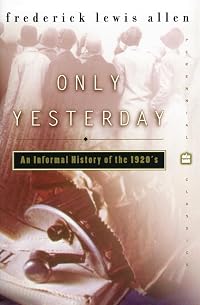
Only Yesterday: An Informal History of the 1920s
by Frederick Lewis Allen
On This Page
Description
Jazz, flappers, flasks, rumbleseats, and raccoon coats; Mah Jong, crossword puzzles, marathon dancers, and flagpole sitters; Red Grange, Rudolph Valentino, and Lucky Lindy. These were the catch words of the roaring, irrepressible '20's. But so were the Boston Police Strike, the K.K.K., women's suffrage, Sigmund Freud, Sacco and Vanzetti, Teapot Dome, Black Tuesday. In this span between armistice and depression, Americans were kicking up their heels, but they were also bringing about major show more changes in the social and political structure of their country. Only Yesterday is a fond, witty, penetrating biography of this restless decade-a delightful reminiscence for those who can remember, a fascinating firsthand look for those who've only heard. show lessTags
Recommendations




















Member Reviews
Lessons That Go Unheeded
History teaches many lessons but people are bad pupils. Not just people today, but people throughout history have ignored the lessons taught by events preceding them. Consequently, we repeat mistakes over and over again. Those new to Only Yesterday will only have to read a few chapters to see how true these statements are, because the parallels between the 1920s and current times are numerous. Errors made then are still being made today. Read it for yourself to see the truth in this.
Only Yesterday is a contemporaneous history published two years after the 1929 stock market crash, as well as shortly after the Florida Land Bubble bust that began in 1925 (and is argued to be the precipitating cause of the Great show more Depression by Christopher Knowlton in his recent book, Bubble in the Sun). Frederick Lewis Allen worked as a contributor to Harper’s Magazine, later, in 1941, assuming the position of editor-in-chief. Readers will enjoy his breezy and often tongue-in-cheek style, making this anything but a dry trudge.
Allen covers all the highlights of the years 1919 through 1929, among them the incapacitated years of Woodrow Wilson, the scandal-plagued presidency of Warren G. Harding, the Red Scare spearheaded by AG Mitchell Palmer, the complacent and laissez-faire presidency of Calvin Coolidge, the disaster that was Prohibition, the rise of organized crime that features Al Capone, the rising popularity of spectator sports starring Tunney, Ruth, and others, the adoption of more liberal mores, the books and intellectual arguments of the times, and the financials of the day, among them the above mentioned Florida Land Bubble, the plight of American farmers, intermingling of business and religion, margin buying, unregulated mutual trusts, boosterism, and other like factors resulting in the Stock Market Crash of 1929. Readers cannot help but be struck by the similarities, especially in government and business, to what we are experiencing today.
To emphasize this, readers will find much that rings true in this brief quote from the Red Scare pages: “There is a certain grim humor in the fact that what Mr. Palmer did during the next three months was done by him as the chief legal officer of an Administration which had come into power to bring about the New Freedom.” Palmer-ism burned hot in America for a time with some pretty terrible consequences, as this passage reveals: “The intolerance of those days took many forms. Almost inevitably it took the form of an ugly flare-up of feeling against the Negro, the Jew, and the Roman Catholic. The notions of group loyalty and of hatred, expanded during war-time and then suddenly denied their intended expression, found a perverted release in the persecution not only of supposed radicals, but also of other elements which to the dominant American group—the white Protestants—seemed alien or ‘un-American.’” Yes, it is as if we are gazing into a mirror and seeing ourselves.
So, here’s a book of its times that speaks as truly of our own, with lessons for us all. Americans should spend a couple of hours with it, and maybe, hopefully, draw some lesson from it. show less
History teaches many lessons but people are bad pupils. Not just people today, but people throughout history have ignored the lessons taught by events preceding them. Consequently, we repeat mistakes over and over again. Those new to Only Yesterday will only have to read a few chapters to see how true these statements are, because the parallels between the 1920s and current times are numerous. Errors made then are still being made today. Read it for yourself to see the truth in this.
Only Yesterday is a contemporaneous history published two years after the 1929 stock market crash, as well as shortly after the Florida Land Bubble bust that began in 1925 (and is argued to be the precipitating cause of the Great show more Depression by Christopher Knowlton in his recent book, Bubble in the Sun). Frederick Lewis Allen worked as a contributor to Harper’s Magazine, later, in 1941, assuming the position of editor-in-chief. Readers will enjoy his breezy and often tongue-in-cheek style, making this anything but a dry trudge.
Allen covers all the highlights of the years 1919 through 1929, among them the incapacitated years of Woodrow Wilson, the scandal-plagued presidency of Warren G. Harding, the Red Scare spearheaded by AG Mitchell Palmer, the complacent and laissez-faire presidency of Calvin Coolidge, the disaster that was Prohibition, the rise of organized crime that features Al Capone, the rising popularity of spectator sports starring Tunney, Ruth, and others, the adoption of more liberal mores, the books and intellectual arguments of the times, and the financials of the day, among them the above mentioned Florida Land Bubble, the plight of American farmers, intermingling of business and religion, margin buying, unregulated mutual trusts, boosterism, and other like factors resulting in the Stock Market Crash of 1929. Readers cannot help but be struck by the similarities, especially in government and business, to what we are experiencing today.
To emphasize this, readers will find much that rings true in this brief quote from the Red Scare pages: “There is a certain grim humor in the fact that what Mr. Palmer did during the next three months was done by him as the chief legal officer of an Administration which had come into power to bring about the New Freedom.” Palmer-ism burned hot in America for a time with some pretty terrible consequences, as this passage reveals: “The intolerance of those days took many forms. Almost inevitably it took the form of an ugly flare-up of feeling against the Negro, the Jew, and the Roman Catholic. The notions of group loyalty and of hatred, expanded during war-time and then suddenly denied their intended expression, found a perverted release in the persecution not only of supposed radicals, but also of other elements which to the dominant American group—the white Protestants—seemed alien or ‘un-American.’” Yes, it is as if we are gazing into a mirror and seeing ourselves.
So, here’s a book of its times that speaks as truly of our own, with lessons for us all. Americans should spend a couple of hours with it, and maybe, hopefully, draw some lesson from it. show less
Lessons That Go Unheeded
History teaches many lessons but people are bad pupils. Not just people today, but people throughout history have ignored the lessons taught by events preceding them. Consequently, we repeat mistakes over and over again. Those new to Only Yesterday will only have to read a few chapters to see how true these statements are, because the parallels between the 1920s and current times are numerous. Errors made then are still being made today. Read it for yourself to see the truth in this.
Only Yesterday is a contemporaneous history published two years after the 1929 stock market crash, as well as shortly after the Florida Land Bubble bust that began in 1925 (and is argued to be the precipitating cause of the Great show more Depression by Christopher Knowlton in his recent book, Bubble in the Sun). Frederick Lewis Allen worked as a contributor to Harper’s Magazine, later, in 1941, assuming the position of editor-in-chief. Readers will enjoy his breezy and often tongue-in-cheek style, making this anything but a dry trudge.
Allen covers all the highlights of the years 1919 through 1929, among them the incapacitated years of Woodrow Wilson, the scandal-plagued presidency of Warren G. Harding, the Red Scare spearheaded by AG Mitchell Palmer, the complacent and laissez-faire presidency of Calvin Coolidge, the disaster that was Prohibition, the rise of organized crime that features Al Capone, the rising popularity of spectator sports starring Tunney, Ruth, and others, the adoption of more liberal mores, the books and intellectual arguments of the times, and the financials of the day, among them the above mentioned Florida Land Bubble, the plight of American farmers, intermingling of business and religion, margin buying, unregulated mutual trusts, boosterism, and other like factors resulting in the Stock Market Crash of 1929. Readers cannot help but be struck by the similarities, especially in government and business, to what we are experiencing today.
To emphasize this, readers will find much that rings true in this brief quote from the Red Scare pages: “There is a certain grim humor in the fact that what Mr. Palmer did during the next three months was done by him as the chief legal officer of an Administration which had come into power to bring about the New Freedom.” Palmer-ism burned hot in America for a time with some pretty terrible consequences, as this passage reveals: “The intolerance of those days took many forms. Almost inevitably it took the form of an ugly flare-up of feeling against the Negro, the Jew, and the Roman Catholic. The notions of group loyalty and of hatred, expanded during war-time and then suddenly denied their intended expression, found a perverted release in the persecution not only of supposed radicals, but also of other elements which to the dominant American group—the white Protestants—seemed alien or ‘un-American.’” Yes, it is as if we are gazing into a mirror and seeing ourselves.
So, here’s a book of its times that speaks as truly of our own, with lessons for us all. Americans should spend a couple of hours with it, and maybe, hopefully, draw some lesson from it. show less
History teaches many lessons but people are bad pupils. Not just people today, but people throughout history have ignored the lessons taught by events preceding them. Consequently, we repeat mistakes over and over again. Those new to Only Yesterday will only have to read a few chapters to see how true these statements are, because the parallels between the 1920s and current times are numerous. Errors made then are still being made today. Read it for yourself to see the truth in this.
Only Yesterday is a contemporaneous history published two years after the 1929 stock market crash, as well as shortly after the Florida Land Bubble bust that began in 1925 (and is argued to be the precipitating cause of the Great show more Depression by Christopher Knowlton in his recent book, Bubble in the Sun). Frederick Lewis Allen worked as a contributor to Harper’s Magazine, later, in 1941, assuming the position of editor-in-chief. Readers will enjoy his breezy and often tongue-in-cheek style, making this anything but a dry trudge.
Allen covers all the highlights of the years 1919 through 1929, among them the incapacitated years of Woodrow Wilson, the scandal-plagued presidency of Warren G. Harding, the Red Scare spearheaded by AG Mitchell Palmer, the complacent and laissez-faire presidency of Calvin Coolidge, the disaster that was Prohibition, the rise of organized crime that features Al Capone, the rising popularity of spectator sports starring Tunney, Ruth, and others, the adoption of more liberal mores, the books and intellectual arguments of the times, and the financials of the day, among them the above mentioned Florida Land Bubble, the plight of American farmers, intermingling of business and religion, margin buying, unregulated mutual trusts, boosterism, and other like factors resulting in the Stock Market Crash of 1929. Readers cannot help but be struck by the similarities, especially in government and business, to what we are experiencing today.
To emphasize this, readers will find much that rings true in this brief quote from the Red Scare pages: “There is a certain grim humor in the fact that what Mr. Palmer did during the next three months was done by him as the chief legal officer of an Administration which had come into power to bring about the New Freedom.” Palmer-ism burned hot in America for a time with some pretty terrible consequences, as this passage reveals: “The intolerance of those days took many forms. Almost inevitably it took the form of an ugly flare-up of feeling against the Negro, the Jew, and the Roman Catholic. The notions of group loyalty and of hatred, expanded during war-time and then suddenly denied their intended expression, found a perverted release in the persecution not only of supposed radicals, but also of other elements which to the dominant American group—the white Protestants—seemed alien or ‘un-American.’” Yes, it is as if we are gazing into a mirror and seeing ourselves.
So, here’s a book of its times that speaks as truly of our own, with lessons for us all. Americans should spend a couple of hours with it, and maybe, hopefully, draw some lesson from it. show less
I found this to be one of the most fascinating history books I have ever read. The book was originally written in 1931, so the information and comments in the book were untainted by later events. Allen's writing style is casual, informative, and peppered with hilarious asides that kept me engaged through the whole book. My very favorite part was a quotation from John F. Carter in the September 1920 issue of Atlantic Monthly: "The older generation had certainly pretty well ruined this world before passing it on to us. They give us this thing, knocked to pieces, leaky, red-hot, threatening to blow up; and then they are surprised that we don't accept it with the same attitude of pretty, decorous enthusiasm with which they received it, way show more back in the 'eighties." Sound familiar? I read this simultaneously with a book about 1890-1918, and a book about the stock market in the 2000s, and realized that it is true: the more things change, the more they stay the same. show less
An easy and entertaining read, this book by Fred Allen was written in 1930 to reflect on the 20’s and how life in the US changed during that decade.
Fascinating in its immediacy, this book has only aged and dated a little. It was both reassuring (most of this has happened before) and depressing (have we learned nothing in a hundred years?). A lot of focus is, of course on the enormous financial bubble of the late twenties and its ultimate collapse. What the book lacks in mature, studied analysis is more than compensated for by the feeling that the reader is right there, watching events unfold.
Allen writes engagingly. This book is highly recommended
.
Fascinating in its immediacy, this book has only aged and dated a little. It was both reassuring (most of this has happened before) and depressing (have we learned nothing in a hundred years?). A lot of focus is, of course on the enormous financial bubble of the late twenties and its ultimate collapse. What the book lacks in mature, studied analysis is more than compensated for by the feeling that the reader is right there, watching events unfold.
Allen writes engagingly. This book is highly recommended
.
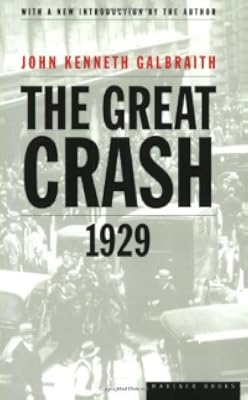
I bought this book because it was referred to favorably in two other books I've read: The Great Crash 1929 and Freedom from Fear: The American People in Depression and War, 1929-1945. It is an almost contemporaneous history of the US in the 1920s, in that it was written in 1931, and it is fascinating for several reasons. First, despite it being almost "instant history," the author has a great deal of perspective on the decade, including the Teapot Dome scandal (first time I ever understood it), the revolution in "morals," Prohibition, selling swampland in Florida, and the Scopes trial, among other topics. Even more interestingly, it is clear that the roots of what we consider modern US culture today lie in the 20s, when the dramatic show more growth in automobile ownership and the development of radio began the switch to suburban living and mass national communication, fads, etc. On top of all this, the author has a lively style and a sense of humor. show less
Allen looks at the 1920s in a way that would be impossible today. He wrote the book in 1931, while the nation was in the early throes of the Great Depression. More recent accounts look at the 'twenties with the realization of the length and depth of the depression.
Allen covers it all--from flappers to prohibition, from gangsters to fundamentalists, from the red scare to the mania over Florida property, and from Babe Ruth to Charles Lindbergh. He is quite hard on the Republican presidents of the decade, blaming them for allowing the economy to rev too fast and ultimately collapse. He even delves into the belief that Harding's death was not from natural causes. What emerges in the pages of his book is a nation full of confidence (perhaps show more even hubris) that nothing bad could ever happen. If something bad did happen, it would only be temporary. He even notes that Herbert Hoover claimed that the US had banished poverty.
This is a well-written social history of the US during the roaring 'twenties, speeding unknowingly to the cliff that was the 1930s. show less
Allen covers it all--from flappers to prohibition, from gangsters to fundamentalists, from the red scare to the mania over Florida property, and from Babe Ruth to Charles Lindbergh. He is quite hard on the Republican presidents of the decade, blaming them for allowing the economy to rev too fast and ultimately collapse. He even delves into the belief that Harding's death was not from natural causes. What emerges in the pages of his book is a nation full of confidence (perhaps show more even hubris) that nothing bad could ever happen. If something bad did happen, it would only be temporary. He even notes that Herbert Hoover claimed that the US had banished poverty.
This is a well-written social history of the US during the roaring 'twenties, speeding unknowingly to the cliff that was the 1930s. show less
This history of the 1920s was unpleasant reading, and quickly became a chore: partly because I'm already familiar with much of what happened in the 1920s, and consider it banal; partly because author Frederick Allan's attitude toward 1920s Americans and their culture is arrogant and snide throughout. He very obviously casts his lot with the 1920s intellectuals, whom he says openly and ardently hated American society; and when the history introduced H.L. Mencken and described his total contempt for middle-class Americana, more than once mentioning that Mencken likened his work to watching animals in a zoo, I perceived that Allan clearly sympathized. I don't, because I can acknowledge people's stupidity and superficiality without show more despising them for it.
Speaking of superficiality: despite being a classic, Only Yesterday well demonstrates the limitations of books of popular history, in that it's actually quite superficial in most ways. It largely ignores Calvin Coolidge and completely misses how unusual he was among American presidents; and, more to its detriment, it displays a total lack of interest in religion's influence in 1920s America, except when forced to (as by discussion of the Scopes trial).
Factual information presented in the book seems to be quite accurate--I can say that much. I want to own a copy for its informational value, but I'm glad to be finished reading it. show less
Speaking of superficiality: despite being a classic, Only Yesterday well demonstrates the limitations of books of popular history, in that it's actually quite superficial in most ways. It largely ignores Calvin Coolidge and completely misses how unusual he was among American presidents; and, more to its detriment, it displays a total lack of interest in religion's influence in 1920s America, except when forced to (as by discussion of the Scopes trial).
Factual information presented in the book seems to be quite accurate--I can say that much. I want to own a copy for its informational value, but I'm glad to be finished reading it. show less
Members
- Recently Added By
Lists

Trinity College Booklist (1951): Class Four, History
120 works; 2 members

Best Books of 1926-1935
403 works; 10 members

Publisher's Weekly NON-Fiction list - 1912 - 1975
486 works; 4 members

School Made Us Read It
380 works; 196 members

Books in the Bibliography of Freethinkers by Susan Jacoby
155 works; 1 member
Author Information

15+ Works 2,449 Members
Some Editions
Awards and Honors
Distinctions
Series
Belongs to Publisher Series
Work Relationships
Is contained in
Contains
Is abridged in
Common Knowledge
- Canonical title
- Only Yesterday: An Informal History of the 1920s
- Alternate titles
- Only Yesterday: The Fabulous Twenties; Only Yesterday: An Informal History of the Nineteen-Twenties
- Original publication date
- 1931
- People/Characters
- Calvin Coolidge; Harry M. Daugherty; Jack Dempsey; Edward F. Doheny; Al Capone; Warren G. Harding (show all 23); Herbert Hoover; Charles Evans Hughes; Joseph Wood Krutch; Charles A. Lindbergh; Gaston B. Means; Andrew W. Mellon; Walter Lippmann; George Edgar Merrick; A. Mitchell Palmer; John J. Raskob; Babe Ruth; John Thomas Scopes; Harry F. Sinclair; Alfred E. Smith; Robert W. Stewart; Frank P. Walsh; Woodrow Wilson
- Important places
- USA
- Dedication
- To the memory of D. P. A.
- First words
- When Frederick Lewis Allen's fascinating social history of America in the 1920's was first published in 1931, the twenties were inded Only Yesterday. (Foreword by Roy R. Neuberger, June 1997)
If time were suddenly to turn back to the earliest days of the Postwar Decade, and you were to look about you, what would seem strange to you? since 1919 the circumstances of American life have been transformed--yes, but exac... (show all)tly how? - Quotations
- Something spiritual had gone out of the churches--a sense of certainty that theirs was the way to salvation. Religion was furiously discussed [...] yet all this discussion was itself a sign that for millions of people reli... (show all)gion had become a debatable subject instead of being accepted without question among the traditions of the community. (Chap. 8 [4])
If church attendance declined, it was perhaps because, as Walter Lippman put it, people were not so certain that they were going to meet God when they went to church. If the minister's prestige declined, it was in many cases... (show all) because he had lost his one-time conviction that he had a definite and authoritative mission. The Reverend Charles Stelzle, a shrewd observer of religious conditions, spoke bluntly in an article in the World's Work: the church, he said, was declining largely because "those who are identified with it do not actually believe in it." Mr. Stelzle told of asking groups of Protestant ministers what there was in their church programs which would prompt them, if they were outsiders, to say, "That is great; that is worth lining up for," and of receiving in no case an immediate answer which satisfied even the answerer himself. In the congregations, and especially among the younger men and women, there was an undeniable weakening of loyalty to the church and an undeniable vagueness as to what it had to offer them [...]. (Chap. 8 [4])
Of all the sciences it was the youngest and least scientific which most captivated the general public and had the most disintegrating effect upon religious faith. Psychology was king. Freud, Adler, Jung, and Watson has t... (show all)heir tens of thousands of votaries; intelligence-testers invaded the schools in quest of I.Q.s; psychiatrists were installed in business houses to hire and fire employees and determine advertising policies; an one had only to read the newspapers to be told with complete assurance that psychology held the key to the problems of waywardness, divorce, and crime. (Chap. 8 [4])
Those who believed in the letter of the Bible and refused to accept any teaching, even of science, which seemed to conflict with it, bean in 1921 to call themselves Fundamentalists. The Modernists (or Liberals), on the othe... (show all) hand, tried to reconcile their beliefs with scientific thought: to throw overboard what was out of date, to retain what was essential and intellectually respectable, and generally to mediate between Christianity and the skeptical spirit of the age. (Chap. 8 [4])
The Modernists had the Zeitgeist on their side, but they were not united. Their interpretations of God -- as the first cause, as absolute energy, as idealized reality, as a righteous will working in creation, as the ... (show all)ideal and goal toward which all that is highest and best is moving -- were confusingly various and ambiguous. Some of these interpretations offered little to satisfy the worshiper; one New England clergyman said that when he thought of God he thought of "a sort of oblong blur." And the Modernists threw overboard so many doctrines in which the bulk of American Protestants had grown up believing (such as the Virgin birth, the resurrection of the body, and the Atonement) that they seemed to many to have no religious cargo left except a nebulous faith, a general benevolence, and a disposition to assure everyone that he was really as just as religion as they. Gone for them, as Walter Lippman said, was "that deep, compulsive, organic faith in an external fact which is the essence of religion for all but that very small minority who can live within themselves in mystical communion or by the power of their understanding." (Chap. 8 [4]) - Last words
- (Click to show. Warning: May contain spoilers.)The stream of time often doubles on its course, but it always makes for itself a new channel.
- Original language
- English
- Canonical DDC/MDS
- 973.913
- Canonical LCC
- E784
- Disambiguation notice
- Complete edition of this work; it was also published in two volumes by Pelican Books in 1938. Do not mix volumes 1 or 2 with this complete work.
Classifications
- Genres
- History, Nonfiction, General Nonfiction
- DDC/MDS
- 973.913 — History & geography History of North America United States 1901- World Wars and Depression Era (1901-1953) Woodrow Wilson, (1913-1921) World War I, Federal Reserve Act, Treaty of Versailles
- LCC
- E784 — History of the United States United States Twentieth century 1919-1933. Harding-Coolidge-Hoover era. "The
- BISAC
Statistics
- Members
- 1,322
- Popularity
- 18,317
- Reviews
- 32
- Rating
- (4.14)
- Languages
- Dutch, English
- Media
- Paper, Audiobook, Ebook
- ISBNs
- 21
- ASINs
- 47