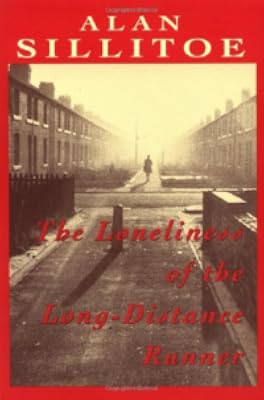
The Loneliness of the Long Distance Runner
by Alan Sillitoe
On This Page
Description
Perhaps one of the most revered works of twentieth-century fiction, The Loneliness of the Long-Distance Runner is a modern classic about integrity, courage, and bucking the system. In the title story, a reform-school cross-country runner seizes the perfect opportunity to defy the authority that governs his life.Tags
Recommendations


















Member Recommendations

by anonymous user

charlie68 Also a gritty set of stories with a good heart.

Member Reviews
Summary: A collection of nine short stories set in the pre-and post-World War II British working class, characterized by a strong sense of anger, alienation, and desolation.
There was a season in my life where I was into running--anywhere from 5K races to half marathons. This book kept coming up but I never had a chance to read it. It's probably just as well, because even the title story had far less to do with running than loneliness. It is a book that could have been the inspiration for the Beatles "Eleanor Rigby." All the lonely people.
The title story is about an adolescent boy from working class origins caught up in petty crime and sentenced to "borstal," a kind of reform school. He is permitted to train outside the fences for a long show more distance competition, and much of the story is his private thoughts on those runs, culminating in the struggle between being awarded a light work load if he wins versus not wanting to comply with the borstal administration.
Other stories describe:
An upholsterer "Uncle Ernest" abandoned by his wife, exploited by some young girls for food and money in a cafe, yet who become the one bright spot in his life until the police warn him against ever seeing them again, leading him to turn to drink.
A religious education teacher who combats the tedium of dealing with unruly boys through fantasizing about the shop girls across the street from his classroom winter, until faced down by one particularly defiant boy.
A postman abandoned by his wife after six years of marriage, taking up with a housepainter. Later she begins to visit again, often in need of money, saying the housepainter had died, musing about "The Fishing Boat Picture" until he gives it to her, then finds it in a pawn shop and buys it back. Neither the picture nor the former wife fare well.
"Noah's Ark" is a carnival ride that culminates a day of cadging money by two poor boys whose big thrill is getting on the ride without paying, chased by the ride operator.
A man who tries (and fails) to hang himself, persuading a young neighbor boy to help him in "On Saturday Afternoon."
"The Match" is not just about a losing soccer match but how two men return to their wives, one engaging in domestic violence, while his friend overhears the fight in the bliss of being newly-wed.
In "The Disgrace of Jim Scarfedale" a young neighbor narrates the sad story of mama's boy Jim, who to prove he is not, marries and divorces in haste, returns to mama, while secretly pursuing a disgraceful life across town.
"The Decline and Fall of Frankie Buller" is an actual account of Sillitoe's youth, where he was led in street gang activities by Frankie, a warrior who loved to do battle with a rival gang. Separated by war, their lives take very different courses, Frankie's downward, Alan's upward, as he discovers in an encounter years later.
These are not uplifting or "feel good" stories, as you can well see. What they do describe are young men who feel trapped in a banal existence, lashing out in anger, whether through criminal activity, violence against others, or turning that anger inward in self-destructive behavior. It is not unlike the accounts of the rust belt working class in J. D. Vance's Hillbilly Elegy. Like that book, it narrates the reservoir of free floating anger as well as hopelessness or even deep loneliness of people who feel there is no way out of their situation. Sadly, stories like these could be written from characters in most of our cities. "All the lonely people/Where do they all come from?" show less
There was a season in my life where I was into running--anywhere from 5K races to half marathons. This book kept coming up but I never had a chance to read it. It's probably just as well, because even the title story had far less to do with running than loneliness. It is a book that could have been the inspiration for the Beatles "Eleanor Rigby." All the lonely people.
The title story is about an adolescent boy from working class origins caught up in petty crime and sentenced to "borstal," a kind of reform school. He is permitted to train outside the fences for a long show more distance competition, and much of the story is his private thoughts on those runs, culminating in the struggle between being awarded a light work load if he wins versus not wanting to comply with the borstal administration.
Other stories describe:
An upholsterer "Uncle Ernest" abandoned by his wife, exploited by some young girls for food and money in a cafe, yet who become the one bright spot in his life until the police warn him against ever seeing them again, leading him to turn to drink.
A religious education teacher who combats the tedium of dealing with unruly boys through fantasizing about the shop girls across the street from his classroom winter, until faced down by one particularly defiant boy.
A postman abandoned by his wife after six years of marriage, taking up with a housepainter. Later she begins to visit again, often in need of money, saying the housepainter had died, musing about "The Fishing Boat Picture" until he gives it to her, then finds it in a pawn shop and buys it back. Neither the picture nor the former wife fare well.
"Noah's Ark" is a carnival ride that culminates a day of cadging money by two poor boys whose big thrill is getting on the ride without paying, chased by the ride operator.
A man who tries (and fails) to hang himself, persuading a young neighbor boy to help him in "On Saturday Afternoon."
"The Match" is not just about a losing soccer match but how two men return to their wives, one engaging in domestic violence, while his friend overhears the fight in the bliss of being newly-wed.
In "The Disgrace of Jim Scarfedale" a young neighbor narrates the sad story of mama's boy Jim, who to prove he is not, marries and divorces in haste, returns to mama, while secretly pursuing a disgraceful life across town.
"The Decline and Fall of Frankie Buller" is an actual account of Sillitoe's youth, where he was led in street gang activities by Frankie, a warrior who loved to do battle with a rival gang. Separated by war, their lives take very different courses, Frankie's downward, Alan's upward, as he discovers in an encounter years later.
These are not uplifting or "feel good" stories, as you can well see. What they do describe are young men who feel trapped in a banal existence, lashing out in anger, whether through criminal activity, violence against others, or turning that anger inward in self-destructive behavior. It is not unlike the accounts of the rust belt working class in J. D. Vance's Hillbilly Elegy. Like that book, it narrates the reservoir of free floating anger as well as hopelessness or even deep loneliness of people who feel there is no way out of their situation. Sadly, stories like these could be written from characters in most of our cities. "All the lonely people/Where do they all come from?" show less
The story of a young "Borstal" boy told almost entirely from the boy's point of view is a riveting novella about overcoming both your heritage and your self through courage and persistence. The long-distance runner - we learn eventually that his name is Smith - is at war with the governor of the Borstal to which he has been sent as a result of the "bakery job". His conflict with the warden is a matter of honesty; that is whether the 'outlaw' brand of it is more valid that the governor's 'in-law' brand.
The Governor, who treats the boy like a prize race horse, is counting on him winning the long-distance 'All England' running cup for his Borstal. The boy seems to go along with this although we are privy to his inner thoughts which show more contradict his responses to the Governor. " And I swear under my breath: . . . No, I won't get them that cup, even though the stupid tash-twitching bastard has all his hopes on me." He goes out every morning 'frozen stiff with nothing to get me warm except a couple of hours' long-distance running before breakfast' and feels 'like the first bloke in the world . . . fifty times better than when I'm cooped up in the dormitory with three hundred others'. What is more, he has a plan. 'Cunning is what counts in this life,' he tells us at the outset, 'and even that you've got to use in the sliest way you can.'
When the day of the race comes we are there with him on the run, with his thoughts of his plan, his situation, memories of his deceased father (also an outlaw), and hints of his future. It is as if his short life is going on there in his head and before our eyes. The result of the race is not really the important thing in this gripping story. Rather; it is the presence of the mind of a teenage rebel who ruminates on his life and his self. The result is profoundly thought-provoking and utterly readable. Three years after it was published the author penned the screenplay for a film version that won several awards. show less
The Governor, who treats the boy like a prize race horse, is counting on him winning the long-distance 'All England' running cup for his Borstal. The boy seems to go along with this although we are privy to his inner thoughts which show more contradict his responses to the Governor. " And I swear under my breath: . . . No, I won't get them that cup, even though the stupid tash-twitching bastard has all his hopes on me." He goes out every morning 'frozen stiff with nothing to get me warm except a couple of hours' long-distance running before breakfast' and feels 'like the first bloke in the world . . . fifty times better than when I'm cooped up in the dormitory with three hundred others'. What is more, he has a plan. 'Cunning is what counts in this life,' he tells us at the outset, 'and even that you've got to use in the sliest way you can.'
When the day of the race comes we are there with him on the run, with his thoughts of his plan, his situation, memories of his deceased father (also an outlaw), and hints of his future. It is as if his short life is going on there in his head and before our eyes. The result of the race is not really the important thing in this gripping story. Rather; it is the presence of the mind of a teenage rebel who ruminates on his life and his self. The result is profoundly thought-provoking and utterly readable. Three years after it was published the author penned the screenplay for a film version that won several awards. show less
http://andalittlewine.blogspot.com/2012/12/class-warfare-in-loneliness-of-long.h...
There is a war coming. While a war between countries will grab the headlines, it is the war between the classes that is will do the most damage- because the lower classes are growing, the chasm between the bottom and the top is impenetrably deep, and the well-meaning middle class (because they want to avoid the war, or because they don't think war is really necessary) serve as tools of hegemony.
It's hard not to read Alan Sillitoe's The Loneliness of the Long-Distance Runner through the prism of our American fiscal cliff.
In story after story of this slim collection, the lower class Britons on the eve of the Second World War slouch from birth to death. They show more make terrible choices for lack of options across nine stories: robbery; a fight between a teacher and student; a man kindly assists his ex-wife in drinking herself to death; two boys beg, lie and steal to scrape together enough money to enjoy a fair; a man hangs himself with the help of a young boy; one man alleviates the misery of his life by beating his wife and children, while another exposes himself to little girls.
In the cruelest story of them all, "Uncle Ernest," the title character (a hard working upholsterer) finds joy in his hand-to-mouth existence by caring for two young girls. It's unclear if they needed his care: their mother has a job, and they go to school. When they first meet Ernest, they have the money for the bus ride home from a small cafe. Still, they accept his charity- he goes hungry and runs up debt to buy them tea and sweets. In kindness, he finds companionship and a hollow measure of happiness. The world, of course, punished him for that. A pair of coppers show up, responding to complaints or questions- some people thought the little girls were taking advantage of the old man's generosity. The police, acting on the best behalf of society, accuse him of untoward acts that have never crossed his mind, and they finally fling him into the street with orders to never contact the girls again. Uncle Ernest retreats to a bar, for the only escape society allows him.
This is how the world ends.
On both sides of our political divide, people are fighting for what they believe is best. I hold my beliefs because I think they are what would be best for the most people. I am sure that the senators and congressmen who are working against my desires belief they are striving for the same goal.
But the system is broken, badly. The wealthy have, over time, accumulated so many advantages that while it is possible for an American to move from the lower class to the middle class through ingenuity, perseverance and a little luck, the middle class is the peak of the summit.
As in The Loneliness of the Long-Distance Runner, we make choices every day, not because they are the best choices, but because they are the only ones we are allowed. There are too many people willing to work hard and believe that good fortune will come, too many coppers doing their duty, too many neighbors listening silently through the wall who are glad when the beating ends but who do nothing to stop it.
We cannot fix a broken system from within when millions of people are working to maintain the status quo because they believe it is in their best interest. World War II broke Great Britain; the Empire was bankrupt, and re-industrialization through the Marshall Plan took a backseat to the illusion of global power. In American history, confronted with a similar stratification in the 1890s, Americans pushed back, forcing major democratizing reforms on their government in favor of the majority and against the wealthy, powerful and well connected. With another 40 years of hindsight, will Americans look at the dawn of the 21st Century as the beginning or the end of the Second Gilded Age? show less
There is a war coming. While a war between countries will grab the headlines, it is the war between the classes that is will do the most damage- because the lower classes are growing, the chasm between the bottom and the top is impenetrably deep, and the well-meaning middle class (because they want to avoid the war, or because they don't think war is really necessary) serve as tools of hegemony.
It's hard not to read Alan Sillitoe's The Loneliness of the Long-Distance Runner through the prism of our American fiscal cliff.
In story after story of this slim collection, the lower class Britons on the eve of the Second World War slouch from birth to death. They show more make terrible choices for lack of options across nine stories: robbery; a fight between a teacher and student; a man kindly assists his ex-wife in drinking herself to death; two boys beg, lie and steal to scrape together enough money to enjoy a fair; a man hangs himself with the help of a young boy; one man alleviates the misery of his life by beating his wife and children, while another exposes himself to little girls.
In the cruelest story of them all, "Uncle Ernest," the title character (a hard working upholsterer) finds joy in his hand-to-mouth existence by caring for two young girls. It's unclear if they needed his care: their mother has a job, and they go to school. When they first meet Ernest, they have the money for the bus ride home from a small cafe. Still, they accept his charity- he goes hungry and runs up debt to buy them tea and sweets. In kindness, he finds companionship and a hollow measure of happiness. The world, of course, punished him for that. A pair of coppers show up, responding to complaints or questions- some people thought the little girls were taking advantage of the old man's generosity. The police, acting on the best behalf of society, accuse him of untoward acts that have never crossed his mind, and they finally fling him into the street with orders to never contact the girls again. Uncle Ernest retreats to a bar, for the only escape society allows him.
This is how the world ends.
On both sides of our political divide, people are fighting for what they believe is best. I hold my beliefs because I think they are what would be best for the most people. I am sure that the senators and congressmen who are working against my desires belief they are striving for the same goal.
But the system is broken, badly. The wealthy have, over time, accumulated so many advantages that while it is possible for an American to move from the lower class to the middle class through ingenuity, perseverance and a little luck, the middle class is the peak of the summit.
As in The Loneliness of the Long-Distance Runner, we make choices every day, not because they are the best choices, but because they are the only ones we are allowed. There are too many people willing to work hard and believe that good fortune will come, too many coppers doing their duty, too many neighbors listening silently through the wall who are glad when the beating ends but who do nothing to stop it.
We cannot fix a broken system from within when millions of people are working to maintain the status quo because they believe it is in their best interest. World War II broke Great Britain; the Empire was bankrupt, and re-industrialization through the Marshall Plan took a backseat to the illusion of global power. In American history, confronted with a similar stratification in the 1890s, Americans pushed back, forcing major democratizing reforms on their government in favor of the majority and against the wealthy, powerful and well connected. With another 40 years of hindsight, will Americans look at the dawn of the 21st Century as the beginning or the end of the Second Gilded Age? show less
I picked this up because I so liked the movie adapted from the title story in this collection, The Loneliness of the Long Distance Runner. The narrator of this story is an inmate at a Borstal (juvenile detention facility). When it was discovered that he was a talented runner he was given leave by the Chief Warden to exit the facility each morning in the freezing predawn hours to train. The Chief Warden is hopeful his Borstal will win the annual sports day competition with this runner. Most of the story consists of the narrator's thoughts while running--what led to his incarceration, is he to blame or is it society's fault? And of course, because of who the author is (one of the group of writers known as the Angry Young Men) and the time show more at which this was written, the focus is on class inequalities. Had I read this story before seeing the movie, I'm not sure I could have imagined making a movie of this story, which consists mostly of interior monologue. But both the story and the movie are excellent.
There is also a selection of other stories, most of which consider the same themes, and most of which are also very good. Recommended.
3 1/2 stars show less
There is also a selection of other stories, most of which consider the same themes, and most of which are also very good. Recommended.
3 1/2 stars show less
Squalid without being sensationalized. Charming and melancholy. It's hard being a human, but failure isn't as dramatic as all that.
First story is the British cousin of Catcher in the Rye, a bit.
Some of these are very slice of life, which is fine.
I first heard of this from Iron Maiden.
First story is the British cousin of Catcher in the Rye, a bit.
Some of these are very slice of life, which is fine.
I first heard of this from Iron Maiden.
The title short story is a magnificent summing up of the psychology created by the English Class system. You will learn a very great deal by reading it more than two years of formal sociology. But, the story may inspire you to try formal sociology as a mental discipline. In short, out hero is given an opportunity to get a small reward for involving himself in one of the activities of a society that gives him precious little other outlet. But, running does give him a platform for a political act which is now one of his ambitions. Do not pass up this insightful experience.
This is a collection of nine shory stories. The title story, The ‘Loneliness of the Long Distance Runner’, is about a young offender, Smith, who is sent to borstal (a detention centre). The governor has high hopes that Smith will win his institution the cup for a cross-country race. Smith likes to run and finds freedom in it but he feels conflicted: winning the race would mean giving in to the system and getting a cushier stay or sticking two fingers up to the authorities by throwing the race making his stay in the borstal unpleasant. Most of the story is narrated in the form of flashbacks whilst he’s running, where we find out what his life was like before borstal and how he ended up there. It’s a fesinating piece of show more writing.
The other stories in this collection are: ‘Uncle Ernest’, ‘Mr Raynor the School-teacher’, ‘The Fishing-boat Picture’, ‘Noah’s Ark’, ‘On Saturday Afternoon’, ‘The Match’, ‘The Disgrace of Jim Scarfedale’ and ‘The Decline and Fall of Frankie Buller’. I think the best of these are ‘The Fishing-boat Picture’, which is about an estranged married couple, and ‘The Decline and Fall of Frankie Buller' about a boy who is the leader of a gang of youths but grows to become an also-ran.
All the stories are about the experiences of working class men in the 1930s – 50s, are mostly set in Nottingham and all have a very male focus. The overriding theme of each story is conflict – ‘us against them’ - themes that are still relevant today even if some of the language may not be. These aren't flowery tales and are all quite grim. Despite the fact that not all the stories work as well as others I found the writing quite remarkable. show less
The other stories in this collection are: ‘Uncle Ernest’, ‘Mr Raynor the School-teacher’, ‘The Fishing-boat Picture’, ‘Noah’s Ark’, ‘On Saturday Afternoon’, ‘The Match’, ‘The Disgrace of Jim Scarfedale’ and ‘The Decline and Fall of Frankie Buller’. I think the best of these are ‘The Fishing-boat Picture’, which is about an estranged married couple, and ‘The Decline and Fall of Frankie Buller' about a boy who is the leader of a gang of youths but grows to become an also-ran.
All the stories are about the experiences of working class men in the 1930s – 50s, are mostly set in Nottingham and all have a very male focus. The overriding theme of each story is conflict – ‘us against them’ - themes that are still relevant today even if some of the language may not be. These aren't flowery tales and are all quite grim. Despite the fact that not all the stories work as well as others I found the writing quite remarkable. show less
Members
- Recently Added By
Lists

1950s
340 works; 22 members

Best Antiheroes and Antiheroines
119 works; 7 members

Short and Sweet
246 works; 24 members

in the name of the game ~ sport novels
23 works; 2 members

Literature which inspired Pop songs
85 works; 9 members

Penguin Random House
458 works; 4 members

Novels about Sport
10 works; 1 member

The "A" List
67 works; 8 members
Author Information

Alan Sillitoe was born on March 4, 1928 and grew up in the slums of the industrial city of Nottingham. He began to write while in the Royal Air Force, stationed in Malaya. He is best known for Saturday Night and Sunday Morning (1958), which won the Author's Club Prize for the best British novel of 1958 and The Loneliness of the Long-Distance show more Runner (1959), which won Britain's Hawthornden Prize for 1960. Both books were adapted into films in 1960 and 1962 respectively. His other works include The Death of William Posters (1965), Tree on Fire (1967), Travels in Nihilon (1971), and Raw Material (1972). He died on April 25, 2010 at the age of 82. (Bowker Author Biography) show less
Some Editions
Awards and Honors
Awards
Notable Lists
Series
Belongs to Publisher Series
Work Relationships
Is contained in
Contains
Has the adaptation
Common Knowledge
- Canonical title
- The Loneliness of the Long Distance Runner
- Original title
- The Loneliness of the Long Distance Runner
- Original publication date
- 1959
- Important places
- Nottingham, Nottinghamshire, England, UK; England, UK
- Related movies
- The Loneliness of the Long Distance Runner (1962 | IMDb)
- First words
- As soon as I got to Borstal they made me a long-distance cross-country runner.
- Blurbers
- Mortimer, Penelope; Bradbury, Malcolm
Classifications
Statistics
- Members
- 1,753
- Popularity
- 12,572
- Reviews
- 33
- Rating
- (3.68)
- Languages
- 13 — Catalan, Danish, Dutch, English, French, German, Greek, Hungarian, Italian, Japanese, Norwegian, Polish, Spanish
- Media
- Paper, Ebook
- ISBNs
- 75
- UPCs
- 2
- ASINs
- 38