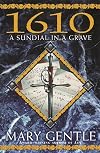
1610: A Sundial In A Grave
by Mary Gentle
On This Page
Description
It's about sex, and cruelty, and forgiveness ... Thus begins a sweeping historical adventure about two dueling swordsmen and the plot to kill a king in the grand tradition of Dorothy Dunnett and Alexander Dumas. The year is 1610. Continental Europe is briefly at peace after years of war, but Henri IV of France is planning to invade the German principalities. In England, only five years earlier, conspirators nearly succeeded in blowing up King James I and his Parliament. The seeds of the show more English Civil War and the Thirty Years War are visibly being sown, and the possibility for both enlightenment and disaster abounds. But Valentin Rochefort, duelist and spy for France's powerful financial minister, could not care less. Until he is drawn into the glittering palaces, bawdy back streets, and stunning theatrics of Renaissance France and Shakespearean London in a deadly plot both to kill King James I and to save him. For this swordsman without a conscience is about to find himself caught between loyalty, love, and blackmail, between kings, queens, politicians, and Rosicrucians -- and the woman he has, unknowingly, crossed land and sea to meet. show lessTags
Recommendations
























Member Reviews
I bought this book fifteen years ago. And it has sat unread on my bookshelves ever since. Despite the fact I’m a big fan of Gentle’s fiction. But. She writes such big novels. 1610: Sundial in a Grave is 594pp! And my copy is the hardback edition. It must weigh about ten kilos. (Slight exaggeration.) I am a big fan of brevity (see the Apollo Quartet…), but I also recognise the appeal of longer works. And with Gentle you know you’re certainly getting your money’s worth. Her research is incredible. 1610: Sundial in a Grave is, like Ash: A Secret History, a series of nested narratives, with the innermost one providing the bulk of the contents. An “introduction” describes how the author (unnamed, but surely Gentle herself) was show more as a child a big fan of a particular (invented) Dumas-esque book, and was surprised to learn it was based on real historical figures. There then follows a fragment of a document by Robert Fludd, a Jacobean occult philosopher and mathematician (like the earlier Dr John Dee), which is described as one of several documents found with the memoirs of Rochefort. And it is Rochefort’s memoirs which form the main narrative of 1610: Sundial in a Grave. The disgraced son of the retired Marshal of France, Rochefort is responsible for the assassination of Henri IV, at the instigation of Henri’s wife Marie de Medici, although he had been blackmailed into it and had planned for it to fail as his master, the Duc de Sully, wanted… But Rochefort ends up fleeing France, knowing there are plenty of people who want his head. Including hothead duellist Dariole, who had been challenging Rochefort for months. All of which leads to Rochefort on a Normandy beach fighting Dariole, rescuing Saburo, the sole survivor of a Japanese mission to King James I, taking ship to England with both, becoming embroiled in the plot by Robert Fludd to assassinate James I, foiling that plot, and… It’s all about the mathematics invented by Bruno Giordano – a real historical figure who appears in, and inspired, Gentle’s White Crow novels – which is capable of predicting the future, especially a comet due to obliterate life on Earth in the twenty-first century (yes, please). As well as numerous events before that cataclysm. Rochefort and Dariole are great characters, not that much different from White Crow and Casaubon (and yes, Dariole’s secret was pretty obvious right from the start) inasmuch as they’re both almost too good to be true. There’s a unexpected strain of BDSM throughout the novel – the relationship between Rochefort and Dariole is predicated on it – but if anything it adds depth to their interactions. The historical detail is, unsurprisingly, hugely convincing. Gentle does historical filth and smells extremely well. At 594pp, 1610: Sundial in a Grave is not a short book, but it doesn’t feel like it overstays its welcome. Surprisingly, the book ends on a happy note, although there’s a cunning slingshot inasmuch as it suggests an origin, and a purpose, for the Rosicrucians, which ties into the whole occult mathematics mythos. I thought the book excellent, and I’m only sorry I didn’t read it sooner. And I really do need to read two other books by Gentle I own which I’ve yet to read. show less
Mary Gentle is definitely one of my favorite authors. In "1610," she continues with some of the themes that run through much of her work – historical settings, swordswomen, and hermetic magic.
Rochefort is loyal man to the Duc Sully, a member of the court of France. But when Marie de Medici embroils the unwilling Rochefort in her conspiracy to kill her husband the King – and that assassination attempt is unexpectedly successful – Rochefort must flee the country, also half-unwillingly bringing along the headstrong young duelist Dariole (whom he can't decide if he would rather kill or ravish), and soon acquiring a shipwrecked Japanese ambassador/samurai, Saburo. However, practically no sooner have the unlikely trio assembled show more themselves in England, that a separate group of conspirators want to compel Rochefort to assist in yet another regicide – this time that of King James. And this conspiracy, headed by the mysterious Doctor Fludd, and backed by the Crown Prince, seems much more insidiously dangerous – because the Doctor seems able to truly divine the future through his mathematical equations. And the future seen through these equations shows that much more than the fate of a kingdom may rest on the outcome of this conspiracy.
Although Gentle sets up a situation that would seemingly be very unlikely in the 17th century, her well-researched details make her theories at least seem possible. The device of having the book purport to be a computer-reconstructed version of a damaged manuscript works well, also. And with the addition of an awfully sweet sadomasochistic love story... well, I'd have to say that I'd recommend this book to anyone who loves reading Alexandre Dumas, but can't help wishing for more spicy bits... show less
Rochefort is loyal man to the Duc Sully, a member of the court of France. But when Marie de Medici embroils the unwilling Rochefort in her conspiracy to kill her husband the King – and that assassination attempt is unexpectedly successful – Rochefort must flee the country, also half-unwillingly bringing along the headstrong young duelist Dariole (whom he can't decide if he would rather kill or ravish), and soon acquiring a shipwrecked Japanese ambassador/samurai, Saburo. However, practically no sooner have the unlikely trio assembled show more themselves in England, that a separate group of conspirators want to compel Rochefort to assist in yet another regicide – this time that of King James. And this conspiracy, headed by the mysterious Doctor Fludd, and backed by the Crown Prince, seems much more insidiously dangerous – because the Doctor seems able to truly divine the future through his mathematical equations. And the future seen through these equations shows that much more than the fate of a kingdom may rest on the outcome of this conspiracy.
Although Gentle sets up a situation that would seemingly be very unlikely in the 17th century, her well-researched details make her theories at least seem possible. The device of having the book purport to be a computer-reconstructed version of a damaged manuscript works well, also. And with the addition of an awfully sweet sadomasochistic love story... well, I'd have to say that I'd recommend this book to anyone who loves reading Alexandre Dumas, but can't help wishing for more spicy bits... show less
It's odd that one of the the blurbs for this, not the one on this actual edition, contains two big plot points which are not present in the text. I am left wondering of there were significant revisions at some point, or no one familiar with the text ever bothered to read the blurb, or there is some kind of time travel/magic/multiverse shenanigans. Along the same vein, I have been wanting to read this for years because I thought it was about Christopher Marlowe, which it is not, at all.
Nor did I realize it was a swashbuckling extravaganza, and fun with that. In retrospect, I wonder if Neal Stephenson considered it an influence on The Baroque Cycle.
I'm glad it's been reissued: it deserves more readers
Nor did I realize it was a swashbuckling extravaganza, and fun with that. In retrospect, I wonder if Neal Stephenson considered it an influence on The Baroque Cycle.
I'm glad it's been reissued: it deserves more readers
This novel presents itself as a true story, the memoirs of a Renaissance spy and duelist named Valentin Rochefort. Valentin begins the year 1610 in France, but when he accidentally assassinates King Henri IV, he’s forced to flee the country. Along the way, he joins forces with Dariole, a boy with rapier skills to rival his own, and a Japanese ambassador to the English court. The three of them travel to England together, where Valentin is roped into another assassination plot, this time against King James I. Now Valentin must outwit the would-be conspirators and save the king – even though his chief adversary is a mathematical genius who claims to be able to predict the future.
The plot of this book is exciting, and the book itself show more ought to be exciting, but for some reason I never really got into it. First of all, I didn’t like the cutesy introduction by the “translator” (actually the author) about how she found this old manuscript that sheds a new light on history. I was also put off by the detailed description of certain unusual sexual practices. However, the story itself was interesting enough that I stuck with it. The pacing of the novel is strangely slow, though, given how many action scenes there are (lots of duels and such). I did enjoy the Renaissance setting, but overall I feel like this book was a really promising idea whose execution fell flat. show less
The plot of this book is exciting, and the book itself show more ought to be exciting, but for some reason I never really got into it. First of all, I didn’t like the cutesy introduction by the “translator” (actually the author) about how she found this old manuscript that sheds a new light on history. I was also put off by the detailed description of certain unusual sexual practices. However, the story itself was interesting enough that I stuck with it. The pacing of the novel is strangely slow, though, given how many action scenes there are (lots of duels and such). I did enjoy the Renaissance setting, but overall I feel like this book was a really promising idea whose execution fell flat. show less
This is quite a blend of historical fiction with touches of fantasy and eroticism with some scenes that may shock some readers; a love story with duels and plenty of political intrigue and conspiracies. You’ll be forgiven for thinking you’re reading a gay romance to begin with, but then the book takes a turn. That’s not to say it’s an easy read. Often I get through 100 pages a day, even when it’s a complex plot, but found I needed to take my time with this. This mostly gripped me, but there was a sense of wondering whether I’d ever finish, although it’s hard to say why. I’ve read books more involved than this, but some scenes felt needlessly long. I can’t help feeling I’m doing the book a disservice by saying some show more pages flashed by, others were a slow amble, and the tone of the book changed throughout, which also threw me. The author is meticulous, maybe overly so, but I found sticking with this worthwhile. A story that begins in France with the arrangement of an assassination moves on across the world. show less
OK, this wasn't quite as riveting as I remembered it on rereading it but I'm not reducing the score as some of the story actually felt quire new (though it's been a long while since it was last reread). Can history be calculated in advance? And, if so, what are the moral responsibilities of those who know of these techniques? Those questions lie at the heart of the story as the spy Rochefort, and his tormentor/lover Dariole travel through early 1600s Europe and Japan in search of the enigmatic Robert Flood. Modern theory would tend to say that it is impossible to give a definitive answer to the possibility of calculating future conditions but this book allows for the possibility and Rochefort gradually finds himself acknowledging that show more he has a duty to that ill-defined future - inaction is it's own sort of action and not without it's own set of consequences.
The main problem I had with this book this time was its length and wordiness to no real effect show less
The main problem I had with this book this time was its length and wordiness to no real effect show less
Quite enjoyable. Mary Gentle is better know for science fiction novels; this is an alternate history (not very alternate, though). The protagonist (and narrator; the book is presented as an edition of his memoirs) is Valentin Rochefort, who will be recognized as the Cardinal’s chief instrument in The Three Musketeers. The book is set well before Rochefort’s initial encounter with D’Artagnan, and Rochefort turn out to have a somewhat different personality than that presented by Dumas. (To be fair, if your mental image of Rochefort is created by movies, you might note that in the book Rochefort and D’Artagnan end up as friends).
I can’t give too many spoilers, but a Japanese samurai and a young duelist end up in the mix, there show more are lots of delightful plot twists, and the historical characters (including Henri IV, James I, the Duc de Sully, and Robert Cecil) are all well portrayed. There is a little less action and more mental dialogue than I would like, and Arabella Stuart seem to be dropped into the novel just so the author can prove she knows who she was. Nevertheless, I stayed up to 2:30 to finish this one. show less
I can’t give too many spoilers, but a Japanese samurai and a young duelist end up in the mix, there show more are lots of delightful plot twists, and the historical characters (including Henri IV, James I, the Duc de Sully, and Robert Cecil) are all well portrayed. There is a little less action and more mental dialogue than I would like, and Arabella Stuart seem to be dropped into the novel just so the author can prove she knows who she was. Nevertheless, I stayed up to 2:30 to finish this one. show less
Members
- Recently Added By
Lists

KayStJ's to-read list
1,616 works; 11 members
Author Information

Some Editions
Awards and Honors
Distinctions
Series
Belongs to Publisher Series
Gallimard, Folio SF (389)
Work Relationships
Common Knowledge
- Canonical title
- 1610: A Sundial In A Grave
- Original publication date
- 2003
- People/Characters
- Robert Fludd; Valentin Rochefort; Marie de Medici; Tanaka Saburo; Dariole
- Important places
- London, England, UK; England, UK; France
- Epigraph
- '[...]make
The sons of sword, and hazard fall before
The golden calf, and on their knees, whole nights,
Commit idolatry with wine, and trumpets.'
- II.i.18 - 28, ... (show all)" rel="nofollow" target="_new">The Alchemist, Ben Jonson (1610) - Dedication
- For Dean, my first reader; without whom, nothing.
- First words
- Translator's Foreword. It's about sex, and cruelty, and forgiveness.
- Last words
- (Click to show. Warning: May contain spoilers.)As yet, no data exists on the location of a relevant comet.
Classifications
Statistics
- Members
- 601
- Popularity
- 48,808
- Reviews
- 24
- Rating
- (3.53)
- Languages
- English, French, Spanish
- Media
- Paper, Ebook
- ISBNs
- 12
- ASINs
- 5