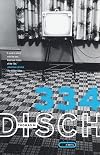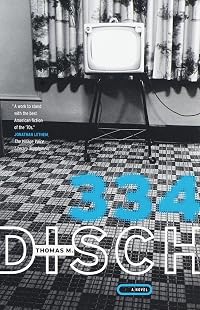
334
by Thomas M. Disch
On This Page
Description
"A visionary portrait of the underbelly of 21st-century New York City."--Cover. "If Charles Dickens had written speculative fiction, he might have created a novel as intricate, passionate, and lacerating as Thomas M. Disch's visionary portrait of the underbelly of 21st-century New York City. The residents of the public housing project at 334 East 111th Street live in a world of rationed babies ans sanctioned drug addiction. Real food is displayed in museums and hospital attendants moonlight show more as body-snatchers . . ." -- Back cover of book. show lessTags
Recommendations





















Member Reviews
Very interesting, incredibly complicated. The first part is little different than a collection of short stories, but they each hint and themes and characters developed later. There's a *chart* to help the reader follow the narrative leaps in the second half, across 3 characters, different years (out of sequence), and narrative type ('another point-of-view', fantasy, reality, and monolog). There's a total of 43 different vinettes in this section, and amazingly they seem to add up to a story. It's a fun read if you like novels like puzzles.
Another plus: technically a science fiction novel, it wears its exposition so lightly it's hard to even tell most of the time. For example, there is a drug depicted in the novel that gives certain show more characters an elaborately detailed fantasy life--a sort of pharmacological virtual reality. While several passages occur in these alternate realities, the SF mechanism through which they occur isn't explained until about halfway through.
I think I would have to read it a few more times to pick up on all the connections and interactions. For example, a seemingly throwaway character from one of the early stories (Martinez) turns out to be the estranged husband of one of the main characters (Juan). It's only later that you realize it's the same person (=Juan Martinez).
I haven't read a book that's both challenging and entertaining in a long time. It's usually one or the other, for me. I didn't rank it 5/5 only because I wouldn't recommend it for everyone: I could easily see how the narrative tricks might seem like tedious affectations, and there's a lot of profanity and disturbing imagery. But if you don't mind that stuff, then I heartily recommend it. show less
Another plus: technically a science fiction novel, it wears its exposition so lightly it's hard to even tell most of the time. For example, there is a drug depicted in the novel that gives certain show more characters an elaborately detailed fantasy life--a sort of pharmacological virtual reality. While several passages occur in these alternate realities, the SF mechanism through which they occur isn't explained until about halfway through.
I think I would have to read it a few more times to pick up on all the connections and interactions. For example, a seemingly throwaway character from one of the early stories (Martinez) turns out to be the estranged husband of one of the main characters (Juan). It's only later that you realize it's the same person (=Juan Martinez).
I haven't read a book that's both challenging and entertaining in a long time. It's usually one or the other, for me. I didn't rank it 5/5 only because I wouldn't recommend it for everyone: I could easily see how the narrative tricks might seem like tedious affectations, and there's a lot of profanity and disturbing imagery. But if you don't mind that stuff, then I heartily recommend it. show less
“The end of the world. Let me tell you about the end of the world. It happened fifty years ago. Maybe a hundred. And since then it's been lovely. I mean it. Nobody tries to bother you. You can relax. You know what? I like the end of the world.”
― Thomas M. Disch, 334
Thomas M. Disch’s 1974 novel, a mix of science fiction and Zola-like social realism, eyeballs 334 East 11th Street, New York City, home to a teeming mass of miserable, poverty-stricken occupants of a 21st century multistory apartment beehive - Thomas Hobbs's philosophy of life as nasty, brutish, and short on a continual supply of amphetamines. Sorry to report, much of Disch's disturbing futuristic world has become harsh reality for huge chunks of our current-day show more population.
Forty-eight chapters, five long and forty-three short, feature interlinking snapshosts of a dozen or so men and women bound by their common plight of sordidness and desperation. To share a glimpse of what a reader is in for, below are commentary on two of the chapters: first, a longer one, a tale about college student Birdie Ludd in battle with the forces of darkness; and the second, a shorter tale, a vivid sketch of an outing at a most unusual art exhibit:
THE DEATH OF SOCRATES
Birdie Ludd has finally made it out of high school (P.S. 141) into one of New York City’s colleges only to sit in class listening to a professor on a TV yack nonstop about the life of Dante and how nearly everyone according to the Italian author’s Inferno will be tormented in hell, most certainly all the Jews.
When a Jewish girl in the class says that doesn’t seem fair, the professor’s assistant simply replies there will be a test on the covered material. As Birdie is quick to recognize, none of what he is being force fed has any relevance to his everyday life and since teaching is done by television, there is absolutely no possibility of dialogue or a lively interchange of ideas; rather, he is required to simply swallow and regurgitate what he is given.
Summoned to the front office, a Mr. Mack informs Birdie his score on the mandatory state test of “twenty-seven” was a mistake and Birdie is now being reclassified as a “twenty-four,” which means he will not be allowed to father any children. Poor Birdie! He complains it isn’t his fault his father has diabetes. But we learn there are more factors to consider, things like Birdie lacking any exceptional service for the country or the economy.
Additionally, we read how Birdie losses points because of his father’s unemployment pattern but gains a few points “by being a Negro.” Goodness, sound like Disch’s futuristic world has the deck stacked against blacks. What else is new? Perhaps not so coincidentally, Philip K. Dick's novel Flow My Tears, the Policeman Said, also published in the 1970s, maps out genetic engineering geared to eliminate the US black population.
Birdie pens an essay for class entitled Problems of Creativeness, that ends “Another criteria of Creativeness was made by Socrates, so cruelly put to death by his own people, and I quote, “To know nothing is the first condition of all knowledge.” From the wisdom of that great Greek Philosopher may we not draw our own conclusions concerning these problems. Creativeness is the ability to see relationships where none exist.”
Read carefully, this essay reveals a highly imaginative, creative, intelligent mind buried under bad English and disastrous inner city public education. Thus the title of Disch’s tale, The Death of Socrates, bestows a double meaning. As they say, a mind is a terrible thing to waste – and observing the social forces crushing Birdie Lund’s brilliant mind makes for one sad, profound story.
Although Birdie is squashed and squeezed by cramped urban seediness, our young man has the capacity to perceive beauty radiating, glowing on the inside, even in dumb vending machines and blind, downtrodden faces. And, as to be expected, he has to continually fight through mass media and pop culture saturation – singing the words of commercials and viewing the movement of autos and ships as if moments from movies and television shows.
One of the saddest endings I’ve ever encountered: Highly intellectual, sensitive, aesthetically attuned Birdie Lund feels trapped no matter which way he turns. As a last resort, he sees but one option open to him. Here are Disch’s concluding words: “The same afternoon, without even bothering to get drunk, he went to Times Square and enlisted in the U.S. Marines to go and defend democracy in Burma. Eight other guys were sworn in at the same time. They raised their right arms and took one step forward and rattled off the Pledge of Allegiance or whatever. Then the sergeant came up and slipped the black Marine Crops mask over Birdie’s sullen face. His new ID number was stenciled across the forehead in big white letters: USMC 100-7011-D07. And that was it, they were gorillas.”
A & P (2021)
Lottie is at the Metropolitan Museum of Art, at an exhibit were there are rows and stacks and pyramids of cans, boxes, meats, dairy, candy, cigarettes, bread, fruits, vegetables – all with individual brand names. Juan is so delighted just to be with her here at the museum. For Lottie, this is a time of perfection, one she wishes she could hold forever: “The real magic, which couldn’t be laid hold of, was simply that Juan was happy and interested and willing to spend perhaps the whole day with her. The trouble was that when you tried this hard to stop the flow it ran through your fingers and you were left squeezing air.”
Juan picks up a carrot that has the look and feel of being real but, of course, as part of the art exhibit, the carrot is not real. Visitors were given instructions as they entered the exhibit on what they would see and how to appreciate the art. The food and containers and cans are all fake, no matter how “real” they look – the Met’s tape said so, thus it must be true. But Juan insists, at the top of his lungs, that the carrot is real. One of the guards strides toward Juan and both he and Lottie are thrown out.
We can all recognize how this unusual art exhibit takes Andy Warhol’s Brillo Boxes and Campbell Soup Cans and expands the concept quantitatively. Arthur C. Danto has written extensively on how Warhol’s creations herald in the “death of art” in the sense that objects of art are no longer separate from everyday objects, no longer special pieces like landscape oil paintings or marble sculptures; rather, the art world defines what is and what is not art. Traveling uptown from his downtown cockroach infested 334 mega-apartment, Juan doesn’t buy into the art world’s artificial distinction. Damn, it’s a carrot! A subtle Thomas M. Disch comment on the would-be state of the visual arts in the years following Warhol and the “death of art.”
Again, these are but two of forty-eight chapters. I hope I have whetted your appetite to sample more of Disch's novel. Special thanks to Goodreads friend Manny Rayner for alerting me to this forgotten classic.
"He knew without having to talk to the rest that the murder would never take place. The idea had never meant for them what it had meant for him. One pill and they were actors again, content to be images in a mirror."
- Thomas M. Disch, 334 show less
Another chilling story about eugenics and overpopulation. IT must be hard for Thomas Disch to get out of bed some mornings, knowing he has to get a few more pages of high quality despair done before the deadline. It's quite readable, just very bad news.
Disch's prose can still be surprising and witty and lovely here, but the rest… The plot and the character and the structure are all opaque and confusing in a way that promises payoff when you first encounter them, but then nothing much develops. It's a book I can imagine being obsessed with, for its frustrating flaws. Maybe they're actually signs of genius? Nah?
http://nwhyte.livejournal.com/2339104.html
The disjointed narrative failed to engage me, and I felt that the stories never quite concentrated sufficiently on either near-future world-building or interesting characterisation. It was interesting that Disch correctly saw the politics of reproduction as being so prominent in the twenty-first century, although the detail has turned out rather differently.
https://fromtheheartofeurope.eu/334-by-thomas-m-disch/
My concentration was at a low ebb in August 2014 because of my role at that year’s Worldcon, and I think that I was unfair. It’s not actually a novel; it’s a group of six short pieces, with a shared setting and some shared characters, all set in and around 334 East 11th Street in New show more York, so I was demanding more coherence than necessary. Within each story, the characterization makes sense. And I’ll get to the world building.
I have come back to it as one of the relatively small number of books set in 2025, looking at next year as science fiction saw it. Actually only one and a half of the six shorter pieces that make up the book is explicitly set in 2025, and the longest piece (which shares the title “334”) has 43 sections, all dated to the years 2021, 2024 and 2026, so none of them in 2025. I missed that when I did my 2021 and 2024 write ups.
It’s interesting that the politics of reproductive health is one of the themes of the book. The 2020s of Disch’s world are over-populated and subject to government regulation, particularly in deciding who gets to have children. The first story is about a young man whose social rating is too low to allow him to become a parent, and his efforts to overcome that. Another is about a couple who do qualify for children, and decide that the male partner will be the one who actually becomes pregnant.
Otherwise, it’s a typical late 60’s / early 70’s story, set in a rather grim dehumanising dystopian society, where advances in technology haven’t brought much improvement for most people and the smart people exploit the cracks in the system. Somewhat depressing. show less
The disjointed narrative failed to engage me, and I felt that the stories never quite concentrated sufficiently on either near-future world-building or interesting characterisation. It was interesting that Disch correctly saw the politics of reproduction as being so prominent in the twenty-first century, although the detail has turned out rather differently.
https://fromtheheartofeurope.eu/334-by-thomas-m-disch/
My concentration was at a low ebb in August 2014 because of my role at that year’s Worldcon, and I think that I was unfair. It’s not actually a novel; it’s a group of six short pieces, with a shared setting and some shared characters, all set in and around 334 East 11th Street in New show more York, so I was demanding more coherence than necessary. Within each story, the characterization makes sense. And I’ll get to the world building.
I have come back to it as one of the relatively small number of books set in 2025, looking at next year as science fiction saw it. Actually only one and a half of the six shorter pieces that make up the book is explicitly set in 2025, and the longest piece (which shares the title “334”) has 43 sections, all dated to the years 2021, 2024 and 2026, so none of them in 2025. I missed that when I did my 2021 and 2024 write ups.
It’s interesting that the politics of reproductive health is one of the themes of the book. The 2020s of Disch’s world are over-populated and subject to government regulation, particularly in deciding who gets to have children. The first story is about a young man whose social rating is too low to allow him to become a parent, and his efforts to overcome that. Another is about a couple who do qualify for children, and decide that the male partner will be the one who actually becomes pregnant.
Otherwise, it’s a typical late 60’s / early 70’s story, set in a rather grim dehumanising dystopian society, where advances in technology haven’t brought much improvement for most people and the smart people exploit the cracks in the system. Somewhat depressing. show less
Sprawling, hilarious, ugly, compassionate, heartbreaking, humane, precise, casual, experimental, classic.
Every time I read it again, I find more in there. I've written a bunch of annotations for it here.
Every time I read it again, I find more in there. I've written a bunch of annotations for it here.
A classic that survived surprisingly well, given its anchoring in 60s and 70s US concerns of welfare state dependencies and overcrowding. I realised that I had read many parts of it before as novellas or short stories (including Angouleme) but it was still a fresh read. The final section, with its diagram showing how the segments move back and forth between years and narrators. was particularly effective although I found the narrative harder going as I was reading the book in small chunks separated by a lot of time.
Members
- Recently Added By
Lists

Dystopian and Apocalyptic Literature
350 works; 74 members

The 5 Parsec Shelf
50 works; 7 members

Books Set in New York City
127 works; 22 members

Urban Fiction
74 works; 7 members
David Pringle's Science Fiction: The 100 Best Novels
101 works; 9 members

Books Read in 2013
1,630 works; 51 members
Author Information

165+ Works 8,133 Members
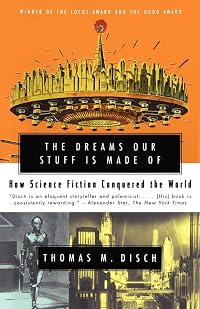
Thomas Disch was a popular & prolific poet, playwright, essayist, & novelist. He is the author of many works of science fiction & the poetry collections "Dark verses & Light" & "Yes, Let's: New & Selected Poems". (Publisher Provided) Thomas M. Disch was born in Des Moines, Iowa on February 2, 1940. He dropped out of the architecture program at show more Cooper Union, and then left New York University after he sold a short story entitled The Double Timer. His first novel, The Genocides, was published in 1965. His other novels include The House That Fear Built, 334, The M.D., The Priest, The Word of God: Or, Holy Writ Rewritten, and Clara Reeve written under the pseudonym Leonie Hargreave. He won several awards including the 1969 Ditmar Award for Camp Concentration, the O. Henry Award in 1975 for Getting into Death and in 1977 for Xmas, the 1980 John W. Campbell, Jr. Memorial Award for On Wings of Song, and the 1981 British Science Fiction Award for The Brave Little Toaster: A Bedtime Story for Small Appliances. He was also wrote poetry, opera librettos, plays, and criticism of theater, films and art. His collections of poetry include Here I Am, There You Are, Where Are We; The Dark Old House; Yes, Let's: New and Selected Poetry; and Dark Verses and Light. He won the 1999 biennial Michael Braude Award for Light Poetry for A Child's Garden of Grammar, the Locus and Hugo Awards for 1999 for The Dreams Our Stuff is Made Of: How Science Fiction Conquered the World, and the Puschcart Prize for The First Annual Performance Art Festival at Slaughter Rock Battlefield. His criticism appeared in several publications including The Nation, The New York Daily News, and The New York Sun. In 1987, he wrote a script for the television series Miami Vice. He shot himself on July 4, 2008 at the age of 68. (Bowker Author Biography) show less
Some Editions
Awards and Honors
Awards
Series
Belongs to Publisher Series
Work Relationships
Common Knowledge
- Canonical title
- 334
- Original title
- 334
- Original publication date
- 1972-11 (Collection) (Collection); 1972; 1972 Novelette (The Death of Socrates) (The Death of Socrates); 1971 Novelette (Bodies) (Bodies); 1972 Novelette (Everyday Life in the Later Roman Empire) (Everyday Life in the Later Roman Empire); 1971 Novelette (Emancipation) (Emancipation) (show all 8); 1971 Short Story (Angouleme) (Angouleme); 1972 Novella (334) (334)
- Important places
- New York, New York, USA
- Epigraph*
- Im April 1524
entdeckte der aus Florenz gebürtige Seefahrer
Verrazzano,
der die französische Karavelle "La Dauphine" führte,
diese Bucht, die heute den Hafen von New York bildet,
und nannte diese Küsten "An... (show all)gouleme",
zu Ehren Franz I., König von Frankreich - Dedication
- For Jerry Mundis,
who lived here. - First words
- There was a dull ache--a kind of hollowness, in the general area of his liver--the seat of intelligence according to Aristotle--a feeling that there was someone inside his chest blowing up a balloon, or that his body was that... (show all) balloon.
- Last words
- (Click to show. Warning: May contain spoilers.)And it's what I want.
- Publisher's editor*
- Jeschke, Wolfgang
- Blurbers
- David Hartwell in Crawdaddy
- Original language*
- Englisch
*Some information comes from Common Knowledge in other languages. Click "Edit" for more information.
Classifications
Statistics
- Members
- 753
- Popularity
- 37,495
- Reviews
- 18
- Rating
- (3.58)
- Languages
- English, French, German, Spanish
- Media
- Paper, Ebook
- ISBNs
- 14
- ASINs
- 7