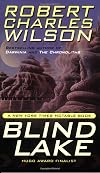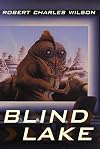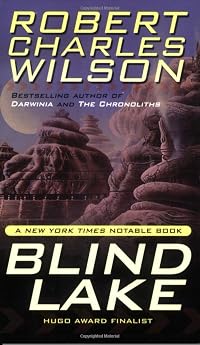
Blind Lake
by Robert Charles Wilson
On This Page
Description
Robert Charles Wilson, saysThe New York Times, "writes superior science fiction thrillers." HisDarwiniawon Canada's Aurora Award; his most recent novel,The Chronoliths, won the prestigious John W. Campbell Memorial Award. Now he tells a gripping tale of alien contact and human love in a mysterious but hopeful universe. At Blind Lake, a large federal research installation in northern Minnesota, scientists are using a technology they barely understand to watch everyday life in a city of show more lobster like aliens upon a distant planet. They can't contact the aliens in any way or understand their language. All they can do is watch. Then, without warning, a military cordon is imposed on the Blind Lake site. All communication with the outside world is cut off. Food and other vital supplies are delivered by remote control. No one knows why. The scientists, nevertheless, go on with their research. Among them are Nerissa Iverson and the man she recently divorced, Raymond Scutter. They continue to work together despite the difficult conditions and the bitterness between them. Ray believes their efforts are doomed; that culture is arbitrary, and the aliens will forever be an enigma. Nerissa believes there is a commonality of sentient thought, and that our failure to understand is our own ignorance, not a fact of nature. The behavior of the alien she has been tracking seems to be developing an elusive narrative logic--and she comes to feel that the alien is somehow, impossibly, aware of the project's observers. But her time is running out. Ray is turning hostile, stalking her. The military cordon is tightening. Understanding had better come soon.... Blind Lake is a 2004 Hugo Award Nominee for Best Novel. show lessTags
Recommendations





Member Reviews
Blind Lake is Robert Charles Wilson’s dark, nuanced take on issues raised in Carl Sagan’s Contact (1985). Blind Lake was nominated for a Hugo, but it never achieved the fame of Sagan’s novel. Hollywood opportunity did not come knocking for Wilson as it did for Sagan, who died during the production of the 1997 film adaptation of Contact. Sagan envisioned religious opposition to alien contact. Wilson suggests a pop culture cult. One of his characters writes a bestseller titled “God & the Quantum Vacuum.” He thinks the ampersand in the title is responsible for its success. Sagan’s aliens adopt a familiar human avatar on a holographic tropical beach; Wilson’s aliens are large, reeking sea creatures who appear in a barren show more desert. Sagan’s aliens learn about us from SETI and early TV; Wilson’s team makes contact through an array of telescopes beyond the orbit of Jupiter, whose data is interpreted by the AI of a quantum computer based on a Bose-Einstein Concentrate. Officials wonder whether the AI itself can be trusted and whether the aliens may have corrupted the system. As it happens, the situation is more complicated than that. An alien AI may be talking to an autistic child and her unstable father. In the end, Wilson’s cosmic vision is closer to that of Ted Chiang’s “Story of Your Life” and its 2016 film adaptation, Arrival, than it is to Sagan’s technological optimism. show less
What is a person?
A new technology (that is not understood) allows us to see, through a screen, other planets. We're watching two different ones. One has a sentient, alien life that builds cities and makes things, but seems entirely unlike humans. And the base using this technology is suddenly cut off, quarantined, from the outside world. Left alone, to wonder what happened.
A good, old sci-fi tale about scientists playing with stuff they don't understand, vast alien societies (or not), even vaster alien intellects (or not). And some basic human insanity, to spice things up.
Young Tess may be crazy... or she may be communicating with an alien presence. Her mother may be overly-sentimental... or onto a breakthrough of galactic proportions. show more Her ex-husband almost certainly is crazy... and suddenly, due to the quarantine, he's in charge. And then there's the weird stuff.
Robert Charles Wilson is another writer that I find easy to read. And fun. Certainly, this is not as good as Darwinia, but it's just about as strange. show less
A new technology (that is not understood) allows us to see, through a screen, other planets. We're watching two different ones. One has a sentient, alien life that builds cities and makes things, but seems entirely unlike humans. And the base using this technology is suddenly cut off, quarantined, from the outside world. Left alone, to wonder what happened.
A good, old sci-fi tale about scientists playing with stuff they don't understand, vast alien societies (or not), even vaster alien intellects (or not). And some basic human insanity, to spice things up.
Young Tess may be crazy... or she may be communicating with an alien presence. Her mother may be overly-sentimental... or onto a breakthrough of galactic proportions. show more Her ex-husband almost certainly is crazy... and suddenly, due to the quarantine, he's in charge. And then there's the weird stuff.
Robert Charles Wilson is another writer that I find easy to read. And fun. Certainly, this is not as good as Darwinia, but it's just about as strange. show less
While this is no "Spin" it's certainly a solid Science Fiction novel with an interesting near-time science concept, great world building and thoughtful characters.
Blind Lake has more of a suspense angle than what you find in typical SF - more of an SF thriller. It starts slow and builds to a very solid ending. I liked the technology aspects quite a bit in this book as the author takes you quite beyond current thinking and into consequences that are quite profound. Without giving too much away, while the primary story lines are quite mundane, there's a mysterious undercurrent that is only presented in glimpses until the end.
As a general read, it may be paced a bit slowly for non-SF readers and the ending may be a bit obtuse for those show more same readers. For SF readers the end is its own reward. show less
Blind Lake has more of a suspense angle than what you find in typical SF - more of an SF thriller. It starts slow and builds to a very solid ending. I liked the technology aspects quite a bit in this book as the author takes you quite beyond current thinking and into consequences that are quite profound. Without giving too much away, while the primary story lines are quite mundane, there's a mysterious undercurrent that is only presented in glimpses until the end.
As a general read, it may be paced a bit slowly for non-SF readers and the ending may be a bit obtuse for those show more same readers. For SF readers the end is its own reward. show less
Con cada novela que escribe, Robert C. Wilson se está convirtiendo en un escritor a tener muy en cuenta. Wilson destaca sobre todo por el tratamiento de los personajes, a los que les da mucha importancia, no se quedan en meras fichas al servicio de una historia, también tienen sus traumas, aunque igualmente es verdad que algunos personajes están algo estereotipados. Pero Wilson tampoco deja la trama en un segundo plano, y escribe una ciencia ficción hard bastante asequible, especulando sobre diversos inventos tecnológicos en un futuro cercano. Sus novelas tienen un elemento común, y es que suelen transcurrir en un entorno cotidiano donde de repente acontece un suceso extraordinario que trastoca las vidas de los personajes.
Testigos show more de las estrellas (Blind Lake), transcurre en un futuro cercano, en una base científica federal de Minnesota habitada por varios cientos de científicos. En Blind Lake, que así es como se llama esta base, se encuentran unos telescopios que filtran las imágenes a través de computadoras cuánticas, método que ni los propios implicados llegan a comprender. Mediante estos telescopios, los equipos se dedican a observar una civilización alienígena como si realmente estuviesen allí. Pero la vida en la base quedará trastocada cuando se vean obligados a soportar una cuarentena…
En cuanto a los personajes, cabe destacar a Chris Carmody, escritor y periodística científico que ha sido invitado para realizar un reportaje sobre el funcionamiento de estos telescopios. Por otra parte, la científica Marguerite Hauser se dedica a observar y analizar a uno de estos alienígenas, teniendo que cuidar también de su hija Tessa, que sufre cierto tipo de alucinaciones.
En resumen, una buena novela de Robert C. Wilson, de fácil y amena lectura, que equilibra perfectamente lo humano y lo científico, y que cierra todos los misterios de manera satisfactoria. show less
Testigos show more de las estrellas (Blind Lake), transcurre en un futuro cercano, en una base científica federal de Minnesota habitada por varios cientos de científicos. En Blind Lake, que así es como se llama esta base, se encuentran unos telescopios que filtran las imágenes a través de computadoras cuánticas, método que ni los propios implicados llegan a comprender. Mediante estos telescopios, los equipos se dedican a observar una civilización alienígena como si realmente estuviesen allí. Pero la vida en la base quedará trastocada cuando se vean obligados a soportar una cuarentena…
En cuanto a los personajes, cabe destacar a Chris Carmody, escritor y periodística científico que ha sido invitado para realizar un reportaje sobre el funcionamiento de estos telescopios. Por otra parte, la científica Marguerite Hauser se dedica a observar y analizar a uno de estos alienígenas, teniendo que cuidar también de su hija Tessa, que sufre cierto tipo de alucinaciones.
En resumen, una buena novela de Robert C. Wilson, de fácil y amena lectura, que equilibra perfectamente lo humano y lo científico, y que cierra todos los misterios de manera satisfactoria. show less
One of two astronomical research stations in the US which show what appear to be living beings on an extra-solar planet is suddenly cut off from the outside world. But why? And are the screens showing something real or just an AI hallucination?
A fascinating and enjoyable exploration of ideas, though it does sometimes tip over into technobabble.
A fascinating and enjoyable exploration of ideas, though it does sometimes tip over into technobabble.
I'm not sure how I feel about this one, other than "I'm not sure." I like reading Wilson's stories because he is great with coming up with unique (to me) ideas. The stories however never seem to completely satisfy me. In this case there are several storylines and I didn't really care for some of the characters or their problems, and yet some I did, quite a bit. This was written in 2003 and it is a near future but not quite tomorrow story, almost a bit of a thriller in part. The book goes at a rather slow pace, which perhaps explains why this doesn't feel like a fast-paced thriller! That sounds silly, but that is partly how it feels, like a slow paced thriller. For a 2003 book Wilson does well looking at the near future with everyone show more downloading their entertainment to watch when they want and really dependent on their online access - most everything feels familiar. The "Big Idea" though is pretty advanced. The "REALLY Big Idea" that develops towards the end reminds me of other work by Wilson where he is trying to give us something beyond our comprehension. Despite this, the novel is really a relationship story - the characters here could be having their problems in a variety of settings.
A couple of elements that tweaked me a little while reading are resolved as the story progresses. One thing that I don't think was handled well was integrating the several viewpoint characters into one narrative. We would get so far and then jag back without necessarily knowing it to an earlier time with another character. This would only become apparent when the story caught up with a scene from someone else. It just didn't seem to be handled as well as I've read in many other stories. On the plus side there is some real strong characterization in here, esp the 11 year old girl who may be slightly autistic. She's different. I got a real sense of the world she lived in. Other good character portraits in here as well, including the girl's mother and a journalist. 4 stars for imagination and characterization. Less for the rest. show less
A couple of elements that tweaked me a little while reading are resolved as the story progresses. One thing that I don't think was handled well was integrating the several viewpoint characters into one narrative. We would get so far and then jag back without necessarily knowing it to an earlier time with another character. This would only become apparent when the story caught up with a scene from someone else. It just didn't seem to be handled as well as I've read in many other stories. On the plus side there is some real strong characterization in here, esp the 11 year old girl who may be slightly autistic. She's different. I got a real sense of the world she lived in. Other good character portraits in here as well, including the girl's mother and a journalist. 4 stars for imagination and characterization. Less for the rest. show less
Blind Lake is a victim of bad enblurbening. The back of the book gives a misleading summary that can easily blind the reader to its very slight charms. Marketed as a scifi thriller, in actuality it's a quite old school, far from audacious but an okay enough way to spend a few days.
The eponymous Lake is a large science/govt community, built around a puzzling type of quantum computing that allows Earthlings to view life on an alien planet fifty light years away. When something - either inside or outside - causes a lockdown, pressure to resolve how the observation works will mount.
It's easy enough to slip into the language of a thriller when describing the plot, but the novel really isn't like that. A small, transparent cast are rendered show more well, but very simply by Wilson, and their pressures are just as much familial and social as they are a result of aliens and strange technology.
The pace is... not exactly languid - Wilson is happy to elide long periods of time where required - but leisurely, and three quarters of the book reads as a set-up for a hasty conclusion where answers are quickly, almost casually, supplied. I can easily see why a typical scifi fan would be alienated by the book's focus on non-scifi relationships and life.
The problem is that Wilson - whose prose is generally quite fluid - doesn't offer very much for non-scifi readers. The characters are believable Everypeople, but as a consequence they're quite boring and this is exacerbated by the author's willingness to telegraph every single thought they have. There is a lot of telling *and* showing here, and it just makes everything a bit flat.
Blind Lake isn't a terrible book, but it's very simple, and I was nonplussed to see its Hugo nomination and starred reviews from Publishers Weekly and Kirkus - both usually quite reliable for genre recommendations. It certainly doesn't plunge the depths of the genre, but by the same token it's nowhere near the peaks. show less
The eponymous Lake is a large science/govt community, built around a puzzling type of quantum computing that allows Earthlings to view life on an alien planet fifty light years away. When something - either inside or outside - causes a lockdown, pressure to resolve how the observation works will mount.
It's easy enough to slip into the language of a thriller when describing the plot, but the novel really isn't like that. A small, transparent cast are rendered show more well, but very simply by Wilson, and their pressures are just as much familial and social as they are a result of aliens and strange technology.
The pace is... not exactly languid - Wilson is happy to elide long periods of time where required - but leisurely, and three quarters of the book reads as a set-up for a hasty conclusion where answers are quickly, almost casually, supplied. I can easily see why a typical scifi fan would be alienated by the book's focus on non-scifi relationships and life.
The problem is that Wilson - whose prose is generally quite fluid - doesn't offer very much for non-scifi readers. The characters are believable Everypeople, but as a consequence they're quite boring and this is exacerbated by the author's willingness to telegraph every single thought they have. There is a lot of telling *and* showing here, and it just makes everything a bit flat.
Blind Lake isn't a terrible book, but it's very simple, and I was nonplussed to see its Hugo nomination and starred reviews from Publishers Weekly and Kirkus - both usually quite reliable for genre recommendations. It certainly doesn't plunge the depths of the genre, but by the same token it's nowhere near the peaks. show less
Members
- Recently Added By
Lists

Best Science Fiction Novels
816 works; 430 members
Author Information

47+ Works 14,413 Members
Some Editions
Awards and Honors
Awards
Distinctions
Series
Belongs to Publisher Series
Gallimard, Folio SF (349)
Common Knowledge
- Canonical title
- Blind Lake
- Original title
- Blind lake
- Original publication date
- 2003
- People/Characters
- Tess Hauser; Marguerite Hauser; Chris Carmody; Ray Scutter; Subject; Sue Sempel
- Important places
- Blind Lake; UMa47/E
- First words
- It could end at anytime.
- Last words
- (Click to show. Warning: May contain spoilers.)Long ago. Far away.
- Publisher's editor
- Nielsen Hayden, Teresa
- Original language*
- Anglais canadien
*Some information comes from Common Knowledge in other languages. Click "Edit" for more information.
Classifications
Statistics
- Members
- 847
- Popularity
- 32,464
- Reviews
- 24
- Rating
- (3.59)
- Languages
- 5 — English, French, German, Hungarian, Spanish
- Media
- Paper, Audiobook, Ebook
- ISBNs
- 9
- ASINs
- 5