On This Page
Description
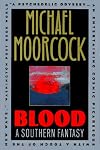
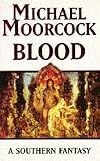
From Michael Moorcock, author of Mother London and Stormbringer, comes this fantasy adventure featuring the jugaderos who live and die by a strict moral code, and risk all on the turn of a card.Tags
Recommendations





















Member Recommendations

paradoxosalpha Post-apocalyptic tales of reality failure
Member Reviews
Blood: A Southern Fantasy was written in the early 1990s when Moorcock had been living for a short while in central Texas, and had recently traveled around the southern US. It is the first volume of the Second Ether trilogy. Despite a tone of straightforward exposition, it involves so much implicit worldbuilding (and multiversebuilding) that it can be confounding. A successful reader will likely just have to roll with it on many occasions. Chapter titles are polyglot, with Spanglish, Creole, and German accounting for many of them.
The initial setting is a North America in which racial privileges and biases are largely reversed from our own. As a result of greedy accident, there has been a corrosive failure of reality, and chance has come show more to dominate over law in the operation of nature. The protagonists of the tale are gambler adepts. Chief of these for the story's part is Jack Karaquasian, who is the Eternal Champion, or at least the Elric and Jerry Cornelius analogue of Blood. Gaming by means some sort of simulative technology never fully detailed, Mr. Karaquasian and his friend Sam Oakenhurst have made careers of this art. The upshot of the thing is a sort of Moorcockian psychedelic cyberpunk.
The Second Ether itself is another world differing in scale and fractally linked with the others in a multiverse roamed by "freescalers" and fought over by the Singularity and the Chaos Engineers. These are recognizable as the "Law and Chaos" teams of Moorcock's earlier fantasies, but they are also expressed in popular media available in Jack's world, recounting an interminable melodramatic space opera in short serial episodes by Warwick Colvin. The sort of porous relationship between these planes of existence reminded me somewhat of Grant Morrison's later comic book The Filth.
Karaquasian and Oakenhurst become connected with love interests who draw them into the Game of Time that transpires in the Second Ether, so that they take on roles in the sprawling conflict of that other world. Despite an overblown cartoonish aesthetic, the Game of Time has a great deal of philosophical meat to it. These later chapters of the book are full of pan-solipsist cosmogony and piquant reflections on fate and freedom, honor and guilt.
Within Moorcock's multiversal hyperwork, the Second Ether seems to have the strongest narrative ties to the von Bek books. Rose von Bek is Sam Oakenhurst's romantic other. This first volume of a trilogy does come to as much of a conclusion as one might reasonably expect. I enjoyed it and I will proceed with the next volume Fabulous Harbours, which I have in hand. show less
The initial setting is a North America in which racial privileges and biases are largely reversed from our own. As a result of greedy accident, there has been a corrosive failure of reality, and chance has come show more to dominate over law in the operation of nature. The protagonists of the tale are gambler adepts. Chief of these for the story's part is Jack Karaquasian, who is the Eternal Champion, or at least the Elric and Jerry Cornelius analogue of Blood. Gaming by means some sort of simulative technology never fully detailed, Mr. Karaquasian and his friend Sam Oakenhurst have made careers of this art. The upshot of the thing is a sort of Moorcockian psychedelic cyberpunk.
The Second Ether itself is another world differing in scale and fractally linked with the others in a multiverse roamed by "freescalers" and fought over by the Singularity and the Chaos Engineers. These are recognizable as the "Law and Chaos" teams of Moorcock's earlier fantasies, but they are also expressed in popular media available in Jack's world, recounting an interminable melodramatic space opera in short serial episodes by Warwick Colvin. The sort of porous relationship between these planes of existence reminded me somewhat of Grant Morrison's later comic book The Filth.
Karaquasian and Oakenhurst become connected with love interests who draw them into the Game of Time that transpires in the Second Ether, so that they take on roles in the sprawling conflict of that other world. Despite an overblown cartoonish aesthetic, the Game of Time has a great deal of philosophical meat to it. These later chapters of the book are full of pan-solipsist cosmogony and piquant reflections on fate and freedom, honor and guilt.
Within Moorcock's multiversal hyperwork, the Second Ether seems to have the strongest narrative ties to the von Bek books. Rose von Bek is Sam Oakenhurst's romantic other. This first volume of a trilogy does come to as much of a conclusion as one might reasonably expect. I enjoyed it and I will proceed with the next volume Fabulous Harbours, which I have in hand. show less
My reaction to reading this novel in 1996. Spoilers follow.
This was probably the strangest, most obscure novel I’ve read of Moorcock’s though, in skimming over his The Warhound and the World’s Pain, I realized they both share Moorcock’s typical preoccupation with the contest between Chaos and Law (not be confused with Good and Evil, neither can be allowed to win, life can only exist through their struggle) and all its many symbolic connotations (justice and tyranny, life and evolution versus entropy). Usually, in the novels set in Moorcock’s multiverse (virtually all of them as far as I can tell), there is a struggle about maintaining the balance between Law and Chaos or, as in his Stormbringer, a loss of that struggle.
This show more novel’s plot is more ambitious in that the Rose and Captain Billy-Bob Begg (the von Bek and Begg families seem to be nearly ubiquitous in Moorcock novels and show up here as does a Renark – a protagonist in Moorcock’s The Sundered Worlds) seek to fashion – and seem to be at least temporarily successful – a new order in the multiverse, an order less inimical to human life and needs. In the introduction to his omnibus The Eternal Champion, Moorcock remarked on how the new science of chaos, and particularly Mandlebrot sets and fractals, fits in with his multiverse idea, and he borrows terminology and metaphors from chaos theory to provide a different, sometimes clearer, sometimes more puzzling – description of his multiverse than I’ve encountered in some of his other works. Thus his Chaos Engineers and Singularity talk of scaling up and down the multiverse to imply that the alternate universes exist on different physical scales and one can be contained, at another level of observation, in another. (Thus there is the hint that the games of historical, social, and political simulation – sort of a cross between role-playing games and Sim games – that the jugador gamblers play may, at some level, involve the manipulation of real people and not just “semi-sentient” characters. In turn, the jugadors may be pieces played in a game taking place on a larger scale.)
The idea of self-similarity is evoked to rationalize how (in a tradition older than Pilgrim’s Progress – one of Moorcock’s favorite books) the moral is symbolized by the physical (the Fault and the increasing civil violence in the book’s alternate south both symbolize a growing chaos) and how characters can echo each other and archetypal figures (their lives often echo archetypal plots).
The book is interesting on several levels. I found Moorcock’s fantasies some of the few I can take. Not Tolkein copies or tales of youngsters discovering secret powers to help save their people, his fantasies are unique though almost always involving the struggle between Law and Chaos – a more complex struggle than mere Good and Evil. His works have a lot of startling images and his Law-Chaos struggle is increasingly used for political commentary but lends itself to many variations and interpretations. I liked the humor of the pulpy metaphysics of the Chaos Engineers and their fight against the Singularity. At first, it seems Moorcock is partially parodying pulp sf – and he probably is – but their described adventures turn out to be mostly true. There is a lot of linguistic playfulness throughout. What I find most interesting are the literary ‘sins” Moorcock gets away within producing a strange, compelling read. First, the story mainly takes place in a black dominated North America with “whitey” slaves and freeman, a world in which Europe seems to be a barbaric backwater and Moslem Egypt a dominant power. However, many of the place names in America remain the same despite the much different history. Some product names like Oldsmobile improbably remain. On a realistic level, this is very improbable, but on a literary level it successfully gives a surrealistic tone to the book by distorting the familiar and juxtaposing it oddly. show less
This was probably the strangest, most obscure novel I’ve read of Moorcock’s though, in skimming over his The Warhound and the World’s Pain, I realized they both share Moorcock’s typical preoccupation with the contest between Chaos and Law (not be confused with Good and Evil, neither can be allowed to win, life can only exist through their struggle) and all its many symbolic connotations (justice and tyranny, life and evolution versus entropy). Usually, in the novels set in Moorcock’s multiverse (virtually all of them as far as I can tell), there is a struggle about maintaining the balance between Law and Chaos or, as in his Stormbringer, a loss of that struggle.
This show more novel’s plot is more ambitious in that the Rose and Captain Billy-Bob Begg (the von Bek and Begg families seem to be nearly ubiquitous in Moorcock novels and show up here as does a Renark – a protagonist in Moorcock’s The Sundered Worlds) seek to fashion – and seem to be at least temporarily successful – a new order in the multiverse, an order less inimical to human life and needs. In the introduction to his omnibus The Eternal Champion, Moorcock remarked on how the new science of chaos, and particularly Mandlebrot sets and fractals, fits in with his multiverse idea, and he borrows terminology and metaphors from chaos theory to provide a different, sometimes clearer, sometimes more puzzling – description of his multiverse than I’ve encountered in some of his other works. Thus his Chaos Engineers and Singularity talk of scaling up and down the multiverse to imply that the alternate universes exist on different physical scales and one can be contained, at another level of observation, in another. (Thus there is the hint that the games of historical, social, and political simulation – sort of a cross between role-playing games and Sim games – that the jugador gamblers play may, at some level, involve the manipulation of real people and not just “semi-sentient” characters. In turn, the jugadors may be pieces played in a game taking place on a larger scale.)
The idea of self-similarity is evoked to rationalize how (in a tradition older than Pilgrim’s Progress – one of Moorcock’s favorite books) the moral is symbolized by the physical (the Fault and the increasing civil violence in the book’s alternate south both symbolize a growing chaos) and how characters can echo each other and archetypal figures (their lives often echo archetypal plots).
The book is interesting on several levels. I found Moorcock’s fantasies some of the few I can take. Not Tolkein copies or tales of youngsters discovering secret powers to help save their people, his fantasies are unique though almost always involving the struggle between Law and Chaos – a more complex struggle than mere Good and Evil. His works have a lot of startling images and his Law-Chaos struggle is increasingly used for political commentary but lends itself to many variations and interpretations. I liked the humor of the pulpy metaphysics of the Chaos Engineers and their fight against the Singularity. At first, it seems Moorcock is partially parodying pulp sf – and he probably is – but their described adventures turn out to be mostly true. There is a lot of linguistic playfulness throughout. What I find most interesting are the literary ‘sins” Moorcock gets away within producing a strange, compelling read. First, the story mainly takes place in a black dominated North America with “whitey” slaves and freeman, a world in which Europe seems to be a barbaric backwater and Moslem Egypt a dominant power. However, many of the place names in America remain the same despite the much different history. Some product names like Oldsmobile improbably remain. On a realistic level, this is very improbable, but on a literary level it successfully gives a surrealistic tone to the book by distorting the familiar and juxtaposing it oddly. show less
A tale of the multiverse. A timeframe somewhat corresponding to our own. Jack Karaquazian is a gambler of phenomenal ability. Colinda Dovero is his equal, his love, his desperation and his shame. Sam Oakenhurst has found his loves - Pearl Peru and the Rose - but can't escape his dark longings. The Rose introduces Jack and Sam to the Great Game - the Game of Time - a game pitting the side of Order against the side of Chaos. Anarchy versus Law. The Singulary against the Chaos Engineers. With the Singularity threatening to win, the fate of the multiverse appears set - the final triumph of law - complete sterility. Jack and Sam enter the game on the side of Chaos. Can they turn the tide of the game, thus saving the multiverse? Tune in the show more for the next chapter of The Corsairs of the Second Ether!
This book never really grabbed me. I found Karaquazian to be both too mundane and too much like a Thomas Covenant. Whining about his weaknesses - doing nothing to better himself, or forgive himself, or move on in search of Colinda. I never truly understood the nature of the games, either. There were many games named - but few described. And while Jack's uncanny luck was touted throughout the novel, I never understood how the luck mattered or whether his luck made him a good player - or even what made Jack special. I had far more respect and admiration for Sam - even though he appeared to give up at the end.
I found the book somewhat confusing with the interjections of the Second Ether chronicles. There were writing techniques that I found difficult to keep up with and the whole main type scenario was never explained in a way that I could grasp the concept and the consequences.
All in all, not a big fan. show less
This book never really grabbed me. I found Karaquazian to be both too mundane and too much like a Thomas Covenant. Whining about his weaknesses - doing nothing to better himself, or forgive himself, or move on in search of Colinda. I never truly understood the nature of the games, either. There were many games named - but few described. And while Jack's uncanny luck was touted throughout the novel, I never understood how the luck mattered or whether his luck made him a good player - or even what made Jack special. I had far more respect and admiration for Sam - even though he appeared to give up at the end.
I found the book somewhat confusing with the interjections of the Second Ether chronicles. There were writing techniques that I found difficult to keep up with and the whole main type scenario was never explained in a way that I could grasp the concept and the consequences.
All in all, not a big fan. show less
Het eerste deel van een trilogie waar ik pas achter kwam nadat ik de laatste bladzijde had omgeslagen. Teleurstellend want ik hoopte zo dat ik een los verhaal te pakken had.
Nu kwamen de verschillende personages uit het boek me al heel erg bekend voor. En na nog even verder graven in mijn geheugen kwam ik er achter dat ik ooit het derde deel gelezen had (ook niet wetende dat het een deel van een trilogie was).
Ik zou er erg voor willen pleiten dat als boeken niet op zichzelf staan, dit op de kaft met duidelijke letters wordt aangegeven. Dat zou bij mij een hoop teleurstelling schelen.
De tweede teleurstelling was dat ik niet goed in dit verhaal kwam. En dat terwijl Michael Moorcock een van mijn lievelingsschrijvers is.
De hoofdpersonen zijn show more professionele kansspelers. Het spel is telkens een andere en wordt naast dat het een naam gegeven wordt amper toegelicht. Behalve de Game of Time. Dit blijkt een spel te zijn gemaakt door de Chaos Ingenieurs en de Singulariteit die de realiteit beïnvloedt. Er is een voortdurende bedreiging van verlies van geliefden, de huidige realiteit en het eigen bestaan. Door de aard van de tijd te veranderen, hopen de spelers te winnen.
Dit alles zou heel boeiend kunnen zijn maar door het ongemerkt wisselen van de realiteit en de onduidelijke motieven van bepaalde hoofdrolspelers had ik als lezer te weinig houvast om te volgen waar het over ging. Niet dat ik een liefhebber ben van verhalen die in de puntjes worden uitgelegd maar dit was iets te weinig voor mij.
Wel de moeite waard vind ik de namen van de hoofdpersonages (Jack Karaquazian, Sam Oakenhurst, Rose von Bek), van de spellen (Desdemona's Luck, Dead King's Chair), van de schepen (Now The Clouds Have Meaning, The Statement of Truth) en de pulppersonages die eerst als verhaalfiguren worden geïntroduceerd en steeds meer een rol gaan spelen in de realiteit van Jack, Sam en Rose (Fearless Frank Force, Karl Kapital, Kaprikorn Schultz, Pearl Peru).
Deze namen roepen iedereen al een verhaal in zichzelf op.
Confronterend was de omdraaiing van de huidskleur die de macht bepaald. De witten worden met grote minachting behandeld en door sommigen zelfs met afschuw bekeken. Als zelf een van die witten zijnde vond ik dit zeer bedreigend. Knap gedaan.
Alles bij elkaar genomen prikkelt het boek mij niet genoeg om het tweede deel te willen lezen. show less
Nu kwamen de verschillende personages uit het boek me al heel erg bekend voor. En na nog even verder graven in mijn geheugen kwam ik er achter dat ik ooit het derde deel gelezen had (ook niet wetende dat het een deel van een trilogie was).
Ik zou er erg voor willen pleiten dat als boeken niet op zichzelf staan, dit op de kaft met duidelijke letters wordt aangegeven. Dat zou bij mij een hoop teleurstelling schelen.
De tweede teleurstelling was dat ik niet goed in dit verhaal kwam. En dat terwijl Michael Moorcock een van mijn lievelingsschrijvers is.
De hoofdpersonen zijn show more professionele kansspelers. Het spel is telkens een andere en wordt naast dat het een naam gegeven wordt amper toegelicht. Behalve de Game of Time. Dit blijkt een spel te zijn gemaakt door de Chaos Ingenieurs en de Singulariteit die de realiteit beïnvloedt. Er is een voortdurende bedreiging van verlies van geliefden, de huidige realiteit en het eigen bestaan. Door de aard van de tijd te veranderen, hopen de spelers te winnen.
Dit alles zou heel boeiend kunnen zijn maar door het ongemerkt wisselen van de realiteit en de onduidelijke motieven van bepaalde hoofdrolspelers had ik als lezer te weinig houvast om te volgen waar het over ging. Niet dat ik een liefhebber ben van verhalen die in de puntjes worden uitgelegd maar dit was iets te weinig voor mij.
Wel de moeite waard vind ik de namen van de hoofdpersonages (Jack Karaquazian, Sam Oakenhurst, Rose von Bek), van de spellen (Desdemona's Luck, Dead King's Chair), van de schepen (Now The Clouds Have Meaning, The Statement of Truth) en de pulppersonages die eerst als verhaalfiguren worden geïntroduceerd en steeds meer een rol gaan spelen in de realiteit van Jack, Sam en Rose (Fearless Frank Force, Karl Kapital, Kaprikorn Schultz, Pearl Peru).
Deze namen roepen iedereen al een verhaal in zichzelf op.
Confronterend was de omdraaiing van de huidskleur die de macht bepaald. De witten worden met grote minachting behandeld en door sommigen zelfs met afschuw bekeken. Als zelf een van die witten zijnde vond ik dit zeer bedreigend. Knap gedaan.
Alles bij elkaar genomen prikkelt het boek mij niet genoeg om het tweede deel te willen lezen. show less
Jun 23, 2014Dutch
Ratings
Members
- Recently Added By
Lists

Broderick and Di Filippo's Science Fiction: The 101 Best Novels 1985-2010
103 works; 7 members
Author Information

657+ Works 64,848 Members
Michael Moorcock, 1939 - Writer Michael Moorcock was born December 18, 1939 in Mitcham, Surrey, England. Moorcock was the editor of the juvenile magazine Tarzan Adventures from 1956-58, an editor and writer for the Sexton Blake Library and for comic strips and children's annuals from 1959-61, an editor and pamphleteer for Liberal Party in 1962, show more and became editor and publisher for the science fiction magazine New Worlds in 1964. He has worked as a singer-guitarist, has worked with the rock bands Hawkwind and Blue Oyster Cult and is a member of the rock band Michael Moorcock and the Deep Fix. Moorcock's writing covers a wide range of science fiction and fantasy genres. "The Chronicles of Castle Brass" was a sword and sorcery novel, and "Breakfast in the Ruins: A Novel of Inhumanity" uses the character Karl Glogauer as a different person in different times. Karl participates in the political violence of the French Revolution, the Paris Commune, and a Nazi concentration camp. Moorcock also wrote books and stories that featured the character Jerry Cornelius, who had no consistent character or appearance. "The Condition of Muzak" completed the initial Jerry Cornelius tetralogy and won Guardian Literary Prize in 1977. "Byzantium Endures" and "The Laughter of Carthage" are two autobiographical novels of the Russian emigre Colonel Pyat and were the closest Moorcock came to conventional literary fiction. "Byzantium Endures" focuses on the first twenty years of Pyat's life and tells of his role in the Russian revolution. Pyat survives the revolution and the subsequent civil war by working first for one side and then another. "The Laughter of Carthage" covers Pyat's life from 1920-1924 telling of his escape from Communist Russia and his travels in Europe and America. It's a sweeping picture of the world during the 1920's because it takes the character from living in Constantinople to Hollywood. Moorcock returned to the New Wave style in "Blood: A Southern Fantasy" (1994) and combined mainstream fiction with fantasy in "The Brothel of Rosenstrasse," which is set in the imaginary city of Mirenburg. MoorCock won the 1967 Nebula Award for Behold the Man and the 1979 World Fantasy Award for his novel, Gloriana. (Bowker Author Biography) show less
Some Editions
Awards and Honors
Awards
Series


Work Relationships
Is contained in
Common Knowledge
- Canonical title
- Blood
- Original publication date
- 1995
Classifications
Statistics
- Members
- 300
- Popularity
- 106,752
- Reviews
- 4
- Rating
- (3.35)
- Languages
- English
- Media
- Paper, Ebook
- ISBNs
- 8
- ASINs
- 1