
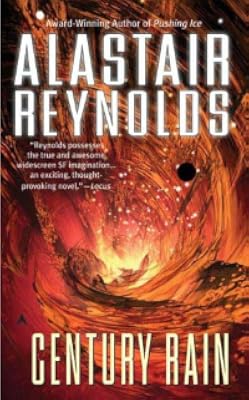
Century Rain
by Alastair Reynolds
On This Page
Description
Three hundred years from now, Earth has been rendered uninhabitable due to the technological catastrophe known as the Nanocaust.Archaeologist Verity Auger specializes in the exploration of its surviving landscape. Now, her expertise is required for a far greater purpose.Something astonishing has been discovered at the far end of a wormhole: mid-twentieth-century Earth, preserved like a fly in amber. Somewhere on this alternate planet is a device capable of destroying both worlds at either show more end of the wormhole. And Verity must find the device, and the man who plans to activate it, before it's too late-for the past and the future of two worlds. show lessTags
Recommendations
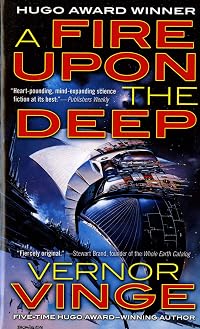

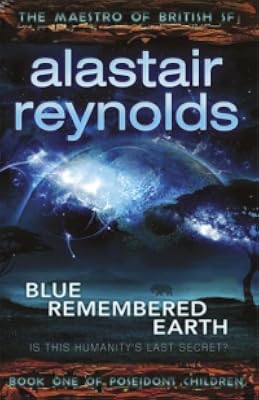
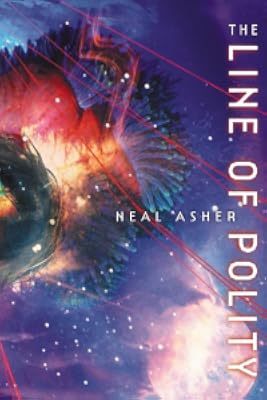
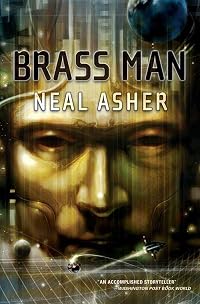


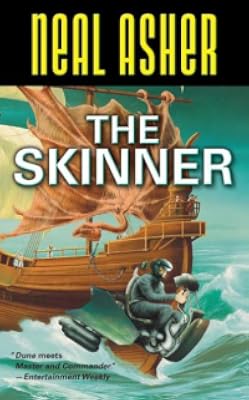
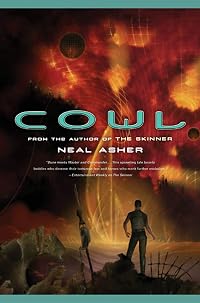
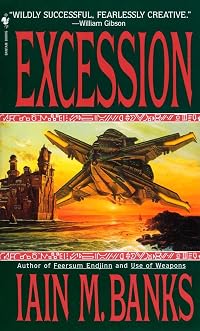
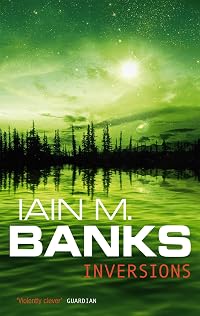

Member Recommendations
by anonymous user
by anonymous user
Member Reviews
I read Alastair Reynolds' [b:Revelation Space|89187|Revelation Space (Revelation Space, #1)|Alastair Reynolds|https://i.gr-assets.com/images/S/compressed.photo.goodreads.com/books/1405532042l/89187._SY75_.jpg|219037] series years ago, but somehow did not come across 'Century Rain' until recently. A friend recommended it on the basis of the intriguing historical counterfactual presented within the wider space opera: World War II never got going, as the Nazi invasion of France through the Ardennes was routed. There was no Holocaust, no Eastern Front, and Japan and America didn't get involved. Europe therefore lacks the scars of war, but instead retains a strong vein of authoritarianism and antisemitism. A main character even complains show more that France might be run better if the German invasion has succeeded! Technology is not as advanced, with no space race or computing. It's a very neatly drawn world and combined surprisingly well with a space opera set hundreds of years in the future. As I also recall from [b:Chasm City|89185|Chasm City|Alastair Reynolds|https://i.gr-assets.com/images/S/compressed.photo.goodreads.com/books/1309203334l/89185._SY75_.jpg|2926628], Reynolds enjoys throwing in lots of noir tropes, some of which are affectionately parodied. He switches between foot chases on the mean streets of 1950s Alternate Paris to space battles between nanotech-enhanced posthumans impressively smoothly. I found the plot compelling and the antagonists (who include creepy children) suitably unsettling. The characterisation is perhaps less adept, especially when it comes to romance. I didn't think it was necessary for Auger and Floyd to fall in love, but at least this doesn't get in the way of the plot. The friendships were fun, though, and there was some delightful noir-inflected dialogue.
Although I also liked the world-building of a Solar System scarred by conflict over nanotech, the alternate history was the strongest part of the book. I was left wanting to see more of it. Without the Cold War, what was going on with the USSR? How did the absence of WWII play out beyond Europe? There are some spectacular action scenes, notably those involving the Eiffel Tower, and the dramatic tension is well sustained over more than 500 pages. Overall, an excellent lockdown read with plenty of excitement and escapism. The only thing that slightly detracted was the difficulty of taking the Slashers seriously because they're called the Slashers. show less
Although I also liked the world-building of a Solar System scarred by conflict over nanotech, the alternate history was the strongest part of the book. I was left wanting to see more of it. Without the Cold War, what was going on with the USSR? How did the absence of WWII play out beyond Europe? There are some spectacular action scenes, notably those involving the Eiffel Tower, and the dramatic tension is well sustained over more than 500 pages. Overall, an excellent lockdown read with plenty of excitement and escapism. The only thing that slightly detracted was the difficulty of taking the Slashers seriously because they're called the Slashers. show less
WOW! What a cracking - but crazy - read. I'm still reeling from it. It doesn't get muddled or daft and yet it has everything... really... everything: time travel, spies, archaeology, cyborgs, a love triangle, wars, wormholes, virtual reality, a quest, death and sacrifice, murder mystery (with all the usual clichés lovingly included), nanotech, code-breaking, genocide, bodysnatching/ swapping, bootleg music, ecological disaster, white-knuckle chases, wraith-like horror characters, alternative history, secret passages, ethics of immortality, terraforming, some steampunk, a nod to Casablanca and an even bigger nod to The Truman Show , and the weirdest biological weapon I've ever heard of! It even has some strong and significant female show more characters, which is not exactly the norm in sci-fi.
SETTING & PLOT
It is primarily a detective drama in a noirish sci-fi setting. Whereas all the other Reynolds' I've read have three threads of story, this has only two: Paris in 1959 and Paris in 2266. The difference between the two versions of the city were enhanced because I read this before and after Mieville's "The City & The City" (http://www.goodreads.com/review/show/396185571), which is also a noirish detective thriller, featuring archaeologists and set in two versions of a city, albeit a very different sort of separation.
Floyd is an impoverished private eye in 1959, whose excitement at the prospect of a case echoes my own feelings about the book: he "felt a weird sense of vertigo: a combination of fear and thrill that he knew he would not be able to resist. It would pull him deeper and it would do what it would with him." Similarly, there's a character who doesn't want to be a detective, but gets sucked in - just like the reader.
One thread starts off as a slightly odd murder investigation; the other is a slightly odd quest to retrieve historical artifacts (though the most important artefacts turn out to be a rather bigger concept). As with any good thriller, what seem like trivial asides often turn out to be important later.
WRITING STYLE
As usual, Reynolds' story is told in a very visual way: at times it is almost like watching a film: the chases, the wraiths, and especially a nail-biting scene where someone is looking for a vital bit of paper that is not quite hidden (will they find it or not?).
There are a couple of places where the exposition of backstory and science is explained in a slightly heavy-handed way (and a couple of the baddies are not much of a surprise), but those are trivial issues when there is so much good stuff crammed in barely 500 pages.
THEMES
When you climb off the walls from the relentless excitement, this raises many profound issues:
* How do we know what is "real" and what is simulated - and does it matter? Who decides?Do simulants have the same rights and feelings as "real" people? How would you cope if you thought you yourself weren't real?
* If you could be immortal, or virtually so, would you want to be, and to what lengths would you go?
* If you could have the (appearance of) whatever you wanted, whenever you wanted, would you tire of it? What if you could even conjure things we can't imagine: "colours were unfamiliar (and heart-wrenchingly beautiful) , but she could hear them, fell them, smell them"?
Four more
* Every archaeologist's dream must be to travel back in time to see and experience things first hand. But the risks - ethical, practical, psychological - are high. "As much as she longed for all the time in the world to explore it, she did not want to become its prisoner."
* What are the ethics and etiquette of taking over someone else's body?! Once there, would you evict a friendly usurper if it meant they would die? What if they wanted to do something altruistic, but which imperilled you body: "My body was mine to throw away... [but] you just don't do that with someone else's."
* If the Nazis had failed to invade France so that Enigma codes were not cracked, how much later would the computer revolution have happened, and with what consequences?
* What are the dangers of digital (over physical) storage? Or maybe the past has nothing to teach us, so we can we live in the present and not worry about the past?
MISCELLANEOUS QUOTES
* "New patterns would begin to emerge from the doughy grey of unstructured cloud... But right now the clouds were bickering. The patterns formed and decayed at an accelerated rate, with lightning of a kind of emphatic punctuation to the dialogue. The clouds fissioned and merged, as if negotiating age-old treaties and alliances."
* "Charm was what he excelled at. If anyone sensed his underlying shallowness, they usually mistook it for well-hidden great depth of character, like misinterpreting a radar bounce."
* On the dangers of studying maths too deeply (Reynolds was a physicist before turning to writing): "she had studied mathematics so furiously that after an evening manipulating complex bracketed equations, simplifying forms and extracting common terms, her brain had actually started to apply the same rules to spoken language, as if a sentence could be bracketed and simplified like some quadratic formula for radioisotope decay."
* "like an electric shock without the pain... a sharp inquisitional light... it lasted an eternity and an instant."
* "The trains waited with snorting impatience, pushing quills of white steam up towards the roof... Its red tail light spilled blood on to the polished surfaces of the rails."
No technology is omnipotent even if, to quote Arthur C Clarke, it is sufficiently advanced to be indistinguishable from magic: "In the presence of a wizard, she wanted miracles, not excuses." With this book, I felt the story was being told by a wizard with words; no excuses were necessary. WOW! show less
SETTING & PLOT
It is primarily a detective drama in a noirish sci-fi setting. Whereas all the other Reynolds' I've read have three threads of story, this has only two: Paris in 1959 and Paris in 2266. The difference between the two versions of the city were enhanced because I read this before and after Mieville's "The City & The City" (http://www.goodreads.com/review/show/396185571), which is also a noirish detective thriller, featuring archaeologists and set in two versions of a city, albeit a very different sort of separation.
Floyd is an impoverished private eye in 1959, whose excitement at the prospect of a case echoes my own feelings about the book: he "felt a weird sense of vertigo: a combination of fear and thrill that he knew he would not be able to resist. It would pull him deeper and it would do what it would with him." Similarly, there's a character who doesn't want to be a detective, but gets sucked in - just like the reader.
One thread starts off as a slightly odd murder investigation; the other is a slightly odd quest to retrieve historical artifacts (though the most important artefacts turn out to be a rather bigger concept). As with any good thriller, what seem like trivial asides often turn out to be important later.
WRITING STYLE
As usual, Reynolds' story is told in a very visual way: at times it is almost like watching a film: the chases, the wraiths, and especially a nail-biting scene where someone is looking for a vital bit of paper that is not quite hidden (will they find it or not?).
There are a couple of places where the exposition of backstory and science is explained in a slightly heavy-handed way (and a couple of the baddies are not much of a surprise), but those are trivial issues when there is so much good stuff crammed in barely 500 pages.
THEMES
When you climb off the walls from the relentless excitement, this raises many profound issues:
* How do we know what is "real" and what is simulated - and does it matter? Who decides?
* If you could be immortal, or virtually so, would you want to be, and to what lengths would you go?
* If you could have the (appearance of) whatever you wanted, whenever you wanted, would you tire of it? What if you could even conjure things we can't imagine: "colours were unfamiliar (and heart-wrenchingly beautiful) , but she could hear them, fell them, smell them"?
Four more
* Every archaeologist's dream must be to travel back in time to see and experience things first hand. But the risks - ethical, practical, psychological - are high. "As much as she longed for all the time in the world to explore it, she did not want to become its prisoner."
* What are the ethics and etiquette of taking over someone else's body?! Once there, would you evict a friendly usurper if it meant they would die? What if they wanted to do something altruistic, but which imperilled you body: "My body was mine to throw away... [but] you just don't do that with someone else's."
* If the Nazis had failed to invade France so that Enigma codes were not cracked, how much later would the computer revolution have happened, and with what consequences?
* What are the dangers of digital (over physical) storage? Or maybe the past has nothing to teach us, so we can we live in the present and not worry about the past?
MISCELLANEOUS QUOTES
* "New patterns would begin to emerge from the doughy grey of unstructured cloud... But right now the clouds were bickering. The patterns formed and decayed at an accelerated rate, with lightning of a kind of emphatic punctuation to the dialogue. The clouds fissioned and merged, as if negotiating age-old treaties and alliances."
* "Charm was what he excelled at. If anyone sensed his underlying shallowness, they usually mistook it for well-hidden great depth of character, like misinterpreting a radar bounce."
* On the dangers of studying maths too deeply (Reynolds was a physicist before turning to writing): "she had studied mathematics so furiously that after an evening manipulating complex bracketed equations, simplifying forms and extracting common terms, her brain had actually started to apply the same rules to spoken language, as if a sentence could be bracketed and simplified like some quadratic formula for radioisotope decay."
* "like an electric shock without the pain... a sharp inquisitional light... it lasted an eternity and an instant."
* "The trains waited with snorting impatience, pushing quills of white steam up towards the roof... Its red tail light spilled blood on to the polished surfaces of the rails."
No technology is omnipotent even if, to quote Arthur C Clarke, it is sufficiently advanced to be indistinguishable from magic: "In the presence of a wizard, she wanted miracles, not excuses." With this book, I felt the story was being told by a wizard with words; no excuses were necessary. WOW! show less
This might become one of my favorite Alastair Reynolds novels. Why? Because he manages to turn one hell of a tale out of a kitchen sink worth of ideas. Great characters, from an ex-jazz musician/gumshoe from an alternate-timeline 1959, to a complex archeologist 300 years in the future sifting through the remains of a nanotech-eaten Earth, to wormholes, body-snatching, one hellofacool mystery, with murder, Casablanca vibes, and a nail-biting space battle that reminded me of Iain M. Banks and Neal Asher in a huge way. Or, if I'm being literal to a fault, it reminded me of Alastair Reynolds at his best. :)
There's so much I could say about this book, but let me boil it down to the basics.
This particular Earth is caught in amber. Caught in a show more pre-nuclear, pre-computer state. And it is being kept that way. Was kept that way for 300 years until the future factions (heavy nanotech or purist humans) unlocked frozen Earth. Roll with this, Reynolds explains it all a lot better than me. :)
Enter in the conflicting factions to this lesser-tech Earth and follow the Noir gumshoe across Paris, murders, awesome alternate Earth worldbuilding, and fantastic characterizations.
Any one of these elements are noteworthy and a cool read, but Reynolds went all-out ambitious and tied EVERYTHING together in a huge way and I loved it. :) Really perfect for mystery lovers AND hardcore missile/laser beam fanatics. Oh, and horror fans, too. Creepy undead children. :) And didn't I mention body-hopping?
lol, I had too much fun with this. show less
There's so much I could say about this book, but let me boil it down to the basics.
This particular Earth is caught in amber. Caught in a show more pre-nuclear, pre-computer state. And it is being kept that way. Was kept that way for 300 years until the future factions (heavy nanotech or purist humans) unlocked frozen Earth. Roll with this, Reynolds explains it all a lot better than me. :)
Enter in the conflicting factions to this lesser-tech Earth and follow the Noir gumshoe across Paris, murders, awesome alternate Earth worldbuilding, and fantastic characterizations.
Any one of these elements are noteworthy and a cool read, but Reynolds went all-out ambitious and tied EVERYTHING together in a huge way and I loved it. :) Really perfect for mystery lovers AND hardcore missile/laser beam fanatics. Oh, and horror fans, too. Creepy undead children. :) And didn't I mention body-hopping?
lol, I had too much fun with this. show less
I found this book to be a compulsive page-turner; something I wasn't expecting. Given that Reynolds is noted for his strict real-world physics approach (even if he does probe the boundaries of the possible from time to time), I wasn't entirely expecting an alternate history novel from him. But Reynolds has found a way to deliver such a thing in a manner totally consistent with "real" physics.
The story concerns archaeologists excavating a post-disaster Earth that has been ravaged by uncontrolled nanotechnology, and a noir thriller plot set in a 1950s Paris - but not the Paris we are familiar with. The two are linked via wormhole technology - again, well described with a proper feel for the technicalities that a practical application of show more such technology would involve.
The Parisian scenes are well written and vivid; Reynolds acknowledges a debt to Georges Simenon; film fans should think of Dassin's 'Rififi' to get the feel of the piece. About two-thirds of the way through, the Paris character experiences conceptual breakthrough and comes into the future world, and I was concerned about the gear change the novel goes through into space opera. I needn't have worried; the action was seamlessly added in, and was itself both exciting and strange. (Even the fact that one character appeared to spring out of nowhere didn't cause too many problems, as that character never actually appeared on-stage, which in retrospect seems strange but at the time worked surprisingly well. Reynolds has done this trick before; it's akin to the real world, where our lives and what we do can be affected by politicians who we know a lot about, and whose decisions impact our lives directlty, but who we hardly never meet, do not interact with, and know nothing about on a personal level.)
In all, a book with an intriguing premise, a puzzle that gets deeper even as we find out more, and some characters who we engage with closely. show less
The story concerns archaeologists excavating a post-disaster Earth that has been ravaged by uncontrolled nanotechnology, and a noir thriller plot set in a 1950s Paris - but not the Paris we are familiar with. The two are linked via wormhole technology - again, well described with a proper feel for the technicalities that a practical application of show more such technology would involve.
The Parisian scenes are well written and vivid; Reynolds acknowledges a debt to Georges Simenon; film fans should think of Dassin's 'Rififi' to get the feel of the piece. About two-thirds of the way through, the Paris character experiences conceptual breakthrough and comes into the future world, and I was concerned about the gear change the novel goes through into space opera. I needn't have worried; the action was seamlessly added in, and was itself both exciting and strange. (Even the fact that one character appeared to spring out of nowhere didn't cause too many problems, as that character never actually appeared on-stage, which in retrospect seems strange but at the time worked surprisingly well. Reynolds has done this trick before; it's akin to the real world, where our lives and what we do can be affected by politicians who we know a lot about, and whose decisions impact our lives directlty, but who we hardly never meet, do not interact with, and know nothing about on a personal level.)
In all, a book with an intriguing premise, a puzzle that gets deeper even as we find out more, and some characters who we engage with closely. show less
★★★-3/4 rounded up to 4 stars.
Almost a solid 4-star read for me. The concept and world-building are just so damn cool. If it weren't for a few eye-rolling moments having to do with character motivation... For instance, the lovey-dovey stuff after the sphere falls on Floyd in the German factory scene just seemed suddenly grafted on. Not to mention that he is described as BLEEDING COPIOUSLY FROM HIS HEAD! Instead of getting all kissy-face with him, perhaps Auger should have done something else? Like, maybe try to STAUNCH THE BLEEDING?!? I'm not sure what Reynolds was thinking there. I don't have a problem with them falling in love, that seemed a likely eventuality from long before they actually met. It was the circumstance where show more they first expressed their affections that rang a dissonant note. Ah well... thankfully, most of the book is filled with better-written scenery and is therefore pretty darn brilliant.
Conceptually, the stuff Reynolds has dreamed up is rather mind-boggling:
- Archaeological digging in the midst of nanobot 'Furies'? Check!
- A noir detective murder whodunit mystery? Check!
- Wormholes leading to ALS's (Anomalous Large Structures) - a galactic subway system! - all left behind by technologically advanced but unknown creators? Check!
- Political intrigues between factions of humans still alive after the nanocaust? Check! (hrmm... who to trust? who to trust?)
- Off-Earth habitats in the year 2266 interacting with Earth in 1959? Check! (nope, not by time-traveling - this whole part is just beautifully imagined.)
- War-babies? Check! (oh man, were they ever a nice creepy touch!)
- A super-duper secret planet-killing weapon mystery that needs to be solved before the world goes nano-boom? Check!
- A Hollywoodishcarspaceship-chase in wormhole space? Check!
All in all, I really liked this book. It was a great first Reynolds for me. I just wish some of the romantic aspects had been handled with a skosh more elegance. show less
Almost a solid 4-star read for me. The concept and world-building are just so damn cool. If it weren't for a few eye-rolling moments having to do with character motivation... For instance, the lovey-dovey stuff after the sphere falls on Floyd in the German factory scene just seemed suddenly grafted on. Not to mention that he is described as BLEEDING COPIOUSLY FROM HIS HEAD! Instead of getting all kissy-face with him, perhaps Auger should have done something else? Like, maybe try to STAUNCH THE BLEEDING?!? I'm not sure what Reynolds was thinking there. I don't have a problem with them falling in love, that seemed a likely eventuality from long before they actually met. It was the circumstance where show more they first expressed their affections that rang a dissonant note. Ah well... thankfully, most of the book is filled with better-written scenery and is therefore pretty darn brilliant.
Conceptually, the stuff Reynolds has dreamed up is rather mind-boggling:
- Archaeological digging in the midst of nanobot 'Furies'? Check!
- A noir detective murder whodunit mystery? Check!
- Wormholes leading to ALS's (Anomalous Large Structures) - a galactic subway system! - all left behind by technologically advanced but unknown creators? Check!
- Political intrigues between factions of humans still alive after the nanocaust? Check! (hrmm... who to trust? who to trust?)
- Off-Earth habitats in the year 2266 interacting with Earth in 1959? Check! (nope, not by time-traveling - this whole part is just beautifully imagined.)
- War-babies? Check! (oh man, were they ever a nice creepy touch!)
- A super-duper secret planet-killing weapon mystery that needs to be solved before the world goes nano-boom? Check!
- A Hollywoodish
All in all, I really liked this book. It was a great first Reynolds for me. I just wish some of the romantic aspects had been handled with a skosh more elegance. show less
A neat novel, with two distinct threads for the first bit, one mystery, one straight up sci-fi and a love story thrown in on top for good measure. The complete mix seems to provoke love it or hate it responses in readers - just check out the other reviews. Personally I'm glad I read the book before I read the publisher's own blurb - it worked better with me wondering what the heck was going on rather than being in the know from the beginning.
There's lots of little details, especially in the first third that make you wonder what the authour is thinking, that indirectly get tidied up later.
The love story wanders back and forth between good and lame. The climax is a bit low key. The characters are distinctive except for a few minor stand show more ins.
All in all, I rather liked it - a solid 3-1/2 stars. show less
There's lots of little details, especially in the first third that make you wonder what the authour is thinking, that indirectly get tidied up later.
The love story wanders back and forth between good and lame. The climax is a bit low key. The characters are distinctive except for a few minor stand show more ins.
All in all, I rather liked it - a solid 3-1/2 stars. show less
I read this right after Peter Hamilton's double door-stopper Pandora's Star/Judas Unchained -- a battle of modern space opera mavens, so to speak. For much of this novel, Reynolds was in the lead. If less inventive in his future setting, he was much better focused on the narrative flow and much better at character development. For a while the novel alternates between two planets, as Hamilton's books often do. One planet is an future Earth several centuries after the Nanocaust has made it not only uninhabitable but practically unvisitable. We follow Verity Auger, a modern archaeologist, who ends up a pawn between the political machinations of the Threshers (her side) and the Slashers (the other side). The other planet is Earth in 1950's show more France, where we follow Wendell Floyd, a low-budget gumshoe. It turns out the two Earths are related neither by time nor by parallel universes, but a third option that Reynolds has fun with, even it's more magic than science. It's not too many chapters before these two narratives merge and pretty much stay that way until the end. Unfortunately, things kind of fall apart at about the 3/4 mark. First comes a chapter or so of pure info-dump on the history of the future, specifically Slashers vs Threshers. Then the relationship between Verity and Floyd becomes cliched Hollywood plotting. Worst of all though, the final chapters of the books, just as in Judas Unchained, is nothing more than one long chase, where it all comes down to the final few seconds. And the villain pursued is never seen, just as in Judas Unchained. Let's call it the Sauron factor.
Enjoyable for several hundred page, but I was happy to see it end. show less
Enjoyable for several hundred page, but I was happy to see it end. show less
Members
- Recently Added By
Lists

Paris, City of Lights
103 works; 17 members

Murder Mysteries
57 works; 11 members
Author Information

141+ Works 39,952 Members
Some Editions
Awards and Honors
Awards
Distinctions
Series
Belongs to Publisher Series
Heyne Allgemeine Reihe (52175)
Work Relationships
Is contained in
Common Knowledge
- Canonical title
- Century Rain
- Original title
- Century Rain
- Original publication date
- 2004-11
- People/Characters
- Verity Auger; Wendell Floyd
- Important places
- Paris, France
- Dedication
- For Josette
- First words
- The river flowing sluggishly under Pont de la Concorde was flat and grey, like worn-out linoleum.
- Quotations
- I'm not going to let a little space-time difficulty spoil my day.
-Verity Auger - Last words
- (Click to show. Warning: May contain spoilers.)He crunched it underfoot and lost himself in the fog.
- Original language
- English
Classifications
Statistics
- Members
- 2,072
- Popularity
- 9,956
- Reviews
- 47
- Rating
- (3.74)
- Languages
- English, French, German, Russian
- Media
- Paper, Audiobook, Ebook
- ISBNs
- 24
- ASINs
- 15