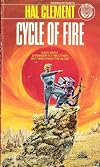
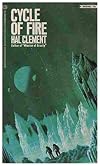
Cycle of Fire
by Hal Clement
On This Page
Tags
Recommendations









Member Reviews
I was not expecting much from this book, written in 1957, other than some light entertainment. Instead I was caught up in the story from page 1. With the cover tagline "Each was a stranger to the other but who was the alien?" and the blurb on the back I thought I had a story that sounded like an early version of Barry Longyear's classic "Enemy Mine". This was more than that similarity however. Quite different. A human teenage boy is stranded on a planet in a somewhat inhospitable area where one of the residents, non-human, has crashed his aircraft on a long trip. The two join forces to survive and make a long perilous journey, and they learn about each other in the process. We the readers also learn a lot about the interesting planet show more Abyorman that has a binary star and an unusual orbit and seasons and culture. It reads sort of like a good Heinlein juvenile such as "Red Planet", only smarter.
There is a big central mystery to the book about the various inhabitants of the planet, their lifecycle and abandoned cities. I think this was drawn out a bit too much and the initial momentum of the story seemed to bog down and to my mind kind of kept this from being a really good book, rather than just a very good one. Still, for a mid-50's book this seems like a much better than average story. The ending had a bit of a twist to it and what was telegraphed was only part of the mystery. show less
There is a big central mystery to the book about the various inhabitants of the planet, their lifecycle and abandoned cities. I think this was drawn out a bit too much and the initial momentum of the story seemed to bog down and to my mind kind of kept this from being a really good book, rather than just a very good one. Still, for a mid-50's book this seems like a much better than average story. The ending had a bit of a twist to it and what was telegraphed was only part of the mystery. show less
Cycle of Fire might be my favorite so far - lots of mystery and suspense, an unexpected friendship. In classic Clement fashion everyone is so reasonable they don't seem quite like the human beings I know, but then, these are space-going humans a good deal in the future and I can hope we might evolve to be better thinkers. This one struggles, at the end, with a moral dilemma too, which is a development, over whether this complex alien 'race' might not constitute a threat to human hegemony in the universe. Lots of interesting stuff.
Favorite quote: "Human beings have a strong tendency to cling to whatever hypothesis they may evolve to explain some new situation." Understatement?
I kept thinking of the Brian Aldiss Helliconia series where show more two very very different humanoids share a planet with similarly shifting hot/cold conditions. show less
Favorite quote: "Human beings have a strong tendency to cling to whatever hypothesis they may evolve to explain some new situation." Understatement?
I kept thinking of the Brian Aldiss Helliconia series where show more two very very different humanoids share a planet with similarly shifting hot/cold conditions. show less
Two suns, one red and one blue, hang in the sky, above a world where a young person seeks to survive. Familiar from Star Wars of course, and an image that's a natural for an adventure story. At the start, a native to the planet, Dar Lang Ahn, crash lands his glider in wilderness, and sets out to complete an urgent mission on foot. He meets Nils Kruger, a 16 year old human castaway from Earth. The two must cooperate to survive, and they gradually become friends.
But this novel is by Hal Clement, so we know those suns are not there just for decoration. The motion of each sun in the sky, as the two walk north, is carefully described, allowing the reader to figure out something about the planet's orbit. Hints about the planet's biology also show more accumulate. The two companions discover a deserted city with buildings that are not designed for Dar's 4+1/2 foot tall bipedal anatomy, nor for the 8 foot tall "Teachers" who raised him. Who lived in the city, and where are they now? When being questioned by the unseen Teachers associated with the city, Nils is asked "when do you die?" He learns that Dar does indeed expect to die at a definite time - and that time will be soon.
Eventually Nils is reunited with the rest of the expedition from Earth, and the human scientists set to work unraveling the planet's astrodynamics, geology, and biology. As usual, Clement leaves many details as an exercise for the reader, and some of the biology is left incomplete with no way for us to figure it out. He does take some of the usual Sci-Fi shortcuts to move the plot along - Nils's ship flies faster than light, and Dar and Nils learn each others' languages way too easily for beings from separate evolutions. As you'd expect from a 1957 story, Clement uses "he" as Dar's pronoun, even though Dar's nonhuman reproductive biology definitely doesn't fit with that usage.
About that biology: the picture assembled by the humans could serve as the engine of a horror novel - one that James Tiptree, Jr. might have written not many years after 1957. The fates of Dar and others of his species are treated with Clement's usual reticence, minimizing the horror aspect - but that aspect is still there. I have long thought that Clement is a much better writer than the hard-SF, essentially YA figure people often view him as, spinning clever science puzzles without much human depth. There's that greatest-generation reserve so many World War II veterans like him had, and his insistence on having the reader do the work of understanding what the book is about.
I've not been able to put these notions into a coherent account. I do want to read all the Clement I haven't already. This edition has been in my possession since 1968, so I had better speed things up. show less
But this novel is by Hal Clement, so we know those suns are not there just for decoration. The motion of each sun in the sky, as the two walk north, is carefully described, allowing the reader to figure out something about the planet's orbit. Hints about the planet's biology also show more accumulate. The two companions discover a deserted city with buildings that are not designed for Dar's 4+1/2 foot tall bipedal anatomy, nor for the 8 foot tall "Teachers" who raised him. Who lived in the city, and where are they now? When being questioned by the unseen Teachers associated with the city, Nils is asked "when do you die?" He learns that Dar does indeed expect to die at a definite time - and that time will be soon.
Eventually Nils is reunited with the rest of the expedition from Earth, and the human scientists set to work unraveling the planet's astrodynamics, geology, and biology. As usual, Clement leaves many details as an exercise for the reader, and some of the biology is left incomplete with no way for us to figure it out. He does take some of the usual Sci-Fi shortcuts to move the plot along - Nils's ship flies faster than light, and Dar and Nils learn each others' languages way too easily for beings from separate evolutions. As you'd expect from a 1957 story, Clement uses "he" as Dar's pronoun, even though Dar's nonhuman reproductive biology definitely doesn't fit with that usage.
About that biology: the picture assembled by the humans could serve as the engine of a horror novel - one that James Tiptree, Jr. might have written not many years after 1957. The fates of Dar and others of his species are treated with Clement's usual reticence, minimizing the horror aspect - but that aspect is still there. I have long thought that Clement is a much better writer than the hard-SF, essentially YA figure people often view him as, spinning clever science puzzles without much human depth. There's that greatest-generation reserve so many World War II veterans like him had, and his insistence on having the reader do the work of understanding what the book is about.
I've not been able to put these notions into a coherent account. I do want to read all the Clement I haven't already. This edition has been in my possession since 1968, so I had better speed things up. show less
Pretty much exactly what you expect from a Hal Clement novel...Fascinating world populated by fascinating aliens. Check...Not particularly compelling characterization and not particularly compelling storytelling. Check.
In the end, the protagonist of this one proves to be the scientific method. The ending is rather touching.
In the end, the protagonist of this one proves to be the scientific method. The ending is rather touching.
Nils is a teenage cadet abandoned for dead by his space ship crew after an accident on the planet Abyorman. Dar is transporting books to the Teachers at the Ice Ramparts, knowledge gathered during his life to be transmitted before his predetermined death, when his glider crashes. The two meet as both are attempting to survive on an expanse of desert. Nils assumes that Dar, who is near death from dehydration, must be an alien unfamiliar with the planet. Dar assumes that Nils, who has been sustained by a ubiquitous cactus-like plant, must be a resident of this region of the planet. Initially they cannot communicate verbally, but within mere pages of the continued trek toward the Ice Ramparts, Nils has adopted Dar’s language on the show more assumption that he will never leave the planet, understanding and speaking complete sentences minus the occasional crucial word. A few things are clarified. Nils puzzles out the arrangement of a planet with two suns, while becoming increasingly fond of Dar and sad about his anticipated death. Along the way, Nils and Dar discover an abandoned city with an electrical infrastructure, and are escorted to a disembodied voice that communicates by radio. Then the space ship comes to the intellectual rescue, returning to the planet with geologists and biologists and astronomers who rather rapidly explore and analyze the life cycle, of both the planet and its creatures. Nils and Dar are kind of sweet, and the planet is a geeky curiosity, but neither relationships nor science are all that strongly developed, and the style is skewed more toward description than drama. show less
Sort of like the movie Enemy Mine, without the enemy part. It looks like it was sold as a YA novel.
A 16 year old space explorer is marooned on the planet of Abyormen -a planet circling a dwarf star which in turn circles a blue giant. Whilst struggling to survive, he sees an alien in an air glider crash land. The two join up to reach the cooler polar region.
I liked this as much as Mission of Gravity and The Nitrogen Fix. Some might find the novel's concluding chapters a little too much of an info dump, but the ideas are wild and the conclusion is moving. Clement is often accused of being too much about the science and the worlds he creates, but I think this is a very effective character drama-a great alien buddy story.
A 16 year old space explorer is marooned on the planet of Abyormen -a planet circling a dwarf star which in turn circles a blue giant. Whilst struggling to survive, he sees an alien in an air glider crash land. The two join up to reach the cooler polar region.
I liked this as much as Mission of Gravity and The Nitrogen Fix. Some might find the novel's concluding chapters a little too much of an info dump, but the ideas are wild and the conclusion is moving. Clement is often accused of being too much about the science and the worlds he creates, but I think this is a very effective character drama-a great alien buddy story.
Perhaps it was partially personal circumstances, but this book didn't draw me in quite as much as I had hoped. Dar and Kruger are friends, and I had hoped for that to be more strongly present, more emotionally present. It was clearly there, but it seemed to take second place to the discovery of the workings of the planet and the native people. The dilemma surrounding Dar is readily resolved and does not involve Kruger's friendship, which seemed a bit too easy for me.
Members
- Recently Added By
Author Information

Some Editions
Series
Belongs to Publisher Series
Work Relationships
Is contained in
Is abridged in
Common Knowledge
- Canonical title*
- Ciclo de Fuego
- Original title
- Cycle of Fire
- Alternate titles
- Огненный цикл
- Original publication date
- 1957
- People/Characters
- Dar Lang Ahn; Nils Kruger
- Important places
- Alcyone (star)
- First words
- Considering the general nature of a lava field the glider had no business looking as sound as it did.
- Last words
- (Click to show. Warning: May contain spoilers.)He turned away as the thud of a great door sounded from the tunnel.
- Original language
- English
*Some information comes from Common Knowledge in other languages. Click "Edit" for more information.
Classifications
Statistics
- Members
- 395
- Popularity
- 79,256
- Reviews
- 10
- Rating
- (3.62)
- Languages
- English, German, Russian, Spanish
- Media
- Paper, Audiobook, Ebook
- ISBNs
- 8
- ASINs
- 21