
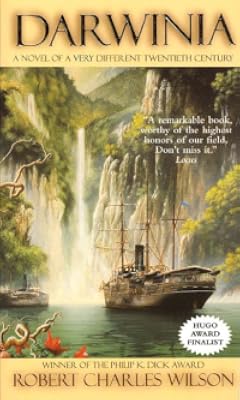
Darwinia: A Novel of a Very Different Twentieth Century
by Robert Charles Wilson
On This Page
Description
In 1912, history was changed by the Miracle, when the old world of Europe was replaced by Darwinia, a strange land of nightmarish jungle and antedeluvian monsters. To some, the Miracle is an act of divine retribution; to others, it is an opportunity to carve out a new empire. Leaving American now ruled by religious fundamentalism, young Guilford Law travels to Darwinia on a mission of discovery that will take him further than he can possibly a shattering revelation about mankind's destiny in show more the universe. Darwinia is a 1999 Hugo Award Nominee for Best Novel. At the Publisher's request, this title is being sold without Digital Rights Management Software (DRM) applied. show lessTags
Recommendations


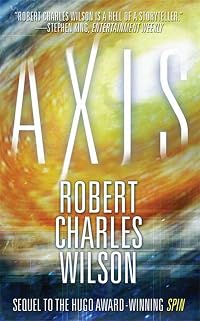




Member Recommendations
Member Reviews
I posted on a SFF thread that, at the beginning, this novel feels exactly the way Peter Jackson's movie "King Kong" looked. The premise of the novel is that, in 1912, the entire European continent and some of its surround is, overnight, transformed into a steaming jungle which, of course, is populated by various types of giant, often lethal bugs. Yeah, that last detail should ring some bells (urgh -- the giant bugs in "King Kong" almost made me lose it). We are introduced to a young man who is fascinated with 'Darwinia', as the newly transformed continent is nicknamed, and when the novel moves forward to him joining an expedition into this untamed, transformed land, we, the readers, think we know what to expect.
We expect the novel to show more develop as a speculative history, where the familiar events of our known early-20th-century are somehow distorted or transformed along with the continent; in many ways, the novel fulfills this expectation. But we also expect an adventure novel -- when our hero crosses the sea and then the channel and then the river, the shades of Edgar Rice Burroughs (alluded to several times), Daniel Defoe, and even Joseph Conrad rise up to greet us. We anticipate, if not quite buckled swashes, then at least machetes ripping through jungle, the clash of man and nature and, perhaps, primitive culture, the manly imprint of boots upon virgin earth. This is the great colonial vision given us by writers of the past.
But we live in a postcolonial and postmodern society. Expectations are rarely fulfilled in the way we think they ought to be anymore. What we think is a good scifi adventure yarn at the beginning could turn into anything by the end. This is the joy and the frustration of literature in the current age.
So when Wilson's novel, about halfway in, takes a turn toward astronomical tech-theology and abandons man vs. nature for god vs. demon, we shouldn't really be surprised.
We are, but we shouldn't be.
We are, and so the shift -- which really isn't a shift, we realize, but more of a reveal, since the 'new' themes have been there all along, disguised and biding their time -- is a bit of an adjustment. The reader must reevaluate the novel's priorities.
The whole text ends up being significantly more epic than it first appears. It takes up a much grander scale -- an astronomical scale, as a matter of fact -- and deals with speculations about the nature of existence, the existence of gods, and the god within man. Wilson handles the move from "new world" to "worlds within worlds" deftly, but not subtly. His interludes -- the space between sections of the book wherein the larger significance is revealed -- are at first irritating, and then confusing, and then, toward the end of the book, finally revealing. The reader, in fact, feels much like the main character as this progression unfolds -- this deliberate (one assumes) connection between reader and character is a gorgeous act of creative craftsmanship.
The book feels a little lopsided, once one has a chance to appreciate the whole; the first sections of the book (the adventure-y part) are significantly longer than the bits where the 'celestial war' is laid out. Even so, even with all its unexpected choices, this novel is a strange and wonderful beast. It's not an "easy" read, but it is a worthwhile one. show less
We expect the novel to show more develop as a speculative history, where the familiar events of our known early-20th-century are somehow distorted or transformed along with the continent; in many ways, the novel fulfills this expectation. But we also expect an adventure novel -- when our hero crosses the sea and then the channel and then the river, the shades of Edgar Rice Burroughs (alluded to several times), Daniel Defoe, and even Joseph Conrad rise up to greet us. We anticipate, if not quite buckled swashes, then at least machetes ripping through jungle, the clash of man and nature and, perhaps, primitive culture, the manly imprint of boots upon virgin earth. This is the great colonial vision given us by writers of the past.
But we live in a postcolonial and postmodern society. Expectations are rarely fulfilled in the way we think they ought to be anymore. What we think is a good scifi adventure yarn at the beginning could turn into anything by the end. This is the joy and the frustration of literature in the current age.
So when Wilson's novel, about halfway in, takes a turn toward astronomical tech-theology and abandons man vs. nature for god vs. demon, we shouldn't really be surprised.
We are, but we shouldn't be.
We are, and so the shift -- which really isn't a shift, we realize, but more of a reveal, since the 'new' themes have been there all along, disguised and biding their time -- is a bit of an adjustment. The reader must reevaluate the novel's priorities.
The whole text ends up being significantly more epic than it first appears. It takes up a much grander scale -- an astronomical scale, as a matter of fact -- and deals with speculations about the nature of existence, the existence of gods, and the god within man. Wilson handles the move from "new world" to "worlds within worlds" deftly, but not subtly. His interludes -- the space between sections of the book wherein the larger significance is revealed -- are at first irritating, and then confusing, and then, toward the end of the book, finally revealing. The reader, in fact, feels much like the main character as this progression unfolds -- this deliberate (one assumes) connection between reader and character is a gorgeous act of creative craftsmanship.
The book feels a little lopsided, once one has a chance to appreciate the whole; the first sections of the book (the adventure-y part) are significantly longer than the bits where the 'celestial war' is laid out. Even so, even with all its unexpected choices, this novel is a strange and wonderful beast. It's not an "easy" read, but it is a worthwhile one. show less
I am a fan of Robert Charles Wilson, but it has been a while since I read any of his books. This one took me a while to get into, but I think that may have been as much my rusty reading habits as the slowness of the build-up. It was worth sticking with it -- Robert's writing style is fluid, illustrative but not flowery. There are moments when I just feel deeply those precious little moments, and I really love that gift he gives the reader.
The story was poignant, and the ending really worked for me. His explorations of death and the afterlife made me wonder, and I kind of liked where he took things in this fantasy. As someone who has lost a dear family member, I appreciate being reminded of how precious a life is no matter how short. We show more need to remember things, preserve those memories...and I also wonder if immortality can exist through that preservation. This was a unique book, but classically Robert Charles Wilson in that the protagonist is a wanderer. show less
The story was poignant, and the ending really worked for me. His explorations of death and the afterlife made me wonder, and I kind of liked where he took things in this fantasy. As someone who has lost a dear family member, I appreciate being reminded of how precious a life is no matter how short. We show more need to remember things, preserve those memories...and I also wonder if immortality can exist through that preservation. This was a unique book, but classically Robert Charles Wilson in that the protagonist is a wanderer. show less
This novel starts out with an uncanny event that transforms the world. One night in 1912, a giant circular patch of the Earth, roughly Europe and a bit of North Africa, goes silent. Arriving ships find that all the people and every trace of their works have vanished. The general topography of the land is the same, but its flora and fauna are nothing that have ever been seen in the planet's history - yet nonetheless betray an evolutionary history just as long as the one we know.
The history of the world proceeds differently. No 1914-1918 Great War, slower technological progress, the US the sole world superpower, and a revival of creationist explanations of the origin of Earth and life follow the apparent miracle. In 1920, Guilford Law and show more his wife and child travel to England, which is being resettled by the remains of the British Empire. He will join an American scientific expedition into the interior of the land now called Darwinia. But Guilford is haunted by dreams of another life, one that ended in a war that his history and his memory say never occurred. Other men around the world are likewise haunted, by dreams or, for certain men without conscience, by terrible phantoms they think of as gods - evil gods with real-world powers.
Wilson loves setting ordinary human relationships against a backdrop of cosmic scale, and Darwinia eventually becomes cosmic indeed - this 1998 release is a very 1990s SF novel. Not Wilson's best, but quite satisfying. show less
The history of the world proceeds differently. No 1914-1918 Great War, slower technological progress, the US the sole world superpower, and a revival of creationist explanations of the origin of Earth and life follow the apparent miracle. In 1920, Guilford Law and show more his wife and child travel to England, which is being resettled by the remains of the British Empire. He will join an American scientific expedition into the interior of the land now called Darwinia. But Guilford is haunted by dreams of another life, one that ended in a war that his history and his memory say never occurred. Other men around the world are likewise haunted, by dreams or, for certain men without conscience, by terrible phantoms they think of as gods - evil gods with real-world powers.
Wilson loves setting ordinary human relationships against a backdrop of cosmic scale, and Darwinia eventually becomes cosmic indeed - this 1998 release is a very 1990s SF novel. Not Wilson's best, but quite satisfying. show less
Reminiscent of such diverse writers as Edgar Rice Burroughs, H. G. Wells, and Philip K. Dick, Darwinia by Robert Charles Wilson is an amazing piece of literary alchemy. Imagine, if you will, a reality where in 1912 Europe transforms into a strange land of nightmarish jungles and alien creatures. This so‑called Miracle is the centerpiece of this fascinating and truly different alternate history.
Young Guilford Law joins an expedition to explore this Darwinia. What they uncover shatters conception of reality and man's destiny in the universe. This book is at the essence of what makes SF wonderful!
Young Guilford Law joins an expedition to explore this Darwinia. What they uncover shatters conception of reality and man's destiny in the universe. This book is at the essence of what makes SF wonderful!
Wilson, Robert Charles. Darwinia. Tor, 1998.
I love the premise of this novel, but about halfway through, it gets off track badly. In 1912 almost all of Europe and some of Africa and Asia are suddenly replaced by a not quite historical Jurassic wilderness. By 1916, London is a frontier town, a launching point for expeditions by the remaining world powers competing to develop the new old world. We follow a young photographer and a team into the wilds with the aim of discovering what might have caused the dislocation. The characters are all well-described, and the period voices seem authentic. So far so good, but then the story takes a decided Lovecraftian twist that is given science fictional explanation that seem to belong to some other show more novel. Conrad has already written The Heart of Darkness, and this story does not improve on it. 3.5 stars. show less
I love the premise of this novel, but about halfway through, it gets off track badly. In 1912 almost all of Europe and some of Africa and Asia are suddenly replaced by a not quite historical Jurassic wilderness. By 1916, London is a frontier town, a launching point for expeditions by the remaining world powers competing to develop the new old world. We follow a young photographer and a team into the wilds with the aim of discovering what might have caused the dislocation. The characters are all well-described, and the period voices seem authentic. So far so good, but then the story takes a decided Lovecraftian twist that is given science fictional explanation that seem to belong to some other show more novel. Conrad has already written The Heart of Darkness, and this story does not improve on it. 3.5 stars. show less
In one of the chief storylines, Darwinia, a land from an alternate universe, has replaced or overlaid early 20th century Europe; North America and the other non-European areas are not affected. Some of the flora and fauna of Darwinia can be hostile to humans. An exploratory expedition, mostly American, encounters a “midden,” a circle of bones representing the boundary of a colony of carnivorous insects (chapter 14). Creatures that stray within the boundary are brought down and eaten alive to the bones by the colony drones. This functions as a metaphor for the backstory, a cosmological end of days scenario. It seems that the universe has actually come to an end eons ago and is only preserved as a virtual memory in islands of show more interconnected nodes of sentience in the memory of a cosmic computer. However, the memory is being damaged and destroyed by swarms of entropic algorithms that are programmed to devour sentience, much as the Darwinian insects devour the (virtually) living creatures they are able to capture. At another level, the mind and memory of the universe are in battle with the mindless, memory destroying, prionic, virus-like programs, a cosmic case of Alzheimers. In Wilson’s short story Utriusque Cosmi in the collection The New Space Opera 2 (see the review), the memory of worlds systematically being destroyed by dark matter is preserved in cosmic computer files. Darwinia carries the preserved memories into a future at the end of time. Unfortunately, the surface story itself, recalling H.G. Wells and John Wyndham, was rather dull; the climax to me resembles a pastiche of shopworn eschatologies, perhaps an acknowledgement of the limits of the Second Life of virtual memory. show less
An online friend mentioned that one of her favourite SF writers was Canadian Robert Charles Wilson. I was chagrined that I had not read any of his works and, judging by this book, that is a major hole in my reading life. This book was nominated for the Hugo Award in 1999 and I don't think it is any discredit that it didn't win because the winner that year was Connie Willis' To Say Nothing of the Dog. (As an aside, Robert Sawyer also had a book on the shortlist that year, Factoring Humanity, so it was a good year for Canadian SF.) Wilson has won a Hugo Award for the book Spin and since that book is one the CBC list of 100 Novels that Make You Proud to be Canadian I think I will have to read it soon.
In the alternate history described in show more this book March of 1912 saw a catastrophic change to Europe. In one night everyone who lived there disappeared and the flora and fauna changed dramatically. The new Europe was christened Darwinia as an homage to Charles Darwin who probably would have wanted to examine the beasts and birds of the new continent. The transformation was hailed by many as a miracle from God and ushered in a new wave of religious fervour in the rest of the world. It also created upheaval in the world's finances. People were thrown out of work and stock markets crashed. Guilford Law was fourteen years old and living in Boston when the world changed. Eight years later, with a wife and young daughter, he joined a scientific expedition led by Preston Finch to explore the interior of the continent. Guilford was a photographer, not a scientist, but he was anxious to see what they could discover. His wife, Caroline, and his daughter, Lilly, were going to stay in London with relatives while the expedition ventured up the river that used to be the Rhine as far as a steamer could take them. After that they would go overland as far as the Alps. Tom Compton who had lived and explored in and around the Rhine for years would guide the expedition. They were well equipped but perhaps not really ready to face the dangers of the "New World" which included men who prayed on unsuspecting travellers. A few members of the team were lost before they even reached the Alps. In the mountains they discovered what appeared to be the ruins of a city but one that did not seem to be built by humans. Guilford and a few others explored it and while they were away from camp it was attacked. Only Guilford, Preston Finch and Tom Compton survived but winter arrived and they had to stay in the mountains. The expedition was given up for lost and Caroline believed Guilford was dead. Yet Guilford lived on, recovered from illnesses and injuries that most men would succumb to. He had disturbing dreams of being a soldier in a field of mud. Then the soldier appeared in his waking life and told him something incredible. Read the book to find out what that was and what happened to Guilford.
Wilson reveals the mechanics of the plot in tiny bits. That was probably wise; if he had started out with the full-fledged explanation at the beginning it would have seemed too improbable. This way the reader's understanding built up incrementally and going from one step to another did not seem improbable. show less
In the alternate history described in show more this book March of 1912 saw a catastrophic change to Europe. In one night everyone who lived there disappeared and the flora and fauna changed dramatically. The new Europe was christened Darwinia as an homage to Charles Darwin who probably would have wanted to examine the beasts and birds of the new continent. The transformation was hailed by many as a miracle from God and ushered in a new wave of religious fervour in the rest of the world. It also created upheaval in the world's finances. People were thrown out of work and stock markets crashed. Guilford Law was fourteen years old and living in Boston when the world changed. Eight years later, with a wife and young daughter, he joined a scientific expedition led by Preston Finch to explore the interior of the continent. Guilford was a photographer, not a scientist, but he was anxious to see what they could discover. His wife, Caroline, and his daughter, Lilly, were going to stay in London with relatives while the expedition ventured up the river that used to be the Rhine as far as a steamer could take them. After that they would go overland as far as the Alps. Tom Compton who had lived and explored in and around the Rhine for years would guide the expedition. They were well equipped but perhaps not really ready to face the dangers of the "New World" which included men who prayed on unsuspecting travellers. A few members of the team were lost before they even reached the Alps. In the mountains they discovered what appeared to be the ruins of a city but one that did not seem to be built by humans. Guilford and a few others explored it and while they were away from camp it was attacked. Only Guilford, Preston Finch and Tom Compton survived but winter arrived and they had to stay in the mountains. The expedition was given up for lost and Caroline believed Guilford was dead. Yet Guilford lived on, recovered from illnesses and injuries that most men would succumb to. He had disturbing dreams of being a soldier in a field of mud. Then the soldier appeared in his waking life and told him something incredible. Read the book to find out what that was and what happened to Guilford.
Wilson reveals the mechanics of the plot in tiny bits. That was probably wise; if he had started out with the full-fledged explanation at the beginning it would have seemed too improbable. This way the reader's understanding built up incrementally and going from one step to another did not seem improbable. show less
Members
- Recently Added By
Lists

Speculative Fiction to Read
706 works; 31 members

Simulated Reality in Fiction
124 works; 7 members

Recommended AltHist
24 works; 1 member

Alternate History Stories
11 works; 1 member
Author Information

47+ Works 14,413 Members
Some Editions
Awards and Honors
Awards
Notable Lists
Series
Belongs to Publisher Series
Common Knowledge
- Canonical title*
- Darwinia
- Original title
- Darwinia
- Alternate titles
- Darwinia
- Original publication date
- 1998-06
- People/Characters
- Ed Betts (Finch expedition); Rafe Buckley (First Officer of the Oregon); Raymond Burke (Finch expedition); Tom Compton (tracker, Finch expedition); Timothy Crane; Truxton Davies (Captain of the Oregon) (show all 29); Marion Digby (Diggs, cook, Finch expedition); Kenneth Donner (Finch expedition); Erasmus; Wilson W. Farr (Finch expedition); Preston Finch (naturalist, Finch expedition); Tom Gillvany (entomologist, Finch expedition); Charles Curtis Hemphill (Chuck, surveyor, Finch expedition); Avery Keck (Finch expedition); Caroline Law; Guilford Law (photographer, Finch expedition); Lily Law; Tim Mackelroy; Alice Pierce (Jered's wife); Jered Pierce (Caroline's uncle); Liam Pierce (Caroline's uncle); Eugene Randall (Professor); Paul Robertson (Finch expedition); Eleanor Sanders-Moss; John W. Sullivan (botanist, Finch expedition); Emil Swensen (Finch expedition); Christopher Tuckman (Finch expedition); Elias Vale; Colin Watson (Lieutenant)
- Important places
- Boston, Massachusetts, USA; Cobh, County Cork, Ireland (as Queenstown); Darwinia; London, England, UK; Virginia, USA
- Dedication
- To PNH and TNH, for patience and good advice; Shawna, for believing in my work; and unindicted co-conspirators everywhere (you know who you are).
- First words
- Guilford Law turned fourteen the night the world changed.
- Last words
- (Click to show. Warning: May contain spoilers.)And only a moment to rest, to close his eyes, to sleep.
- Publisher's editor
- Nielsen Hayden, Patrick (Tor)
- Original language*
- Anglais canadien
*Some information comes from Common Knowledge in other languages. Click "Edit" for more information.
Classifications
Statistics
- Members
- 1,519
- Popularity
- 15,125
- Reviews
- 47
- Rating
- (3.34)
- Languages
- 10 — Czech, English, French, German, Hungarian, Italian, Polish, Portuguese, Spanish, Turkish
- Media
- Paper, Audiobook, Ebook
- ISBNs
- 23
- ASINs
- 10