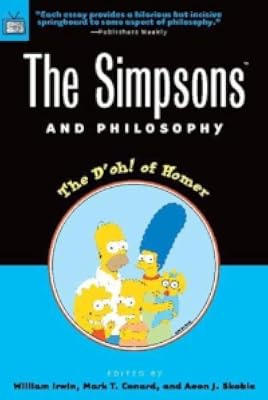
The Simpsons and Philosophy: The D'oh! of Homer
by William Irwin (Editor), Mark T. Conard (Editor), Aeon J. Skoble (Editor)
Popular Culture and Philosophy (2)
On This Page
Description
This unconventional and lighthearted introduction to the ideas of the major Western philosophers examines The Simpsons ? TV's favorite animated family. The authors look beyond the jokes, the crudeness, the attacks on society ? and see a clever display of irony, social criticism, and philosophical thought. The writers begin with an examination of the characters. Does Homer actually display Aristotle's virtues of character? In what way does Bart exemplify American pragmatism? The book also show more examines the ethics and themes of the show, and concludes with discussions of how the series reflects show lessTags
Recommendations



Member Reviews
I really enjoyed these series of essays on philosophy with the Simpsons as the starting point. My favorite essay has to be the one comparing Nietze to Bart. I was actually laughing while reading the essay!
Just the fact that this book exists is awesome. I love the chapter about Lisa and how we live in an anti-intellectual society. However, there is a downside: the essays are written in an academic format, and thus don't read fluidly, which I think would have made this book perfect.
Disappointing
I was not terribly impressed by this book. The problem is not that I'm not a fan of "The Simpsons"; I watch that show in reruns just about every day. The problem is not that I don't find philosophy interesting; I own about 40 books on philosophy and tend to spend a lot of my spare time reading them. I gave the first book in this series (_Seinfeld and Philosophy_) 4 stars. The authors of that book had meaningful things to say about the philosophical aspects of "Seinfeld", but they seemed to think it would be hilarious if they liberally and randomly inserted phrases like "not that there's anything wrong with that" into their essays, and that got old really quick. (To get an idea how annoying this can be, think of your show more acquaintances who can't seem to carry on a conversation without repeating dialogue from _Monty Python and the Holy Grail_.)
In _The Simpsons and Philosophy_, the editors have managed to keep the cuteness under control, but the authors don't establish too many non-obvious connections between philosophy and the show. Part of the problem is that some of them don't seem to be very familiar with the program and with popular culture, in general. For example, the author of one essay asserts that Maude Flanders was killed at a football game and that the running character on the old Letterman show was the "equalizer guy", and seems unaware that the song "Jazzman" that was featured in the episode about the death of Bleeding Gums Murphy was an old Carole King hit. Another essay reveals the shocking fact that "The Simpsons" does not, to the essay's author's dismay, push a consistent Marxist agenda.
Several of the essays make only tangential and superficial reference to the Simpsons. It's hard to suppress the impression that many of the authors are junior faculty members who jumped at the chance to pad their CV's by taking an old essay of theirs and dressing it up with token reference to the Simpsons. There is also an essay or two that reads like another Alan Sokal parody. show less
I was not terribly impressed by this book. The problem is not that I'm not a fan of "The Simpsons"; I watch that show in reruns just about every day. The problem is not that I don't find philosophy interesting; I own about 40 books on philosophy and tend to spend a lot of my spare time reading them. I gave the first book in this series (_Seinfeld and Philosophy_) 4 stars. The authors of that book had meaningful things to say about the philosophical aspects of "Seinfeld", but they seemed to think it would be hilarious if they liberally and randomly inserted phrases like "not that there's anything wrong with that" into their essays, and that got old really quick. (To get an idea how annoying this can be, think of your show more acquaintances who can't seem to carry on a conversation without repeating dialogue from _Monty Python and the Holy Grail_.)
In _The Simpsons and Philosophy_, the editors have managed to keep the cuteness under control, but the authors don't establish too many non-obvious connections between philosophy and the show. Part of the problem is that some of them don't seem to be very familiar with the program and with popular culture, in general. For example, the author of one essay asserts that Maude Flanders was killed at a football game and that the running character on the old Letterman show was the "equalizer guy", and seems unaware that the song "Jazzman" that was featured in the episode about the death of Bleeding Gums Murphy was an old Carole King hit. Another essay reveals the shocking fact that "The Simpsons" does not, to the essay's author's dismay, push a consistent Marxist agenda.
Several of the essays make only tangential and superficial reference to the Simpsons. It's hard to suppress the impression that many of the authors are junior faculty members who jumped at the chance to pad their CV's by taking an old essay of theirs and dressing it up with token reference to the Simpsons. There is also an essay or two that reads like another Alan Sokal parody. show less
I was a bit worried that reading this book would ruin the Simpsons for me but I'm happy to report that I still laugh out loud every time I watch it. The essays were all vastly different - for example some tended to explain characturistics of the Simpsons using different philosophers and some tended to try to explain certain philosophies using the Simpsons as examples. Some worked for me and some didn't. Some of the authors missed the point that the Simpsons is written to be funny - for example in "Thus Spake Bart" (a Neitzscean analysis of Barts characture) the author misses the irony in a dialog between Bart and Lisa and attributes Bart's response to the loss of his identity as a rebel (personally I think it's just a gag - just a we show more all sometimes say things that we don;t really mean for the sake of a cheap laugh. My favourite chapter was the one on semiotics towards the end which explained the difference between the written word (in which the signifier is inherantly abstracted from the signified) and media like photography or moving images in which the signifier seems (on the surface) to be inherant to what is being signified but (for example in advertising) the signifier is more than just a picture of an object, it is a production and the objects are made to look a certain way. I guess that's why visual media is so important to advertising and why western culture is increasingly visual. Intersting (very interesting) :-) show less
Oh don't be pretentious . . . it's fun! It's also all good. The ability to relate thought and thinking not only to the issues of today, but to the contemporary inculturated expressions of that thought is a necessary discipline if ideas are to be recognized and used well. This book undertakes that task well. Enjoy it - and admit it - you just wish you'd thought of it first!
The Simpsons gets me suckered into buying another book exploring all the meaning and philosophy behind my favorite show. This is probably the best of these types of books.
Absolutley fun foray into philosophy.
Members
- Recently Added By
Author Information

William Irwin is Assistant Professor of Philosophy at King's College, Pennsylvania Dr. Conard has published scholarly articles on Kant, Nietzsche, and Quentin Tarantino Dr. Skoble teaches philosophy at the U.S. Military Academy at West Point
Mark T. Conard, associate professor of philosophy at Marymount Manhattan College, is the editor of the Philosophy of Popular Culture series and of numerous books, including The Philosophy of Film Noir, The Philosophy of Neo-Noir, and The Philosophy of Martin Scorsese.

Aeon J. Skoble is Associate Professor of Philosophy at Bridgewater State College in Massachusetts.
All Editions
Series

Common Knowledge
- Canonical title
- The Simpsons and Philosophy: The D'oh! of Homer
- Original publication date
- 2001-02-23
- People/Characters
- The Simpsons
- Related movies
- The Simpsons Movie (2007 | IMDb); The Simpsons Gone Wild; Treehouse of Horror (1990 | IMDb)
- Dedication
- Dedicated to Lionel Hutz and Troy McClure
(whom you might remember from such TV shows as The Simpsons) - First words
- (Introduction): How many philosophers does it take to write a book about The Simpsons?
Homer Simpson does not fare well when evaluated morally. - Last words
- (Click to show. Warning: May contain spoilers.)But the relationship is wrongly conceived if it is taken to be something that could fall out, consequently, from a syllogism.
- Blurbers
- Carrier, David; Broman, Per; Morris, Tom; Pinsky, Mark I.
- Original language
- English
Classifications
Statistics
- Members
- 1,483
- Popularity
- 15,722
- Reviews
- 13
- Rating
- (3.45)
- Languages
- 8 — Czech, English, French, German, Italian, Croatian, Spanish, Portuguese (Portugal)
- Media
- Paper, Audiobook, Ebook
- ISBNs
- 23
- ASINs
- 7
