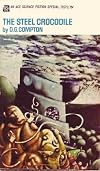
The Steel Crocodile
by David G. Compton
On This Page
Tags
Recommendations















Member Reviews
The Steel Crocodile (renamed The Electric Crocodile for US audiences) is a dystopian novel emphasizing interpersonal relationships and the relative merits of science and religion in improving society and the individual’s role within it. Technology plays a part, but it’s a classic MacGuffin insofar as neither plot nor theme depend upon it: it simply provides a convenient means for setting the scene (‘an advanced technotopia’) without muddying the waters if, for example, the regime were fascist or totalitarian.
The future envisioned by Compton shares with Iain Banks’ Culture the idea of a post-property society, made possible by industrial production enabling everyone to have all the necessities. Compton’s imagined society is show more more recently arrived at this level of production, however, and retains a strong social class system adapted to the new economy. This is as intriguing a part of the story as any, for me. Compton also provides a bare outline of the global military-strategic balance of power, clearly extended from Cold War blocs dominant at the time Comptom was writing. Plausible but not particularly innovative, but then it's there to lend credibility and not much more.
Compton’s (perhaps unique?) contribution to dystopian fiction is his particular concern for science and religion, examining how each serves different personalities in society, and holding out the same ambivalent chance of success for each. Neither is made a straw man nor a savior, and the upshot seems to be that social progress is as uncertain and troubling as ever. In this manner, Compton does not so much warn against a specific danger from science or from religion, as he raises a caution against any chance at improving society -- perhaps especially when deliberately setting out to do so. So is he focused on the hubris of the race, or is he simply espousing libertarianism?
Compton’s dramatic style & plot is driven by dialogue and situation rather than description, and is reminiscent of R.U.R. The comparison was prompted by the biographical note indicating Compton was an established playwright at the time he wrote SC, would not have occurred to me elsewise. show less
The future envisioned by Compton shares with Iain Banks’ Culture the idea of a post-property society, made possible by industrial production enabling everyone to have all the necessities. Compton’s imagined society is show more more recently arrived at this level of production, however, and retains a strong social class system adapted to the new economy. This is as intriguing a part of the story as any, for me. Compton also provides a bare outline of the global military-strategic balance of power, clearly extended from Cold War blocs dominant at the time Comptom was writing. Plausible but not particularly innovative, but then it's there to lend credibility and not much more.
Compton’s (perhaps unique?) contribution to dystopian fiction is his particular concern for science and religion, examining how each serves different personalities in society, and holding out the same ambivalent chance of success for each. Neither is made a straw man nor a savior, and the upshot seems to be that social progress is as uncertain and troubling as ever. In this manner, Compton does not so much warn against a specific danger from science or from religion, as he raises a caution against any chance at improving society -- perhaps especially when deliberately setting out to do so. So is he focused on the hubris of the race, or is he simply espousing libertarianism?
Compton’s dramatic style & plot is driven by dialogue and situation rather than description, and is reminiscent of R.U.R. The comparison was prompted by the biographical note indicating Compton was an established playwright at the time he wrote SC, would not have occurred to me elsewise. show less
The only other review here is very literary, so I'll put in a shorter, less esoteric review.
The book is about a research scientist that goes to live on a research campus to do important research, taking his somewhat reluctant wife along with him. The campus and the project as well as a surface glimpse into the world the story takes place in are the interesting sci fi topics. But, they are not the actual focus of the book. The actual focus is the couple and their relationship.
The author does an admirable job switching between the two perspectives and showing the two sides of a relationship, but in the end, the plot is a little cold, and not enough time is spent in the science fiction and the plotting.
It is a reasonable read, though, show more although it is a rather dour book, so don't go reading it on a rainy Saturday unless you want to be in a dour mood. show less
The book is about a research scientist that goes to live on a research campus to do important research, taking his somewhat reluctant wife along with him. The campus and the project as well as a surface glimpse into the world the story takes place in are the interesting sci fi topics. But, they are not the actual focus of the book. The actual focus is the couple and their relationship.
The author does an admirable job switching between the two perspectives and showing the two sides of a relationship, but in the end, the plot is a little cold, and not enough time is spent in the science fiction and the plotting.
It is a reasonable read, though, show more although it is a rather dour book, so don't go reading it on a rainy Saturday unless you want to be in a dour mood. show less
The "steel crocodile" is a reference to the supposed fact that crocodiles cannot turn their heads. I don't know if that's actually true of crocodiles. Regardless, it works reasonably well as a metaphor for a kind of tunnel vision and, perhaps, reckless forward movement in scientific pursuits and a fetish for linearly-concatenated experiences as the basis for ultimate truth.
Ultimately, it seems a little unfair to suppose that science is the "steel crocodile" in this case, but maybe there is a case for applying the metaphor to the AI that becomes the focus of the book. Many of us now accept as true that in our algorithmic culture created by media technology, assistive information technologies, and artificial intelligence (increasingly) show more the biases and shortcomings of the designers and the creators of the algorithms gets baked into the systems they design. A similar theme shows up in this book in the design of the Bohn AI by the Colindale think tank.
Overall, this is an odd little book about the tension between science and religion. On that score, the book is not really very different or any more insightful than other books tackling similar themes. However, the writing was pretty solid and sophisticated and the ideas had some depth of concept and treatment. show less
Ultimately, it seems a little unfair to suppose that science is the "steel crocodile" in this case, but maybe there is a case for applying the metaphor to the AI that becomes the focus of the book. Many of us now accept as true that in our algorithmic culture created by media technology, assistive information technologies, and artificial intelligence (increasingly) show more the biases and shortcomings of the designers and the creators of the algorithms gets baked into the systems they design. A similar theme shows up in this book in the design of the Bohn AI by the Colindale think tank.
Overall, this is an odd little book about the tension between science and religion. On that score, the book is not really very different or any more insightful than other books tackling similar themes. However, the writing was pretty solid and sophisticated and the ideas had some depth of concept and treatment. show less
I would agree with Bob3k's review. It is a good read but it has a very down beat ending
Ratings
Members
- Recently Added By
Author Information

39+ Works 1,408 Members
Some Editions
Awards and Honors
Awards
Series
Belongs to Publisher Series
Common Knowledge
- Canonical title*
- Das elektrische Krokodil
- Original title
- The Steel Crocodile
- Alternate titles
- The Electric Crocodile
- Original publication date
- 1970
- People/Characters*
- Edmund Gryphon; Dr. Matthew Oliver; Abigail Oliver; Kriminalinspektor Kahn; Sergeant Wilson; Paul (show all 17); Chester Billon; Dr. Wolfgang Mozart; Sir William Beeston; Pater Carter; Margaret Pelham; Mrs. Foster; Andrew Scarfe; Pater Hilliard; Alice Billon; Dingle; Zacharie Mallalieu
- Important places
- Colindale Institute; European bloc
- Epigraph
- "But to this day I wish I had known
the name of that excellent crocodile,
My mentor and friend, most proper enemy."
(from 'Woulds't Eat A Crocodile?' by John Smith)
"In particular, as computers become more self programming they will ... perform activities that amount to 'learning' from experience and training. Thus they will eventually evolve subtle methods and processes that may defy t... (show all)he understanding of the human designer.
... If it turns out that they cannot duplicate or exceed certain characteristically human activities, that will be one of the most important discoveries of the twentieth century."
-- Kahn and Wiener
The Year 2000 - Dedication
- For Anne Marie, who showed me faith.
- First words
- Gryphon turned on the high frequency jammer. Before being taken over by the university, his office had been used by an insurance company, and therefore had been fully wired.
- Quotations
- What a lot people had tried to teach her. And then given her a degree. In spite of that she still had a good mind when she cared to use it. [34]
"In 1933, Oliver, a laboratory was built for the physicist Pyotr Kapitza. For the facade he ordered the head of a crocodile in steel. 'The crocodile of science,' he said. 'The crocodile cannot turn its head. Like science it m... (show all)ust always go forward with all-devouring jaws ...' " [Billon, 96]
"Come now, my child, morality is overloaded as it is, without making it a basis for choosing our friends." [Father Hilliard, 108]
"Still, without the weather, what'd there be left to complain about? Except the government, of course." She sat down. "Maybe that's why they left us the weather." [Maggie, 166] - Last words
- (Click to show. Warning: May contain spoilers.)Mrs. Oliver, wife of Matthew, widow of Matthew. She began to cry. Grief that was long overdue, an awkward bleeding, secret. But God loved her and she'd survive. Nobody was tested beyond what he could endure. She let herself be led away down the moonlit cloisters to her novitiate.
- Publisher's editor*
- Jeschke, Wolfgang
- Blurbers
- McCaffrey, Anne; Simak, Clifford D.
- Original language*
- Englisch
*Some information comes from Common Knowledge in other languages. Click "Edit" for more information.
Classifications
Statistics
- Members
- 185
- Popularity
- 176,489
- Reviews
- 4
- Rating
- (3.19)
- Languages
- Dutch, English, French, German
- Media
- Paper, Ebook
- ISBNs
- 7
- ASINs
- 9