
Floater
by Lucius Shepard
On This Page
Description
Detective William Dempsey of the NYPD is having a bad time of it. Having endured a months-long homicide trial for the inadvertent shooting of Haitian immigrant, Israel Lara, he's been abandoned by his fiancee, deemed unfit for duty, and is sinking into an oblivion of vodka and pills. Then there's that little problem with his eye.Tags
Recommendations




























Member Reviews
http://www.infinityplus.co.uk/nonfiction/floater.htm
"Dempsey hated the mornings before his drugs kicked in." From the very first sentence, you know this is going to be something special. The protagonist, a New York cop who has recently been acquitted of murder after shooting dead a Haitian immigrant in controversial circumstances, begins to dig deeper into the background of the incident and finds himself enmeshed in a world of strange Caribbean voodoo cults where nothing and nobody are quite what they seem. The "Floater" of the title is a speck of protein in Dempsey's eye, which impedes his vision -- or perhaps may allow him to see what other people can't.
Shepard's sensuous prose is at its best in the tropical settings of Life in show more Wartime, "Radiant Green Star", "Crocodile Rock" and "The Jaguar Hunter"; although New York is much further north, he manages to find the required climate for his habitual style in raves, in Santeria ceremonies, and in two memorable scenes set in steam-filled bathrooms. But even in other settings, the words sing from the page: we read of "the neon script pizza joint mad cabby hip hop ambiance of millennial rush hour Brooklyn", of "rows of apartment buildings with blank reflectionless windows, like the disapproving faces of gigantic maiden aunts hidden behind thick spectacles".
At one point the plot appears to be getting too clever for its own good, as an academic expert who appears to be straight from central casting explains to Dempsey that he is participating in a standard quest narrative. But my expectations were blown away almost by the next sentence, and although the story does indeed climax with Dempsey participating in a cosmic conflict, the ending is sufficiently subversive that I actually went to the lengths of contacting the publisher to make sure my copy had been printed correctly.
Of course, I need not have worried. This is yet another classy production from PS Publishing, with an introduction by Jeffrey Ford which puts the story in the context of Shepard's other writings. Ford thinks that this novella "will be considered one of Shepard's best". I agree. (It's a pity that the title will cause sniggers on this side of the Atlantic from the lavatorially minded.) show less
"Dempsey hated the mornings before his drugs kicked in." From the very first sentence, you know this is going to be something special. The protagonist, a New York cop who has recently been acquitted of murder after shooting dead a Haitian immigrant in controversial circumstances, begins to dig deeper into the background of the incident and finds himself enmeshed in a world of strange Caribbean voodoo cults where nothing and nobody are quite what they seem. The "Floater" of the title is a speck of protein in Dempsey's eye, which impedes his vision -- or perhaps may allow him to see what other people can't.
Shepard's sensuous prose is at its best in the tropical settings of Life in show more Wartime, "Radiant Green Star", "Crocodile Rock" and "The Jaguar Hunter"; although New York is much further north, he manages to find the required climate for his habitual style in raves, in Santeria ceremonies, and in two memorable scenes set in steam-filled bathrooms. But even in other settings, the words sing from the page: we read of "the neon script pizza joint mad cabby hip hop ambiance of millennial rush hour Brooklyn", of "rows of apartment buildings with blank reflectionless windows, like the disapproving faces of gigantic maiden aunts hidden behind thick spectacles".
At one point the plot appears to be getting too clever for its own good, as an academic expert who appears to be straight from central casting explains to Dempsey that he is participating in a standard quest narrative. But my expectations were blown away almost by the next sentence, and although the story does indeed climax with Dempsey participating in a cosmic conflict, the ending is sufficiently subversive that I actually went to the lengths of contacting the publisher to make sure my copy had been printed correctly.
Of course, I need not have worried. This is yet another classy production from PS Publishing, with an introduction by Jeffrey Ford which puts the story in the context of Shepard's other writings. Ford thinks that this novella "will be considered one of Shepard's best". I agree. (It's a pity that the title will cause sniggers on this side of the Atlantic from the lavatorially minded.) show less
Ratings
Members
- Recently Added By
Author Information

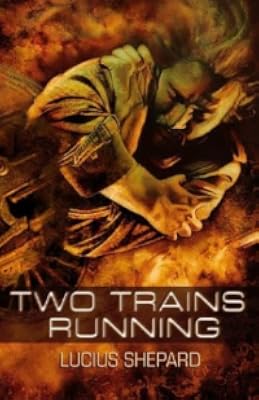
Lucius Shepard was born in Lynchburg, Virginia in 1947. He wrote in many different genres including science fiction and fantasy, cyberpunk, magical realism, poetry, and non-fiction. He published his first short stories in 1983 and his first novel, Green Eyes, in 1984. His other works include Life During Wartime, The Jaguar Hunter, and Two Trains show more Running. He won several awards including the John W. Campbell Award for Best New Writer in 1985, the Nebula Award for the novella R&R, the Hugo Award for the novella Barnacle Bill the Spacer, and the Shirley Jackson Award for the novella Vacancy. He died on March 18, 2014 at the age of 66. (Bowker Author Biography) show less
Some Editions
Awards and Honors
Awards
Classifications
Statistics
- Members
- 40
- Popularity
- 733,741
- Reviews
- 1
- Rating
- (4.50)
- Languages
- English
- Media
- Paper
- ISBNs
- 2


