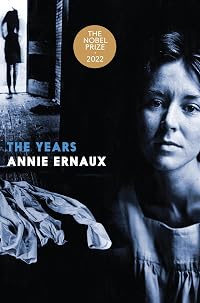
The Years
by Annie Ernaux
On This Page
Description
This is a personal narrative of the period 1941 to 2006 told through the lens of memory, impressions past and present -- even projections into the future -- photos, books, songs, radio, television and decades of advertising, headlines, contrasted with intimate conflicts and writing notes from six decades of diaries. Local dialect, words of the times, slogans, brands and names for the ever-proliferating objects, are given voice here. The voice we recognize as the author's continually show more dissolves and re-emerges. Ernaux makes the passage of time palpable. Time itself, inexorable, narrates its own course, consigning all other narrators to anonymity. A new kind of autobiography emerges, at once subjective and impersonal, private and collective. On its 2008 publication in France, The Years came as a surprise. Though Ernaux had for years been hailed as a beloved, bestselling and award-winning author, The Years was in many ways a departure: both an intimate memoir written by entire generations, and a story of generations telling a very personal story. Like the generation before hers, the narrator eschews the "I" for the "we" (or "they", or "one") as if collective life were inextricably intertwined with a private life that in her parents' generation ceased to exist. She writes of her parents' generation (and could be writing of her own book): "From a common fund of hunger and fear, everything was told in the we and impersonal pronouns. show lessTags
Recommendations
















Member Recommendations
Babou_wk Une vie racontée à partir de photographies.
JuliaMaria Zeitgeschichte, feministische Geschichte erzählt im Roman
Member Reviews
The first question one wants to ask is is this a novel or a memoir? The closest kin (in book terms) is Karl Ove Knausgaard's
My Struggle, but there are others where the re-explored and re-imagined life can be considered as both memoir and fiction. The author is generally after a 'truth' that might not exactly please family members as being 'what happened' as well as being absurd to claim that your version is the "real" one but Ernaux has side-stepped or gone further by attaching the life of the narrator/protagonist to the events going on concurrently during her life. She doesn't separate herself as a single individual exclusively, but as both -- herself and a person deeply influenced, indeed arguably created by the times she has lived show more in. It's a breathtaking concept and she succeeded in giving me a new way to regard my own life -- something only the great writers can do, shift a little something in your head. Not easy to read but I suggest that if you plan to, don't get hung up on the details of what was going on in France but associate them with your own experience at that time in your own context and at the appropriate age. A younger person would find this more challenging but they might find themselves examining their present obsessions and beliefs more skeptically! I read about half the book in French and English together then ran out of time and read only the English for the remainder. I plan to read the rest of her work. Extraordinary. ***** show less
My Struggle, but there are others where the re-explored and re-imagined life can be considered as both memoir and fiction. The author is generally after a 'truth' that might not exactly please family members as being 'what happened' as well as being absurd to claim that your version is the "real" one but Ernaux has side-stepped or gone further by attaching the life of the narrator/protagonist to the events going on concurrently during her life. She doesn't separate herself as a single individual exclusively, but as both -- herself and a person deeply influenced, indeed arguably created by the times she has lived show more in. It's a breathtaking concept and she succeeded in giving me a new way to regard my own life -- something only the great writers can do, shift a little something in your head. Not easy to read but I suggest that if you plan to, don't get hung up on the details of what was going on in France but associate them with your own experience at that time in your own context and at the appropriate age. A younger person would find this more challenging but they might find themselves examining their present obsessions and beliefs more skeptically! I read about half the book in French and English together then ran out of time and read only the English for the remainder. I plan to read the rest of her work. Extraordinary. ***** show less
Though I did not love this book, I can see how someone would (especially the French, as there is A LOT of French political history in here).
This books is a "generational" memoir, for lack of a better term. Ernaux has written a memoir that is told through her eyes, experiencing life as a member of a generation. The entire generation experienced the same school types, media, events, politicians, changing laws, changing sexual morés, etc. It begins with the description of a baby in a photo c1941 (herself) and continues into the 21st century. It is fully linear, discussing daily life, dreams, politics, family, work (she was a teacher), relationships, immigration, and so on.
Early on she examines the world her grandparents discuss at the show more table, the world her generation never knew, of dirt floors in houses and washing clothes in wood-ash (p25), and of the provincialness of different areas of France: their habits, food (p33), voices, "a mangled French mixed with local dialects" (p27), the following the Catholic calendar and sexual morés, and living in the scarcity of everything (p34). And how, for her generation, the school calendar replaced that of the season (p29).
My favorite bits revolved around the consumerism. First it was exciting, as "the days of restrictions were at an end" (p37). "We had time to desire things, plastic pencil cases, crepe-soled shoes, gold watches" (p39)--while they lived without indoor plumbing, enitre families sleeping in one room, with mustard poultices a common medicine.
p 110: "And we who were undeceived, who seriously examined the dangers of advertising with our students; we who assigned the topic "Does the possession of material goods lead to happiness?" nought a stereo, a Grundig radio-cassette player, and a Bell & Howell Super 8 camera, with a sense of using modernity to intelligent ends. For us and by us, consumption was purified." This continues, right up to computers and cell phones. She is as nervous about a cellphone as her parents' generation was about computers. Which brings up aging, and how it sneaks up on you. "For a moment we were struck by the strangeness of repeating a ritual in which we now occupied the middle position between two generations" (p129) "She pictures herself in ten or fifteen years...for grandchildren not yet born. BUt she sees that woman as improbable, just as the girl of 25 saw the woman of forty, who she has become and already ceased to be" (p169).
There are two quotes at the very beginning of the book--facing the copyright page. On by José Ortega, the other by Chekhov. Part of the Chekhov quote: "And it may be that our present life, which we accept so readily, will in time seem strange, inconvenient, stupid, not clean enough, perhaps even sinful...". That is pretty much what this book is about. show less
This books is a "generational" memoir, for lack of a better term. Ernaux has written a memoir that is told through her eyes, experiencing life as a member of a generation. The entire generation experienced the same school types, media, events, politicians, changing laws, changing sexual morés, etc. It begins with the description of a baby in a photo c1941 (herself) and continues into the 21st century. It is fully linear, discussing daily life, dreams, politics, family, work (she was a teacher), relationships, immigration, and so on.
Early on she examines the world her grandparents discuss at the show more table, the world her generation never knew, of dirt floors in houses and washing clothes in wood-ash (p25), and of the provincialness of different areas of France: their habits, food (p33), voices, "a mangled French mixed with local dialects" (p27), the following the Catholic calendar and sexual morés, and living in the scarcity of everything (p34). And how, for her generation, the school calendar replaced that of the season (p29).
My favorite bits revolved around the consumerism. First it was exciting, as "the days of restrictions were at an end" (p37). "We had time to desire things, plastic pencil cases, crepe-soled shoes, gold watches" (p39)--while they lived without indoor plumbing, enitre families sleeping in one room, with mustard poultices a common medicine.
p 110: "And we who were undeceived, who seriously examined the dangers of advertising with our students; we who assigned the topic "Does the possession of material goods lead to happiness?" nought a stereo, a Grundig radio-cassette player, and a Bell & Howell Super 8 camera, with a sense of using modernity to intelligent ends. For us and by us, consumption was purified." This continues, right up to computers and cell phones. She is as nervous about a cellphone as her parents' generation was about computers. Which brings up aging, and how it sneaks up on you. "For a moment we were struck by the strangeness of repeating a ritual in which we now occupied the middle position between two generations" (p129) "She pictures herself in ten or fifteen years...for grandchildren not yet born. BUt she sees that woman as improbable, just as the girl of 25 saw the woman of forty, who she has become and already ceased to be" (p169).
There are two quotes at the very beginning of the book--facing the copyright page. On by José Ortega, the other by Chekhov. Part of the Chekhov quote: "And it may be that our present life, which we accept so readily, will in time seem strange, inconvenient, stupid, not clean enough, perhaps even sinful...". That is pretty much what this book is about. show less
"Save something from the time where we will never be again."
This is the story of a woman's life (Annie Ernaux's) merged and intertwined with the history of her times, from 1940 (when she was born) through 2008, shortly before the book was published. The book is structured with recurring leitmotifs--photographs at intervals, starting when she was a baby and ending when she was a grandmother. She describes each photograph, who took them, and tries to surmise what the subject (herself at various ages) may have been thinking, or was thinking, if she remembers. She also describes the circumstances of her life at the time, her thoughts and goals if she can remember them.
Another motif is family dinners over time, what was eaten who was there, show more what the discussions were about, and how all of these changed over time.
In between these mostly personal things are people, events, trends, intellectual thoughts, occurring or prevalent at the time, some seemingly grabbed from the headlines ("the day Saigon fell we realized that we'd never believed an American defeat possible. They were finally paying for the napalm, the little girl on the poster that hung on our walls.").
At various times during her adulthood, she discusses a book she wants to write, and considers how to arrange it. She wants to write a book that would be a personal narrative, but also a history of her time, "How would she organize the accumulated memory of events and news items and the thousands of days that have conveyed her to the present?" And this is the book that resulted.
Annie Ernaux, who won the Nobel for literature this year, is a few years older than me, but many of her experiences were my experiences, and this book really spoke to me (i.e. "1968 was the first year of the world."). Since her life was mostly lived in Europe, the events she discusses are more Euro-centric, so there were many references I was unfamiliar with. But thank goodness for Google.
Her statements about aging in particular resonate with me at this particular time of my life:
"She has lost her sense of the future, a kind of limitless background on which her actions and gestures were once projected, a waiting for all the good and unknown things that lived inside her...."
and,
"As the time ahead objectively decreases, the time behind her stretches farther and farther back, to long before birth and ahead to a time after her death."
Highly recommended.
5 stars show less
This is the story of a woman's life (Annie Ernaux's) merged and intertwined with the history of her times, from 1940 (when she was born) through 2008, shortly before the book was published. The book is structured with recurring leitmotifs--photographs at intervals, starting when she was a baby and ending when she was a grandmother. She describes each photograph, who took them, and tries to surmise what the subject (herself at various ages) may have been thinking, or was thinking, if she remembers. She also describes the circumstances of her life at the time, her thoughts and goals if she can remember them.
Another motif is family dinners over time, what was eaten who was there, show more what the discussions were about, and how all of these changed over time.
In between these mostly personal things are people, events, trends, intellectual thoughts, occurring or prevalent at the time, some seemingly grabbed from the headlines ("the day Saigon fell we realized that we'd never believed an American defeat possible. They were finally paying for the napalm, the little girl on the poster that hung on our walls.").
At various times during her adulthood, she discusses a book she wants to write, and considers how to arrange it. She wants to write a book that would be a personal narrative, but also a history of her time, "How would she organize the accumulated memory of events and news items and the thousands of days that have conveyed her to the present?" And this is the book that resulted.
Annie Ernaux, who won the Nobel for literature this year, is a few years older than me, but many of her experiences were my experiences, and this book really spoke to me (i.e. "1968 was the first year of the world."). Since her life was mostly lived in Europe, the events she discusses are more Euro-centric, so there were many references I was unfamiliar with. But thank goodness for Google.
Her statements about aging in particular resonate with me at this particular time of my life:
"She has lost her sense of the future, a kind of limitless background on which her actions and gestures were once projected, a waiting for all the good and unknown things that lived inside her...."
and,
"As the time ahead objectively decreases, the time behind her stretches farther and farther back, to long before birth and ahead to a time after her death."
Highly recommended.
5 stars show less
The Years is a narrative of the period 1941 to 2006 told through the very selective recollection of memories of the French author, interspersed amongst the impressions, cultural habits, language, descriptions of photos, books, songs, radio, films, television, advertising and news headlines.
The author does this in a chronological manner, interleaving personal recollections into more generalised commentary on social changes, with the personal comments integral to the narrative but feeling detached from the author, as she seeks to recall her thoughts at the time, as well as allowing some hindsight for comments on world events, such as the French fighting in Indo-China and then Algeria.
Although some short phrases are left in French, these show more are generally easily understood, or for longer passages there are useful notes providing a translation, as there are also a few notes for particular matters, such as the names of the school years or textbooks known by their authors.
This book provides an enjoyable, but demanding, insight into life as lived by an educated French woman during these years. Although the lists of books, films, actresses etc powerfully anchor the book in its time, they might also be considered a lazy shorthand for portraying the intellectual, cultural and political thoughts by trying to generalise the particular.
This method works well when the reader recognises the references, quickly conjuring up the milieu. However I am British and twenty odd years younger than the author, so that many references are lost on me. I am unsure how this historical collage shorthand approach will be understood by someone another thirty years younger than me, or a non-European without the ability to quickly transform the lists into the milieu. For example, in a list of contrasts (for example Khrushchev/Kennedy) there is Peppone/Don Camillo; I know that these are the contrasting communist mayor and catholic priest from the Italian Don Camillo short stories, but these references are culturally time specific. A reference to Mylène Demongeot left me none the wiser, having to look up the name on Wikipedia (she’s an actress) and reference to a red staircase in a Soutine painting did not increase my understanding, being unable to locate a copy of the painting on Wikiart. When too many references are lost on the reader, they detract from the overall impression, they become like the lists of ancestors in the Old Testament.
I enjoyed the recollection of family reunions with the telling of anecdotes, familiar family stories, how they change over the years, which is skilfully portrayed at intervals throughout the book. It called to mind evenings at my grandparents when an uncle or family friend would visit and have supper, reminiscing (yarns) and gossiping over the meal.
To quote Ernaux:
By retrieving the memory of collective memory in an individual memory, she will capture the lived dimension of History.
This will not be a work of remembrance in the usual sense, aimed at putting a life into story, creating an explanation of self. She will go within herself only to retrieve the world, the memory and imagination of its bygone days, grasp the changes in ideas, beliefs, and sensibility, the transformation of people and the subject that she has seen.
There is no ‘I’ in what she views as a sort of impersonal autobiography. There is only ‘one’ and ‘we’, as if now it were her turn to tell the story of the time-before.
Overall, I am left conflicted. This is an outstanding and readable work of French social history, which does successfully work as an impersonal autobiography, although the closer the author got to 2006, the less persuasive it becomes. However because of its deliberately impersonal approach, I feel little empathy with the author telling her individual story, so that on the other hand, it becomes a book where history “is just one damned thing after another”.
My conclusion, it is successful French social history 1945-2000, leveraging off the personal specifically to fix the social history as lived experience. It is just confusing if you expect autobiography, which I had.
As an aside, I had just read One Two Three Four, a group biography of the Beatles, which includes a broadly contemporary narrative up to about 1960 when the Beatles started touring (Hamburg and England). From mentions in both books, I had never appreciated the cultural impact of Brigitte Bardot. In 1956-7 Ernaux pasted photos of Brigitte Bardot in And God Created Woman in her room and in Liverpool, John Lennon pinned up multiple posters of her in his bedroom. show less
The author does this in a chronological manner, interleaving personal recollections into more generalised commentary on social changes, with the personal comments integral to the narrative but feeling detached from the author, as she seeks to recall her thoughts at the time, as well as allowing some hindsight for comments on world events, such as the French fighting in Indo-China and then Algeria.
Although some short phrases are left in French, these show more are generally easily understood, or for longer passages there are useful notes providing a translation, as there are also a few notes for particular matters, such as the names of the school years or textbooks known by their authors.
This book provides an enjoyable, but demanding, insight into life as lived by an educated French woman during these years. Although the lists of books, films, actresses etc powerfully anchor the book in its time, they might also be considered a lazy shorthand for portraying the intellectual, cultural and political thoughts by trying to generalise the particular.
This method works well when the reader recognises the references, quickly conjuring up the milieu. However I am British and twenty odd years younger than the author, so that many references are lost on me. I am unsure how this historical collage shorthand approach will be understood by someone another thirty years younger than me, or a non-European without the ability to quickly transform the lists into the milieu. For example, in a list of contrasts (for example Khrushchev/Kennedy) there is Peppone/Don Camillo; I know that these are the contrasting communist mayor and catholic priest from the Italian Don Camillo short stories, but these references are culturally time specific. A reference to Mylène Demongeot left me none the wiser, having to look up the name on Wikipedia (she’s an actress) and reference to a red staircase in a Soutine painting did not increase my understanding, being unable to locate a copy of the painting on Wikiart. When too many references are lost on the reader, they detract from the overall impression, they become like the lists of ancestors in the Old Testament.
I enjoyed the recollection of family reunions with the telling of anecdotes, familiar family stories, how they change over the years, which is skilfully portrayed at intervals throughout the book. It called to mind evenings at my grandparents when an uncle or family friend would visit and have supper, reminiscing (yarns) and gossiping over the meal.
To quote Ernaux:
By retrieving the memory of collective memory in an individual memory, she will capture the lived dimension of History.
This will not be a work of remembrance in the usual sense, aimed at putting a life into story, creating an explanation of self. She will go within herself only to retrieve the world, the memory and imagination of its bygone days, grasp the changes in ideas, beliefs, and sensibility, the transformation of people and the subject that she has seen.
There is no ‘I’ in what she views as a sort of impersonal autobiography. There is only ‘one’ and ‘we’, as if now it were her turn to tell the story of the time-before.
Overall, I am left conflicted. This is an outstanding and readable work of French social history, which does successfully work as an impersonal autobiography, although the closer the author got to 2006, the less persuasive it becomes. However because of its deliberately impersonal approach, I feel little empathy with the author telling her individual story, so that on the other hand, it becomes a book where history “is just one damned thing after another”.
My conclusion, it is successful French social history 1945-2000, leveraging off the personal specifically to fix the social history as lived experience. It is just confusing if you expect autobiography, which I had.
As an aside, I had just read One Two Three Four, a group biography of the Beatles, which includes a broadly contemporary narrative up to about 1960 when the Beatles started touring (Hamburg and England). From mentions in both books, I had never appreciated the cultural impact of Brigitte Bardot. In 1956-7 Ernaux pasted photos of Brigitte Bardot in And God Created Woman in her room and in Liverpool, John Lennon pinned up multiple posters of her in his bedroom. show less
Sauver quelque chose du temps où l'on ne sera plus jamais
Les Années is a very interesting attempt to mix the forms of memoir and social history to create a kind of depersonalised autobiography which is at the same time a history of living in France from the 1940s to the early 21st century - from de Gaulle to Sarko. She writes about herself in the third person ("elle", not "je") and avoids the perfect tense as far as possible to insist on the generality of the experiences she is describing. She isn't trying to rewrite Proust: "La recherche du temps perdu passait par le web", she notes ironically when discussing the first years of the new century. But the book does take concrete artefacts, in particular photographs of herself, as show more stimulants of memory.
The viewpoint is detached, none of the characters in the story is named, but she doesn't try to step entirely outside her own experience: she is explicitly writing as a woman born in the 1940s, coming from a provincial, working-class background, and spending her working life in an intellectual, left-leaning environment. The text is full of references to products, films, books, songs, political and cultural events, causes, technological change, and all the other markers that we use to place ourselves in history, but it becomes vague and allusive when it is talking about personal life. Births and deaths happen offstage, love affairs are commented on mostly in retrospect (Ernaux has written in detail about all these things elsewhere, of course).
Obviously you miss some of the fine detail of this if you haven't actually lived in France during the decades she is describing (I've probably seen about 1/10 of the films she mentions and heard of about half of the politicians and musicians...), but that isn't really important: it's a book that makes you think about history and memory and the way the two work together in literature, and that's always an interesting and worthwhile exercise. And it manages to look at nearly seventy years of social and political change without becoming morose and pessimistic. The tone is always pleasantly ironic, never overcome by events, but never so detached that it refuses to take a moral stand. Very nicely done! show less
Les Années is a very interesting attempt to mix the forms of memoir and social history to create a kind of depersonalised autobiography which is at the same time a history of living in France from the 1940s to the early 21st century - from de Gaulle to Sarko. She writes about herself in the third person ("elle", not "je") and avoids the perfect tense as far as possible to insist on the generality of the experiences she is describing. She isn't trying to rewrite Proust: "La recherche du temps perdu passait par le web", she notes ironically when discussing the first years of the new century. But the book does take concrete artefacts, in particular photographs of herself, as show more stimulants of memory.
The viewpoint is detached, none of the characters in the story is named, but she doesn't try to step entirely outside her own experience: she is explicitly writing as a woman born in the 1940s, coming from a provincial, working-class background, and spending her working life in an intellectual, left-leaning environment. The text is full of references to products, films, books, songs, political and cultural events, causes, technological change, and all the other markers that we use to place ourselves in history, but it becomes vague and allusive when it is talking about personal life. Births and deaths happen offstage, love affairs are commented on mostly in retrospect (Ernaux has written in detail about all these things elsewhere, of course).
Obviously you miss some of the fine detail of this if you haven't actually lived in France during the decades she is describing (I've probably seen about 1/10 of the films she mentions and heard of about half of the politicians and musicians...), but that isn't really important: it's a book that makes you think about history and memory and the way the two work together in literature, and that's always an interesting and worthwhile exercise. And it manages to look at nearly seventy years of social and political change without becoming morose and pessimistic. The tone is always pleasantly ironic, never overcome by events, but never so detached that it refuses to take a moral stand. Very nicely done! show less
Annie Ernaux's book belongs in that odd genre of auto-fiction, books that are based on the author's own life, but the events of the past have either been altered or the author concedes that their own memories are not necessarily accurate. Here, Ernaux takes her own life and memories as a way of telling the story of what life was like during her life, for herself, for women in France, and for France itself.
Beginning in the mid-1940s, the book begins with Ernaux's earliest memories, and with descriptions of family photos of herself. As her story moves forward, it becomes a universal story of a time and place, of what family dinners looked like, what school was like and how things changed over time, with lifestyles adapting to the show more availability of consumer goods, as the older folks died and so the Sunday dinner conversations moved on from the war to other subjects, like the events in Algeria or student uprisings.
This is a superbly constructed and immensely readable book. I did stop many times to look up names and events, but that was due to my lack of knowledge of French history and popular culture. It was so interesting to look at a time slightly different from my own (Ernaux belongs to my parents' generation) and at a country other than my own. Ernaux mixes the personal with the universal as she writes her way through the years of her life and the result is something greater than either a straight memoir or social history would have been. show less
Beginning in the mid-1940s, the book begins with Ernaux's earliest memories, and with descriptions of family photos of herself. As her story moves forward, it becomes a universal story of a time and place, of what family dinners looked like, what school was like and how things changed over time, with lifestyles adapting to the show more availability of consumer goods, as the older folks died and so the Sunday dinner conversations moved on from the war to other subjects, like the events in Algeria or student uprisings.
This is a superbly constructed and immensely readable book. I did stop many times to look up names and events, but that was due to my lack of knowledge of French history and popular culture. It was so interesting to look at a time slightly different from my own (Ernaux belongs to my parents' generation) and at a country other than my own. Ernaux mixes the personal with the universal as she writes her way through the years of her life and the result is something greater than either a straight memoir or social history would have been. show less
A soulless and joyless march through a life conceived as a passive recipient of headlines and social events. The author explains her purpose at the end. She creates a narrator who is an unstable collection of observations--there is no I, no person, or subject who experiences life. It didn't work for me. I care very much about the person who is a moral agent, who finds higher values and purpose in life, and makes sense of the whirlwind of "history." Maybe she proves Descartes' point. Try as she did, there is an I there, but that I is a weak and passive recipient of confusing forces--life happens to her, but the anemic response isn't love or rage or really much of anything.
Members
- Recently Added By
Lists

Top Five Books of 2022
736 works; 272 members

Books Read in 2013
1,630 works; 51 members

Books recommended in the history category on FiveBooks.com
329 works; 4 members

.
184 works; 1 member

Les 50 meilleurs livres de langue française de 1900 à aujourd’hui
69 works; 2 members

NYT 100 best books of 21st C
100 works; 31 members

French, female, working-class authors
26 works; 2 members

Books Read in 2023
5,547 works; 145 members
Nobel Price Winners
222 works; 20 members

Fiction about the Working Class
74 works; 10 members

Top Five Books of 2021
604 works; 181 members

Books Read in 2021
5,361 works; 114 members

Five star books
1,757 works; 108 members

Elena Ferrante's 40 favourite books by female authors
40 works; 10 members

Female Author
1,235 works; 67 members

Books Read in 2016
4,666 works; 199 members

contemporary literary fiction list to check out
47 works; 1 member
Author Information

61+ Works 8,976 Members
Annie Ernaux was born in 1940 in Normandy. She is the winner of numerous prizes including the Prix Renaudot. Her "A Woman's Story", "A Man's Place", and "Simple Passion" were all "New York Times" Notable Books. "A Woman's Story" was also a "Los Angeles Times" Fiction Prize finalist and "A Man's Place" was a French-American Foundation Award show more finalist. Her Previous book "Shame", was named a Best Book of 1998 by "Publishers Weekly". Her books are taught in schools throughout France as contemporary classics. Ernaux lives outside Paris. (Bowker Author Biography) show less
Some Editions
Awards and Honors
Awards
Distinctions
Notable Lists
Series
Belongs to Publisher Series
Work Relationships
Is contained in
Has the adaptation
Common Knowledge
- Canonical title
- The Years
- Original title
- Les années
- Original publication date
- 2008
- Important places
- Yvetot, Normandy, France; France
- Epigraph
- All we have is our history, and it
does not belong to us.
—José Ortega y Gasset
Yes. They’ll forget us. Such is our fate, there is no help for it. What seems to us serious, significant, very important, will one day be forgotten or will seem unimportant. And it’s curious that we can’t possibly tell ... (show all)what exactly will be considered great and important, and what will seem petty and ridiculous [. . .]. And it may be that our present life, which we accept so readily, will in time seem strange, inconvenient, stupid, not clean enough,
perhaps even sinful . . .
—Anton Chekhov
Translated from the Russian by Constance Garnett
(New York: Macmillan, 1916) - First words
- All the images will disappear.
- Last words*
- (Click to show. Warning: May contain spoilers.)Etwas von der Zeit retten, in der man nie wieder sein wird.
- Original language
- French
*Some information comes from Common Knowledge in other languages. Click "Edit" for more information.
Classifications
Statistics
- Members
- 1,841
- Popularity
- 11,771
- Reviews
- 73
- Rating
- (4.05)
- Languages
- 17 — Catalan, Chinese, Czech, Danish, Dutch, English, Finnish, French, German, Greek, Hungarian, Italian, Polish, Portuguese, Slovenian, Spanish, Swedish
- Media
- Paper, Audiobook, Ebook
- ISBNs
- 59
- ASINs
- 19