Millennium People
by J. G. Ballard
On This Page
Description
The explosive J. G. Ballard renaissance, which began with the 2009 publication of The Complete Stories of J. G. Ballard, now continues with his first novel to be published in America in a full decade.Millennium People tells the story of David Markham, a psychologist who is searching for the truth behind a bomb that exploded on a Heathrow baggage carousel, killing his ex-wife. Infiltrating a shadowy protest group responsible for her death, David finds himself succumbing to the charismatic show more charms of the group's leader, who hopes to foment a violent rebellion against the government by his fanatical adherents, the spiritually and financially impoverished members of Britain's white middle class. It reveals a shockingly plausible and extremely unsettling vision of society in collapse.
. show less
Tags
Recommendations















Member Reviews
This is the seventh book I've read this month for my J.G. Ballard binge and I've decided it's going to be my last because I'm building up a residue of a theme, from these novels, that links them, and that is amplified with each next novel; a theme that might be condensed as "How weary, stale, flat, and unprofitable seem to me all the uses of this world."
As with every other Ballard novel I've read this month, Ballard's prose here is unique and flabbergasting (if that's a word). Nearly every sentence he writes is a condensed, nearly psychedelic rendering of a nihilistic and yet somehow excruciatingly beautiful worldview.
A bitter poetry that makes no apologies.
I feel like I've been flayed.
As with every other Ballard novel I've read this month, Ballard's prose here is unique and flabbergasting (if that's a word). Nearly every sentence he writes is a condensed, nearly psychedelic rendering of a nihilistic and yet somehow excruciatingly beautiful worldview.
A bitter poetry that makes no apologies.
I feel like I've been flayed.
Come si fa a dare un voto a Ballard? Ballard o lo ami o lo odi, ma non puoi rimanere indifferente davanti alle sue visioni sessual - apocalittiche, oniriche e demoniache nello stesso tempo.
Ballard mi piace, ma spesso la lettura è difficile, e del fatto che un suo libro ti abbia arricchito te ne rendi conto solo quando, faticosamente, sei arrivato in fondo.
Ballard mi piace, ma spesso la lettura è difficile, e del fatto che un suo libro ti abbia arricchito te ne rendi conto solo quando, faticosamente, sei arrivato in fondo.
An entertaining tale, funny at times, occasionally prescient, imaginative but ultimately a little too silly for my taste.
The plot of the novel revolves around a gated estate in Fulham called Chelsea Marina, where a professional middle class population is increasingly being squeezed financially by the cost of living and rapacious landlords, making them vulnerable to the maverick agitator Dr Richard Gould and his revolutionary ideas. Their protests are witnessed by the narrator David Markham, a psychologist who starts investigating them after his ex-wife is killed by a bomb at Heathrow Airport and becomes deeply involved in the movement. We know from the start that the protests and the resulting clashes with the police became pretty show more extreme because the first chapter has Markham returning to the estate in the aftermath of the final confrontation, but Ballard still manages some shocks and surprises along the way.
My reservations were partly that it was all a bit too thrillerish for my taste, but also because I am British and I remember the period Ballard is talking about. While he is right that the righteous anger of the middle classes can sometimes get extreme and spill over into violence, I didn't believe that they would spontaneously join an uprising with no political ideas or financial vested interests behind it. Some of Ballard's influences are transparent, for example the apparently murder of a minor television personality at her home is clearly a mildly fictionalised account of the Jill Dando case. The Hungerford massacre was also crucial to Gould's psychological make-up, but that was the action of an individual loner - I understand that Ballard is partly motivated by trying to understand what motivates such extreme and random actions. Ballard's view of Britain is overwhelmingly white, middle-class and London-centric, and conventional politics is almost entirely absent from his narrative, as is any form of external agitation or religious motivation.
An interesting book, so thanks to Lark for choosing it for a discussion in the 21st Century Literature group. show less
The plot of the novel revolves around a gated estate in Fulham called Chelsea Marina, where a professional middle class population is increasingly being squeezed financially by the cost of living and rapacious landlords, making them vulnerable to the maverick agitator Dr Richard Gould and his revolutionary ideas. Their protests are witnessed by the narrator David Markham, a psychologist who starts investigating them after his ex-wife is killed by a bomb at Heathrow Airport and becomes deeply involved in the movement. We know from the start that the protests and the resulting clashes with the police became pretty show more extreme because the first chapter has Markham returning to the estate in the aftermath of the final confrontation, but Ballard still manages some shocks and surprises along the way.
My reservations were partly that it was all a bit too thrillerish for my taste, but also because I am British and I remember the period Ballard is talking about. While he is right that the righteous anger of the middle classes can sometimes get extreme and spill over into violence, I didn't believe that they would spontaneously join an uprising with no political ideas or financial vested interests behind it. Some of Ballard's influences are transparent, for example the apparently murder of a minor television personality at her home is clearly a mildly fictionalised account of the Jill Dando case. The Hungerford massacre was also crucial to Gould's psychological make-up, but that was the action of an individual loner - I understand that Ballard is partly motivated by trying to understand what motivates such extreme and random actions. Ballard's view of Britain is overwhelmingly white, middle-class and London-centric, and conventional politics is almost entirely absent from his narrative, as is any form of external agitation or religious motivation.
An interesting book, so thanks to Lark for choosing it for a discussion in the 21st Century Literature group. show less
I read this in London a month after the July 2005 bombings by young English muslims, though Ballard is not interested in the kind of sociological and historical explanations that might account for those atrocities. His bombers are middle class professionals, and mostly white. Their anger is a kind of existential disease of affluence - an extension of road rage, tantrums in supermarket queues or assault of parking attendants. As the disruptions come 'home' to London (after the continental European locations of Super Cannes and Cocaine Nights), this book has more echoes of The Atrocity Exhibition near the start of Ballard's career.
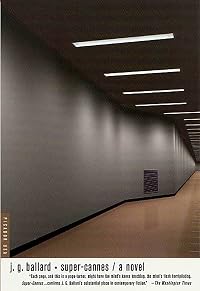
I've read the previous two novels Ballard wrote before this one, Cocaine Nights and Super-Cannes, and this continued to explore the themes of middle class rebellion against a society they have unwittingly created. The story is about a violent uprising championed by a small group of disillusioned professionals including a doctor and parish minister. You can almost imagine it happening. The things the middle class aspire to - good housing, schooling, law enforcement, job security - have become beyond their reach or have been turned against them. Who in society will support or even listen to their grievances? The poor have their support structures, the rich buy theirs and the government needs the man in the middle to placidly support both. show more For what, asks Ballard? His characters set out to smash the system and increasingly find themselves enjoying the anarchy for its own sake. The book is full of challenging ideas, and manages to avoid the easy targets that your typical Daily Mail reader might settle upon to rebel against. If you haven't read anything by this author, he's more than worth a look. show less
From reading the reviews below, perhaps this is a book for relative newcomers to Ballard (I've only read the Empire of the Sun and the Kindness of Women before). I thought this was provocative and compelling; a book that engages humorously and challengingly with modern anomie and our current post Marxist, post Thatcher state of apathy. So few writers today really try to engage with the social world in which we live, that Ballard's fantastical take on it seems all the more refreshing and unsettling.
Middle class rebelling against what it created. Molotov cocktails made with Perrier bottle and regimental ties, "Bonfire of the Volovos", the book picks up on the most endangered sector of society trying to free itself from the world it worked for and created...or could it just be something meaningless.
Members
- Recently Added By
Published Reviews
ThingScore 100
C'est du Ballard très politique, psychiquement moins dérangeant que Crash ou La Foire aux atrocités, facile d'accès, presque trop.
added by miniwark
Lists

The Guardian's 1000 Novels Everyone Must Read
1,005 works; 547 members
Author Information

291+ Works 37,704 Members
J. G. Ballard was born to British parents in Shanghai, China on November 15, 1930. While a child during World War II, he spent four years in a Japanese POW camp. This experience was the basis for the emotionally moving novel Empire of the Sun, which he adapted into a successful movie, directed by Steven Spielberg. Before becoming a full-time show more writer, he studied medicine at Cambridge University and served as a pilot in the British Royal Air Force. Ballard is best known for his science fiction writings. His early works were heavily influenced by surrealism. Most of his novels deal with death and destruction of the human spirit. Novels such as Crash, Concrete Island, and High Rise portray a society that is devolving into barbaric chaos. Crash was made into a movie by David Cronenberg in 1996. The Drowned World describes an apocalyptic society, with a hero that ushers in the destruction of the world. His novel Empire of the Sun was shortlisted for the Booker Prize and awarded the Guardian Fiction Prize and James Tait Black Memorial Prize for fiction. Empire of the Sun was filmed by Steven Spielberg in 1987, starring a young Christian Bale as Jim (Ballard). Ballard moved away from science fiction, but he is still considered one of the leading authors of the genre. He died on April 19, 2009 at the age of 78. (Bowker Author Biography) show less
Some Editions
Awards and Honors
Series
Belongs to Publisher Series
Gallimard, Folio (4350)
Common Knowledge
- Original publication date
- 2003
- First words
- A small revolution was taking place, so modest and well-behaved that almost no-one had noticed.
Classifications
Statistics
- Members
- 951
- Popularity
- 27,837
- Reviews
- 19
- Rating
- (3.17)
- Languages
- 12 — Czech, Dutch, English, French, German, Greek, Italian, Japanese, Polish, Portuguese, Spanish, Turkish
- Media
- Paper, Audiobook, Ebook
- ISBNs
- 32
- ASINs
- 8