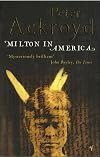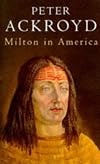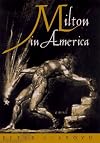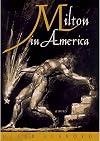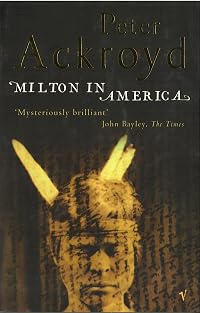
Milton in America
by Peter Ackroyd
On This Page
Description
What if John Milton, Cromwell's secretary, anticipating the King's return to London, had decided to flee England in order to avoid imprisonment or death? What if he had crossed the ocean and joined the Puritans recently settled in New England? From this idea Peter Ackroyd creates an enthralling story of conflict, treachery, hypocrisy and greed.Tags
Recommendations


















Member Reviews
En 1660, John Milton débarque sur le continent américain, terre encore vierge des turpitudes de la monarchie qui l'ont chassé, lui, le célèbre poète aveugle, de la Vieille Angleterre. À son arrivée, des Puritains, prudes commères et rigides travailleurs, le supplient de se mettre à la tête de leur communauté. C'est pour un intellectuel l'occasion rêvée de créer de toutes pièces la société républicaine et chaste qu'il vantait dans ses pamphlets. Décence et labeur sont les piliers de son œuvre, jusqu'au jour où s'installent de l'autre côté de la rivière une bande de catholiques qui narguent les austères Puritains de leurs chants, de leurs danses, de leur intolérable joie de vivre. John Milton comprend que le show more Serpent tentateur vient de s'introduire dans son paradis. show less
Ackroyd explores Milton's complicated and contradictory character by speculating about what might have happened had he fled to America in 1660 and become the spiritual and temporal leader of a Puritan settlement. It's more of a satire of seventeenth-century religious certainty and the intolerance it led to than a serious attempt to describe the Puritan endeavour, but if you read it on that level and accept its one-sided view, it's quite an engaging read, and often rather funny in a bleak, Monrty Python sort of way.
Milton in America (Nan A. Talese, 1997) is Peter Ackroyd's flight of fancy about what might have happened had John Milton opted to leave England at the time of the Restoration and decamp to Puritan America. Told alternately from the perspectives of the blind Milton himself and his companion and guide Goosequill (in both flashbacks and straight narrative, and including transcripts of Milton's missives to an English friend), this novel imagines Milton becoming a sort of Puritanical dictator, enforcing strictures of religion and conduct on the settlers (who are, at first, entirely overawed by Milton's presence and happy to do as he says ... for a while).
There were interesting tidbits of historical material thrown in here and there (but not show more in any systematic way, and usually greatly disguised), but mostly this is Ackroyd musing, creating his own Paradise Lost and putting Milton right in the center of it. He's captured quite well the tensions between English settlers of different religious perspectives and the original inhabitants of the area.
The narrative thread was sometimes rather difficult to keep hold of, and frankly I thought the idea of this book somewhat better than how it ended up being carried off. Nonetheless, a worthy premise, and certainly it's fascinating to think about how things might have gone had Milton in fact crossed the Atlantic and made a new home on this side of the pond.
http://philobiblos.blogspot.com/2010/07/book-review-milton-in-america.html show less
There were interesting tidbits of historical material thrown in here and there (but not show more in any systematic way, and usually greatly disguised), but mostly this is Ackroyd musing, creating his own Paradise Lost and putting Milton right in the center of it. He's captured quite well the tensions between English settlers of different religious perspectives and the original inhabitants of the area.
The narrative thread was sometimes rather difficult to keep hold of, and frankly I thought the idea of this book somewhat better than how it ended up being carried off. Nonetheless, a worthy premise, and certainly it's fascinating to think about how things might have gone had Milton in fact crossed the Atlantic and made a new home on this side of the pond.
http://philobiblos.blogspot.com/2010/07/book-review-milton-in-america.html show less
I often enjoy Ackroyd's novels, but this book is largely a disappointment. Ackroyd's intriguing conceit, that Milton flees to America to escape persecution with the coming of the Restoration leads to little that might not have been achieved in other ways. The place of the character of Milton, who is served by a comic sidekick called Goosequill, could just as well have been taken by any other strong-willed fanatically bigoted American settler (and there were plenty of those). The working of the plot - a dramatic shipwreck in which (mirabile dictu) only Milton and Goosequill survive, a strange magical realistic episode in which Milton is rescued by Indians and temporarily has his sight restored and has sex with a Native American woman, show more Goosequill's mastery of Native American languages after a few informal lessons with a friend - strain credulity without much additional dramatic (or comic) punch. The historical pastiche is disappointing - the sections told from Milton's point of view in letters to a friend, do not sound remotely like anything he might have written. It's hard to know whether this is a jeu d'esprit that got inflated out of control, or serious effort at counter-realist history that never quite takes hold. show less
A curious what if story: the premise of this book is that John Milton runs from the King's return and turns up in the newly discovered America.
Milton's puritanical Christianity causes problems from day one and the tale builds to a war with the next settlement, a Catholic group who raise their leader to the level of king. New Milton, our eponymous hero's township wins a pyrrhic victory over Ralph Kempis (King of Mary Mount - and surely, history's only King Ralph!) .
Milton is not given the pleasure of his victory as he is tricked into an alcohol induced night of sin, after which, he staggers off into the woods, trips and loses the sight which had returned at the hands of an Indian healer.
I found the concept more entertaining than its show more inception: I was not sorry to reach the final full stop. show less
Milton's puritanical Christianity causes problems from day one and the tale builds to a war with the next settlement, a Catholic group who raise their leader to the level of king. New Milton, our eponymous hero's township wins a pyrrhic victory over Ralph Kempis (King of Mary Mount - and surely, history's only King Ralph!) .
Milton is not given the pleasure of his victory as he is tricked into an alcohol induced night of sin, after which, he staggers off into the woods, trips and loses the sight which had returned at the hands of an Indian healer.
I found the concept more entertaining than its show more inception: I was not sorry to reach the final full stop. show less
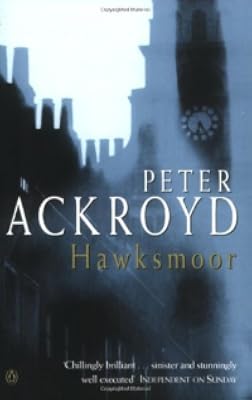
I enjoy Peter Ackroyd's prose and have been a fan since "Hawksmoor", his very chilling possession story. Milton is not his best book, but an interesting exploration of his view of the American character. which seems to be rather autistic. Readable but not captivating.
Ratings
Members
- Recently Added By
Lists

Lives of the Poets (and Philosophers)
110 works; 5 members

real people in fiction circumstances
74 works; 10 members
Author Information

90+ Works 31,852 Members
Peter Ackroyd was born in London in 1949. He graduated from Cambridge University and was a Fellow at Yale (1971-1973). A critically acclaimed and versatile writer, Ackroyd began his career while at Yale, publishing two volumes of poetry. He continued writing poetry until he began delving into historical fiction with The Great Fire of London show more (1982). A constant theme in Ackroyd's work is the blending of past, present, and future, often paralleling the two in his biographies and novels. Much of Ackroyd's work explores the lives of celebrated authors such as Dickens, Milton, Eliot, Blake, and More. Ackroyd's approach is unusual, injecting imagined material into traditional biographies. In The Last Testament of Oscar Wilde (1983), his work takes on an autobiographical form in his account of Wilde's final years. He was widely praised for his believable imitation of Wilde's style. He was awarded the British Whitbread Award for biography in 1984 of T.S. Eliot, and the Whitbread Award for fiction in 1985 for his novel Hawksmoor. Ackroyd currently lives in London and publishes one or two books a year. He still considers poetry to be his first love, seeing his novels as an extension of earlier poetic work. (Bowker Author Biography) Peter Ackroyd is the award-winning author of four biographies, most recently the national bestseller "The Life of Thomas More", as well as ten novels, including "Chatterton" & "Hawksmoor". He lives in London, where he is at work on his next book, "London: The Biography. (Publisher Provided) Peter Ackroyd is a bestselling writer of both fiction and nonfiction. He lives in London. (Publisher Provided) show less
Some Editions
Awards and Honors
Awards
Notable Lists
Common Knowledge
- Original publication date
- 1996
- People/Characters
- John Milton
Classifications
Statistics
- Members
- 388
- Popularity
- 80,745
- Reviews
- 6
- Rating
- (3.27)
- Languages
- 5 — Dutch, English, French, Russian, Spanish
- Media
- Paper, Audiobook, Ebook
- ISBNs
- 12
- ASINs
- 2