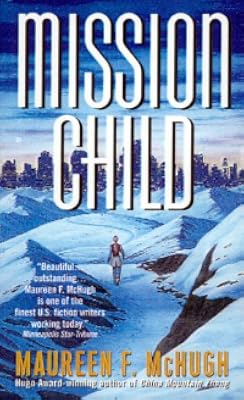
Mission Child
by Maureen F. McHugh
On This Page
Description
Humanity once boldly pushed outward from the Earth to establish colonies throughout the galaxy. But humankind reached too far - overextending, faltering, and ultimately failing - leaving its distant, unremembered settlements to fend for themselves. Now, after many centuries, the progenitors have returned to reclaim their lost territories. A stunning and provocative spiritual odyssey, THE MISSION CHILD is a powerful fable, a stirring adventure and a profoundly moving portrait of a lost woman show more in search of an identity. show lessTags
Recommendations











Member Recommendations
Aquila I kept thinking of the protagonist's journey in Powers as I read Mission Child, apart from being about power and loss they are really very different, though MC is reminiscent of many of Le Guins Hainish books as well.

Member Reviews
‘Mission Child’ is a thoughtful sci-fi novel by the same author as [b:China Mountain Zhang|836964|China Mountain Zhang|Maureen F. McHugh|https://images.gr-assets.com/books/1346669090s/836964.jpg|1607617], which I thought was brilliant. Despite a similar structure and themes, I didn’t find it quite as original and profound. [b:China Mountain Zhang|836964|China Mountain Zhang|Maureen F. McHugh|https://images.gr-assets.com/books/1346669090s/836964.jpg|1607617] was McHugh’s first novel, impressively enough. ‘Mission Child’ also follows the struggles and dilemmas of daily life in a future world, rather than focusing on some grand world-saving plot. Rather than using multiple points of view, though, ‘Mission Child’ has just show more one: Janna/Jan. It’s also a great deal more brutal, as Janna lives on an area of an alien planet with a low technology level. There’s some interesting subtext about this being a deliberate experiment in sustainability, however it’s also a fragile one. The arrival of more advanced technology, specifically guns, destabilises the subsistence economy and forces Janna to flee for their life. Janna’s odyssey in search of a new home is sensitively told and provokes reflection on the parallels between international and interplanetary immigration.
Another fascinating theme throughout the book is gender, as Janna/Jan feels themself to be both man and woman. (The novel is in the first person and, as far as I can tell, the equivalent in current terms would be nonbinary, so I’m using ‘they/them’ pronouns.) This is addressed thoughtfully and undramatically. I also appreciated the clever examination of how technology shapes culture and society, especially the co-existence of the very advanced and very basic. McHugh is not concerned with glorifying technology in itself, as sci-fi sometimes does, but in exploring its impact on the daily life of normal people. Janna and those they meet are not the high-flying rich of the future, in fact quite the opposite: displaced, homeless, without the skills to access decent employment. Not enough novels consider such people, except sometimes to glamorise criminal exploits. There is no glamour here. Indeed, there are some truly horrible depictions of war and plague. ‘Mission Child’ doesn’t wallow in gratuitous horror, rather it considers the unintended consequences of settling other planets through the eyes of a unique and compelling narrator. The cultural world-building is its greatest strength, one unusual enough to be worthy of comment in the sci-fi genre. show less
Another fascinating theme throughout the book is gender, as Janna/Jan feels themself to be both man and woman. (The novel is in the first person and, as far as I can tell, the equivalent in current terms would be nonbinary, so I’m using ‘they/them’ pronouns.) This is addressed thoughtfully and undramatically. I also appreciated the clever examination of how technology shapes culture and society, especially the co-existence of the very advanced and very basic. McHugh is not concerned with glorifying technology in itself, as sci-fi sometimes does, but in exploring its impact on the daily life of normal people. Janna and those they meet are not the high-flying rich of the future, in fact quite the opposite: displaced, homeless, without the skills to access decent employment. Not enough novels consider such people, except sometimes to glamorise criminal exploits. There is no glamour here. Indeed, there are some truly horrible depictions of war and plague. ‘Mission Child’ doesn’t wallow in gratuitous horror, rather it considers the unintended consequences of settling other planets through the eyes of a unique and compelling narrator. The cultural world-building is its greatest strength, one unusual enough to be worthy of comment in the sci-fi genre. show less
I’m not entirely sure what to make of this novel. It had neither a plot nor did it need to be science fiction. And yet it was good. Janna is a teenage girl at an “appropriate technology mission” in the far north. Although the local culture resembles Inuit, the people of the region seem to be descended from northern Europeans. A local tribe wipes out the mission, and only a handful of people escape, including Janna and her husband. They trek to to another tribe, with whom they share kinship, but are never made entirely welcome. Then the tribe that attacked the mission attacks this other tribe, and again Janna and her husband escape. But he dies during the escape, and Janna makes it alone to a coastal city, where she is put in a show more refugee camp. She is mistaken for a man and chooses to impersonate that gender for reasons of safety, although later she decides she is transgender. Janna, now Jan, moves to another city and links up with another tribal person who’s a bit of wideboy, full of semi-legal schemes and deals. Jan gets a job as a technician, brings over a shaman from the refugee camp, and ends up as his helper when the wideboy is murdered after dealing in something high tech he stumbled across. Jan eventually falls out with the shaman and sets off travelling. He ends up on a tropical islands, whose inhabitants are descended from a mix of Indian and Chinese settlers, where he hires out as a bodyguard. But his employer is killed in a raid (this part of the book was originally published as a short story, I believe), and so Jan takes his employer’s daughter to her grandmother on another island, and ends up settling down there. He ends up helping offworlder medics when a plague strikes the islands as he is immune to the disease thanks to a medical implant he was given back in the first chapter. For all that the novel is about the impact of high tech offworlders on the cultures of Jan’s world, there’s no good reason I could see why the novel needed to be set on another world, or even sf. Certainly it gave McHugh free rein in envisaging cultures to make her various points, but it does all feel a bit, well, arbitrary. Which is not to say Mission Child is a bad novel. Far from it. McHugh was definitely one of US science fiction’s more interesting writers during the 1990s (she has not published anything in long-form since 2001), and I should probably give her short fiction ago (there are two collections to date, both published this century). Mission Child is a bit of a puzzler: a book that is clearly genre, but doesn’t really need to be, but works so well as genre it seems churlish to complain it didn’t have to be genre. show less
This story takes place on a colony world where many of the citizens have forgotten or have little knowledge of their origins. It is a richly described world, though not with conventional descriptions or world-building. Instead we learn about it just a bit at a time, just as the protagonist learns. We hear only her voice thinking about what she experiences as she grows from a teenager fleeing trajedy in her village, through childbirth, war, and her search for a place and purpose. Her voice is rich and powerful and yet entirely matter-of-fact. I felt totally immersed in her life because of the writing style, almost as if I was living it myself. It made for a rich and disturbing read and very unlike any book I have read.
She moves from show more place to place, kinless, always searching and learning. She says to someone,
"Death spits me out!". "I could tell he didn't understand it. He thought I was foolish. It made me sad and it made me feel farther away from everying than ever. 'It's true,' I said. 'Do you think you're ever going to die?' he asked. 'Yes. I hope so.' 'You want to die?' he asked in the dark, and I wondered if it was the voice of someone who knew about that feeling. I swallowed. Darkness is a place for truth telling, I think. 'Sometimes. Doesn't everybody?' 'So that's what you were running from,' he said. 'Living?' I had never thought of it that way, and it didn't seem exactly true, but then in another way maybe it was true. I laughed a little. 'Maybe. You said, when you run away from yourself, you're still there.' "
She grows, searches, learns, and experiences, and I was there inside her, every step. The more I think about it, the more astonished I feel about this book and I highly recommend it. show less
She moves from show more place to place, kinless, always searching and learning. She says to someone,
"Death spits me out!". "I could tell he didn't understand it. He thought I was foolish. It made me sad and it made me feel farther away from everying than ever. 'It's true,' I said. 'Do you think you're ever going to die?' he asked. 'Yes. I hope so.' 'You want to die?' he asked in the dark, and I wondered if it was the voice of someone who knew about that feeling. I swallowed. Darkness is a place for truth telling, I think. 'Sometimes. Doesn't everybody?' 'So that's what you were running from,' he said. 'Living?' I had never thought of it that way, and it didn't seem exactly true, but then in another way maybe it was true. I laughed a little. 'Maybe. You said, when you run away from yourself, you're still there.' "
She grows, searches, learns, and experiences, and I was there inside her, every step. The more I think about it, the more astonished I feel about this book and I highly recommend it. show less
An epic masterpiece!
Mothers & Other Monsters excepted, I’ve read the entirety of Maureen McHugh’s oeuvre. (“Devoured” is more like it; after stumbling upon her latest release, After the Apocalypse, I requested every McHugh title my local library owned - including any scifi anthologies containing her short stories - and consumed them all within the space of just a few months. She’s the greatest thing since Margaret Atwood, yo!) Mission Child is far and away my favorite of the bunch.
Hundreds – perhaps thousands – of years into the future, the citizens of Earth have pushed their settlements forever outward, colonizing other planets throughout the universe. Young Janna lives a sparse existence on the north pole of one of show more these “offworld” planets. In Hamra Mission, she and her clan learn about “appropriate technologies” from earth-born missionaries. When her village is attacked and destroyed by a hostile band of raiders, Janna must struggle to find a new home – first with her husband’s clan, later in a refugee camp for indigent peoples, and finally in the “civilized” world. Throughout her journey, Janna struggles with her self-identity and gender expression.
Born a female, Janna begins dressing and “passing” as a man as a teenager in the refugee camp; she makes the astute observation that women traveling alone are at great risk of gender-based violence. Eventually, she begins to identify as both a man and a woman. When offered (by her employer, which provides gender counseling to its employees!) an implant that will impart some male characteristics, enabling her try out another gender without undergoing surgery, Janna jumps at the chance. Throughout the story, she resists others’ attempts to label her; neither woman nor man, Janna is just that: Janna. (Grandmama Lili’s name for Janna is my favorite: “son-in-law.”) Novels featuring transgender and/or genderqueer protagonists are few and far between, making MISSION CHILD the rarest of gems. (FYI: The titular character of McHugh’s debut novel, China Mountain Zhang, is a gay man. Pass ‘em along to those in search of good LGBTQ fiction.)
Mission Child is a masterpiece with true epic potential. Though I don't know of any plans for sequels, prequels, or the like, I sincerely hope that McHugh revisits Janna’s world – or, better yet, introduces us to the inhabitants of another of Earth’s sister planets. Mission Child sets the stage for what could easily be an epic series. McHugh’s knack for creating fully realized future worlds is on full display here, and Janna and her kin will stay with you long after you’ve turned the last page on her story.
Major trigger warnings for violence – especially sexual and gender-based violence, though rape is thankfully implied rather than described – sickness, death, child loss, poverty, and speciesism.
http://www.easyvegan.info/2012/04/27/book-review-mission-child-maureen-f-mchugh-... show less
Mothers & Other Monsters excepted, I’ve read the entirety of Maureen McHugh’s oeuvre. (“Devoured” is more like it; after stumbling upon her latest release, After the Apocalypse, I requested every McHugh title my local library owned - including any scifi anthologies containing her short stories - and consumed them all within the space of just a few months. She’s the greatest thing since Margaret Atwood, yo!) Mission Child is far and away my favorite of the bunch.
Hundreds – perhaps thousands – of years into the future, the citizens of Earth have pushed their settlements forever outward, colonizing other planets throughout the universe. Young Janna lives a sparse existence on the north pole of one of show more these “offworld” planets. In Hamra Mission, she and her clan learn about “appropriate technologies” from earth-born missionaries. When her village is attacked and destroyed by a hostile band of raiders, Janna must struggle to find a new home – first with her husband’s clan, later in a refugee camp for indigent peoples, and finally in the “civilized” world. Throughout her journey, Janna struggles with her self-identity and gender expression.
Born a female, Janna begins dressing and “passing” as a man as a teenager in the refugee camp; she makes the astute observation that women traveling alone are at great risk of gender-based violence. Eventually, she begins to identify as both a man and a woman. When offered (by her employer, which provides gender counseling to its employees!) an implant that will impart some male characteristics, enabling her try out another gender without undergoing surgery, Janna jumps at the chance. Throughout the story, she resists others’ attempts to label her; neither woman nor man, Janna is just that: Janna. (Grandmama Lili’s name for Janna is my favorite: “son-in-law.”) Novels featuring transgender and/or genderqueer protagonists are few and far between, making MISSION CHILD the rarest of gems. (FYI: The titular character of McHugh’s debut novel, China Mountain Zhang, is a gay man. Pass ‘em along to those in search of good LGBTQ fiction.)
Mission Child is a masterpiece with true epic potential. Though I don't know of any plans for sequels, prequels, or the like, I sincerely hope that McHugh revisits Janna’s world – or, better yet, introduces us to the inhabitants of another of Earth’s sister planets. Mission Child sets the stage for what could easily be an epic series. McHugh’s knack for creating fully realized future worlds is on full display here, and Janna and her kin will stay with you long after you’ve turned the last page on her story.
Major trigger warnings for violence – especially sexual and gender-based violence, though rape is thankfully implied rather than described – sickness, death, child loss, poverty, and speciesism.
http://www.easyvegan.info/2012/04/27/book-review-mission-child-maureen-f-mchugh-... show less
4.5 stars really. McHugh has such a gift for telling naturalistic, character-driven stories that are nevertheless intense and dramatic. Her books teach me so much about how to write SF.
Jan(na)'s story of loss and self-discovery on a colony world doesn't have a tidy plot or global stakes, but it is so memorable and rewarding—a study of character and culture in the tradition of Ursula K. Le Guin.
Jan(na)'s story of loss and self-discovery on a colony world doesn't have a tidy plot or global stakes, but it is so memorable and rewarding—a study of character and culture in the tradition of Ursula K. Le Guin.
read for Women of the Future group's 'bookshelf challenge' and because I loved CMZ
Deeply satisfying (despitethe loose threads at the end or maybe even because of them ) exploration of themes including gender politics & gender identity, colonialism, classism, language development, and the definitions of family, friendship, clans, etc. Intelligent and thoughtful. Qualifies as 'social science fiction.'
Love the world-building, the slow reveal of the shape of this colony world, the different peoples, the levels of technology. The idea of an 'appropriate technology' mission. The concept that there are "foreigners" and then there are "offworlders" who are even more foreign. The survival & sustenance chapters that mentioned things like "white show more tea" which is hot water when you're lucky enough to have water and fuel and a cup.
Beautifully written. The voice of the mc is perfect.I imagine some would think it childish, but the point is effectively made that she has lost the people who spoke her original language and shared her original culture, and she's continually learning new languages and ideas, and this causes her to speak and think at a more direct and *seemingly* simpler level.
"We were both alike in that we were foreigners here. We were children in their eyes and they were children in ours. Our lack of language made us appear simple to each other when we weren't."
Imo: Not enjoyable. Not a fast or immersive read. But accessible & highly recommended. Worthy of the author [b:China Mountain Zhang|836964|China Mountain Zhang|Maureen F. McHugh|https://i.gr-assets.com/images/S/compressed.photo.goodreads.com/books/1346669090l/836964._SX50_.jpg|1607617], could even be read as a companion to it. Worthy to be recommended to fans of [a:Chad Oliver|23122|Chad Oliver|https://s.gr-assets.com/assets/nophoto/user/m_50x66-82093808bca726cb3249a493fbd3bd0f.png] and [b:The Word for World is Forest|276767|The Word for World is Forest|Ursula K. Le Guin|https://i.gr-assets.com/images/S/compressed.photo.goodreads.com/books/1283091038l/276767._SY75_.jpg|3256815]. I will try to find more from McHugh in my various libraries.
Would make a good buddy read.
Spoilers above are mild. Read them if you're thinking you'll pass, or if you've read some of the book and are not sure but might dnf. I might be able to persuade you to persevere. :) show less
Deeply satisfying (despite
Love the world-building, the slow reveal of the shape of this colony world, the different peoples, the levels of technology. The idea of an 'appropriate technology' mission. The concept that there are "foreigners" and then there are "offworlders" who are even more foreign. The survival & sustenance chapters that mentioned things like "white show more tea" which is hot water when you're lucky enough to have water and fuel and a cup.
Beautifully written. The voice of the mc is perfect.
"We were both alike in that we were foreigners here. We were children in their eyes and they were children in ours. Our lack of language made us appear simple to each other when we weren't."
Imo: Not enjoyable. Not a fast or immersive read. But accessible & highly recommended. Worthy of the author [b:China Mountain Zhang|836964|China Mountain Zhang|Maureen F. McHugh|https://i.gr-assets.com/images/S/compressed.photo.goodreads.com/books/1346669090l/836964._SX50_.jpg|1607617], could even be read as a companion to it. Worthy to be recommended to fans of [a:Chad Oliver|23122|Chad Oliver|https://s.gr-assets.com/assets/nophoto/user/m_50x66-82093808bca726cb3249a493fbd3bd0f.png] and [b:The Word for World is Forest|276767|The Word for World is Forest|Ursula K. Le Guin|https://i.gr-assets.com/images/S/compressed.photo.goodreads.com/books/1283091038l/276767._SY75_.jpg|3256815]. I will try to find more from McHugh in my various libraries.
Would make a good buddy read.
Spoilers above are mild. Read them if you're thinking you'll pass, or if you've read some of the book and are not sure but might dnf. I might be able to persuade you to persevere. :) show less
I had completely forgotten that the short-story collection "Mothers and Other Monsters," which I'd read this summer, was by the same author. So it was a surprise to begin reading this and think..."Hey, this seems awfully familiar." Apparently, this book had its start in one of the short stories--though I forget the title--with only a few slight differences that I could see. It was nice, to see where this character I'd met, briefly, months ago, would go and what she would become. Though I can see, I guess, what some reviewers mean when they said it had "no plot," or something to that effect, I wasn't bothered by it. Sure, the character kind of just wandered around, with no clearly defined "goal" or anything, but honestly it wasn't like show more the story was pointless, just that she was searching not for a specific thing or person or place, just something less tangible. If the theme here is searching for something, then it makes sense that there would be a certain amount of confused wandering about, uncertainty, etc. Which I think is a perfectly good basis for a story. And the ending, though it wasn't exactly what or at a point that I would have thought it would be, still worked well. I wasn't like, "What...? Where'd the rest of the book go?" which has happened before and is terribly frustrating, as I'm sure anyone who reads much, or at all really, can attest to. So a book with interesting circumstances and characters, which moves along and has some meaning to it, and to wrap it all up has a satisfying ending...I enjoyed it. And though I know some reviewers had a problem with the "simple" or "awkward" prose, and I'll agree that it wasn't the greatest I'd ever seen, it told the story effectively, and also seemed to give a sense of voice, even the sense that the character telling the story came from a different place and spoke a different language--which was the case, after all.
So, not exactly epic, and not heavy sci-fi, but good in any case. show less
So, not exactly epic, and not heavy sci-fi, but good in any case. show less
Members
- Recently Added By
Published Reviews
ThingScore 100
Mission Child is an example of the category of serious thoughtful SF. It’s beautifully written, like everything of McHugh’s, and it has chewy ideas rather than shiny ones.
added by Shortride
Lists

Best Feminist Science Fiction
188 works; 35 members

Best Science Fiction Novels
816 works; 430 members

Favorite Science Fiction by Women Authors
741 works; 203 members

Diversity in Fantasy and Science Fiction
219 works; 32 members

Expand Your Reading Demographics!
47 works; 15 members

Female Author
1,234 works; 64 members
LGBTQ+ Speculative Fiction
821 works; 51 members

Literature About Women and Girls
426 works; 41 members
Author Information

46+ Works 3,687 Members
Some Editions
Awards and Honors
Awards
Work Relationships
Contains
Has as a commentary on the text
Common Knowledge
- Original publication date
- 1998
Classifications
Statistics
- Members
- 380
- Popularity
- 82,878
- Reviews
- 15
- Rating
- (3.71)
- Languages
- English
- Media
- Paper
- ISBNs
- 3