On This Page
Description
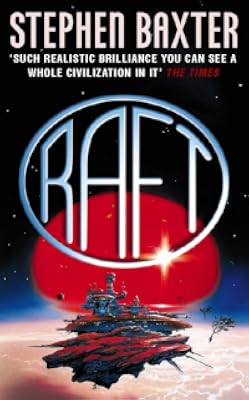
Raft is the first book in the acclaimed Xeelee Sequence, Stephen Baxter's history of the universe. The Raft is built from the wreckage of the spaceship from Earth that crossed into another universe, and it's populated by the original crew's descendants.Tags
Recommendations




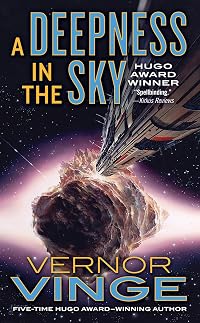
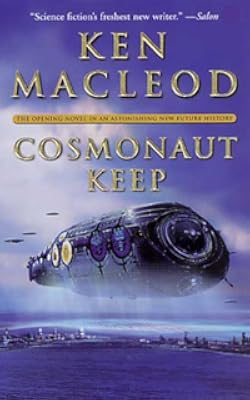
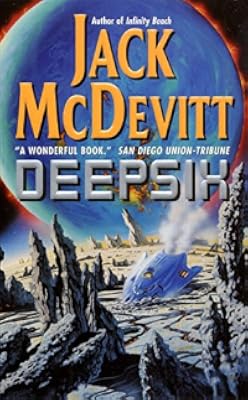

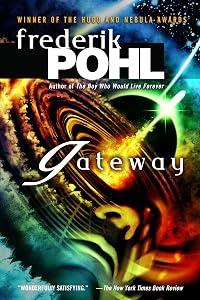

Member Recommendations
Member Reviews
Baxter sucks me in to his high gravity world so well, and doesn't let go. Just like the Boney homeworld, made of decaying human remains . Good, hard SF well deserving of the "Masterworks" title. And just the kind I like, too - starting with a what-if and deftly developing a full world and story around it based on the logical consequences.
Stephen Baxter has an epic imagination. His first novel, Raft (1991), a coming-of-age story of less than 300 pages, creates an entire universe with its own laws of physics. It founded a series that contains at least eight novels and dozens of shorter works.
Five hundred years before the story begins, a starship is thrown into a pocket universe in which the gravitational constant is much stronger than in ours. Fortunately, some of the crew survive and convert the ship into a raft orbiting a small star with a breathable atmosphere at some altitudes. There are no planets in the system, but there are iron-rich asteroids. Trees can be cultivated and adapted into flying ships. Yes, it does sound like Larry Niven’s Integral Trees world from show more the mid-1980s, but Baxter thanks Niven for consulting on the science. Baxter has a lot of fun with the physics. You have to grant him a ship that holds together better than it has any right to and airborne trees that grow in without much trouble. But most of the science is at least plausible.
It is a hard-scrabble environment with large animals called whales and cannibalistic pirates, just right for a young man’s adventure—Treasure Island around a collapsed star. show less
Five hundred years before the story begins, a starship is thrown into a pocket universe in which the gravitational constant is much stronger than in ours. Fortunately, some of the crew survive and convert the ship into a raft orbiting a small star with a breathable atmosphere at some altitudes. There are no planets in the system, but there are iron-rich asteroids. Trees can be cultivated and adapted into flying ships. Yes, it does sound like Larry Niven’s Integral Trees world from show more the mid-1980s, but Baxter thanks Niven for consulting on the science. Baxter has a lot of fun with the physics. You have to grant him a ship that holds together better than it has any right to and airborne trees that grow in without much trouble. But most of the science is at least plausible.
It is a hard-scrabble environment with large animals called whales and cannibalistic pirates, just right for a young man’s adventure—Treasure Island around a collapsed star. show less
Not really sure where to go with this review. It appears from other reviewers that many people loved this book, but for me it was just awful.
So what is it about? A spacecraft somehow passed from one dimension to another through a hole in the fabric of space, the new dimension has a gravitational pull a billion times stronger that earth (yes, that's right... a billion.... not just 2 or 3 times). Fast forward a few hundred years and the inhabitants of the ship have adapted to survive in this extremely unlikely environment. However they are split into two societies, those that live on the ship are mostly scientists and live a seemingly luxurious life, whilst the 'miners' live on and around a dead star and earn food from the scientists by show more mining ore in dangerous conditions, ore that is used for repairs on the ship. This creates a class system and resentment between the two groups. One day Rees, a miner, stows away on a flying tree (yes... trees fly and have pilots and this is the way things are transported) and makes his way to the ship where he tries to fit into the new world. He is accepted and begins to make a
Ok, so forgetting the obviously gaping flaws in the science, which I can usually just go along for the ride with, the book just reads like an utter pile of rubbish. The author seems to have been unsure whether he was writing a book for young adults or mainstream audiences. I understand this is SciFi, but I do like a bit of realism as well, some sort of grounding... so when Rees jumps onto a giant floating space whale that allowed him to just eat its flesh for a few weeks I kind of drifted away. And when, he visits a 'planet' made totally from the bones and rotting corpses of its inhabitants' with the ones lucky enough to make a life having to feed on the jellified flesh and drink putrefied liquid that has filtered to the centre through the mass of decomposition.... it seemed almost palatable compared to forcing myself to the end of this drivel. I could understand if it was marketed as fantasy comedy like Terry Pratchett, and then I would never have picked it up - but it has been reissued as SF masterworks.
Anyway, this is the first book I have read by the author, and I can pretty much say it will also be my last. Although I feel it should really be 1 star (zero?) I will give 2, I decided to award an extra star for the pure genius of the author in managing to pass this off as a real book and getting someone to publish it. show less
So what is it about? A spacecraft somehow passed from one dimension to another through a hole in the fabric of space, the new dimension has a gravitational pull a billion times stronger that earth (yes, that's right... a billion.... not just 2 or 3 times). Fast forward a few hundred years and the inhabitants of the ship have adapted to survive in this extremely unlikely environment. However they are split into two societies, those that live on the ship are mostly scientists and live a seemingly luxurious life, whilst the 'miners' live on and around a dead star and earn food from the scientists by show more mining ore in dangerous conditions, ore that is used for repairs on the ship. This creates a class system and resentment between the two groups. One day Rees, a miner, stows away on a flying tree (yes... trees fly and have pilots and this is the way things are transported) and makes his way to the ship where he tries to fit into the new world. He is accepted and begins to make a
Ok, so forgetting the obviously gaping flaws in the science, which I can usually just go along for the ride with, the book just reads like an utter pile of rubbish. The author seems to have been unsure whether he was writing a book for young adults or mainstream audiences. I understand this is SciFi, but I do like a bit of realism as well, some sort of grounding... so when Rees jumps onto a giant floating space whale that allowed him to just eat its flesh for a few weeks I kind of drifted away. And when, he visits a 'planet' made totally from the bones and rotting corpses of its inhabitants' with the ones lucky enough to make a life having to feed on the jellified flesh and drink putrefied liquid that has filtered to the centre through the mass of decomposition.... it seemed almost palatable compared to forcing myself to the end of this drivel. I could understand if it was marketed as fantasy comedy like Terry Pratchett, and then I would never have picked it up - but it has been reissued as SF masterworks.
Anyway, this is the first book I have read by the author, and I can pretty much say it will also be my last. Although I feel it should really be 1 star (zero?) I will give 2, I decided to award an extra star for the pure genius of the author in managing to pass this off as a real book and getting someone to publish it. show less
This was severely oversold as "hard sci fi". The central conceit is a hard sci fi idea; what if gravity were different, but the execution is closer to a fantasy story. Cardboard characters as is common in ideas sci fi, unfortunately there's not a lot to weigh it up in this story. The world created is interesting as a "what if", but the story isn't.
Pretty good adventure; rags-to-leadership tale with a too-perfect protagonist and a couple of memorable and very likable secondary characters. Very interesting world-building; more Lucian “True History” than hard-science but that isn’t really a criticism, just a PSA for those expecting the latter. The social science & psychology are also predictable but believable and narratively satisfying. A perfect beach read.
The first time I attempted to read Raft I gave up after may be 20 pages. I just could not make head or tail of it. It was my first Stephen Baxter book and I almost gave up on him. Still, he is one of the most highly regarded science fiction authors working today and I just have to keep up with the sci-fi Jones. Baxter’s best known work is probably the Xeelee Sequence of which Raft is said to be the first volume (in publication order). However, I do not recommend reading Raft first, especially if you have a fairly tenuous grasp of science like I have. The setting of Raft is weird and I personally don’t think Baxter explained it very clearly, I think a prologue or some kind of expository chapter would have come in very handy. In any show more case, not wanting to give up on Baxter I asked around for a reading order of the Xeelee Sequence and received several suggestions that Timelike Infinity should be read first which I duly did and I quite enjoyed, a lot of the science still escaped me but the story is easy enough to follow and quite enjoyable. Then I read Ring which is marked as #4 in the series but actually follows directly from Timelike Infinity. I am actually reading these books as parts of the [b:Xeelee|6575201|Xeelee (Xelee Sequence, #1-4)|Stephen Baxter|https://d202m5krfqbpi5.cloudfront.net/books/1347336042s/6575201.jpg|6768426] omnibus edition (saves money you know). Anyway, Raft and [b:Flux|100681|Flux (Xeelee Sequence, #3)|Stephen Baxter|https://d202m5krfqbpi5.cloudfront.net/books/1348474788s/100681.jpg|574446] can be read as standalone novels, and I find that they are easier to understand after reading Timelike Infinity and Ring first.
OK, enough longwinded intro, on with the longwinded review. On this second attempt of reading Raft I do find it much easier to follow and it may be the best of the three Xeelee volumes I read so far ([b:Flux|100681|Flux (Xeelee Sequence, #3)|Stephen Baxter|https://d202m5krfqbpi5.cloudfront.net/books/1348474788s/100681.jpg|574446] is TBR). The first chapter throws the reader into the weird setting of a universe where humans are for some reason (to be revealed in alter volumes) living in a nebula. Gravity is much heavier than our own beloved 1 gee and the people are scattered among The Raft (a floating flat metallic manmade structure), The Belt (mines located on burned-out star kernels) and a tiny “worldlet” occupied by “Boneys” humans who are somewhat deformed from living near the nebula’s core where gravity very heavy (5 gees I think). In this first chapter Rees the young protagonist is working in a foundry on The Belt and he somehow manages to stowaway on a floating tree to travel to The Raft in search of knowledge to satisfy his inquisitive nature. I am not quite clear on how these floating tree things work but they are basically used as crappy, very hard to maneuver little spaceships.
Anyway, once I became acclimatized to the unusual setting the story is quite straightforward. Basically the tiny sun in this nebula is dying which means that the nebula will soon be unable to sustain life. In order to avoid extinction the humans need to find some way of migrating from this dying nebula to a nicely functioning one.
What I know about nebula can be written on a postage stamp and leave enough room for a queen’s entire head but the novel’s plot trajectory (which is actually a keyword for this book) is easy to follow. It is a fairly exciting romp, with a race against time and Baxter even manages to squeeze in some social commentary concerning class systems and equality. As with all Baxter books I have read a lot of the science is beyond me but he is a skilled enough storyteller to convey the story. His prose is sparse as always, but he did make a valiant effort at characterization, I don't think this is his forte but it would be unfair and unkind to call his characters two dimensional. 2.5 dimensional may be. His dialogue is not too bad but the characters still have a tendency to growl a lot (I imagine that is what members of his household do at dinner time).
In spite of my complaint this is an enjoyable read, full of great sci-fi ideas. If you have a good grounding in science, especially physics you will probably have a field day. Onward to [b:Flux|100681|Flux (Xeelee Sequence, #3)|Stephen Baxter|https://d202m5krfqbpi5.cloudfront.net/books/1348474788s/100681.jpg|574446] then! show less
OK, enough longwinded intro, on with the longwinded review. On this second attempt of reading Raft I do find it much easier to follow and it may be the best of the three Xeelee volumes I read so far ([b:Flux|100681|Flux (Xeelee Sequence, #3)|Stephen Baxter|https://d202m5krfqbpi5.cloudfront.net/books/1348474788s/100681.jpg|574446] is TBR). The first chapter throws the reader into the weird setting of a universe where humans are for some reason (to be revealed in alter volumes) living in a nebula. Gravity is much heavier than our own beloved 1 gee and the people are scattered among The Raft (a floating flat metallic manmade structure), The Belt (mines located on burned-out star kernels) and a tiny “worldlet” occupied by “Boneys” humans who are somewhat deformed from living near the nebula’s core where gravity very heavy (5 gees I think). In this first chapter Rees the young protagonist is working in a foundry on The Belt and he somehow manages to stowaway on a floating tree to travel to The Raft in search of knowledge to satisfy his inquisitive nature. I am not quite clear on how these floating tree things work but they are basically used as crappy, very hard to maneuver little spaceships.
Anyway, once I became acclimatized to the unusual setting the story is quite straightforward. Basically the tiny sun in this nebula is dying which means that the nebula will soon be unable to sustain life. In order to avoid extinction the humans need to find some way of migrating from this dying nebula to a nicely functioning one.
What I know about nebula can be written on a postage stamp and leave enough room for a queen’s entire head but the novel’s plot trajectory (which is actually a keyword for this book) is easy to follow. It is a fairly exciting romp, with a race against time and Baxter even manages to squeeze in some social commentary concerning class systems and equality. As with all Baxter books I have read a lot of the science is beyond me but he is a skilled enough storyteller to convey the story. His prose is sparse as always, but he did make a valiant effort at characterization, I don't think this is his forte but it would be unfair and unkind to call his characters two dimensional. 2.5 dimensional may be. His dialogue is not too bad but the characters still have a tendency to growl a lot (I imagine that is what members of his household do at dinner time).
In spite of my complaint this is an enjoyable read, full of great sci-fi ideas. If you have a good grounding in science, especially physics you will probably have a field day. Onward to [b:Flux|100681|Flux (Xeelee Sequence, #3)|Stephen Baxter|https://d202m5krfqbpi5.cloudfront.net/books/1348474788s/100681.jpg|574446] then! show less
All the human interaction and events are so implausible and forced. It's a cool science concept with a mediocre story tacked on.
Members
- Recently Added By
Lists

S.F. Masterworks (Complete)
229 works; 15 members

Books Read in 2014
2,344 works; 86 members

Arthur C. Clarke Award Winners and Shortlisted Books
219 works; 14 members

SF Masterworks
193 works; 8 members
Author Information

Some Editions
Awards and Honors
Series

Belongs to Publisher Series
SF Masterworks (New design)
Work Relationships
Is contained in
Is an expanded version of
Common Knowledge
- Original publication date
- 1991-07-11
- Dedication
- To my wife, Sandra
- Blurbers
- Niven, Larry; Clarke, Arthur C.
Classifications
Statistics
- Members
- 1,001
- Popularity
- 26,163
- Reviews
- 17
- Rating
- (3.55)
- Languages
- English, French, German
- Media
- Paper, Audiobook, Ebook
- ISBNs
- 11
- ASINs
- 4