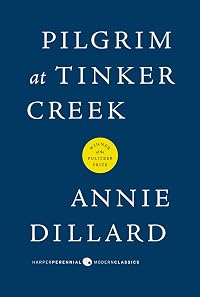
Pilgrim at Tinker Creek
by Annie Dillard
On This Page
Description
Pilgrim at Tinker Creek is the story of a dramatic year in Virginia's Roanoke Valley. Annie Dillard sets out to see what she can see. What she sees are astonishing incidents of "beauty tangled in a rapture with violence." Her personal narrative highlights one year's exploration on foot in the Virginia region through which Tinker Creek runs. In the summer, Dillard stalks muskrats in the creek and contemplates wave mechanics; in the fall, she watches a monarch butterfly migration and dreams of show more Arctic caribou. She tries to con a coot; she collects pond water and examines it under a microscope. She unties a snake skin, witnesses a flood, and plays King of the Meadow with a field of grasshoppers. The result is an exhilarating tale of nature and its seasons. show lessTags
Recommendations




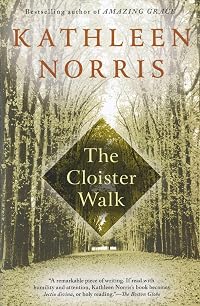
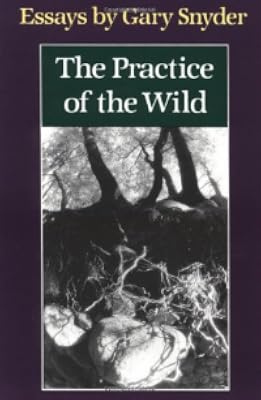

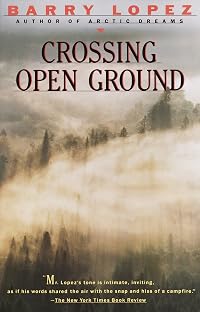
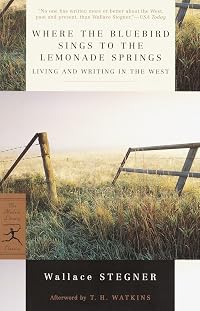

Member Recommendations
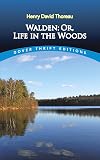
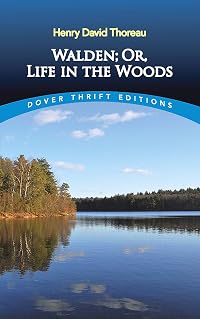
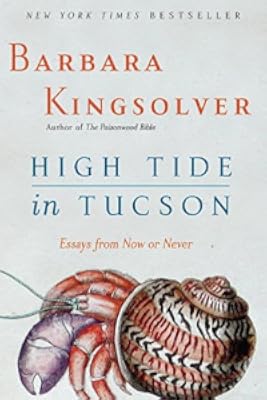
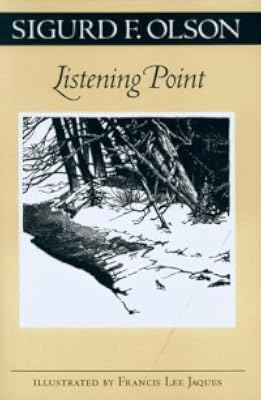
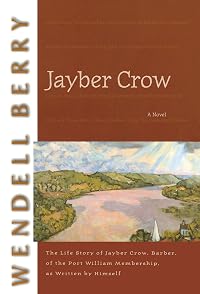
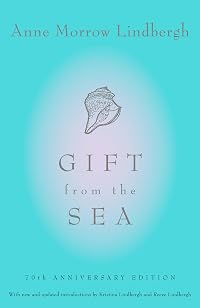
emydid Dillard was very much influenced by Thoreau (she did her master's thesis on Walden), and both Pilgrim at Tinker Creek and Walden have similar narrative structures. Both books follow their narrator through the course of a year, and both weave detailed observations of the natural world together with self-examination and statements of a personal worldview. Annie Dillard's concerns are more explicitly theological, while Thoreau tends to be more concerned with the relationship between the individual and society - but both of their books are beautifully-written, densely symbolic investigations into the relationship between the self, nature, and the spiritual. It's interesting to think about the links and contrasts between the two books - for example, between Dillard's idea of "seeing" and Thoreau's reflections on self-exploration and awareness.
30
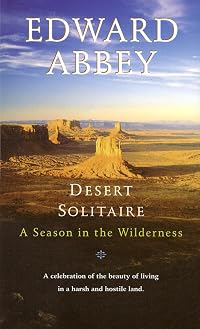
bezoar44 These authors share some of the same fearless introspection; and while both study the natural world, it is in some ways just a (vital) context in which to explore what it means to live meaningfully.
danhammang Love of the land, celebration of the natural world written by one of the finest authors of this generation.
Member Reviews
This stands apart from most other memoirs I’ve read—Dillard isn’t just detailing her experience, as though that were enough to make a meaningful read. The experiences matter, obviously, but this book is at its best when she slows nearly to a stop—observing with breathless stillness, her mind lingering and pressing deeper, so that a moment with a cedar tree or a muskrat or a praying mantis becomes something larger, more complex, more profound.
It’s really the combination of memoir, nature journal, spiritual meditation and philosophical essay that makes the book work for me. I’m never going to be interested in yet another alone-in-the-beauty-of-nature memoir, and at the same time this is something richer than spiritual or show more philosophical rumination. Dillard’s meditations are deeply rooted. They exist in time, and even more so in place. They grow from exquisitely detailed observation, from intimate awareness. Further, she has a real ability to sit with the world, to give it the kind of sustained attention that has always been really rare, but that returns so much value. I loved her concept of seeing as a pearl that “may be found, [but] may not be sought.” Or again later, “You don’t run down the present, pursue it with baited hooks and nets. You wait for it, empty-handed, and you are filled.” She doesn’t make mindfulness sound easy, by any means, but she makes it look intensely rewarding.
I don’t want to just gush, though—it’s not as though nothing bothered me about the book. There are times—lots of times—when the prose just sounds so heavily worked, so wrought that I couldn’t bear it. “The past inserts a finger into a slit in the skin of the present, and pulls.” Really? She allows herself to run with her ideas, and there were moments when she might have reined it in a bit.
Then too, and more significantly, as much as I appreciate her approach to the natural world, I was also persistently aware of the immense privilege that underlay it. The ability to sit so patiently, so consistently over time, with so much solitude and so little real want—that isn’t an experience most people ever have access to, no matter how much they might appreciate it or benefit from it. She doesn’t waste it, I’ll grant, but neither does she ever express any awareness of it.
In the end, I’m able to overlook those qualms, because the book has so much else to offer. There is an intimacy, a vulnerable receptivity, and a substantive beauty in this book that I do not take for granted. show less
It’s really the combination of memoir, nature journal, spiritual meditation and philosophical essay that makes the book work for me. I’m never going to be interested in yet another alone-in-the-beauty-of-nature memoir, and at the same time this is something richer than spiritual or show more philosophical rumination. Dillard’s meditations are deeply rooted. They exist in time, and even more so in place. They grow from exquisitely detailed observation, from intimate awareness. Further, she has a real ability to sit with the world, to give it the kind of sustained attention that has always been really rare, but that returns so much value. I loved her concept of seeing as a pearl that “may be found, [but] may not be sought.” Or again later, “You don’t run down the present, pursue it with baited hooks and nets. You wait for it, empty-handed, and you are filled.” She doesn’t make mindfulness sound easy, by any means, but she makes it look intensely rewarding.
I don’t want to just gush, though—it’s not as though nothing bothered me about the book. There are times—lots of times—when the prose just sounds so heavily worked, so wrought that I couldn’t bear it. “The past inserts a finger into a slit in the skin of the present, and pulls.” Really? She allows herself to run with her ideas, and there were moments when she might have reined it in a bit.
Then too, and more significantly, as much as I appreciate her approach to the natural world, I was also persistently aware of the immense privilege that underlay it. The ability to sit so patiently, so consistently over time, with so much solitude and so little real want—that isn’t an experience most people ever have access to, no matter how much they might appreciate it or benefit from it. She doesn’t waste it, I’ll grant, but neither does she ever express any awareness of it.
In the end, I’m able to overlook those qualms, because the book has so much else to offer. There is an intimacy, a vulnerable receptivity, and a substantive beauty in this book that I do not take for granted. show less
This is volume full of images, entwined with generously multiple adjectives, adverbs, and phrases distributed among all possible parts of speech. An early description in "Spring" has algae growing in thick matted strands fencing the frogs from the air. For the first portions of the book, I was the frog, the words a net fence. Finally, I had to rewire my reading brain to parse the subject, object, and verb and make a conscious effort at meaning, which was present, if a theologically saturated more than my taste prefers. I often enjoy written language that rewires my brain. I find it undesired work to do it myself and then keep pushing through the pages, which never exerted the least suction to pull me through.
"Our life is a faint tracing on the surface of mystery" (p.145)
This book is so good.
I feel a little bit less like an atheist the more Dillard that I read. It's not that her books are particularly religious. They do reference the Bible and a christian god, but just as often reference the Koran, the Bagavad Gita, and other religious traditions. But then, a sentence later, she is deep into source materials on botany, entomology, and scientific method. Her books, this one in particular, are more about spirituality and mystery and wonderment and the ways that we attempt to get closer to that. She is trying to find the divine in the everyday: the growth of a sycamore, the flood waters of a mountain creek, a toad, parasitic wasps.
The thread show more through this book for me is about the joys of learning and applying new ways of seeing and learning about the world and one's place in it but also the joy in hitting a dead end with those means of knowing. There is joy and beauty in the impenetrable mystery of the world. There is a joy of not knowing and of being overwhelmed by and present with something that cannot be understood.
There is a remarkable passage about 1/3 of the way through the book where Dillard is talking about Thoreau (I think) and she is either commenting on or quoting from Thoreau that the quality that holds humanity back from the divine is self-consciousness. Literally that, consciousness that is bounded by the self. The self as the stick against which all things are measured. There is self and there is not-self. But the world is alive with creatures of all kinds that have their own consciousness, ways of being in and getting along in the world. And these consciousnesses, ours included, bump up against one another. And in some of those instances, consciousnesses are extensions of one another. What is it like, I think Dillard is asking, if our consciousness is not bounded by the skin but extends to other things? I'm reminded of Bateson's discussion of the blind person and the cane, asking whether consciousness extends to the tip of the cane or stops where the cane meets the person's hand.
The book feels like a collection of essays, but it isn't really. It's an argument and the prose by which it is delivered is some of the best. show less
This book is so good.
I feel a little bit less like an atheist the more Dillard that I read. It's not that her books are particularly religious. They do reference the Bible and a christian god, but just as often reference the Koran, the Bagavad Gita, and other religious traditions. But then, a sentence later, she is deep into source materials on botany, entomology, and scientific method. Her books, this one in particular, are more about spirituality and mystery and wonderment and the ways that we attempt to get closer to that. She is trying to find the divine in the everyday: the growth of a sycamore, the flood waters of a mountain creek, a toad, parasitic wasps.
The thread show more through this book for me is about the joys of learning and applying new ways of seeing and learning about the world and one's place in it but also the joy in hitting a dead end with those means of knowing. There is joy and beauty in the impenetrable mystery of the world. There is a joy of not knowing and of being overwhelmed by and present with something that cannot be understood.
There is a remarkable passage about 1/3 of the way through the book where Dillard is talking about Thoreau (I think) and she is either commenting on or quoting from Thoreau that the quality that holds humanity back from the divine is self-consciousness. Literally that, consciousness that is bounded by the self. The self as the stick against which all things are measured. There is self and there is not-self. But the world is alive with creatures of all kinds that have their own consciousness, ways of being in and getting along in the world. And these consciousnesses, ours included, bump up against one another. And in some of those instances, consciousnesses are extensions of one another. What is it like, I think Dillard is asking, if our consciousness is not bounded by the skin but extends to other things? I'm reminded of Bateson's discussion of the blind person and the cane, asking whether consciousness extends to the tip of the cane or stops where the cane meets the person's hand.
The book feels like a collection of essays, but it isn't really. It's an argument and the prose by which it is delivered is some of the best. show less
[Update (2020-05-04): You know what? I'm going to go ahead and raise this to 5 stars. I know I'm going to re-read this. It sticks with me to this day. So why wait?]
"Exuberant." "Extravagant." All through this book, I've been searching for the right adjective to describe Dillard's prose. I'm still not satisfied that I've found it. There is much here to treasure: heart-wrenching anecdotes; natural curiosities related as friend-to-friend; deep philosophical and spiritual issues probed. One thing I liked is that the book is entirely observational; as in, "here are things I've seen and my thoughts about them". It is never polemical; Dillard never tries to convince you there is a Creator. She just relates her thoughts, which implicitly show more include that idea.
It is perhaps worth noting that Dillard was 27 when she wrote Pilgrim. So it is very much a young author's book. Hence the exuberance, I suppose. Some may find that off-putting. But I found it refreshing.
I listened to the Audible audiobook version, read by Tavia Gilbert. I strongly suspect I enjoyed the book much more that way than I would have coming to it by text alone. Some writers' voices beg to be heard, not just read. So I strongly encourage newcomers to Tinker's Creek to go the audio route. But that said, before I was half-way done, I had ordered a hardcopy version that I could mark up and highlight favorite passages. show less
"Exuberant." "Extravagant." All through this book, I've been searching for the right adjective to describe Dillard's prose. I'm still not satisfied that I've found it. There is much here to treasure: heart-wrenching anecdotes; natural curiosities related as friend-to-friend; deep philosophical and spiritual issues probed. One thing I liked is that the book is entirely observational; as in, "here are things I've seen and my thoughts about them". It is never polemical; Dillard never tries to convince you there is a Creator. She just relates her thoughts, which implicitly show more include that idea.
It is perhaps worth noting that Dillard was 27 when she wrote Pilgrim. So it is very much a young author's book. Hence the exuberance, I suppose. Some may find that off-putting. But I found it refreshing.
I listened to the Audible audiobook version, read by Tavia Gilbert. I strongly suspect I enjoyed the book much more that way than I would have coming to it by text alone. Some writers' voices beg to be heard, not just read. So I strongly encourage newcomers to Tinker's Creek to go the audio route. But that said, before I was half-way done, I had ordered a hardcopy version that I could mark up and highlight favorite passages. show less
Annie Dillard describes a year spent exploring the creek and forest near her home in the Blue Ridge Mountains. Her observations of nature lead to contemplation of the nature of God and creation. The book starts by celebrating the abundance and extravagance of nature, but then turns to examining the amount of death and waste, such as egg-laying insect who create hundreds of thousands of eggs but only a few survive. Nature can be beautiful, but also very cruel.
I think I will forever be haunted by the final pages of the book. After spending so much time discussing the cruelty of nature, there is one paragraph at the very end that flips that cruelty on its head, and makes the abundance of death in nature into a sign of God's care for show more creation.
This is a book worth discussing and re-reading. There's a lot to unpack in it. Sometimes it feels like she's just rambling about whatever happens to be going through her mind, and then, seemingly out of the blue, one small sentence will tie it all together, often with a big punch.
Dillard's afterword notes that the book suffers from some of the arrogance of her youth: parts of it are definitely over-written, but they are still enjoyable. She certainly had wisdom and humility beyond her years, but I wonder how different the book would be if she had written it when she was older. show less
I think I will forever be haunted by the final pages of the book. After spending so much time discussing the cruelty of nature, there is one paragraph at the very end that flips that cruelty on its head, and makes the abundance of death in nature into a sign of God's care for show more creation.
This is a book worth discussing and re-reading. There's a lot to unpack in it. Sometimes it feels like she's just rambling about whatever happens to be going through her mind, and then, seemingly out of the blue, one small sentence will tie it all together, often with a big punch.
Dillard's afterword notes that the book suffers from some of the arrogance of her youth: parts of it are definitely over-written, but they are still enjoyable. She certainly had wisdom and humility beyond her years, but I wonder how different the book would be if she had written it when she was older. show less
"My God what a world. There is no accounting for one second of it."
That sums it up well. I've always been curious to read this one, but I also feared it would be dry nature writing. In fact it is rarely dry and is heavy on philosophizing. Dillard seems to walk through the world in a constant state of astonishment. She will notice a bug seeming slightly askew, and drop to the ground and stare at it for 45 minutes. She is in awe, awe at the profligacy of creation. She also gets herself into a state of high dudgeon over: the seeming waste of life represented by the sheer number of individual creatures who live nasty, brutish, short lives with only a few of their species living to propagate; the amount of general suffering that goes on in show more the natural world; and the teeming masses of creatures who are parasitic, noxious, or just disgusting.
I don't find interesting everything that she finds interesting. But I do like philosophy. In addition to the sheer wonder Dillard brings to the table, she also holds forth on what it all means relative to our own place in the universe.
"Thomas Merton wrote, 'There is always a temptation to diddle around in the contemplative life, making itsy-bitsy statues.' There is always an enormous temptation in all of life to diddle around making itsy-bitsy friends and meals and journeys for itsy-bitsy years on end."
"I have often noticed that even a few minutes of self-forgetfulness is tremendously invigorating. I wonder if we do not waste most of our energy just by spending every waking minute saying hello to ourselves."
"Nature is, above all, profligate. Don't believe them when they tell you how economical and thrifty nature is, whose leaves return to the soil. Wouldn't it be cheaper to leave them on the tree in the first place?"
"Spend the afternoon. You can't take it with you." show less
That sums it up well. I've always been curious to read this one, but I also feared it would be dry nature writing. In fact it is rarely dry and is heavy on philosophizing. Dillard seems to walk through the world in a constant state of astonishment. She will notice a bug seeming slightly askew, and drop to the ground and stare at it for 45 minutes. She is in awe, awe at the profligacy of creation. She also gets herself into a state of high dudgeon over: the seeming waste of life represented by the sheer number of individual creatures who live nasty, brutish, short lives with only a few of their species living to propagate; the amount of general suffering that goes on in show more the natural world; and the teeming masses of creatures who are parasitic, noxious, or just disgusting.
I don't find interesting everything that she finds interesting. But I do like philosophy. In addition to the sheer wonder Dillard brings to the table, she also holds forth on what it all means relative to our own place in the universe.
"Thomas Merton wrote, 'There is always a temptation to diddle around in the contemplative life, making itsy-bitsy statues.' There is always an enormous temptation in all of life to diddle around making itsy-bitsy friends and meals and journeys for itsy-bitsy years on end."
"I have often noticed that even a few minutes of self-forgetfulness is tremendously invigorating. I wonder if we do not waste most of our energy just by spending every waking minute saying hello to ourselves."
"Nature is, above all, profligate. Don't believe them when they tell you how economical and thrifty nature is, whose leaves return to the soil. Wouldn't it be cheaper to leave them on the tree in the first place?"
"Spend the afternoon. You can't take it with you." show less
Dillard writes about a corner of Appalachia close to my personal wilderness between the Roanoke valley and the West Virginia line; a place that has been developed since her writing "Pilgrim at Tinker Creek".
Her observations of the minute violence and beauty of the creek's nature are poignant; philosophically, she is an heir of Thoreau and Wordsworth in her attempt, through language, to reconnect the human experience with our natural surroundings.
Some of the criticism of the book mentioned in the epilogue says that "Pilgrim" is overwritten; Dillard does overuse some language devices (like alliteration), but she writes with truth and feeling; she really hits her stride towards the end of the book when the religious allusions become explicit.
Her observations of the minute violence and beauty of the creek's nature are poignant; philosophically, she is an heir of Thoreau and Wordsworth in her attempt, through language, to reconnect the human experience with our natural surroundings.
Some of the criticism of the book mentioned in the epilogue says that "Pilgrim" is overwritten; Dillard does overuse some language devices (like alliteration), but she writes with truth and feeling; she really hits her stride towards the end of the book when the religious allusions become explicit.
Members
- Recently Added By
Lists

Recommended Nature Writing
346 works; 180 members

Best Biographies, Autobiographies and Memoirs
465 works; 160 members

Modern Library 100 Best Nonfiction Books
100 works; 8 members

Nature Writing
33 works; 3 members

Check Library
176 works; 1 member

Read For Your Life
157 works; 1 member

Vlogbrothers Book Recommendations
307 works; 4 members

Our Favorite Comfort Reads
334 works; 200 members

Mustich's 1000 Books to Read Before You Die: A Life Changing List
1,001 works; 19 members

Books Read in 2023
5,547 works; 145 members

Mind Expanding Books by hackerkid
581 works; 8 members

500 Great Books by Women
507 works; 60 members
Five star books
1,756 works; 108 members

Schwob Nederland
207 works; 2 members

Swinging Seventies
255 works; 18 members

Blue Pyramid 1,276 Best Books of All Time
1,248 works; 32 members

CCE 1000 Good Books List
1,033 works; 12 members
Top-Rated Books on LibraryThing
272 works; 117 members
Talk Discussions
Past Discussions
Group Read- Pilgrim at Tinker Creek, by Annie Dillard in 75 Books Challenge for 2014 (February 2014)
Author Information

32+ Works 22,141 Members
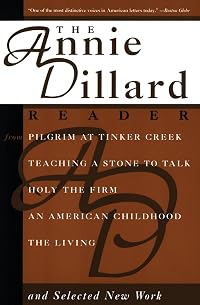
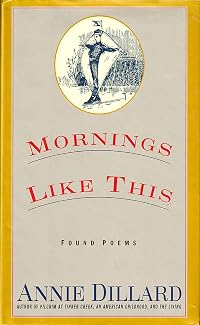
Annie Dillard was born Annie Doak in Pittsburgh, Pennsylvania on April 30, 1945. She received a B.A and an M.A. in English from Hollins College. She writes both fiction and nonfiction books including Tickets for a Prayer Wheel, Holy the Firm, Teaching a Stone to Talk, The Living, and Mornings Like This: Found Poems. She won the 1975 Pulitzer Prize show more for General Nonfiction for Pilgrim at Tinker Creek. She wrote an autobiography entitled An American Childhood. Her work also has appeared in such periodicals as The Atlantic, Harper's Magazine, The Christian Science Monitor, and Cosmopolitan. She taught for 21 years in the English department of Wesleyan University. (Bowker Author Biography) show less
Some Editions
Awards and Honors
Awards
Distinctions
Notable Lists
Series
Belongs to Publisher Series
Work Relationships
Is contained in
Has as a student's study guide
Common Knowledge
- Original publication date
- 1974
- Epigraph
- It ever was, and is, and shall be, ever-living Fire, in measures being kindled and in measures going out.
---Heraclitus - Dedication
- for Richard
- First words
- I used to have a cat, an old fighting tom, who would jump through the open window by my bed in the middle of the night and land on my chest.
[Afterword] In October, 1972, camping in Acadia National Park on the Maine coast, I read a nature book.
[More Years Afterword] I was twenty-seven in 1972 when I began writing Pilgrim at Tinker Creek. - Quotations
- Not only does something come if you wait, but it pours over you like a waterfall, a tidal wave. You wait in all naturalness without expectation or hope, emptied, translucent, and that which comes rocks and topples you; it wil... (show all)l shear, loose, launch, winnow, grind.
- Last words
- (Click to show. Warning: May contain spoilers.)And like Billy Bray I go my way, and my left foot says "Glory," and my right foot says "Amen": in and out of Shadow Creek, upstream and down, exultant, in a daze, dancing, to the twin silver trumpets of praise.
(Click to show. Warning: May contain spoilers.)[Afterword] And consequently a generation of youth has grown up cursing my name--which, you recall, I didn't want to use in the first place. --Annie Dillard, 1999
(Click to show. Warning: May contain spoilers.)[More Years Afterword] (I knew this happened; I did not know I was already that old.) --2007 - Blurbers
- Barkham, John
- Original language*
- Engels
*Some information comes from Common Knowledge in other languages. Click "Edit" for more information.
Classifications
Statistics
- Members
- 6,230
- Popularity
- 1,990
- Reviews
- 121
- Rating
- (4.19)
- Languages
- 6 — Dutch, English, French, German, Italian, Spanish
- Media
- Paper, Audiobook, Ebook
- ISBNs
- 52
- ASINs
- 43