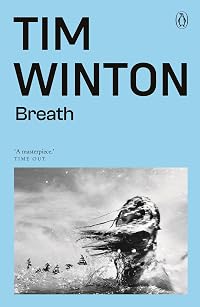
Breath
by Tim Winton
On This Page
Description
When paramedic Bruce Pike is called out to deal with another teenage adventure gone wrong, he knows better than his colleague, better than the kid's parents, what happened and how. Thirty years before, that dead boy could have been him.A relentlessly gripping and deeply moving novel about the damage you do to yourself when you're young and think you're immortal.Tags
Recommendations


















Member Recommendations


Member Reviews
Early in the novel Bruce Pike, a.k.a.,Pikelet, the main character says: "It's funny, but you never really think much about breathing. Until it's all you ever think about." This idea of breathing and the thrill and excitement of holding one's breath and loss of breath is considered in many forms throughout this coming of age novel. Set in Western Australia, Pikelet and his Friend Ivan Loon (Loonie) challenge each other in various adventures and eventually find a mentor in the charismatic Zen-like surfer hero, Sando and his embittered wife, Eva. Sando takes them under his wing and provides increasingly dangerous surfing challenges. Eventually Loonie proves to be the bigger risk taker and he and Sando head out to Thailand to find the big show more waves. While Loonie and Sando are off surfing , Pikelet and Eva become involved. The ocean and landscape become fully formed characters that serve to shape the lives and fortunes of all living there. Each new challenge brings gains and losses. The characters are fully formed and compelling. The novel is swiftly paced and beautifully written. show less
 This review was written for LibraryThing Early Reviewers.
This book reminded me of novels like "Catcher in the Rye" and "The Perks of Being a Wallflower." Of those I liked the first and hated the second. I am on the fence with this one.
Bruce Pike is a withdrawn and strikingly humorless boy growing up in a small Austrailian logging town not far from the coast. He becomes friends with Loonie, a local boy, with whom he explores the physical, mental, and emotional highs of risk. Extremely introverted, Bruce feels asleep inside most of the time, and he seeks to find life through forces outside of himself. When he finds Sando, an aloof and adept older surfer, to be his surfing mentor it takes him further down the path to addiction to fear and risk and being on the edge. The structure is a flashback show more of the main character's early teen years framed between two brief glimpses of his adulthood.
The language is simple and evocative. We see everything through the main character's eyes and he sees with intense emotion. The beauty of the waves breaking on the sea the image is clear and vivid, and the grace inherent in performing a physical skill is well described. This book causes you to feel a lot, and quite strongly, and when it comes down to it, that is what bothers me most.
For most of the book (excepting when you are engrossed in the poetry of riding a wave - each moment singularly laid out in front of you) you are face to face with the suffocating blanket of melancholy, sadness, and lonliness that pervades the whole piece. On the whole it is quite depressing. And when things started to shift for him and he began a destructive sexual relationship with an older woman, I started to wonder if there was any hope left at all.
The last part of the book, a quick detail of his adult life, felt rushed and choppy, written without the smoothness of the rest of the narrative.
I think the author succeeded in delivering to the reader the feeling of being just short of drowning. In the end, despite the profound and insightful look into the emotions of such, I felt as relieved to be done with it as to find breath at the surface of the sea. show less
Bruce Pike is a withdrawn and strikingly humorless boy growing up in a small Austrailian logging town not far from the coast. He becomes friends with Loonie, a local boy, with whom he explores the physical, mental, and emotional highs of risk. Extremely introverted, Bruce feels asleep inside most of the time, and he seeks to find life through forces outside of himself. When he finds Sando, an aloof and adept older surfer, to be his surfing mentor it takes him further down the path to addiction to fear and risk and being on the edge. The structure is a flashback show more of the main character's early teen years framed between two brief glimpses of his adulthood.
The language is simple and evocative. We see everything through the main character's eyes and he sees with intense emotion. The beauty of the waves breaking on the sea the image is clear and vivid, and the grace inherent in performing a physical skill is well described. This book causes you to feel a lot, and quite strongly, and when it comes down to it, that is what bothers me most.
For most of the book (excepting when you are engrossed in the poetry of riding a wave - each moment singularly laid out in front of you) you are face to face with the suffocating blanket of melancholy, sadness, and lonliness that pervades the whole piece. On the whole it is quite depressing. And when things started to shift for him and he began a destructive sexual relationship with an older woman, I started to wonder if there was any hope left at all.
The last part of the book, a quick detail of his adult life, felt rushed and choppy, written without the smoothness of the rest of the narrative.
I think the author succeeded in delivering to the reader the feeling of being just short of drowning. In the end, despite the profound and insightful look into the emotions of such, I felt as relieved to be done with it as to find breath at the surface of the sea. show less
This review was written for LibraryThing Early Reviewers.Brilliant coming-of-age story about a trio of Australian surfers - two boys and their mentor, and the mentor's mysterious wife.
The narrator is 10 years old when he first sees surfers at the ocean:
“I couldn’t have put words to it as a boy, but later I understood what seized my imagination that day. How strange it was to see men do something beautiful. Something pointless and elegant, as though nobody saw or cared. In Sawyer [his home-town], a town of millers and loggers and dairy farmers, with one butcher and a rep from the rural bank beside the BP, men did solid, practical things, mostly with their hands. Perhaps a baker might have had a chance to make something as pretty as it was tasty, but our baker was a woman anyway, a person show more as dour and blunt as any boy’s father and she baked loaves like housebricks. For style we had a couple local footballers with a nice leap and a tidy torpedo punt, and I would concede that my father rowed a wooden boat as sweetly as I’d seen it done, in a manner that disguised and discounted all effort, but apart from that and those old coves with plastic teeth and necks like turtles who got pissed on Anzac Day and sang sad songs on the verandah of the Riverside before they passed out, there wasn’t much room for beauty in the lives of our men. The only exception was the strange Uri Orlov who carved lovely, old-world toys from stuff he fossicked up from the forest floor. But he didn’t like to show his work. He was shy or careful and people said he was half mad anyway. When it came to blokes, his was all the useless beauty the town could manage.
“For all those years when Loonie [his best friend] and I surfed together, having caught the bug that first morning at the Point, we never spoke about the business of beauty. We were mates but there were places our conversation simply couldn’t go. There was never any doubt about the primary thrill of surfing, the huge body-rush we got flying down the line with the wind in our ears. We didn’t know what endorphins were but we quickly understood how narcotic the feeling was, and how addictive it became; from day one I was stoned from just watching. We talked about skill and courage and luck - we shared all that, and in time we surfed to fool with death - but for me there was still the outlaw feeling of doing something graceful, as if dancing on water was the best and bravest thing a man could do.” pp. 23-4 show less
The narrator is 10 years old when he first sees surfers at the ocean:
“I couldn’t have put words to it as a boy, but later I understood what seized my imagination that day. How strange it was to see men do something beautiful. Something pointless and elegant, as though nobody saw or cared. In Sawyer [his home-town], a town of millers and loggers and dairy farmers, with one butcher and a rep from the rural bank beside the BP, men did solid, practical things, mostly with their hands. Perhaps a baker might have had a chance to make something as pretty as it was tasty, but our baker was a woman anyway, a person show more as dour and blunt as any boy’s father and she baked loaves like housebricks. For style we had a couple local footballers with a nice leap and a tidy torpedo punt, and I would concede that my father rowed a wooden boat as sweetly as I’d seen it done, in a manner that disguised and discounted all effort, but apart from that and those old coves with plastic teeth and necks like turtles who got pissed on Anzac Day and sang sad songs on the verandah of the Riverside before they passed out, there wasn’t much room for beauty in the lives of our men. The only exception was the strange Uri Orlov who carved lovely, old-world toys from stuff he fossicked up from the forest floor. But he didn’t like to show his work. He was shy or careful and people said he was half mad anyway. When it came to blokes, his was all the useless beauty the town could manage.
“For all those years when Loonie [his best friend] and I surfed together, having caught the bug that first morning at the Point, we never spoke about the business of beauty. We were mates but there were places our conversation simply couldn’t go. There was never any doubt about the primary thrill of surfing, the huge body-rush we got flying down the line with the wind in our ears. We didn’t know what endorphins were but we quickly understood how narcotic the feeling was, and how addictive it became; from day one I was stoned from just watching. We talked about skill and courage and luck - we shared all that, and in time we surfed to fool with death - but for me there was still the outlaw feeling of doing something graceful, as if dancing on water was the best and bravest thing a man could do.” pp. 23-4 show less
One of the hallmarks of Tim Winton’s work is the way he seems to achieve a sparse poetic intensity in the midst of a compelling and even simplistic storyline. Dreams, the sea, the sky, and desire seem to pervade the story, taking it closer, deeper and making it more powerful than a synopsis could convey. It would be fair to call Breath a surfing novel, as it is infused with the ocean, breaking waves, and the riding of the board. The protagonist, Bruce Pike is an ambulance driver whose grasp of...more One of the hallmarks of Tim Winton’s work is the way he seems to achieve a sparse poetic intensity in the midst of a compelling and even simplistic storyline. Dreams, the sea, the sky, and desire seem to pervade the story, taking it show more closer, deeper and making it more powerful than a synopsis could convey. It would be fair to call Breath a surfing novel, as it is infused with the ocean, breaking waves, and the riding of the board. The protagonist, Bruce Pike is an ambulance driver whose grasp of death and the many pathways to death is just a little too astute for comfort. After attending the death of a teenager, he is reminded of a pivotal point in his youth: the summer when he surfed Old Smoky, the biggest, most dangerous wave on the Point, dodged a shark, fell in love, and found and lost friendship.
The novel is set as a flashback played through the throaty timbre of a didgeridoo. It’s a complete exhalation: the outward breath of the storyteller as he takes us through his visions. Though the main story takes place during one single summer, the impact of that period is broader; giving both meaning and a pervading sense of loss and nostalgia to Bruce Pike's life, and the story as a whole. The fear that begins to grow on Pike, or Pikelet as he is known to his friends, is part of the transition to adulthood: a sense of mortality that the reader will understand:
Now I knew there was no room left in my life for stupid risks. Death was everywhere – waiting, welling, undiminished. It would always be coming for me and for mine and I told myself I could no longer afford the thrill of courting it.(248)
Nearly all of the characters in the story are unhappy and broken in one way or another. Bill Sanderson or Sando is the older surfer – a man who achieved some degree of fame in his younger days. Sando becomes a mentor for Pikelet, and his friend Ivan Loon, or Loonie, an aptly named boy with a penchant for daredevilry. Together the three begin a kind of adventure club where they aim to both increase their surfing skills and take on increasingly dangerous challenges in the surf. It begins safely enough, as a way to escape the ordinariness of the book's setting - Sawyer – the small working-class mill town in Western Australia where people keep to themselves. But as the story progresses, and Sando’s attentions between the boys sparks a serious case of rivalry, things get darker. More risks are taken, and Eva, Sando’s injured American wife sets on her own self-destructive path that takes Pikelet along for a very different sort of ride. The ultimate impact on Pikelet is that he loses his sense of self and walks, tentatively and passionlessly, through much of his life, occasionally dabbling in a parallel self-destruction to Eva’s:
I didn’t understand this behaviour. I had no special interest in electricity. Granted, it’s a potent, tangible presence in a world that’s cast off presences. It just just a moment of righteous sensation, like a blow to the head. It knocked me down. It hurt like hell. But it was something I could feel. (252)
Though this is a painful and sad story, and one that doesn’t really end happily – the damage is permanent -- there’s a transcendent beauty that runs through it, as it does through all of Winton’s novels. It is partly just the utter beauty of the prose. Winton’s words turn a paddle into the ocean into an epiphany:
Like you’ve exploded and all the pieces of you are reassembling themselves. You’re new. Shimmering. Alive. (138)
Nearly every line in this novel is taut, and wrought with tender nerve-ending sensation that it’s impossible not to feel along with the characters. The power of the novel isn’t only in the stormy waves that Pikelet risks his life on. It’s in the quiet musings that take place between the Didgeridoo and the Ambulance rides later: the fear, greater than any wave, that life is just an inhalation and exhalation of breath and nothing more. The breath motif is everywhere. There’s Eva’s breath in a plastic bag; Pikelet’s father’s Apnoea at night; the breath holding between Pikelet and Loonie that prefigures their surfing exploits; the exhalation of didgeridoo that narrates the story; and above all, the breath that is, metaphorically and actually, life itself. In the end, the journey becomes the point, and despite the damage, the breathing and dancing continue, creating meaning and value that needs "no explanation". It’s worth reading (and re-reading) Breath solely for the magic of its linguistic beauty. Tim Winton has created a tremendously powerful story that will continue to linger in the mind of the reader long past the initial reading show less
The novel is set as a flashback played through the throaty timbre of a didgeridoo. It’s a complete exhalation: the outward breath of the storyteller as he takes us through his visions. Though the main story takes place during one single summer, the impact of that period is broader; giving both meaning and a pervading sense of loss and nostalgia to Bruce Pike's life, and the story as a whole. The fear that begins to grow on Pike, or Pikelet as he is known to his friends, is part of the transition to adulthood: a sense of mortality that the reader will understand:
Now I knew there was no room left in my life for stupid risks. Death was everywhere – waiting, welling, undiminished. It would always be coming for me and for mine and I told myself I could no longer afford the thrill of courting it.(248)
Nearly all of the characters in the story are unhappy and broken in one way or another. Bill Sanderson or Sando is the older surfer – a man who achieved some degree of fame in his younger days. Sando becomes a mentor for Pikelet, and his friend Ivan Loon, or Loonie, an aptly named boy with a penchant for daredevilry. Together the three begin a kind of adventure club where they aim to both increase their surfing skills and take on increasingly dangerous challenges in the surf. It begins safely enough, as a way to escape the ordinariness of the book's setting - Sawyer – the small working-class mill town in Western Australia where people keep to themselves. But as the story progresses, and Sando’s attentions between the boys sparks a serious case of rivalry, things get darker. More risks are taken, and Eva, Sando’s injured American wife sets on her own self-destructive path that takes Pikelet along for a very different sort of ride. The ultimate impact on Pikelet is that he loses his sense of self and walks, tentatively and passionlessly, through much of his life, occasionally dabbling in a parallel self-destruction to Eva’s:
I didn’t understand this behaviour. I had no special interest in electricity. Granted, it’s a potent, tangible presence in a world that’s cast off presences. It just just a moment of righteous sensation, like a blow to the head. It knocked me down. It hurt like hell. But it was something I could feel. (252)
Though this is a painful and sad story, and one that doesn’t really end happily – the damage is permanent -- there’s a transcendent beauty that runs through it, as it does through all of Winton’s novels. It is partly just the utter beauty of the prose. Winton’s words turn a paddle into the ocean into an epiphany:
Like you’ve exploded and all the pieces of you are reassembling themselves. You’re new. Shimmering. Alive. (138)
Nearly every line in this novel is taut, and wrought with tender nerve-ending sensation that it’s impossible not to feel along with the characters. The power of the novel isn’t only in the stormy waves that Pikelet risks his life on. It’s in the quiet musings that take place between the Didgeridoo and the Ambulance rides later: the fear, greater than any wave, that life is just an inhalation and exhalation of breath and nothing more. The breath motif is everywhere. There’s Eva’s breath in a plastic bag; Pikelet’s father’s Apnoea at night; the breath holding between Pikelet and Loonie that prefigures their surfing exploits; the exhalation of didgeridoo that narrates the story; and above all, the breath that is, metaphorically and actually, life itself. In the end, the journey becomes the point, and despite the damage, the breathing and dancing continue, creating meaning and value that needs "no explanation". It’s worth reading (and re-reading) Breath solely for the magic of its linguistic beauty. Tim Winton has created a tremendously powerful story that will continue to linger in the mind of the reader long past the initial reading show less
Reading Breath was as unsettling experience. There is a sense of foreboding that pervades this tale of adolescent risk-taking which led me, as a reader, to hold my breath, and sigh with relief upon turning the last page. Winton balances this darkness by conveying the exhilarating joy of surfing better than any novelist has managed before. I really felt I was out beyond the breakers with Pikelet and his friends, and it was that insight that made reading the book worthwhile.
Tim Winton’s ‘Breath’ is like a long wave slowly building up, then breaking and crashing down to cause chaos in it's wake. It is the story of two adolescent surfers who are taken in tow by a veteran surfer and gradually introduced to extreme surfing and the way in which this eventually damages and shapes their future lives.
Pikelet (Bruce Pike) and Loonie (Ivan Loon) are both lonely misfits in a small timber town near the coast who befriend each other one summer swimming at the river and dare each other to more and more extreme exploits. When they ride to the coast on their bikes and see the local lads surfing they know they have to give it a try. Before long they draw the attention of Sando (Bill Sanderson) a veteran surfer who show more takes them under his wing and encourages them to try more and more extreme surf. It’s the 70s and Sando and his American wife Eva are living a hippy lifestyle in a house set in the bush where Eva is also trying to overcome her own demons.
This story is many things. It is a coming of age story for Pikelet and Loonie as they move through adolescence. It is also about the attraction of extreme sport, the addiction to the endorphin and adrenalin rush that is hard to satisfy away from the sport and it is about the dangers of idolizing those who seem adventurous and attractive to us. It also touches on how deviant sexual practices can warp a teenage boy’s sexual awakening affecting his later life and relationships.
Although I grew up in WA and had several surfie friends, I have never been keen to try surfing but found myself enjoying Tim Winton’s descriptions of how to forecast when the surf would be good, how to pick the best position for catching a wave and the exhilaration to be had riding the wave. show less
Pikelet (Bruce Pike) and Loonie (Ivan Loon) are both lonely misfits in a small timber town near the coast who befriend each other one summer swimming at the river and dare each other to more and more extreme exploits. When they ride to the coast on their bikes and see the local lads surfing they know they have to give it a try. Before long they draw the attention of Sando (Bill Sanderson) a veteran surfer who show more takes them under his wing and encourages them to try more and more extreme surf. It’s the 70s and Sando and his American wife Eva are living a hippy lifestyle in a house set in the bush where Eva is also trying to overcome her own demons.
This story is many things. It is a coming of age story for Pikelet and Loonie as they move through adolescence. It is also about the attraction of extreme sport, the addiction to the endorphin and adrenalin rush that is hard to satisfy away from the sport and it is about the dangers of idolizing those who seem adventurous and attractive to us. It also touches on how deviant sexual practices can warp a teenage boy’s sexual awakening affecting his later life and relationships.
Although I grew up in WA and had several surfie friends, I have never been keen to try surfing but found myself enjoying Tim Winton’s descriptions of how to forecast when the surf would be good, how to pick the best position for catching a wave and the exhilaration to be had riding the wave. show less
‘It’s funny, but you never think much about breathing. Until it’s all you ever think about.’ So says Pikelet, the calm, thoughtful fifty-year-old narrator of his own careless, frenetic youth. Breath is a classic coming-of-age novel, all the more resonant for me because its people, places and times are so familiar.
The human body might be limiting, but it is also capable of a redemptive beauty. Pikelet finds this beauty in the aesthetics of which he sees as 'the outlaw feeling of doing something graceful, as if dancing on water was the best and bravest thing a man could do'.
Winton writes with a stunning, simple clarity. The characters are carefully drawn, and reveal themselves slowly over the course of the novel. Pikelet, in show more particular, is breathtakingly real, with Winton deftly balancing the boy's enthusiasm and idealism with the adult's more jaded hindsight
This is a high point in a literary career full of high points, a novel of sex and death, of risk-taking and the need to push one's boundaries in order to feel alive. show less
The human body might be limiting, but it is also capable of a redemptive beauty. Pikelet finds this beauty in the aesthetics of which he sees as 'the outlaw feeling of doing something graceful, as if dancing on water was the best and bravest thing a man could do'.
Winton writes with a stunning, simple clarity. The characters are carefully drawn, and reveal themselves slowly over the course of the novel. Pikelet, in show more particular, is breathtakingly real, with Winton deftly balancing the boy's enthusiasm and idealism with the adult's more jaded hindsight
This is a high point in a literary career full of high points, a novel of sex and death, of risk-taking and the need to push one's boundaries in order to feel alive. show less
Members
- Recently Added By
Lists

One Book, Many Authors
441 works; 40 members

A Novel Cure
742 works; 23 members

Books Read in 2008
335 works; 8 members

Most Popular Books Tagged Australia
35 works; 5 members

Swinging Seventies
255 works; 18 members

AP Lit
363 works; 6 members

Best Australian Books of the 21st Century
88 works; 2 members
Author Information

42+ Works 13,849 Members
Tim Winton was born in 1960 in Western Australia. He attended a Creative Writing Course at Curtin University in Perth, and it was there that he began his first novel, An Open Swimmer. It was entered for The Australian/Vogel Award in 1981 and won. His other works include Shallows, which won the Miles Franklin Award in 1984; The Riders Winton, which show more won the Miles Franklin Award in 1992; and Island Home: A Landscape Memoir, the winner of the 2016 Australian Book Industry Awards, General nonfiction book of the year. The Boy Behind the Curtain, published in 2016, won the 2018 Adelaide Festival Awards for Literature, Nonfiction. His books also include The Shepherd's Hut, Breath, and Dirt Music. (Bowker Author Biography) show less
Some Editions
Awards and Honors
Awards
Common Knowledge
- Canonical title
- Breath
- Original publication date
- 2008-05-27
- People/Characters
- Ivan Loon aka Loonie (Publicans son); Bruce Pike aka Pikelet (main character & ambulance officer); Jodie (Bruce’s ambo colleague); Bill (Sando) Sanderson (Sando); Eva Sanderson
- Important places
- Australia; Western Australia, Australia
- Related movies
- Breath (2017 | IMDb)
- Dedication
- For Howard Willis
- First words
- We come sweeping up the tree-lined boulevard with siren and lights and when the GPS urges us to make the next left we take it so fast that all the gear slams and sways inside the vehicle.
- Last words
- (Click to show. Warning: May contain spoilers.)They probably don't understand this, but its important for me to show them that their father is a man who dances - who saves lives and carries the wounded, yes, but who also does something completely pointless and beautiful, and in this at least he should need no explanation.
Classifications
Statistics
- Members
- 1,957
- Popularity
- 10,851
- Reviews
- 106
- Rating
- (3.83)
- Languages
- 7 — Catalan, Dutch, English, French, German, Italian, Spanish
- Media
- Paper, Audiobook, Ebook
- ISBNs
- 52
- ASINs
- 8
