On This Page
Description
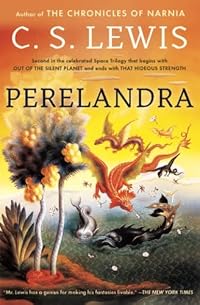
Perelandra is a planet of pleasure, an unearthly, misty world of strange desires, sweet smells, and delicious tastes, where beasts are friendly and naked beauty is unashamed, a new Garden of Eden, where the story of the oldest temptation is enacted in an intriguingly new way. Here, in the second part of C. S. Lewis' acclaimed Ransom Trilogy, Dr. Ransom's adventures continue against the backdrop of a religious allegory that, while it may seem quaint in its treatment of women today, show more nonetheless shows the capability of science to be an evil force tempting a ruler away from the path that has produced a paradisiacal kingdom. Will Perelandra succumb to this malevolent being, who strives to create a new world order, or will it throw off the yoke of corruption and achieve a spiritual perfection as yet unknown to man? show lessTags
Recommendations







Member Recommendations
Member Reviews
At some point after his adventures on Mars in Out of the Silent Planet, philologist Elwin Ransom is summoned to Venus for some unknown purpose. He arrives to find himself alone with unusual fauna amid floating islands that move with the rise and fall of the ocean waters. Eventually he meets the Green Lady, a queen who is searching for her king. Soon a familiar face from his own world arrives, and Ransom begins to understand why he was summoned here.
This book seems to be an allegory for the creation account of Genesis, although at one point Lewis expressly tells his readers that it is not. Lewis presents an alternate world in which Eve (the Green Lady) resists temptation and the Fall doesn’t happen. While it’s the second book in show more Lewis’s space trilogy, it can be read independently of the trilogy. It’s been long enough since I’ve read Out of the Silent Planet that I’ve forgotten most of the details, but I never felt lost without them while reading Perelandra. show less
This book seems to be an allegory for the creation account of Genesis, although at one point Lewis expressly tells his readers that it is not. Lewis presents an alternate world in which Eve (the Green Lady) resists temptation and the Fall doesn’t happen. While it’s the second book in show more Lewis’s space trilogy, it can be read independently of the trilogy. It’s been long enough since I’ve read Out of the Silent Planet that I’ve forgotten most of the details, but I never felt lost without them while reading Perelandra. show less
...thence through thousands of miles of dark and silence and infernal fire, to the very heart of each, Reality lived – the meaningless, the unmade, the omnipotent idiocy to which all spirits were irrelevant and before which all efforts were vain.
There are distinct elements of Lovecraft in this C.S.Lewis tale which is weird. Most of the my favourite parts are of the Lovecraft variety. Apart from that this is a retelling of the Adam and Eve myth but on venus.
I'll just put to one side the moral problems of the myth and the infinity of horrors against women it has, is and will be used to justify.
Just judging the story on its own it can't help but inherit some of that sexism but thats the least of its problems, not i take that back, not show more least but only one of its problems.
Lewis runs out of ideas about half-way and things take a very odd direction, quite a novel one in fact for someone of Lewis' viewpoint. I won't say what it is but his method for dealing with the serpent-in-the-garden character was unexpected to say the least.
The entire last third is mostly visuals and religious, philosophical quantum theory style ramblings. You ever seen the last 15 minutes of '2001 a space odyssey'? Its like that but with words and boredom :lol .
There's also a little what felt like shade thrown at Lord of the Rings (the Moria section) at one point.
Oh and as a sidenote, no judgment, the main character was in the prequel clearly an avatar of Lewis himself, so it comes across a little weird that in this he basically becomes if not jesus at least a major saint.
Overall i had a lot of feelings with this one, its kinda a hot mess but quite interesting. show less
There are distinct elements of Lovecraft in this C.S.Lewis tale which is weird. Most of the my favourite parts are of the Lovecraft variety. Apart from that this is a retelling of the Adam and Eve myth but on venus.
I'll just put to one side the moral problems of the myth and the infinity of horrors against women it has, is and will be used to justify.
Just judging the story on its own it can't help but inherit some of that sexism but thats the least of its problems, not i take that back, not show more least but only one of its problems.
Lewis runs out of ideas about half-way and things take a very odd direction, quite a novel one in fact for someone of Lewis' viewpoint. I won't say what it is but his method for dealing with the serpent-in-the-garden character was unexpected to say the least.
The entire last third is mostly visuals and religious, philosophical quantum theory style ramblings. You ever seen the last 15 minutes of '2001 a space odyssey'? Its like that but with words and boredom :lol .
There's also a little what felt like shade thrown at Lord of the Rings (the Moria section) at one point.
Oh and as a sidenote, no judgment, the main character was in the prequel clearly an avatar of Lewis himself, so it comes across a little weird that in this he basically becomes if not jesus at least a major saint.
Overall i had a lot of feelings with this one, its kinda a hot mess but quite interesting. show less
I read this book as part of my cell group, and I was constantly shocked by how anti-reason Lewis is. The misogyny and anti-feminism I expected going in, but the depth and persistence of the book's antagonism to rational discourse really surprised me.
The book's protagonist, Ransom, travels via deus ex machina to the planet Perelandra, which holds a deeply kyriarchal order of nature: God controls everything absolutely, and everyone knows their place in the food chain underneath: man above woman, the humanoid aliens above the non-humanoid plants and animals, etc. And you thought the Great Chain of Being went out with the Middle Ages.
Into this perfectly ordered "paradise" enters the antagonist, Weston, who alternates between having the show more better lines and being totally insane. Weston and Ransom dialogue interminably, talking past each other for several chapters, until finally Ransom resolves the situation--through violence, throwing Weston into a pit of fire. Yeah. IDEK.
And then I kept waiting for the other shoe to drop, but no, Lewis seems to think this is a perfectly acceptable method of conflict resolution, and apparently far preferable to letting the person with the superior argument persuade the other person or be vindicated by the dialectic of history.
If you're interested in a anti-modernist tirade wrapped up in clunkily-written science fiction allegory, this book is for you. But if you hold a vision of Christianity which engages in culture and edifies human being, you'll only be left feeling ashamed. show less
The book's protagonist, Ransom, travels via deus ex machina to the planet Perelandra, which holds a deeply kyriarchal order of nature: God controls everything absolutely, and everyone knows their place in the food chain underneath: man above woman, the humanoid aliens above the non-humanoid plants and animals, etc. And you thought the Great Chain of Being went out with the Middle Ages.
Into this perfectly ordered "paradise" enters the antagonist, Weston, who alternates between having the show more better lines and being totally insane. Weston and Ransom dialogue interminably, talking past each other for several chapters, until finally Ransom resolves the situation--through violence, throwing Weston into a pit of fire. Yeah. IDEK.
And then I kept waiting for the other shoe to drop, but no, Lewis seems to think this is a perfectly acceptable method of conflict resolution, and apparently far preferable to letting the person with the superior argument persuade the other person or be vindicated by the dialectic of history.
If you're interested in a anti-modernist tirade wrapped up in clunkily-written science fiction allegory, this book is for you. But if you hold a vision of Christianity which engages in culture and edifies human being, you'll only be left feeling ashamed. show less
Although Perelandra is usually classified as science-fiction, it is more or less the exact opposite, extolling the virtues of anti-science and anti-reason, with the only "science fictional" element being that almost all of the action takes place on Venus. The second book in C.S. Lewis' "Space Trilogy", and the weakest of the three books, Perelandra is a slow as molasses story packed with tediously unconvincing theological debates and a healthy dose of patriarchal misogyny. The book is somewhat noteworthy in that it is the first in which Lewis takes the stance that if you cannot overcome your ideological opponents with the superiority of your arguments, then it is okay to resort to violence in the name of your faith.
One of the first show more things to note about this book is that there is almost no story within it. Dr. Elwin Ransom, having returned from Mars in Out of the Silent Planet is called upon to journey to Venus, also known as "Perelandra" on a mission ordained by the agents of heaven. To get to Venus, Ransom gets into a divinely provided coffin and is flown by eldils to the surface and more or less unceremoniously dropped off in the Venusian ocean. The fact that for Ransom's interplanetary journey Lewis discards with even the pretense of having a spaceship powered by something other than outright magic should tip off an astute reader that he has abandoned the pretense that he's writing science fiction rather than religiously inspired fantasy.
Once on Venus, Ransom finds some floating islands and discovers that everything on the planet is "more", as in the colors are brighter, the water is more refreshing, the food is tastier, and generally everything is simply better than on Earth. Venus, it seems, has only recently been endowed with life and as yet it is still in a condition identical to that attributed to the Garden of Eden in Genesis. Before too long Ransom comes across a green-skinned woman who expresses disappointment in finding him. This is because she is the "Mother" and she is searching for the "King", who she apparently had become separated from some time before. And as soon as the Mother shows up the hubris and misogyny begins to flow thick and fast.
The hubris stems from Lewis' extreme humanocentrism: in answer to the question of why the "Mother" looks just like a human with green skin, we are told that because God had incarnated himself as a human all future intelligent beings will look like humans. I suppose it was just the misfortune of the hrossa, pfifltriggi, and sori to be created before humans and thus before God allegedly incarnated himself as a man that caused them to miss out on being shaped just like us. One might note that in Genesis it is asserted that humans were supposedly made in the image of God to begin with, so apparently when he incarnated himself as a human God was just assuming a physical manifestation of his normal form, which makes one wonder why the inhabitants of Malacandra were unlucky enough to be made using such different body architecture. Despite having made a somewhat exotic landscape in the previous book, and populating it with some moderately exotic denizens, Lewis seems to retreat from the exotic in Perelandra (and even further in That Hideous Strength). Oddly, it seems that Lewis became less certain of himself as an author as the series progressed.
And this brings up a side point about Lewis in general as an author and an apologist: he seems to have had only a very limited ability to come up with original ideas. In Out of the Silent Planet he posited a dying planet populated by three alien races. In Perelandra his vision is reduced to a world ocean populated by green humans. In That Hideous Strength he is reduced to university politics, parliamentary maneuvering, and manipulating newspaper articles topped off by recycling Arthurian, Greek, and Egyptian mythology. Even his celebrated Narnia series is populated by creatures drawn directly from Greek mythology to tell stories that are little more than thinly disguised tales from the Bible. Contrasting Lewis' fantasy with that of his friend Tolkien, who gave us a world populated by elves and dwarves that were markedly different than the elves and dwarves of previous stories, hobbit, orcs, and balrogs, reveals that even if one might not consider Tolkien's fantasy particularly imaginative by today's standards, he was leaps and bounds ahead of Lewis in this department.
But the limited story of Perelandra story is marred by more than humanocentrism and a lack of imagination, it is also chock full of misogynistic themes. The "Mother" that Ransom meets is searching for the "King", who was apparently lost on a different floating island than the one Ransom encounters her on. It soon becomes apparent that the entire story of Perelandra is a new version of the fall of humanity, with the lush and inviting floating islands rolling over the ocean of Venus replacing Eden and the prohibition against sleeping on the "fixed land" replacing the forbidden fruit. Once Weston arrives (or at least the animated body of Weston) to fill in for the deceptive serpent, the stage is set for Lewis to replay the temptation of Eve. Ransom quickly decides that he has been sent to Venus to serve as an intercessor in the tempting so as to foil Weston's efforts to convince the Mother to disobey the divine edict against sleeping on the fixed land. But in this drama one can see Lewis' low opinion of women: Weston immediately sets up the Mother as his target, but there is no suggestion that the King, who is also presumably alone and (without Ransom there) unguided, might choose poorly and decide to disobey the divine mandate. Only the Mother is viewed as a juicy target, and only the Mother is seen as requiring guidance from Ransom to make the correct choice.
At this point the book becomes almost comically tedious as Weston makes some fairly weak arguments in favor of disobedience and Ransom makes some even weaker arguments against it. In the course of the interminable debating it becomes apparent that Weston is not Weston any more, having been possessed by some malevolent spirit at some point prior to his arrival on Venus. And this raises a host of nagging questions about the story. Given the edict against the "bent" eldils of Earth traveling the heavens, how did this particular one manage to bridge the gap between worlds? If the "evil" forces use a spiritual tempter to try to deceive the Mother, why was Ransom sent to be her protector given that he cannot even seem to counter the ridiculously limp arguments that Lewis puts into Weston's mouth? Why is Weston not countered by the Oyarsa of Perelandra, who is supposedly acting as the guardian of life on the planet? If the Mother chooses to disobey, would this corrupt the Oyarsa of Perelandra? As a corollary question, which came first on Earth, the bent nature of the planet's Oyarsa or Eve's fall from grace? Given that Weston is apparently a spirit that has taken up residence in a human body and would thus be aware of the reality of the spiritual realm that Lewis assumes is real, why does Weston continue to converse as if the spiritual realm were not real, even when talking only to Ransom? And so on and so forth. Lewis simply didn't bother to think his fictional reality through, probably because he wasn't interested in writing a story but rather interested in getting to the polemics. But the very nature of the unanswered questions that stick out of the story would have undermined Lewis' polemics even if they were well-written, and as Lewis is unable to make a convincing case for either side in his fictional theological debate, the unanswered questions overwhelm them.
Having set Ransom up to be outmatched in debating skill by having him opposed by a tireless denizen of the nether realm, Lewis ends up endorsing violent murder as a means of winning an argument. Once he realizes that he cannot win a debate against demon-Weston, Ransom decides that the only way to save the Mother from making the wrong choice and turning to disobedience is to kill his adversary. But this just raises the question of what the purpose of the whole charade was. If an acceptable resolution to the temptation of the Mother is to take the decision out of her hands and kill off the tempter, why did the divine forces have Ransom involved at all? Why did they let demon-Weston get to Perelandra in the first place? One could have made an argument that the divine wants to allow for free will, which means allowing for the ability of the residents of Perelandra to choose incorrectly, but when Ransom takes it upon himself to kill demon-Weston doesn't that deny the Mother the ability to make a choice on her own? Not only that, the story seems to suggest that should a believer find himself (and in Lewis' mind, one can be certain that it would always be himself) unable to match an ideological opponent with a superior argument, it is perfectly acceptable to resort to violent means to shut them up. Burning heretics and apostates at the stake was always Christianity's best maneuver for silencing the opposition, and Lewis seems to tacitly endorse such actions in this story.
So, having endorsed the idea that women just aren't competent to make choices for themselves and it is okay to beat your enemies to death, Lewis has Ransom aimlessly wander about for a while, along the way seemingly endorsing the position that paying homage to alternate deities could be acceptable. This seems an odd position for someone making Christian apologia to make, but it seems that in Lewis' theology that subordinate divine entities are acceptable and may even be worshiped. Eventually Ransom's meanderings bring him back to where the Mother is, and now that Weston is dead, she has found the King. They are also attended by the Oyarsa of Perelandra who helpfully decides to show up after the crisis has passed. The Oyarsa also turns over dominion of the planet to the King. Having sat around doing not much of anything offstage for the whole book, the King is given rule over everything, including the Mother. And of course, having theoretically done the heavy lifting of making a "choice" to obey or disobey the divinely ordained rules, the Mother is perfectly content to turn over dominion over her future to the King. Because, as should be apparent from the story in Perelandra, women can't be trusted with the weighty responsibility of making decisions for themselves.
As with Out of the Silent Planet, there is not much story in Perelandra. In fact, there is considerably less story and a lot more badly reasoned polemics. The most damning element is not that the polemics are phrased in a way that belittles women, although they are, the most damning element is that Lewis seems to think that reason and argument is simply insufficient to make an effective case for his espoused beliefs. Perelandra is, quite simply, a treatise built upon eschewing reason in favor of brute force. The book could even be fairly construed as advocating anti-reason and continuing Lewis' campaign against all human learning and thought of more recent vintage than the 13th century. With next to no story, and anti-woman message, and a pile of theological debates that amount to nothing more than nonsense, Perelandra is a book that should definitely be avoided.
This review has also been posted to my blog Dreaming About Other Worlds. show less
One of the first show more things to note about this book is that there is almost no story within it. Dr. Elwin Ransom, having returned from Mars in Out of the Silent Planet is called upon to journey to Venus, also known as "Perelandra" on a mission ordained by the agents of heaven. To get to Venus, Ransom gets into a divinely provided coffin and is flown by eldils to the surface and more or less unceremoniously dropped off in the Venusian ocean. The fact that for Ransom's interplanetary journey Lewis discards with even the pretense of having a spaceship powered by something other than outright magic should tip off an astute reader that he has abandoned the pretense that he's writing science fiction rather than religiously inspired fantasy.
Once on Venus, Ransom finds some floating islands and discovers that everything on the planet is "more", as in the colors are brighter, the water is more refreshing, the food is tastier, and generally everything is simply better than on Earth. Venus, it seems, has only recently been endowed with life and as yet it is still in a condition identical to that attributed to the Garden of Eden in Genesis. Before too long Ransom comes across a green-skinned woman who expresses disappointment in finding him. This is because she is the "Mother" and she is searching for the "King", who she apparently had become separated from some time before. And as soon as the Mother shows up the hubris and misogyny begins to flow thick and fast.
The hubris stems from Lewis' extreme humanocentrism: in answer to the question of why the "Mother" looks just like a human with green skin, we are told that because God had incarnated himself as a human all future intelligent beings will look like humans. I suppose it was just the misfortune of the hrossa, pfifltriggi, and sori to be created before humans and thus before God allegedly incarnated himself as a man that caused them to miss out on being shaped just like us. One might note that in Genesis it is asserted that humans were supposedly made in the image of God to begin with, so apparently when he incarnated himself as a human God was just assuming a physical manifestation of his normal form, which makes one wonder why the inhabitants of Malacandra were unlucky enough to be made using such different body architecture. Despite having made a somewhat exotic landscape in the previous book, and populating it with some moderately exotic denizens, Lewis seems to retreat from the exotic in Perelandra (and even further in That Hideous Strength). Oddly, it seems that Lewis became less certain of himself as an author as the series progressed.
And this brings up a side point about Lewis in general as an author and an apologist: he seems to have had only a very limited ability to come up with original ideas. In Out of the Silent Planet he posited a dying planet populated by three alien races. In Perelandra his vision is reduced to a world ocean populated by green humans. In That Hideous Strength he is reduced to university politics, parliamentary maneuvering, and manipulating newspaper articles topped off by recycling Arthurian, Greek, and Egyptian mythology. Even his celebrated Narnia series is populated by creatures drawn directly from Greek mythology to tell stories that are little more than thinly disguised tales from the Bible. Contrasting Lewis' fantasy with that of his friend Tolkien, who gave us a world populated by elves and dwarves that were markedly different than the elves and dwarves of previous stories, hobbit, orcs, and balrogs, reveals that even if one might not consider Tolkien's fantasy particularly imaginative by today's standards, he was leaps and bounds ahead of Lewis in this department.
But the limited story of Perelandra story is marred by more than humanocentrism and a lack of imagination, it is also chock full of misogynistic themes. The "Mother" that Ransom meets is searching for the "King", who was apparently lost on a different floating island than the one Ransom encounters her on. It soon becomes apparent that the entire story of Perelandra is a new version of the fall of humanity, with the lush and inviting floating islands rolling over the ocean of Venus replacing Eden and the prohibition against sleeping on the "fixed land" replacing the forbidden fruit. Once Weston arrives (or at least the animated body of Weston) to fill in for the deceptive serpent, the stage is set for Lewis to replay the temptation of Eve. Ransom quickly decides that he has been sent to Venus to serve as an intercessor in the tempting so as to foil Weston's efforts to convince the Mother to disobey the divine edict against sleeping on the fixed land. But in this drama one can see Lewis' low opinion of women: Weston immediately sets up the Mother as his target, but there is no suggestion that the King, who is also presumably alone and (without Ransom there) unguided, might choose poorly and decide to disobey the divine mandate. Only the Mother is viewed as a juicy target, and only the Mother is seen as requiring guidance from Ransom to make the correct choice.
At this point the book becomes almost comically tedious as Weston makes some fairly weak arguments in favor of disobedience and Ransom makes some even weaker arguments against it. In the course of the interminable debating it becomes apparent that Weston is not Weston any more, having been possessed by some malevolent spirit at some point prior to his arrival on Venus. And this raises a host of nagging questions about the story. Given the edict against the "bent" eldils of Earth traveling the heavens, how did this particular one manage to bridge the gap between worlds? If the "evil" forces use a spiritual tempter to try to deceive the Mother, why was Ransom sent to be her protector given that he cannot even seem to counter the ridiculously limp arguments that Lewis puts into Weston's mouth? Why is Weston not countered by the Oyarsa of Perelandra, who is supposedly acting as the guardian of life on the planet? If the Mother chooses to disobey, would this corrupt the Oyarsa of Perelandra? As a corollary question, which came first on Earth, the bent nature of the planet's Oyarsa or Eve's fall from grace? Given that Weston is apparently a spirit that has taken up residence in a human body and would thus be aware of the reality of the spiritual realm that Lewis assumes is real, why does Weston continue to converse as if the spiritual realm were not real, even when talking only to Ransom? And so on and so forth. Lewis simply didn't bother to think his fictional reality through, probably because he wasn't interested in writing a story but rather interested in getting to the polemics. But the very nature of the unanswered questions that stick out of the story would have undermined Lewis' polemics even if they were well-written, and as Lewis is unable to make a convincing case for either side in his fictional theological debate, the unanswered questions overwhelm them.
Having set Ransom up to be outmatched in debating skill by having him opposed by a tireless denizen of the nether realm, Lewis ends up endorsing violent murder as a means of winning an argument. Once he realizes that he cannot win a debate against demon-Weston, Ransom decides that the only way to save the Mother from making the wrong choice and turning to disobedience is to kill his adversary. But this just raises the question of what the purpose of the whole charade was. If an acceptable resolution to the temptation of the Mother is to take the decision out of her hands and kill off the tempter, why did the divine forces have Ransom involved at all? Why did they let demon-Weston get to Perelandra in the first place? One could have made an argument that the divine wants to allow for free will, which means allowing for the ability of the residents of Perelandra to choose incorrectly, but when Ransom takes it upon himself to kill demon-Weston doesn't that deny the Mother the ability to make a choice on her own? Not only that, the story seems to suggest that should a believer find himself (and in Lewis' mind, one can be certain that it would always be himself) unable to match an ideological opponent with a superior argument, it is perfectly acceptable to resort to violent means to shut them up. Burning heretics and apostates at the stake was always Christianity's best maneuver for silencing the opposition, and Lewis seems to tacitly endorse such actions in this story.
So, having endorsed the idea that women just aren't competent to make choices for themselves and it is okay to beat your enemies to death, Lewis has Ransom aimlessly wander about for a while, along the way seemingly endorsing the position that paying homage to alternate deities could be acceptable. This seems an odd position for someone making Christian apologia to make, but it seems that in Lewis' theology that subordinate divine entities are acceptable and may even be worshiped. Eventually Ransom's meanderings bring him back to where the Mother is, and now that Weston is dead, she has found the King. They are also attended by the Oyarsa of Perelandra who helpfully decides to show up after the crisis has passed. The Oyarsa also turns over dominion of the planet to the King. Having sat around doing not much of anything offstage for the whole book, the King is given rule over everything, including the Mother. And of course, having theoretically done the heavy lifting of making a "choice" to obey or disobey the divinely ordained rules, the Mother is perfectly content to turn over dominion over her future to the King. Because, as should be apparent from the story in Perelandra, women can't be trusted with the weighty responsibility of making decisions for themselves.
As with Out of the Silent Planet, there is not much story in Perelandra. In fact, there is considerably less story and a lot more badly reasoned polemics. The most damning element is not that the polemics are phrased in a way that belittles women, although they are, the most damning element is that Lewis seems to think that reason and argument is simply insufficient to make an effective case for his espoused beliefs. Perelandra is, quite simply, a treatise built upon eschewing reason in favor of brute force. The book could even be fairly construed as advocating anti-reason and continuing Lewis' campaign against all human learning and thought of more recent vintage than the 13th century. With next to no story, and anti-woman message, and a pile of theological debates that amount to nothing more than nonsense, Perelandra is a book that should definitely be avoided.
This review has also been posted to my blog Dreaming About Other Worlds. show less
Every time I read a science fiction of Lewis's I can't help but think of The Wardrobe series and how it could have easily been written in an even more fantastic manner. Instead of an unknown land beyond a wardrobe, the children could have landed on a completely different planet in a completely different universe. But I digress...
Perelandra is a Planet of Pleasure (Venus) where strange desires give way to shameless naked beauty much like the Garden of Eden. Meanwhile, Evil is trying to create a New World Order. Sound familiar? Religion is heavy-handed and ever present in Lewis's work. Perelandra is either orgasmic or hellish; hideous or beautiful. The colors are vibrant and throbbing: gold and green oceans and silver flashes across the show more sky. That was the element of Perelandra I liked the best. The imagery was fantastic.
Here's a stereotype: Ransom needs to travel naked like so many other time travelers. I guess clothes are hard to transmute through time and space. show less
Perelandra is a Planet of Pleasure (Venus) where strange desires give way to shameless naked beauty much like the Garden of Eden. Meanwhile, Evil is trying to create a New World Order. Sound familiar? Religion is heavy-handed and ever present in Lewis's work. Perelandra is either orgasmic or hellish; hideous or beautiful. The colors are vibrant and throbbing: gold and green oceans and silver flashes across the show more sky. That was the element of Perelandra I liked the best. The imagery was fantastic.
Here's a stereotype: Ransom needs to travel naked like so many other time travelers. I guess clothes are hard to transmute through time and space. show less
"As long as what you are afraid of is something evil, you may still hope that the good may come to your rescue. But suppose you struggle through to the good and find it is also dreadful? How if food turns out to be the very thing you can't eat and home the very place you can't live and your very comforter the person who makes you uncomfortable. Then, indeed, there is no rescue possible: the last card has been played. "
This is one of the best books I've read in years, probably the best since The Napoleon of Notting Hill in 2006. In this sequel to Out of the Silent Planet, some time after Dr. Ransom's accidental visit to Malecandra (Mars), the eldila visit him and send him to Perelandra (Venus) on a mission that will determine that world's future. The book is full of spiritual and theological thought, and the end is mostly poetry sung to God.
What my Goodreads friend Laura K says about Perelandra is fair. The science-fiction elements of this book are significantly less interesting and developed than those in Out of the Silent Planet. Basically, it's mostly theological in content, and doesn't try very hard to be science fiction. But I can't say I found show more that objectionable. After reading its first two books, I love the Space Trilogy. Clearly, fewer people read it than the Narnia series; their loss. show less
What my Goodreads friend Laura K says about Perelandra is fair. The science-fiction elements of this book are significantly less interesting and developed than those in Out of the Silent Planet. Basically, it's mostly theological in content, and doesn't try very hard to be science fiction. But I can't say I found show more that objectionable. After reading its first two books, I love the Space Trilogy. Clearly, fewer people read it than the Narnia series; their loss. show less
Members
- Recently Added By
Lists

NPRs your picks: top 100 Sci-Fi/Fantasy books
297 works; 78 members

1001 Books You Must Read Before You Die
1,448 works; 1,132 members

Novels featuring language professionals
98 works; 12 members

Christianity Books You've Read
179 works; 19 members
Best of British Literature
226 works; 41 members

Dystopian and Apocalyptic Literature
350 works; 74 members

S.F. Masterworks (Complete)
229 works; 15 members

Religious Science Fiction
70 works; 19 members
Generation Joshua
115 works; 3 members

1944 (2019) Retro-Hugo Eligible Novels
24 works; 1 member

Speculative Fiction to Read
706 works; 32 members

Hugo Award 2019 Reading List
126 works; 4 members

Our Favorite Banned Books
138 works; 122 members

Books mentioned in Fire and Hemlock by Diana Wynne Jones
33 works; 1 member

Books Read in 2022
5,164 works; 113 members

2024-25 reading
36 works; 1 member

Books Read in 2019
4,052 works; 108 members

Unread books
1,063 works; 84 members

Genesis in literature
47 works; 7 members

Nobel Price Winners
222 works; 20 members
GreatBooks Worldview Academy Lists
133 works; 4 members
Good, Smart, Clean Fiction
46 works; 4 members

Christianity
19 works; 3 members

Literature of Honor for Boys
91 works; 3 members

Books Set on Extraterrestrial Planets
27 works; 5 members

Honey For a Child's Heart
1,152 works; 25 members
Ambleside Books
459 works; 18 members
Favorite Science Fiction
452 works; 216 members
Talk Discussions
Past Discussions
Reading Perelandra in June in The Green Dragon (July 2020)
Author Information

C. S. (Clive Staples) Lewis, "Jack" to his intimates, was born on November 29, 1898 in Belfast, Ireland. His mother died when he was 10 years old and his lawyer father allowed Lewis and his brother Warren extensive freedom. The pair were extremely close and they took full advantage of this freedom, learning on their own and frequently enjoying show more games of make-believe. These early activities led to Lewis's lifelong attraction to fantasy and mythology, often reflected in his writing. He enjoyed writing about, and reading, literature of the past, publishing such works as the award-winning The Allegory of Love (1936), about the period of history known as the Middle Ages. Although at one time Lewis considered himself an atheist, he soon became fascinated with religion. He is probably best known for his books for young adults, such as his Chronicles of Narnia series. This fantasy series, as well as such works as The Screwtape Letters (a collection of letters written by the devil), is typical of the author's interest in mixing religion and mythology, evident in both his fictional works and nonfiction articles. Lewis served with the Somerset Light Infantry in World War I; for nearly 30 years he served as Fellow and tutor of Magdalen College at Oxford University. Later, he became Professor of Medieval and Renaissance English at Cambridge University. C.S. Lewis married late in life, in 1957, and his wife, writer Joy Davidman, died of cancer in 1960. He remained at Cambridge until his death on November 22, 1963. (Bowker Author Biography) show less
Some Editions
Awards and Honors
Awards
Notable Lists
Series

Belongs to Publisher Series
Work Relationships
Is contained in
Was inspired by
Has as a student's study guide
Common Knowledge
- Canonical title
- Perelandra
- Original title
- Perelandra
- Alternate titles
- Voyage to Venus
- Original publication date
- 1943
- People/Characters
- Oyarsa; Elwin Ransom; Maleldil the Young; Edward Rolles Weston (Professor); Tinidril; King of Perelandra (show all 12); Lucifer (Thulcandra); Perelandra (Venus); Venus (Perelandra); Mars (Malacandra); Malacandra (Mars); Thulcandra (Lucifer)
- Important places
- England, UK; Venus (Perelandra); Mars; Floating Islands; Fixed Land; Hell
- Dedication
- To Some Ladies at Wantage
- First words
- As I left the railway station at Worchester and set out on the three-mile walk to Ransom's cottage, I reflected that no one on that platform could possibly guess the truth about the man I was going to visit.
- Last words
- (Click to show. Warning: May contain spoilers.)Then his consciousness was engulfed.
- Original language
- English; Inglés
- Disambiguation notice
- Also known as Voyage to Venus
Classifications
Statistics
- Members
- 10,189
- Popularity
- 956
- Reviews
- 118
- Rating
- (3.84)
- Languages
- 18 — Bulgarian, Czech, Danish, Dutch, English, Finnish, French, German, Hungarian, Italian, Japanese, Lithuanian, Norwegian (Bokmål), Polish, Spanish, Swedish, Turkish, Portuguese (Portugal)
- Media
- Paper, Audiobook, Ebook
- ISBNs
- 91
- ASINs
- 121