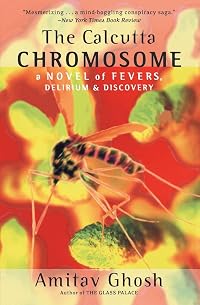
The Calcutta Chromosome
by Amitav Ghosh
On This Page
Description
A computer operator in New York stumbles on information regarding an experiment in 1895 Calcutta to change people. In the experiment, mosquitos were used to transfer chromosomes from one person to another.Tags
Recommendations


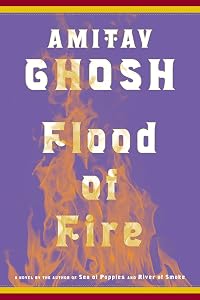







Member Recommendations
Member Reviews
https://nwhyte.livejournal.com/3288552.html
The Calcutta Chromosome is a fascinating book in which the research of Ronald Ross into malaria in 1898 turns out to have been something of a sham, in fact the outcome of manipulation by shadowy forces whose nature is only hinted at. The story is told in roughly three timelines: a near-future New York (probably roughly 2019), where an unassuming Egyptian with a friendly Siri-like AI is sucked into research on how and why a former colleague who was obsessed with Ross disappeared in 1995; the story from the former colleague's point of view, as he goes to Calcutta to get first-hand evidence on what Ross actually did; and the story from Ross's own point of view, which does not really explain all show more that much. The western versions of science and history are in conflict with Indian traditions, and subverted by the mysterious immortal character Behind It All; there is a memorable ghost train moment as well.
It's a really fun read - Murugan's obsession with Ross could have been weritten as tedious info-dumping, but Ghosh turns it into some very strong characterisation, and the other Indian characters of 1995, the poet Phulboni, the journalists Sonali and Urmila, and indeed Calcutta itself are vividly visualised. The ending is a bit of a let-down, in that the various plot strands are not really brought together and none of them is really resolved, though hints are left for the reader to draw their own conclusions. Still, I'm glad that the Clarke judges stepped outside the usual circles of genre fiction to recognise this. show less
The Calcutta Chromosome is a fascinating book in which the research of Ronald Ross into malaria in 1898 turns out to have been something of a sham, in fact the outcome of manipulation by shadowy forces whose nature is only hinted at. The story is told in roughly three timelines: a near-future New York (probably roughly 2019), where an unassuming Egyptian with a friendly Siri-like AI is sucked into research on how and why a former colleague who was obsessed with Ross disappeared in 1995; the story from the former colleague's point of view, as he goes to Calcutta to get first-hand evidence on what Ross actually did; and the story from Ross's own point of view, which does not really explain all show more that much. The western versions of science and history are in conflict with Indian traditions, and subverted by the mysterious immortal character Behind It All; there is a memorable ghost train moment as well.
It's a really fun read - Murugan's obsession with Ross could have been weritten as tedious info-dumping, but Ghosh turns it into some very strong characterisation, and the other Indian characters of 1995, the poet Phulboni, the journalists Sonali and Urmila, and indeed Calcutta itself are vividly visualised. The ending is a bit of a let-down, in that the various plot strands are not really brought together and none of them is really resolved, though hints are left for the reader to draw their own conclusions. Still, I'm glad that the Clarke judges stepped outside the usual circles of genre fiction to recognise this. show less
A computer programmer working with an advanced computer system discovers an ID belonging to a man he used to know. A man who's been missing since 1995. His coworkers had thought he committed suicide, but the truth involves a fateful trip to Calcutta, a conspiracy theory related to malaria research, and a web of interconnecting mysteries the reader will be trying to piece together even as the characters are. What is true and what is speculation? What happened to the missing man? And how will the discovery of this truth impact the one who finally uncovers it?
The Calcutta Chromosome is a science fiction book, but much of it reads like literary fiction. Originally published in 1995, aspects like the advanced computer system were likely more show more impressive once upon a time, but to modern readers the most interesting sci-fi elements involve the fields of genetics and epidemiology. Personally, I found this to be a very creative approach, although it took a lot of pages to ramp up.
I'm no expert on the history of malaria, but a brief research stint reveals at least some of the information this book conveys is based on real events. And the book does such a great job of making it all seem real that a non-expert like myself can't tell the exact point at which truth blends into fiction. For me, this had the delightful effect of making me wonder, "This can't be real, can it?" long past the point at which things started getting strange. I had to read patiently through a lot of long history lessons to get to that point, but my patience was definitely rewarded.
It also helped that there were likeable characters. I personally felt a certain kinship with the work-from-home computer programmer who wished he could be reading when the work got boring. I also liked Urmila, a reporter for Calcutta magazine who has a storyline intersecting with the man who eventually goes missing. She did have one vivid sexual fantasy I couldn't understand the purpose of being included in the narrative, but this was far outweighed by the role she plays in tracking down leads and the scenes depicting her relationship with her family. She's a capable woman with a good job, yet she struggles to assert her independence with a family constantly pressuring her to get married and demanding she take on a clearly unfair portion of the housework. I thought it provided excellent insight into the cultural pressures women can face, depicting them as pervasive and not easy to overcome.
In fact, there were a lot of smaller plot points that kept my interest in the story going even as the main plot required so much build up. I read on to find out if Antar would be able to finish his work in time to prepare for dinner with his neighbor, to find out if Urmila would cook the fish she really didn't have time for, and eventually to find out what had happened to certain characters left on a cliffhanger as the next chapter rotated to someone else. It's true that this contributed to the feeling that there was a ton of information and plot threads to keep track of, but if you like a complex story that rewards you for paying attention and remembering even the smallest details, you won't be disappointed.
In the end, I don't think this book would suit the attention span of every reader, but for the right kind of reader it's not to be missed. I recommend reading it in a short time frame to minimize what you forget between reading sessions. But I also recommend taking breaks every so often to let each section sink in, as opposed to speed reading it straight through. Personally, I read for an hour or so at a time over a period of three days and found that worked quite well. You'll need a high tolerance for facts about malaria and a willingness to entertain fictional conspiracy speculations, but you'll certainly get a unique experience. show less
The Calcutta Chromosome is a science fiction book, but much of it reads like literary fiction. Originally published in 1995, aspects like the advanced computer system were likely more show more impressive once upon a time, but to modern readers the most interesting sci-fi elements involve the fields of genetics and epidemiology. Personally, I found this to be a very creative approach, although it took a lot of pages to ramp up.
I'm no expert on the history of malaria, but a brief research stint reveals at least some of the information this book conveys is based on real events. And the book does such a great job of making it all seem real that a non-expert like myself can't tell the exact point at which truth blends into fiction. For me, this had the delightful effect of making me wonder, "This can't be real, can it?" long past the point at which things started getting strange. I had to read patiently through a lot of long history lessons to get to that point, but my patience was definitely rewarded.
It also helped that there were likeable characters. I personally felt a certain kinship with the work-from-home computer programmer who wished he could be reading when the work got boring. I also liked Urmila, a reporter for Calcutta magazine who has a storyline intersecting with the man who eventually goes missing. She did have one vivid sexual fantasy I couldn't understand the purpose of being included in the narrative, but this was far outweighed by the role she plays in tracking down leads and the scenes depicting her relationship with her family. She's a capable woman with a good job, yet she struggles to assert her independence with a family constantly pressuring her to get married and demanding she take on a clearly unfair portion of the housework. I thought it provided excellent insight into the cultural pressures women can face, depicting them as pervasive and not easy to overcome.
In fact, there were a lot of smaller plot points that kept my interest in the story going even as the main plot required so much build up. I read on to find out if Antar would be able to finish his work in time to prepare for dinner with his neighbor, to find out if Urmila would cook the fish she really didn't have time for, and eventually to find out what had happened to certain characters left on a cliffhanger as the next chapter rotated to someone else. It's true that this contributed to the feeling that there was a ton of information and plot threads to keep track of, but if you like a complex story that rewards you for paying attention and remembering even the smallest details, you won't be disappointed.
In the end, I don't think this book would suit the attention span of every reader, but for the right kind of reader it's not to be missed. I recommend reading it in a short time frame to minimize what you forget between reading sessions. But I also recommend taking breaks every so often to let each section sink in, as opposed to speed reading it straight through. Personally, I read for an hour or so at a time over a period of three days and found that worked quite well. You'll need a high tolerance for facts about malaria and a willingness to entertain fictional conspiracy speculations, but you'll certainly get a unique experience. show less
I've been working on a project regarding Indian science fiction recently. The amount of Indian sf written in English is staggeringly small, and perhaps the two most frequently cited members of the genre are Manjula Padmanabhan's Harvest and Amitav Ghosh's The Calcutta Chromosome. In one sense, The Calcutta Chromosome's claim to sfness is very small; there's a frame story set in the future that features an advanced computer, but most of the novel is set in the year of publication (1995) without any fantastic technology, and much of that is taken up with characters telling each other about historical events.
On the other hand, The Calcutta Chromosome is more sfnal than most sf; it's all about science and how we understand it and how it show more works. The whole central conflict of the novel is one of science vs. "counterscience," two distinct ways of seeing the world that stand in opposition to one another, but also feed off one another to survive. Like a lot of reviewers (apparently), I'm left a little bewildered by the ending, but I think I liked it on the whole, and I think what Ghosh was trying to do with the uncertainty makes sense.
I was surprised what an engaging book this was. This sounds mean to say, but a lot of literary fiction-- and Ghosh is primarily a literary writer even if this is a genre work-- is not fun to read. But The Calcutta Chromosome is; Ghosh makes one character telling another character about a Victorian scientist for chapters on end absolutely delightful! I also really liked the way that this book jumped from narrative thread to narrative thread. There are a lot of them, but the way the story unfolds both backwards and forwards (and maybe even sideways) is done with great skill, and keeps the reader moving along at a fair clip. A fascinating book. show less
On the other hand, The Calcutta Chromosome is more sfnal than most sf; it's all about science and how we understand it and how it show more works. The whole central conflict of the novel is one of science vs. "counterscience," two distinct ways of seeing the world that stand in opposition to one another, but also feed off one another to survive. Like a lot of reviewers (apparently), I'm left a little bewildered by the ending, but I think I liked it on the whole, and I think what Ghosh was trying to do with the uncertainty makes sense.
I was surprised what an engaging book this was. This sounds mean to say, but a lot of literary fiction-- and Ghosh is primarily a literary writer even if this is a genre work-- is not fun to read. But The Calcutta Chromosome is; Ghosh makes one character telling another character about a Victorian scientist for chapters on end absolutely delightful! I also really liked the way that this book jumped from narrative thread to narrative thread. There are a lot of them, but the way the story unfolds both backwards and forwards (and maybe even sideways) is done with great skill, and keeps the reader moving along at a fair clip. A fascinating book. show less
The Calcutta Chromosome, by Amitav Ghosh
In The Calcutta Chromosome, Amitav Ghosh explores the different and overlapping worlds of (scientific, written-down) language, and intuitive, oral folk tradition, and silence. This exploration takes the reader through an experiential process in which the customary way of reading a novel is challenged.
The novel begins at an unspecified time in the near future, when Antar, an employee of LifeWatch, a public health consultancy, is asked to find out what happened to another employee, L. Murugan, who disappeared in Calcutta in 1995. The plot is complicated (reviewers described it as “mind boggling” and “Rubik’s Cube of a novel”), and demands a special sort of concentration, as it shifts show more between different time periods and perspectives. The major plotline being that Murugan had asked to be transferred to Calcutta to investigate the life of Sir Ronald Ross – Nobel Prize winner for his work on how malaria enters the organism – but had disappeared under mysterious circumstances. I shall not attempt to summarize the novel here, as this has been done already quite competently.
Ghosh explores a complex web of themes: science, myth, language, silence, society and the individual. It is a web skilfully span, as he pairs the most unexpected themes, only suddenly to juxtapose them in the most astonishing patterns. For instance, silence is presented in various relationships to language, including scientific language. A character says about silence: “I see signs of her presence everywhere I go, in images, words, glances, but only signs, nothing more…”
Perhaps wisely, Ghosh does not attempt to describe in words this kind of silence. The implication being that by using language, we enter into a relationship with the background of silence similar to that we have as train travelers through a landscape, though infinitely more complex. For to say something is to change it. In a manner reminding me of the observer effect (in Quantum Mechanics) – the observer and the act of observation affecting the system being observed, regardless of the specific method used – the novel presents scientific knowledge as altering the landscape of the silence it tries to describe. Ghosh rather provides allusions, hints, pointers to it.
Language introduces other drawbacks. A scientist investigating a topic is burdened by scientific language, with particular ways of seeing and describing the world in the scientific community. A lay person, on the other hand, free from the restraints that scientific community and its language impose on him/her is well placed to make new discoveries, Ghosh is saying. It is as if, if you don’t know where to look, you may be in a better position to find what you don’t know you are looking for. Except in the novel, the natives know what they are looking for, and they are using the scientists’ results, and the results’ by-products, to gather the information they are seeking.
Taking the two major ways of knowing, scientific effort and language on the one hand and intuition, wisdom and silence on the other, Ghosh skilfully explores the opposition and mistrust that exist between the followers of the two. The setting being India, he also takes the reader on a reflective journey between the British colonial attitude of knowing best scientifically, and the native Indian one, of also knowing best, intuitively! There is more opposition and antagonism between the two ways of knowing in this book than there is in The Hungry Tide.
It may well be the case, as John Thieme wrote in The Literary Encyclopaedia, that in The Calcutta Chromosome, Ghosh explores “the possibility of an alternative subaltern history, which exists in parallel with colonial history as an equally – or possibly more – potent epistemological system, albeit one which has traditionally operated through silence.”
One of my own associations is to W. R. Bion, the British psychoanalyst born in India, who also wrote about knowledge and the processes of transformation that it has to go through in the mind before it reaches the potential of being knowable. Describing this process, Bion wrote about the shared human preconceptions and their journey to become concepts in the mind of the individual.
Bion valued the state of reverie, in which the mind sits quietly and allows things to unfold “without memory or desire,” or without expectation and aim-directed behavior. In this state, he believed, what had been obscured by the glare of expectation, wishful thinking, knowledge and assumptions would be allowed to show its true color, to shine through its own presence. In such a state of mind, one does not identify with, but rather becomes the thing thought about.
Bion wrote in a style which – although described as “not reader-friendly” – invites the reader to work with the text, to associate, feel and think for herself, i.e., to make or become its meaning. It seems to me that Ghosh too, in this novel, through his weaving of text and plot, knowledge, not-knowing, and guessing, attempts such a feat – risking, however, leaving the reader in a state of bafflement rather than becoming. Ultimately, the reader of the novel has to go through the process of experiencing it and form her/his own idea about it.
This review appears on: http://stellapierides.com/blog/the-calcutta-chromosome-by-amitav-ghosh show less
In The Calcutta Chromosome, Amitav Ghosh explores the different and overlapping worlds of (scientific, written-down) language, and intuitive, oral folk tradition, and silence. This exploration takes the reader through an experiential process in which the customary way of reading a novel is challenged.
The novel begins at an unspecified time in the near future, when Antar, an employee of LifeWatch, a public health consultancy, is asked to find out what happened to another employee, L. Murugan, who disappeared in Calcutta in 1995. The plot is complicated (reviewers described it as “mind boggling” and “Rubik’s Cube of a novel”), and demands a special sort of concentration, as it shifts show more between different time periods and perspectives. The major plotline being that Murugan had asked to be transferred to Calcutta to investigate the life of Sir Ronald Ross – Nobel Prize winner for his work on how malaria enters the organism – but had disappeared under mysterious circumstances. I shall not attempt to summarize the novel here, as this has been done already quite competently.
Ghosh explores a complex web of themes: science, myth, language, silence, society and the individual. It is a web skilfully span, as he pairs the most unexpected themes, only suddenly to juxtapose them in the most astonishing patterns. For instance, silence is presented in various relationships to language, including scientific language. A character says about silence: “I see signs of her presence everywhere I go, in images, words, glances, but only signs, nothing more…”
Perhaps wisely, Ghosh does not attempt to describe in words this kind of silence. The implication being that by using language, we enter into a relationship with the background of silence similar to that we have as train travelers through a landscape, though infinitely more complex. For to say something is to change it. In a manner reminding me of the observer effect (in Quantum Mechanics) – the observer and the act of observation affecting the system being observed, regardless of the specific method used – the novel presents scientific knowledge as altering the landscape of the silence it tries to describe. Ghosh rather provides allusions, hints, pointers to it.
Language introduces other drawbacks. A scientist investigating a topic is burdened by scientific language, with particular ways of seeing and describing the world in the scientific community. A lay person, on the other hand, free from the restraints that scientific community and its language impose on him/her is well placed to make new discoveries, Ghosh is saying. It is as if, if you don’t know where to look, you may be in a better position to find what you don’t know you are looking for. Except in the novel, the natives know what they are looking for, and they are using the scientists’ results, and the results’ by-products, to gather the information they are seeking.
Taking the two major ways of knowing, scientific effort and language on the one hand and intuition, wisdom and silence on the other, Ghosh skilfully explores the opposition and mistrust that exist between the followers of the two. The setting being India, he also takes the reader on a reflective journey between the British colonial attitude of knowing best scientifically, and the native Indian one, of also knowing best, intuitively! There is more opposition and antagonism between the two ways of knowing in this book than there is in The Hungry Tide.
It may well be the case, as John Thieme wrote in The Literary Encyclopaedia, that in The Calcutta Chromosome, Ghosh explores “the possibility of an alternative subaltern history, which exists in parallel with colonial history as an equally – or possibly more – potent epistemological system, albeit one which has traditionally operated through silence.”
One of my own associations is to W. R. Bion, the British psychoanalyst born in India, who also wrote about knowledge and the processes of transformation that it has to go through in the mind before it reaches the potential of being knowable. Describing this process, Bion wrote about the shared human preconceptions and their journey to become concepts in the mind of the individual.
Bion valued the state of reverie, in which the mind sits quietly and allows things to unfold “without memory or desire,” or without expectation and aim-directed behavior. In this state, he believed, what had been obscured by the glare of expectation, wishful thinking, knowledge and assumptions would be allowed to show its true color, to shine through its own presence. In such a state of mind, one does not identify with, but rather becomes the thing thought about.
Bion wrote in a style which – although described as “not reader-friendly” – invites the reader to work with the text, to associate, feel and think for herself, i.e., to make or become its meaning. It seems to me that Ghosh too, in this novel, through his weaving of text and plot, knowledge, not-knowing, and guessing, attempts such a feat – risking, however, leaving the reader in a state of bafflement rather than becoming. Ultimately, the reader of the novel has to go through the process of experiencing it and form her/his own idea about it.
This review appears on: http://stellapierides.com/blog/the-calcutta-chromosome-by-amitav-ghosh show less
This is one of the earlier Amitav Ghosh novels, that I hadn't read yet. It was a fun, interesting yet complicated reading experience! Its complication lies mainly in the anti-chronological order of the story and partly in the concept of science & anti-science that I found a little difficult to understand, and which is probably why I am at a loss to explain the end!
Basically the story is set in 3 time zones.
1) The future. Antar works from his New York home. His advanced computer, Ava, collects and describes objects from the company archives. Ava stumbles upon part of an identity card, that Antar finds out belongs to his former colleague Murugan, who disappeared in Calcutta in 1995. Antar remembers Murugan as an odd man, who was show more completely obsessed by Ronald Ross, the person who discovered the malaria parasite. Yet still, he is intrigued about what happened to Murugan back in 1995, and starts researching.
2) 1995. Murugan has just arrived in Calcutta. His path crosses that of 2 journalists, Urmila and Sonali. The threesome keep on stumbling upon tiny pieces of information about Ronald Ross, and his malaria research. This confirms Murugans suspicions that Ross got to his breakthrough discoveries because he was pushed that way by a mystic group of Indians, who were actually after another discovery themselves: isolation of the Calcutta chromosome.
3) The end of the 19th century. The British occupy India, and British scientists work on malaria research. But in the background a complot is taking place. Scientists disappear and others are manipulated by a group of seemingly uneducated Indians.
And then there is the story of the author Phulboni, who gets stuck on a desolate railway station, amidst a flood and is almost killed by a spirit train in the middle of the night. A very creepy scene!
In reviews I have read that the Calcutta chromosome makes it possible to live forever, by transforming in or taking over another body. And that certain of the 1995 characters are actually reincarnations of the 1890's characters. Interesting interpretation. It reminded me of a couple of David Mitchells books, especially Ghostwritten. At the same time I feel that Amitav Ghosh leaves a lot unsaid and open to interpretation of the reader. And that there may be some Indian mythology behind this that I don't know about. I am a little flabbergasted by the ending. Food for thought! show less
Basically the story is set in 3 time zones.
1) The future. Antar works from his New York home. His advanced computer, Ava, collects and describes objects from the company archives. Ava stumbles upon part of an identity card, that Antar finds out belongs to his former colleague Murugan, who disappeared in Calcutta in 1995. Antar remembers Murugan as an odd man, who was show more completely obsessed by Ronald Ross, the person who discovered the malaria parasite. Yet still, he is intrigued about what happened to Murugan back in 1995, and starts researching.
2) 1995. Murugan has just arrived in Calcutta. His path crosses that of 2 journalists, Urmila and Sonali. The threesome keep on stumbling upon tiny pieces of information about Ronald Ross, and his malaria research. This confirms Murugans suspicions that Ross got to his breakthrough discoveries because he was pushed that way by a mystic group of Indians, who were actually after another discovery themselves: isolation of the Calcutta chromosome.
3) The end of the 19th century. The British occupy India, and British scientists work on malaria research. But in the background a complot is taking place. Scientists disappear and others are manipulated by a group of seemingly uneducated Indians.
And then there is the story of the author Phulboni, who gets stuck on a desolate railway station, amidst a flood and is almost killed by a spirit train in the middle of the night. A very creepy scene!
In reviews I have read that the Calcutta chromosome makes it possible to live forever, by transforming in or taking over another body. And that certain of the 1995 characters are actually reincarnations of the 1890's characters. Interesting interpretation. It reminded me of a couple of David Mitchells books, especially Ghostwritten. At the same time I feel that Amitav Ghosh leaves a lot unsaid and open to interpretation of the reader. And that there may be some Indian mythology behind this that I don't know about. I am a little flabbergasted by the ending. Food for thought! show less
The Calcutta Chromosome is certainly a page turner. The supernatural, fictional science, and historical facts regarding malaria research are interwoven to create a complicated story that takes place in three different times: the late 1800s in Calcutta and other places in India where malaria research was going on, the 90s when a man becomes obsessed with finding out the real story of how malaria was researched, and a futuristic today, when another man is investigating the disappearance of the previous man (or the re-appearance of this man's ID card from Calcutta). Ghosh does a great job of bringing his characters to life. Malaria and Calcutta also appear prominently as characters in the novel.
As a molecular biologist, I was lost in one show more or two places, when some histological observation or explanation of it was described as copulation. I am not sure what this is suppose to invoke, or what fake science Ghosh was trying to create. I am familiar with the life cycle of malaria in the female mosquito as well as in the vertebrate system (blood, liver, etc.), so to me it seemed that the observations were of the bacteria reproducing in blood cells, but I fail to see how this is (paraphrasing here:) "what men do to women." So this was a bit confusing to me. I wasn't sure if Ghosh was trying to truthfully describe the situation, as he does about other aspects of the disease, or he was elaborating on his fake science stuff; but neither seemed to fit the bill.
Nevertheless, The Calcutta Chromosome is a great, fast-paced read full of parallel happenings and mysteries that unfold to yield more mysteries. In the end, knowing something is changing it (a variation on the philosophical implications of the Heisenberg Uncertainty Principle, which at its simplest states that observing something without changing/affecting it is impossible, and alas, observing and knowing are usually linked, though not always simply or directly), and perhaps that's why we cannot really know just how exactly the counterscience in the book works. If we knew, it would cease to be what we knew, but something else entirely different or changed. There is a lot of wishy washy explanations like this in the book, meaning, if you are a scientist, you have to let go of what you know and use your imagination.
What's interesting to me as a scientist is the idea that all science is hypothesis driven. It seems that Ghosh sets up two camps: science vs. counterscience. Science, as it is defined as the opposite of this other thing like religion or cult, and seems strictly to be what the general public would think of science: a hypothesis-driven effort. As much as hypothesis-driven science is what we, scientist, always promote to the public face of science, as otherwise, it seems that we are wasting our time and faculties on luck or coincidences, much of science relies on luck, coincidence, randomness. In fact many breakthroughs in science have come about by pure luck; meaning, one would work as hard or set up as many experiments to ask the same questions, but without that one lucky break or coincidence that has nothing to do with the experiments, the thing that was discovered would not have been discovered. Sure, it could have been discovered somewhere else, by someone else, in another way, but that particular discovery would not have happened. So to read this novel where coincidences are interpreted as a part of an intelligent conspiracy plot (or counterscience project) is a bit funny for me. In this respect, science and counterscience are not that far apart. In fact, many prominent scientist have expressed their opinions about the fact that if science were to be done only in a hypothesis-driven manner, we not get anywhere (we don't get far as it is...)
Lastly, I cannot help but comment on the cover (the neon red and green one with the mosquito on it): wow, someone actually designed this and thought it was a good idea? Can color blind people see anything? I will nominate this cover for one of the worst covers of any book that I have seen or read (I am sure there is a list on GR for this...)
I recommend that people read this book only in cooler seasons, otherwise one might start itching just by reading about mosquitos biting people... Recommended for those who are interested in conspiracies, Indian food, ethics, and colonial history. show less
As a molecular biologist, I was lost in one show more or two places, when some histological observation or explanation of it was described as copulation. I am not sure what this is suppose to invoke, or what fake science Ghosh was trying to create. I am familiar with the life cycle of malaria in the female mosquito as well as in the vertebrate system (blood, liver, etc.), so to me it seemed that the observations were of the bacteria reproducing in blood cells, but I fail to see how this is (paraphrasing here:) "what men do to women." So this was a bit confusing to me. I wasn't sure if Ghosh was trying to truthfully describe the situation, as he does about other aspects of the disease, or he was elaborating on his fake science stuff; but neither seemed to fit the bill.
Nevertheless, The Calcutta Chromosome is a great, fast-paced read full of parallel happenings and mysteries that unfold to yield more mysteries. In the end, knowing something is changing it (a variation on the philosophical implications of the Heisenberg Uncertainty Principle, which at its simplest states that observing something without changing/affecting it is impossible, and alas, observing and knowing are usually linked, though not always simply or directly), and perhaps that's why we cannot really know just how exactly the counterscience in the book works. If we knew, it would cease to be what we knew, but something else entirely different or changed. There is a lot of wishy washy explanations like this in the book, meaning, if you are a scientist, you have to let go of what you know and use your imagination.
What's interesting to me as a scientist is the idea that all science is hypothesis driven. It seems that Ghosh sets up two camps: science vs. counterscience. Science, as it is defined as the opposite of this other thing like religion or cult, and seems strictly to be what the general public would think of science: a hypothesis-driven effort. As much as hypothesis-driven science is what we, scientist, always promote to the public face of science, as otherwise, it seems that we are wasting our time and faculties on luck or coincidences, much of science relies on luck, coincidence, randomness. In fact many breakthroughs in science have come about by pure luck; meaning, one would work as hard or set up as many experiments to ask the same questions, but without that one lucky break or coincidence that has nothing to do with the experiments, the thing that was discovered would not have been discovered. Sure, it could have been discovered somewhere else, by someone else, in another way, but that particular discovery would not have happened. So to read this novel where coincidences are interpreted as a part of an intelligent conspiracy plot (or counterscience project) is a bit funny for me. In this respect, science and counterscience are not that far apart. In fact, many prominent scientist have expressed their opinions about the fact that if science were to be done only in a hypothesis-driven manner, we not get anywhere (we don't get far as it is...)
Lastly, I cannot help but comment on the cover (the neon red and green one with the mosquito on it): wow, someone actually designed this and thought it was a good idea? Can color blind people see anything? I will nominate this cover for one of the worst covers of any book that I have seen or read (I am sure there is a list on GR for this...)
I recommend that people read this book only in cooler seasons, otherwise one might start itching just by reading about mosquitos biting people... Recommended for those who are interested in conspiracies, Indian food, ethics, and colonial history. show less
Why I Read This
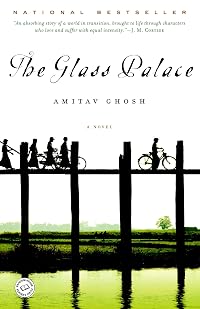
I loved The Glass Palace by Amitav Ghosh, and thus eagerly picked up this other novel by him. Unfortunately, it did not win me over in the same way. This book – part fantasy, part horror story, and part a tale of science-gone-bad – lacks the strong development of character and place that is so appealing in The Glass Palace. Instead, it is plot driven, and the plot can most succinctly be described as “weird.”
Believe It Or Not, This Is The Plot
The "Calcutta Chromosome" of the title concerns a chromosome that can be transmitted via malaria injected into syphilitics which is then transformed with a little help from decapitated pigeon heads into a gene conferring a bit of immortality to new recipients, who will reveal show more to you what they're up to, but if they tell you they have to kill you. Black magic is also a part of the transference process, as you might expect....
Evaluation
I was very disappointed. The plot is annoyingly opaque and dare I say stupid, and the characters seem only to have been included to move it along. In the end, I felt the story lacked significance and gravitas. Ghosh is a good writer. Maybe he was bitten by one too many mosquitoes when he wrote this. show less
I loved The Glass Palace by Amitav Ghosh, and thus eagerly picked up this other novel by him. Unfortunately, it did not win me over in the same way. This book – part fantasy, part horror story, and part a tale of science-gone-bad – lacks the strong development of character and place that is so appealing in The Glass Palace. Instead, it is plot driven, and the plot can most succinctly be described as “weird.”
Believe It Or Not, This Is The Plot
The "Calcutta Chromosome" of the title concerns a chromosome that can be transmitted via malaria injected into syphilitics which is then transformed with a little help from decapitated pigeon heads into a gene conferring a bit of immortality to new recipients, who will reveal show more to you what they're up to, but if they tell you they have to kill you. Black magic is also a part of the transference process, as you might expect....
Evaluation
I was very disappointed. The plot is annoyingly opaque and dare I say stupid, and the characters seem only to have been included to move it along. In the end, I felt the story lacked significance and gravitas. Ghosh is a good writer. Maybe he was bitten by one too many mosquitoes when he wrote this. show less
Members
- Recently Added By
Lists

All Things India
95 works; 21 members

tell me where it hurts
36 works; 7 members

Arthur C. Clarke Award Winners and Shortlisted Books
219 works; 14 members

Asia
178 works; 7 members
Author Information

44+ Works 15,854 Members
Born in Calcutta, and spent his childhood in Bangladesh, Sri Lanka, and Northern India. He studied in Delhi, Oxford, and Egypt and taught at various Indian and American universities. Author of a travel book and three acclaimed novels. Ghosh has also written for GRANTA, THE NEW YORKER, THE NEW YORK TIMES, and THE OBSERVER. He lives in New York City show more with his wife and two children. (Publisher Provided) Amitav Ghosh was born in Calcutta, India on July 11, 1956. He studied in Delhi, Oxford and Alexandria. His first book, The Circle of Reason, won France's Prix Médicis. He has won several other awards including the Sahitya Akademi Award and the Ananda Puraskar for The Shadow Lines, the Arthur C. Clarke award for The Calcutta Chromosome, and the Crossword Book Prize for The Hungry Tide and Sea of Poppies. His other works include In an Antique Land, Dancing in Cambodia, The Glass Palace, and River of Smoke. In 2007, he was awarded the Padma Shri, one of India's highest honors, by the President of India. He made the New Zealand Best Seller List in 2015 with his title Flood of Fire. (Bowker Author Biography) show less
Awards and Honors
Series
Belongs to Publisher Series
Common Knowledge
- Canonical title
- The Calcutta Chromosome
- Original title
- The Calcutta Chromosome
- Original publication date
- 1995
- People/Characters
- Antar; Murugan; Urmila; Sonali; Ronald Ross; Elijah Monroe Farley (show all 7); Phulboni
- Important places
- Calcutta, India; New York, New York, USA
- First words
- If the system hadn't stalled Antar would never have guessed that the scrap of paper on his screen was the remnant of an ID card.
- Last words
- (Click to show. Warning: May contain spoilers.)He sat back and sighed like he hadn't sighed in years.
Classifications
Statistics
- Members
- 1,010
- Popularity
- 25,789
- Reviews
- 22
- Rating
- (3.35)
- Languages
- 11 — Danish, Dutch, English, French, German, Italian, Japanese, Norwegian (Bokmål), Polish, Portuguese, Spanish
- Media
- Paper, Audiobook, Ebook
- ISBNs
- 35
- ASINs
- 13