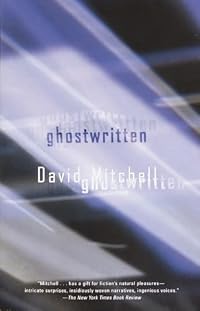
Ghostwritten
by David Mitchell
On This Page
Description
David Mitchell's electrifying debut novel takes readers on a mesmerizing trek across a world of human experience through a series of ingeniously linked narratives. Oblivious to the bizarre ways in which their lives intersect, nine characters-a terrorist in Okinawa, a record-shop clerk in Tokyo, a money-laundering British financier in Hong Kong, an old woman running a tea shack in China, a transmigrating "noncorpum" entity seeking a human host in Mongolia, a gallery-attendant-cum-art-thief in show more Petersburg, a drummer in London, a female physicist in Ireland, and a radio deejay in New York-hurtle toward a shared destiny of astonishing impact. Like the book's one non-human narrator, Mitchell latches onto his host characters and invades their lives with parasitic precision, making Ghostwritten a sprawling and brilliant literary relief map of the modern world. show lessTags
Recommendations




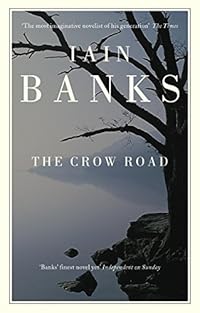

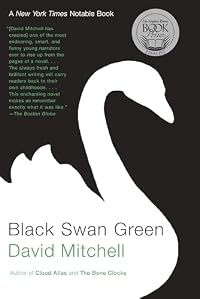
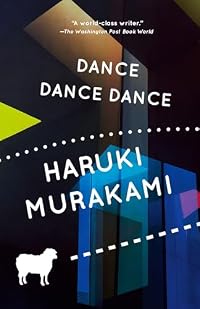


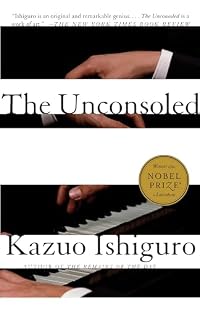



















Member Recommendations
Tinwara Kehlmann uses the same technique of overlapping and somehow interconnected stories. Coincidentally even the number of stories is the same!

Member Reviews
A quantum physicist passes the time on a long overnight flight calculating the odds that these particular three hundred sixty passengers would share it. She concludes they are long indeed. Yet at the end of the chapter centering on her, when she is coerced to return to a project she’d fled from, she realizes how the electrons, other subatomic matter, and the forces that hold them together are one.
That may be one of the pearls at the heart of this collection of interconnected stories. Each story focuses on one person, but characters from other stories pop up. Along with swans who turn into girls (and vice versa) and bats falling from the sky. And an approaching comet.
Whichever the main character, the stories are all narrated in the show more first person. I admired the way the author created a unique voice for each narrator.
The lives of these characters intersect across the globe, in Japan, Hong Kong, Petersburg, and others. It seemed a virtuoso performance until the author set part of one of the stories in Switzerland. In it, he refers to the mechanical figurines on the town clock in Zurich. The author may have been thinking of the Zytglogge in Bern. An earlier chapter had been set in Mongolia, where I’ve never been, and now I wondered how accurate that local color had been.
A petty point, you might say, and I’d grant that. It’s a nagging flaw in a book I was otherwise wowed by. It’s a virtuoso performance. The stories are cleverly plotted, with cross-references strewn like breadcrumbs on the path. The writing is crafted like lyrical poetry. All of this in a debut novel.
At the close of one episode, “Petersburg,” the narrator remarks: “None of this happened. None of this really happened.” My first reaction is that this was an obviously meta touch. After all, it’s a novel—of course, none of it happened (well, aside from the Tokyo subway sarin attack and a few other unpleasant events). Only later did I tie this to what I’ve previously concluded was that character’s massive ability to self-delude.
Another of the pearls in the book is that our technology has advanced beyond our ability to control it. The person who voices this insight is the quantum physicist, my favorite among the many characters. She is confident, though, that she has found a way to overcome that problem, somewhat like the imperatives Asimov formulated for robots. But, then, in the breathless crescendo that is the penultimate chapter, this turns out to have been an illusory hope.
This is David Mitchell’s debut novel, and it’s a masterpiece. I’m looking forward to reading more of his books. show less
That may be one of the pearls at the heart of this collection of interconnected stories. Each story focuses on one person, but characters from other stories pop up. Along with swans who turn into girls (and vice versa) and bats falling from the sky. And an approaching comet.
Whichever the main character, the stories are all narrated in the show more first person. I admired the way the author created a unique voice for each narrator.
The lives of these characters intersect across the globe, in Japan, Hong Kong, Petersburg, and others. It seemed a virtuoso performance until the author set part of one of the stories in Switzerland. In it, he refers to the mechanical figurines on the town clock in Zurich. The author may have been thinking of the Zytglogge in Bern. An earlier chapter had been set in Mongolia, where I’ve never been, and now I wondered how accurate that local color had been.
A petty point, you might say, and I’d grant that. It’s a nagging flaw in a book I was otherwise wowed by. It’s a virtuoso performance. The stories are cleverly plotted, with cross-references strewn like breadcrumbs on the path. The writing is crafted like lyrical poetry. All of this in a debut novel.
At the close of one episode, “Petersburg,” the narrator remarks: “None of this happened. None of this really happened.” My first reaction is that this was an obviously meta touch. After all, it’s a novel—of course, none of it happened (well, aside from the Tokyo subway sarin attack and a few other unpleasant events). Only later did I tie this to what I’ve previously concluded was that character’s massive ability to self-delude.
Another of the pearls in the book is that our technology has advanced beyond our ability to control it. The person who voices this insight is the quantum physicist, my favorite among the many characters. She is confident, though, that she has found a way to overcome that problem, somewhat like the imperatives Asimov formulated for robots. But, then, in the breathless crescendo that is the penultimate chapter, this turns out to have been an illusory hope.
This is David Mitchell’s debut novel, and it’s a masterpiece. I’m looking forward to reading more of his books. show less
"The act of memory is an act of ghostwriting. ... And it's not just our memories. Our actions too. We all think we're in control of our own lives, but really they're pre-ghostwritten by forces around us." (286-7)
David Mitchell's 1999 debut Ghostwritten is one of those rare fictions that has a useful reason to subtitle itself "A Novel." It seems at first to be a string of nine tangentially connected novellas, each with its own speaker, and separated by great leaps of geography. But the short tenth chapter--almost an epilogue, though set chronologically before the first--should clarify the identities of the two superhuman ghostwriters whose machinations have propelled the rich array of characters and settings throughout the book.
There is show more a lot of unreliable narration and dramatic irony in this book that starts with a narrator who is a terrorist adherent of a lightly-fictionalized version of the Aum Shinrikyo doomsday cult. Many central and incidental characters re-appear in Mitchell's subsequent novels, usually at chronological points prior to their stories in Ghostwritten.
As Mitchell would later do even more assertively in books like Cloud Atlas and The Bone Clocks, he gives an account that moves from the past through its time of inscription into a projected future. Of course, the "present" of Ghostwritten is now a full generation old, and its relatively tight diachronic window shows its age a little bit, but that is amply compensated by the vivid characters and mordant prose, leavened with recurring motifs that intimate the larger shapes behind each scene.
"I added 'writers' to my list of people not to trust. They make everything up." (145) show less
David Mitchell's 1999 debut Ghostwritten is one of those rare fictions that has a useful reason to subtitle itself "A Novel." It seems at first to be a string of nine tangentially connected novellas, each with its own speaker, and separated by great leaps of geography. But the short tenth chapter--almost an epilogue, though set chronologically before the first--should clarify the identities of the two superhuman ghostwriters whose machinations have propelled the rich array of characters and settings throughout the book.
There is show more a lot of unreliable narration and dramatic irony in this book that starts with a narrator who is a terrorist adherent of a lightly-fictionalized version of the Aum Shinrikyo doomsday cult. Many central and incidental characters re-appear in Mitchell's subsequent novels, usually at chronological points prior to their stories in Ghostwritten.
As Mitchell would later do even more assertively in books like Cloud Atlas and The Bone Clocks, he gives an account that moves from the past through its time of inscription into a projected future. Of course, the "present" of Ghostwritten is now a full generation old, and its relatively tight diachronic window shows its age a little bit, but that is amply compensated by the vivid characters and mordant prose, leavened with recurring motifs that intimate the larger shapes behind each scene.
"I added 'writers' to my list of people not to trust. They make everything up." (145) show less
This is Mitchell's first novel, but having read Cloud Atlas and The Bone Clocks before reading Ghostwritten, this books feels familiar, particularly in relation to The Bone Clocks. This isn't as good as Cloud Atlas but so much better than The Bone Clocks. A part of me feels cheated with what one might describe as recycled material (though I guess it's the later books that recycle it not this one and I was dissatisfied with The Bone Clocks as its own thing), but the writing is so good and the themes so big that any repetition is fine with.
With the several story lines in the book, I was most impressed with how instantly I felt empathy for the protagonist in each section and how gracefully the different components fit together and worked show more together. The craft is seamless.
In response to my suspicions, the internet gives some hints that Mitchell is a Buddhist or influenced by Buddhism, and this book brings to mind the Song of Zazen "when shall we be free from birth and death" and explores in very satisfying detail the idea of dependent origination and ideas about the self. What with the big Buddha on the hill, this cannot be an accident. show less
With the several story lines in the book, I was most impressed with how instantly I felt empathy for the protagonist in each section and how gracefully the different components fit together and worked show more together. The craft is seamless.
In response to my suspicions, the internet gives some hints that Mitchell is a Buddhist or influenced by Buddhism, and this book brings to mind the Song of Zazen "when shall we be free from birth and death" and explores in very satisfying detail the idea of dependent origination and ideas about the self. What with the big Buddha on the hill, this cannot be an accident. show less
The story begins in Okinawa with Quasar, a member of a doomsday cult, who has released a nerve agent in a subway in Tokyo and is now attempting to keep from being captured. He’s following orders from His Serendipity, a man who professes the abilities of teleportation amongst others. The doomsday in question is a comet that will be colliding with Earth in a few months. It will be up to Quasar and the other enlightened ones to rebuild society.
From there we move to Tokyo and a young jazz enthusiast experiencing his first love, then to Hong Kong where a financial lawyer’s illegal activities are catching up with him, then to Holy Mountain in China, Mongolia, St Petersburg, London, Cape Clear Island (Ireland), Night Train (a radio show show more based in NYC) and finally the Underground.
Each section appears to be unrelated to the others, but characters from sections before makes an appearance in the current section until we get a clear view of the plot and the fate of characters from other parts. His characters often make terrible choices, but those choices make sense in their minds and to us, being there with them.
Ghostwritten is David Mitchell’s debut novel and it’s impressive in its beauty and complexity but also simplicity. Each section/character is completely believable, even when that character isn’t an actual person.
The characters are the stars, to my mind, the plot is interesting and I did want to know what was going to happen, but what person Mitchell was going to introduce next and how utterly real they were going to be was what I was most intrigued by. How was he going to blow my mind next?
I’ve read his Black Swan Green and 1,000 Autumns of Jacob de Zoet, both of which are completely different from this one and one another. The only thing all three have in common are a deftness with the English language readers don’t see every day, unpredictable plots and fully-formed characters. If I’d read the three books without knowing the author I wouldn’t have guessed they were written by the same person, which isn’t something you can say about many authors–that depth of imagination and versatility is rare. show less
From there we move to Tokyo and a young jazz enthusiast experiencing his first love, then to Hong Kong where a financial lawyer’s illegal activities are catching up with him, then to Holy Mountain in China, Mongolia, St Petersburg, London, Cape Clear Island (Ireland), Night Train (a radio show show more based in NYC) and finally the Underground.
Each section appears to be unrelated to the others, but characters from sections before makes an appearance in the current section until we get a clear view of the plot and the fate of characters from other parts. His characters often make terrible choices, but those choices make sense in their minds and to us, being there with them.
Ghostwritten is David Mitchell’s debut novel and it’s impressive in its beauty and complexity but also simplicity. Each section/character is completely believable, even when that character isn’t an actual person.
The characters are the stars, to my mind, the plot is interesting and I did want to know what was going to happen, but what person Mitchell was going to introduce next and how utterly real they were going to be was what I was most intrigued by. How was he going to blow my mind next?
I’ve read his Black Swan Green and 1,000 Autumns of Jacob de Zoet, both of which are completely different from this one and one another. The only thing all three have in common are a deftness with the English language readers don’t see every day, unpredictable plots and fully-formed characters. If I’d read the three books without knowing the author I wouldn’t have guessed they were written by the same person, which isn’t something you can say about many authors–that depth of imagination and versatility is rare. show less
“We’re all ghostwriters, my boy, and it’s not just our memories, our actions too. We all think we are in control of our own lives, but really, they are pre-ghostwritten by forces around us.”
This novel consists of a series of nine interrelated stories.
1. It opens in Okinawa. Quasar is part of a doomsday cult (led by His Serendipity) that plans to release nerve gas in a Tokyo subway.
2. Satoru works in a record shop in Tokyo. He falls in love with one of the customers, Tomoyo, who lives in Hong Kong.
3. Neal Brose is a British expat living in Hong Kong. He is involved in a fraudulent financial transaction related to the Russian mafia. His wife left him, and he is having an affair with a Chinese housekeeper.
4. In rural China, a show more woman runs a tea shack on the Holy Mountain and communes with a tree spirit. This story follows the life of the woman and the massive changes in China over the course of her life of 80 years.
5. In Mongolia, a disembodied spirit lives in the heads of its hosts and can move from one person to another if they touch each other. It is searching for identity through finding its origin story.
6. In Petersburg, Russia, an art heist is planned, executed, and does not go well. The ring of art thieves is led by a man from the Russian mafia.
7. In London, Marco is a drummer in a band who also works as a ghostwriter. He gets involved with a bet as to who can win the most money in a casino.
8. Mo is a quantum physicist is in hiding on Clear Island off the coast of Ireland. She is a fugitive working on the future of computing technology. The US military wants to use this new technology and she does not want to cooperate.
9. Bat Segundo is the host of a late-night radio show. He takes calls and plays music. One of the callers, known only as Zookeeper, appears to be a sentient artificial intelligence. Zookeeper calls each year. On air, it destroys a secret US Government project site, saves the world from nuclear war, and tries to decide whether to keep a comet from destroying the earth.
An Epilogue brings the stories together, returning to Quasar in Tokyo as he attempts to escape the nerve gas attack. I will not document all the linkages as it is part of the fun of reading this book to figure them out.
This is not a light read and is the type that would benefit from re-reading. The intricate connections among these stories are sometimes fleeting so it requires close attention to catch them all (and I am sure I missed some). There are many literary and musical references. Themes include the role of coincidence in life, the desire for a meaningful existence, and the human tendency to try to discover meaning amid the chaos. David Mitchell is a brilliant writer. His use of language, variety of topics, and depth of storytelling is among the best. He is one of my favorite authors and this was his impressive debut. Readers of his entire catalogue will notice some characters from other works. I have not yet read them all, but I found connections to Black Swan Green, The Thousand Autumns of Jacob de Zoet, and Utopia Avenue. This book is both intellectually stimulating and engaging. show less
This novel consists of a series of nine interrelated stories.
1. It opens in Okinawa. Quasar is part of a doomsday cult (led by His Serendipity) that plans to release nerve gas in a Tokyo subway.
2. Satoru works in a record shop in Tokyo. He falls in love with one of the customers, Tomoyo, who lives in Hong Kong.
3. Neal Brose is a British expat living in Hong Kong. He is involved in a fraudulent financial transaction related to the Russian mafia. His wife left him, and he is having an affair with a Chinese housekeeper.
4. In rural China, a show more woman runs a tea shack on the Holy Mountain and communes with a tree spirit. This story follows the life of the woman and the massive changes in China over the course of her life of 80 years.
5. In Mongolia, a disembodied spirit lives in the heads of its hosts and can move from one person to another if they touch each other. It is searching for identity through finding its origin story.
6. In Petersburg, Russia, an art heist is planned, executed, and does not go well. The ring of art thieves is led by a man from the Russian mafia.
7. In London, Marco is a drummer in a band who also works as a ghostwriter. He gets involved with a bet as to who can win the most money in a casino.
8. Mo is a quantum physicist is in hiding on Clear Island off the coast of Ireland. She is a fugitive working on the future of computing technology. The US military wants to use this new technology and she does not want to cooperate.
9. Bat Segundo is the host of a late-night radio show. He takes calls and plays music. One of the callers, known only as Zookeeper, appears to be a sentient artificial intelligence. Zookeeper calls each year. On air, it destroys a secret US Government project site, saves the world from nuclear war, and tries to decide whether to keep a comet from destroying the earth.
An Epilogue brings the stories together, returning to Quasar in Tokyo as he attempts to escape the nerve gas attack. I will not document all the linkages as it is part of the fun of reading this book to figure them out.
This is not a light read and is the type that would benefit from re-reading. The intricate connections among these stories are sometimes fleeting so it requires close attention to catch them all (and I am sure I missed some). There are many literary and musical references. Themes include the role of coincidence in life, the desire for a meaningful existence, and the human tendency to try to discover meaning amid the chaos. David Mitchell is a brilliant writer. His use of language, variety of topics, and depth of storytelling is among the best. He is one of my favorite authors and this was his impressive debut. Readers of his entire catalogue will notice some characters from other works. I have not yet read them all, but I found connections to Black Swan Green, The Thousand Autumns of Jacob de Zoet, and Utopia Avenue. This book is both intellectually stimulating and engaging. show less
The novel is true to its sub-title. The first eight parts are all narrated in the first person from the respective viewpoints of a brain-washed cult member, perpetrator of a gas attack in a Japanese subway (in thrall to His Serendipity); a young half-Korean worker in a Tokyo shop selling jazz records; a compromised English banker in Hong Kong; a woman whose misfortune it was to live in China through most of the Twentieth Century; a mind-dwelling entity who can transmigrate from person to person by touch; a gallery attendant in the Hermitage, St Petersburg, who is an agent of an art-stealing syndicate; a London-dwelling, womanising ghostwriter; a female Irish physicist with the key to making atomic weapons worthless; and to round off we show more have transcripts from the broadcasts of Night Train FM, 97.8 ‘til late. The last two are awfully familiar but I can’t put my finger on from where (beyond the section set in Ireland in the same author’s The Bone Clocks.)
At first the connections between the parts seem tenuous, that between one and two is a misplaced phone call, between two and three seems to be a reference to the couple embarking on a love affair in part two, but gradually, the more sections come into play, the more resonances between them build up. Still, the Queen Anne chair mentioned in Hong Kong and a biography of His Serendipity seem lobbed into the London section when they arrive, gratuitous intrusions; the Music of Chance is the name of the ghostwriter’s band but also occurs as a phrase in a later section. Each part, though, is wonderfully written, suspending disbelief is never difficult - except in the case of the transmigrating mind entity, an interpolation of the fantastic which seems at odds with the realistic tone of the other parts. But then we find the fulcrum on which the novel comes to turn is a process called quantum cognition. This is not merely smuggling quantum physics into the literary landscape but making it the book’s focus - a piece of bravery (or potential folly) in a first novel which almost makes the previous mind-hopping seem mundane. “Evolution and history are the bagatelle of particle waves,” is not the sort of comparison common in literary texts.
Asides like, “For a moment I had an odd sensation of being in a story that someone was writing,” or “I added ‘writers’ to my list of people not to trust. They make everything up,” is perhaps over-egging the pudding, however. “Humans live in a pit of cheating, exploiting, hurting, incarcerating. Every time, the species wastes some part of what it could be. This waste is poisonous,” is a pessimistic view of humanity. The last bit is always worth repeating, though.
The pessimism is carried on by phrases like, “‘Loving somebody’ means ‘wanting something’. Love makes people do selfish, moronic, cruel and inhumane things,” but “‘womanisers are victims – unable to communicate with women any other way. They either never knew their mother or never had a good relationship with her,’” is more compassionate. The killer line follows as the womaniser is told, ‘I don’t quite know what you want from us. But it’s something to do with approval.’”
At one point one of the narrators says, “Italians give their cities sexes.... London’s middle-aged and male, respectably married but secretly gay.” I suspect all cities are secretly gay. “The USA is even crazier than the rest of humanity,” is either a prescient thesis or one now in the process of hard testing.
Ghosts, of memories and of sentience, begin to permeate the book. “Memories are their own descendants masquerading as the ancestors of the present,” while, “The act of memory is an act of ghostwriting..... We all think we’re in control of our own lives, but really they’re pre-ghostwritten by forces around us,” which leads to, “The real drag about being a ghostwriter is you never get to write anything beautiful.” Pessimism again.
But, “Technology is repeatable miracles.” That is the age in which we live.
I read in a recent(ish) review (of Slade House?) the opinion that Ghostwritten is still the best Mitchell has done. Not for me, of the ones I have read that would be The Thousand Autumns of Jacob de Zoet but in Ghostwritten I found the intrusion of the fantastical elements took away from the whole. Perhaps if they had been fully present from the start - part one is in the viewpoint of a delusion sufferer, true, but it is only the later parts which suggest it may not be a delusion - I would have felt differently, but I suppose in that case Mitchell might not have found a publisher. It’s brilliantly written and the characterisation is superb, but paradoxically, I thought Ghostwritten came to something less than the sum of its parts. show less
At first the connections between the parts seem tenuous, that between one and two is a misplaced phone call, between two and three seems to be a reference to the couple embarking on a love affair in part two, but gradually, the more sections come into play, the more resonances between them build up. Still, the Queen Anne chair mentioned in Hong Kong and a biography of His Serendipity seem lobbed into the London section when they arrive, gratuitous intrusions; the Music of Chance is the name of the ghostwriter’s band but also occurs as a phrase in a later section. Each part, though, is wonderfully written, suspending disbelief is never difficult - except in the case of the transmigrating mind entity, an interpolation of the fantastic which seems at odds with the realistic tone of the other parts. But then we find the fulcrum on which the novel comes to turn is a process called quantum cognition. This is not merely smuggling quantum physics into the literary landscape but making it the book’s focus - a piece of bravery (or potential folly) in a first novel which almost makes the previous mind-hopping seem mundane. “Evolution and history are the bagatelle of particle waves,” is not the sort of comparison common in literary texts.
Asides like, “For a moment I had an odd sensation of being in a story that someone was writing,” or “I added ‘writers’ to my list of people not to trust. They make everything up,” is perhaps over-egging the pudding, however. “Humans live in a pit of cheating, exploiting, hurting, incarcerating. Every time, the species wastes some part of what it could be. This waste is poisonous,” is a pessimistic view of humanity. The last bit is always worth repeating, though.
The pessimism is carried on by phrases like, “‘Loving somebody’ means ‘wanting something’. Love makes people do selfish, moronic, cruel and inhumane things,” but “‘womanisers are victims – unable to communicate with women any other way. They either never knew their mother or never had a good relationship with her,’” is more compassionate. The killer line follows as the womaniser is told, ‘I don’t quite know what you want from us. But it’s something to do with approval.’”
At one point one of the narrators says, “Italians give their cities sexes.... London’s middle-aged and male, respectably married but secretly gay.” I suspect all cities are secretly gay. “The USA is even crazier than the rest of humanity,” is either a prescient thesis or one now in the process of hard testing.
Ghosts, of memories and of sentience, begin to permeate the book. “Memories are their own descendants masquerading as the ancestors of the present,” while, “The act of memory is an act of ghostwriting..... We all think we’re in control of our own lives, but really they’re pre-ghostwritten by forces around us,” which leads to, “The real drag about being a ghostwriter is you never get to write anything beautiful.” Pessimism again.
But, “Technology is repeatable miracles.” That is the age in which we live.
I read in a recent(ish) review (of Slade House?) the opinion that Ghostwritten is still the best Mitchell has done. Not for me, of the ones I have read that would be The Thousand Autumns of Jacob de Zoet but in Ghostwritten I found the intrusion of the fantastical elements took away from the whole. Perhaps if they had been fully present from the start - part one is in the viewpoint of a delusion sufferer, true, but it is only the later parts which suggest it may not be a delusion - I would have felt differently, but I suppose in that case Mitchell might not have found a publisher. It’s brilliantly written and the characterisation is superb, but paradoxically, I thought Ghostwritten came to something less than the sum of its parts. show less
First of all, I want to acknowledge that this book was highly ambitious and written with a deft hand. However, there's a bunch of narratives going on, some of them overlapping or echoing themes throughout, but I ultimately felt let down. I kept waiting for it to come together, but it just felt utterly disconnected - so many wtf moments (which, truthfully, are to be expected with the author's non-linear, surrealistic, at times dream-like storytelling) - and the ending was a big let down. It felt like nothing was really resolved or fully explained (which, I realize, probably has more to do with me as a reader and not necessarily indicative of Mitchell's writing). I kept experiencing the feeling that I was reading a Murakami novel. (Not a show more bad thing). However, I'll cut Mitchell some slack, as this book is his debut novel. For what it's worth, I thoroughly enjoyed Cloud Atlas and The Bone Clocks. Check them out. show less
Members
- Recently Added By
Lists

Top Five Books of 2014
1,064 works; 397 members

Top Five Books of 2017
757 works; 230 members

Books Read in 2014
2,343 works; 86 members

Top 50 Favourite Books
50 works; 2 members

Books Read in 2015
3,299 works; 129 members
Books Read in 2016
4,666 works; 199 members

Books To Get From The Library
115 works; 5 members

2015 UpROOTed
28 works; 1 member

Global Reads: Books Set in East Asia
139 works; 12 members

Books Read in 2021
5,361 works; 113 members

TBR - Older Books
92 works; 1 member

living room bookshelf
150 works; 1 member

Take Four Books
130 works; 1 member
Author Information

18+ Works 50,314 Members
Some Editions
Awards and Honors
Distinctions
Series
Belongs to Publisher Series
Common Knowledge
- Canonical title
- Ghostwritten
- Original title
- Ghostwritten
- Original publication date
- 1999
- People/Characters
- Timothy Cavendish; Keisuke Tanaka 'Quasar'; Satoru Sonada; Neal Brose; Katy Forbes; Suhbataar (show all 22); Jerome; Head Curator Rogorshev; Margarita Latunsky; Tatyana Makuch; Luisa Rey; Mo Muntervary; Huw Llewellyn; Denholme Cavendish; Bartolomew Caesar 'Bat' Segundo; Dwight Silverwind; Caspar; Sherry; Alfred Knopf; John Cullen; Andrei Gregorski; Rudi
- Important places
- Okinawa, Japan; Tokyo, Japan; Hong Kong; Holy Mountain, China; Mongolia; St Petersburg, Russia (show all 9); London, England, UK; Cléire, County Cork, Ireland (as 'Cape Clear Island'); New York, New York, USA
- Epigraph
- ... And I, who claim to know so much more, isn't it possible that even I have missed the very spring within the spring?
Some say that we shall never know, and that to the gods we are like the flies that the boys kill on a... (show all) summer day, and some say, on the contrary, that the very sparrows do not lose a feather that has not been brushed away by the finger of God.
Thornton Wilder, The Bridge of San Luis Rey - Dedication
- For John
- First words
- Who was blowing on the nape of my neck?
- Quotations
- Mama-San told me I was eighteen when I was born. That makes me old enough to be my father.
I added 'writers' to my list of people not to trust. They make everything up.
The act of memory is an act of ghostwriting. ... And it's not just our memories. Our actions too. We all think we're in control of our own lives, but really they're pre-ghostwritten by forces around us.
Memories are their own descendants masquerading as the ancestors of the present. - Last words
- (Click to show. Warning: May contain spoilers.)I swing around - nothing but the back of the train, accelerating into the darkness.
- Blurbers
- Lively, Adam; Norfolk, Lawrence; Byatt, A. S.; Cusk, Rachel; Ingham, Peter; Tonkin, Boyd (show all 11); Fischer, Tibor; Biswell, Andrew; Schipper, Michael; Arnott, Jake; Seaton, Matt
- Original language
- English
Classifications
Statistics
- Members
- 4,237
- Popularity
- 3,572
- Reviews
- 128
- Rating
- (4.04)
- Languages
- 13 — Czech, Dutch, English, Estonian, French, German, Greek, Hungarian, Italian, Polish, Russian, Slovenian, Spanish
- Media
- Paper, Audiobook, Ebook
- ISBNs
- 36
- ASINs
- 16